The Ainu People, Japan's Indigenous North
· 13 min read
The Ainu people lived in Hokkaido long before Japan renamed it, and their language, rituals, and craft survived a century of pressure to reach a national museum of their own.
Most visitors to Hokkaido never hear the name. They come for powder snow, lavender fields, and bowls of miso ramen, and they leave without knowing that the island they crossed has another name, another language, and another people. The Ainu people lived here long before the island was called Hokkaido, and their story runs through the map itself, in place names most travellers pronounce without understanding.
The Ainu people are the Indigenous people of Japan's far north. Their homeland once stretched across Hokkaido, Sakhalin, the Kuril Islands, and the northern tip of Honshu. They hunted deer in the mountains, fished salmon in the rivers, traded with neighbours across the sea, and built a culture of wood carving, embroidery, song, and oral epic that had no written language and needed none. Then, in the space of a single lifetime in the nineteenth century, their land was renamed, their language was pushed out of schools, and their hunting and fishing were made illegal. What happened next, and what is happening now, says a great deal about Japan.
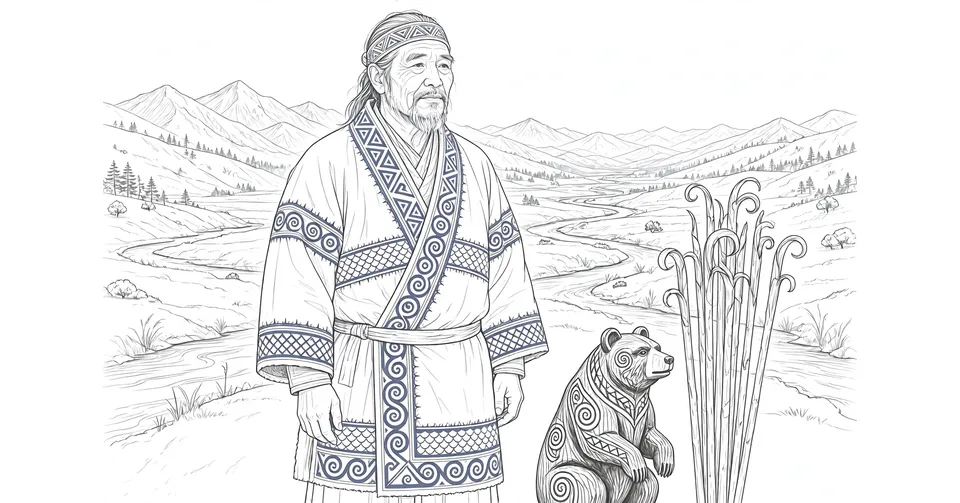
The word Ainu means human in the Ainu language. It is a quiet word for a people who were, for most of modern Japanese history, treated as anything but ordinary citizens. Understanding the Ainu people means starting with that word, and with the land that shaped them.
Who the Ainu People Are
The Ainu people descend from the Jomon hunter gatherers who lived across the Japanese islands from around 14,000 to 300 BCE. Historians trace Ainu culture more directly to the Satsumon culture of Hokkaido and northern Tohoku, with additions from the seafaring Okhotsk culture of the north. A recognisable Ainu culture had emerged by about the thirteenth century, with its own language, its own villages, and its own way of reading the natural world.
Ainu villages were called kotan. A kotan was a small settlement of extended families beside a river or a coast, placed where salmon ran and deer passed. Life followed the seasons. Spring brought wild plants from the hills. Summer brought fishing. Autumn brought the salmon run, the most important event of the year. Winter brought carving, weaving, and storytelling around the hearth. The Ainu people did not farm in the Japanese sense, and they did not build castles or keep written records. Their wealth was knowledge: where the fish gathered, which plants healed, how to read weather in the clouds over the mountains.
Trade tied the kotan to the wider world. Ainu traders exchanged furs, dried salmon, and eagle feathers for rice, iron tools, sake, and lacquerware from Honshu, and for goods from Sakhalin and the continent beyond. The Matsumae domain in southern Hokkaido, the only Japanese foothold in the north for centuries, grew rich on this trade, and the Ainu people grew dependent on it. That dependence would later become a lever of control.
The Ainu language has no proven relatives. Linguists class it as an isolate, unrelated to Japanese, Korean, or any other known tongue. It is an oral language, carried in epic poems called yukar, in songs, and in prayer. A single yukar could run for hours, telling of gods who visited the human world in the shape of animals. Today UNESCO classes the Ainu language as critically endangered, with only a handful of fluent first language speakers remaining. By 1966, only around 300 people still spoke Ainu natively, and by the 1980s that number had fallen below 100. Yet the language survives in another form, on the map. Sapporo comes from the Ainu sat poro pet, a dry, great river. Hundreds of Hokkaido place names are Ainu words wearing Japanese pronunciation, a reminder that the Ainu people named this land first.
A Land Before the Name Hokkaido
Before 1869, the island was not Hokkaido. The Japanese called it Ezochi, the land of the Ezo, and the Ainu people called it by the names of its rivers and mountains. Japanese presence in the north had grown slowly, through trade and then through the Matsumae domain, but the Ainu still governed their own villages and kept their own customs.
The Meiji Restoration of 1868 changed everything at speed. The new government saw Hokkaido as empty land waiting to be developed, a frontier for settlers from crowded Honshu. In 1869, a government proclamation renamed Ezochi as Hokkaido and divided it into eleven provinces. The Kaitakushi, a development commission, was set up to organise colonisation. Settlers arrived in waves. Roads, railways, and farms spread across the plains. The Ainu people, who had lived on this land for centuries, were not consulted, and their claim to it was not recognised.
The legal blow came in 1899 with the Hokkaido Former Aborigines Protection Act. Despite its name, the act was an instrument of assimilation. It stripped the Ainu of their land, forbade hunting and fishing in their ancestral waters, barred the Ainu language from schools, and pressured families to abandon their religion and take Japanese names. Ainu children were taught that their language was backward and their customs shameful. Women had traditionally tattooed their lips and the area around their mouths, a pattern that honoured the beards worn by men. Under assimilation, the tattoos were banned. The Ainu people were told, in law and in the classroom, that to be Japanese they had to stop being Ainu.
The pressure worked, in the way such pressure always works. Many Ainu families hid their identity. Intermarriage with Japanese settlers blurred the lines of ancestry across generations. Official surveys today count roughly 13,000 to 25,000 people who identify as Ainu in Hokkaido, while some estimates of wider ancestry run to 200,000 or more, because decades of discrimination drove countless Ainu to conceal their heritage. The numbers are soft, and the softness itself is part of the story. A people cannot be counted when counting was dangerous.
Kamuy, the Spirits in Everything
To understand the Ainu people, it helps to understand kamuy. In Ainu belief, everything has a kamuy, a spirit or god: the fire in the hearth, the water in the river, the wind, the bear, the salmon, the tools in a person's hands. The world is not a backdrop to human life. It is full of beings, and human beings live among them by courtesy, not by right.
The best known rite was iyomante, the ceremony that sent the spirit of a bear raised in the village back to the world of the gods. A bear cub was raised with care, treated as a honoured guest, and then, in a ritual of farewell, its spirit was released to return to the kamuy world bearing gifts and messages. Outsiders often misunderstood iyomante as cruelty. For the Ainu people, it was gratitude and reciprocity: the bear gave itself, and the village gave thanks.
Daily prayer took quieter forms. Ritual sticks of shaved wood, called inau, were set up as offerings and messengers to the kamuy. Prayers called kamui nomi were woven into ordinary days, before fishing, before a journey, at the hearth in the morning. The goddess of the hearth watched over the home, and the god of bears and mountains watched over the hunt. The Ainu people lived inside a web of obligations to the unseen world, and the web held their ethics together: take only what you need, thank what you take, and remember that the salmon will return if the river is respected.
Craft carried the same worldview. Ainu robes called attus were woven from elm bark fibre and embroidered with bold geometric patterns, spirals and thorns that were believed to protect the wearer from evil spirits. Men carved wooden bowls, cups, and ritual objects with the same patterns. Women wove and embroidered, and the patterns differed from village to village, so a robe could tell a stranger where its wearer came from. These were not decorations. They were identity, worn on the body.
The Slow Turn Toward Recognition
Change came slowly, and it came from the Ainu people themselves. For decades, Ainu activists, teachers, and elders kept the language and the crafts alive in living rooms and community halls, long before the state showed interest. Shigeru Kayano, an Ainu cultural leader from Nibutani, was elected to the Diet in 1994 as the first Ainu member of Japan's parliament, and he used the position to speak plainly about language, land, and rights.
The legal turning points followed. In 1997, a court ruling over a dam at Nibutani recognised the Ainu as Indigenous for the first time in Japanese case law, and the Ainu Culture Promotion Act was passed the same year, replacing the 1899 assimilation law. In 2008, the Diet passed a resolution recognising the Ainu as an Indigenous people of Japan. In 2009, UNESCO recognised traditional Ainu dance as Intangible Cultural Heritage of Humanity. Then, in 2019, the Diet passed the Ainu Policy Promotion Act, the first law to formally recognise the Ainu people as the Indigenous people of Japan and to fund culture and community measures. Activists welcomed the recognition and continue to debate it as incomplete, particularly on land rights and self determination. The law was a beginning, not an ending.
The cultural revival runs alongside the legal one. Ainu language classes, once held quietly, now run in community centres and online. AI Pirika, a digital platform launched in April 2019, supports preservation of the Ainu language and its cultural heritage. Young Ainu artists, musicians, and designers are taking the old patterns into new forms, from fashion to hip hop, refusing the idea that Ainu culture belongs only in a museum. The popular manga and anime Golden Kamuy, set in early twentieth century Hokkaido, has pulled a new generation of readers toward the name, and toward the history behind it.
Upopoy and the Living Culture
In July 2020, Upopoy, the National Ainu Museum and Park, opened in Shiraoi, Hokkaido, as a national centre for Ainu history and culture. It is Japan's northernmost national museum, and it was built as a symbolic space for ethnic harmony, not as a living village of forced residents. The distinction matters. Upopoy does not stage Ainu people as exhibits. It presents their history, their craft, and their present, and it employs Ainu people as guides, performers, and curators.
A visit to Upopoy puts the abstract history into physical form. The museum holds six themed exhibitions on Ainu life, history, work, and spirituality. Outside, a reconstructed kotan stands beside Lake Poroto, with traditional houses called cise, and visitors can watch dances, listen to the tonkori, a five stringed instrument, and try their hand at embroidery. The wooden ritual objects called inau, once hidden from outsiders, are now explained in context, as objects of prayer rather than curiosities. It is a good place to start, and a humbling one, because the museum does not hide what was done to the Ainu people. It tells the story of the 1899 law, the banned language, and the stolen land alongside the beauty of the craft.
Hokkaido rewards the traveller who looks for the Ainu layer. The island's winter draws crowds to the Sapporo Snow Festival, a spectacle of ice and light that fills the city every February. But Sapporo itself is an Ainu name, and the city stands on land where Ainu villages once fished the Toyohira River. In autumn, the autumn leaves of Hokkaido turn earlier than anywhere else in Japan, and the mountains that flame red and gold are the same mountains the Ainu people read for weather and for game. Even the island's famous hot springs carry the older story: Noboribetsu, one of Hokkaido's great onsen towns, sits in a volcanic valley the Ainu knew long before the first bathhouse was built. The Ainu layer is everywhere in Hokkaido, once you know how to see it.
What the Ainu People Teach Japan
There is a temptation to treat the Ainu people as a sad chapter, a story of a culture that was nearly erased and then, at the last moment, saved. That reading is too simple, and it lets the rest of Japan off too easily. The Ainu people were not saved by the state. They survived because Ainu families, in the face of laws designed to erase them, kept speaking, kept carving, kept dancing, and kept teaching their children who they were, even when it was safer to forget.
Their survival also asks a question of Japan that has not been answered. Japan is often described, by Japanese and by visitors, as a single, homogeneous nation, a place where everyone shares one language, one history, and one culture. The Ainu people are the living proof that this was never true. Japan has always contained more than one people, more than one language, and more than one way of living with the land. The 2019 law recognised that fact in statute. The harder work, of land, of language, of equal standing, is still ahead, and it is work that belongs to all of Japan, not only to the Ainu.
My own view, after reading the history, is that the Ainu story changes how I see Hokkaido, and how I see Japan. I had thought of the island as Japan's wild north, a place of snow and space. Now I see it as a place with two histories layered on top of each other, one written in Japanese and one spoken in Ainu, and the second is older and, in some ways, wiser. The Ainu idea that the salmon, the bear, and the fire are not resources but guests, beings owed gratitude, feels less like folklore and more like a practical ethic for a century of climate strain. Japan did not listen to the Ainu people for a hundred years. It would do well to listen now, while there are still elders who remember, and young people determined to carry the language forward.
The Ainu people are still here. Their language is endangered, their numbers are uncertain, and their rights are incomplete. But their dances are performed at Upopoy, their patterns are embroidered by young hands, their place names cover the map of Hokkaido, and their story is finally being told in Japan's own parliament and museums. The north was never empty. It was Ainu, and in the ways that matter most, it still is.
More in Culture & Society
- Koi-Koi Is the Card Game Where Knowing When to Stop Wins
- Reog Ponorogo and the Giant Lion Mask That Dancers Carry With Their Teeth
- Hanafuda Turns Twelve Months of Flowers Into a Card Game
- Tana Toraja and the Funerals That Last for Days
- Rangda Is the Witch Queen Bali Never Lets Win
- The Japanese School Uniform and the Story Behind the Sailor Suit
Latest posts
- Indonesian Coffee and the Islands Behind Every Cup
- Mount Rinjani, the Volcano Trek That Tests Every Hiker
- Yogyakarta and the City Where Java Keeps Its Soul
- Doraemon, the Blue Robot Cat Japan Still Cannot Live Without
- Shirakawa-go, the Village of Praying Hands
- Nintendo, the Playing Card Maker That Became a Gaming Giant
- Tempeh and the Fermented Bean Cake Indonesia Gave the World
- Gado-Gado, the Peanut Sauce Salad That Feeds All of Indonesia
- The Washlet Made the Japanese Bathroom the Warmest Room in the House
- Bakso and the Meatball Soup Indonesia Eats Everywhere
- Kecak Dance and the Hundred Voices That Tell the Ramayana
- Sapporo Snow Festival and the Ice City That Rises Every February
- Aikido and the Martial Art That Refuses to Fight Back
- Satay and the Smoke That Carries Indonesia to the World
- Barong Is the Lion Bali Calls Out When the Village Needs Protection