Sendai Tanabata Turns Three August Days Into Japan's Grandest Star Festival
· 18 min read
Sendai Tanabata fills the shopping arcades of Sendai with thousands of handmade paper streamers every August 6 to 8, and it is the largest Tanabata celebration in Japan.
For three days every August, the covered shopping streets of Sendai turn into a river of coloured paper. Long streamers in red, gold, blue and green hang from bamboo poles more than ten metres tall, swaying just above the heads of the crowds, and the whole arcade glows like a lantern tunnel. This is Sendai Tanabata, the largest Tanabata celebration in Japan, and it is not a fireworks show or a parade. Sendai Tanabata is a festival of paper, bamboo and patience, built by hand by the shopkeepers of the city.
Most of Japan celebrates Tanabata on July 7. Sendai Tanabata waits a month, holding its festival from August 6 to 8, and the delay is the whole point. The city keeps to the seasonality of the old lunar calendar, so its star festival arrives in the true heat of summer, when the evenings are long and the whole of Tohoku is in festival season. More than two million visitors come to see it every year, which makes Sendai Tanabata one of the three great festivals of Tohoku, alongside the Nebuta Festival in Aomori and the Kanto Festival in Akita.
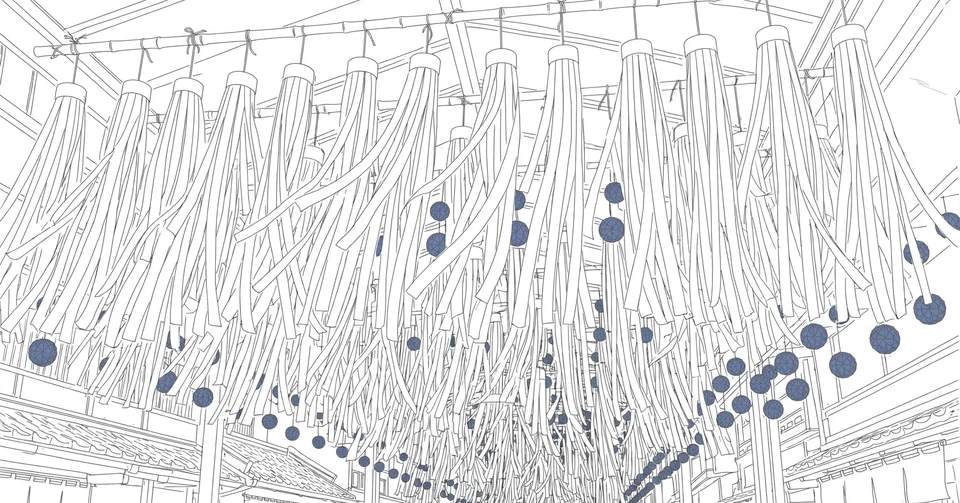
What makes Sendai Tanabata different is not only its size. It is the fact that the decorations are handmade, every one of them, by the shops beneath them, and that each one carries a wish. Sendai Tanabata has seven traditional decorations, and each stands for something practical: learning, health, good trade, a good catch, a clean home. A festival that asks for better sewing and cleaner kitchens is a festival rooted in ordinary life, and that is exactly why it has survived for four centuries.
Why Sendai Tanabata waits until August
Tanabata is the star festival of the seventh day of the seventh month, and its story is a short one. The weaver Orihime and the herdsman Hikoboshi, two lovers set on opposite sides of the Milky Way, are allowed to meet only once a year, on that single night. The full story, and the bamboo wishes that go with it, are told in Tanabata Festival and the Star-Crossed Lovers Behind the Bamboo Wishes, and it is worth knowing before you stand under the streamers. But the legend is only the beginning of what Sendai Tanabata is. The festival itself is about something else entirely: a city that refused to let its season slip away.
The old lunar calendar put the seventh day of the seventh month around August. When Japan adopted the Western calendar, most places simply moved Tanabata to July 7, and the festival lost its summer heat. Sendai did not follow. The city kept to the seasonality of the old festival by holding it a month later on the modern calendar, a reckoning known as the middle calendar, or chureki. That is why Sendai Tanabata runs from August 6 to 8 every year, on fixed dates, whatever day of the week they fall on.
The choice matters more than it sounds. Early August is the height of summer in Tohoku, the short northern summer that the region celebrates fiercely because it knows how brief it is. The evenings stay warm, the arcades fill with people after work, and the festival lands in a chain of great summer events across the north. A July 7 festival would be a pleasant evening. An August festival is a season. Sendai Tanabata understands that difference, and it has built its whole identity on it.
There is a quiet lesson in the delay. A city can inherit a tradition and still decide, deliberately, to keep it in its right season rather than its convenient one. Sendai chose the harder date, the one that required explaining to visitors and holding firm against the rest of the country, and the festival is grander for it. Traditions survive not by being easy, but by being kept properly, even when keeping them properly takes effort.
A festival with roots in the Date Masamune era
Sendai Tanabata traces its roots to the time of Date Masamune, the first lord of the Sendai domain and the founder of the city. Masamune wrote eight waka poems about Tanabata, the earliest in 1618, which shows the custom was already kept in Sendai in his day. Bamboo hung with poems on coloured paper and handmade crafts was set up under the eaves, and afterwards it was floated down the river, carrying the wishes away with the current.
Sendai Tanabata did not stay fixed in that early form. From the time of the seventh lord, Date Shigemura, Sendai decorated on the evening of the sixth and floated the bamboo down the Hirose River on the morning of the seventh, as the thirteenth lord, Date Yoshikuni, recorded in his journal. That morning was nanukabi, a day of purification before Bon, the festival of the ancestors. The decorations were already doing double work: they were wishes for the living and a cleansing before honouring the dead.
Then Sendai Tanabata faded. The switch to the modern calendar in 1873 pushed Tanabata out of its season, and the slump after the First World War drained the city's mood and its money. In 1927 the merchants of Omachi revived the decorations to lift the spirits of the city, and in 1928 the festival was held on August 6 to 8 with a decoration contest, as part of the Tohoku Industrial Exposition. That year is regarded as the full revival of Sendai Tanabata, and the contest it started is still part of the festival today.
War emptied the streets again. But in 1946, the year after the war ended, 52 bamboo decorations stood in the burnt out Ichibancho district, put up by people who had almost nothing and still chose to make something beautiful. A year later, in 1947, about 5,000 decorations lined the route of Emperor Showa's visit to the city. The festival grew back from those 52 poles, year by year, until it became the event that now draws more than two million people.
The most recent interruption came in 2020, when Sendai Tanabata was cancelled for the first time since the postwar era. The shopping streets sold small Tanabata decorations and trinkets instead, to raise funds for future festivals, and the smaller scale 2021 festival helped the streets recover. The 2026 Sendai Tanabata was the 80th since the postwar revival, and it was marked with a commemorative logo and an exhibition of posters from past years.
I keep coming back to those 52 decorations in 1946. A festival is easy to hold when a city is rich and at peace. It is something else entirely to hang paper streamers over a burnt street, with no money and no certainty, because the act of making them is itself a statement that the city intends to go on. Sendai Tanabata has been cancelled, forgotten, revived and rebuilt, and each time it has come back larger, because the people who make it refuse to treat it as decoration. To them it is a promise, remade every year by hand.
The seven decorations and what each one wishes for
At the heart of Sendai Tanabata are seven traditional decorations, the nanatsu kazari, and each one carries a wish. They are smaller than the great streamers, and they hang in sets among the bamboo, but they are the moral centre of the festival. While the streamers catch the eye, the seven decorations say what Sendai Tanabata is actually for, and what they ask for is strikingly practical.
| Decoration | Japanese | The wish it carries |
|---|---|---|
| Tanzaku | 短冊 | Progress in study and calligraphy |
| Kamigoromo | 紙衣 | Protection from illness and skill in sewing |
| Orizuru | 折鶴 | Health and long life for the family |
| Kinchaku | 巾着 | Good trade and prosperity |
| Toami | 投網 | Good catches and a rich harvest |
| Kuzukago | 屑篭 | Cleanliness and thrift |
| Fukinagashi | 吹き流し | The weaver's threads, and skill in crafts |
The tanzaku is the only one of the seven that carries words. It is a strip of paper on which a person writes a wish by hand, and its story is rich enough to deserve its own telling, which is why Tanzaku Carries Japan's Wishes on a Strip of Paper follows the strip through its life as a poem sheet, a wish and a playing card. At Sendai Tanabata, the strip stands for learning and good handwriting, the wish of a student who wants to write better and think more clearly. It is a modest wish, and that modesty is the point.
The other six are symbols rather than sentences, but each one is just as grounded. The kamigoromo is a small paper kimono, a wish against illness and for skill in sewing, which once meant the difference between a family clothed and a family cold. The orizuru is a folded paper crane, the classic wish for health and a long life. The kinchaku is a small purse, a wish for good business, hung by shopkeepers who understood that prosperity is something you ask for openly. The toami is a casting net, a wish for good fishing and good harvests, which in a region struck again and again by cold summers and famine was never a light request. The kuzukago is a waste basket, a wish for cleanliness and thrift, the least glamorous wish of the seven and perhaps the most honest. And the fukinagashi, the streamers, stand for the threads of Orihime the weaver, and for skill in crafts of every kind.
Look at that list again and notice what is missing. There is no wish for fame, no wish for victory, no wish to be better than a neighbour. The wishes are for learning, health, honest trade, a full net, a clean house and skilful hands. Sendai Tanabata hangs these wishes over its busiest streets, telling its city what it values, and it has been telling it for centuries. That is a kind of public moral teaching, and it works precisely because it is beautiful enough that people stop and look.
The fukinagashi streamers steal the show
If the seven decorations are the moral centre of Sendai Tanabata, the fukinagashi streamers are its spectacle. Each decoration is built around a tall bamboo pole, often more than ten metres long, cut in the mountains just two days before the festival, and hung with five long streamers that flutter down like coloured rain. By custom the streamers hang in sets of five, and the effect, repeated hundreds of times along a covered arcade, is what makes the festival feel less like an event and more like a place you have walked into.
Each shop makes its own decorations by hand, months ahead, and new every year. The work is not small. A single large decoration can weigh up to five kilograms and cost hundreds of thousands of yen to create, paid for by the shop that hangs it. The designs are kept secret until the decorations go up on the first morning, and judging follows the same day, with gold, silver and bronze plates fixed to the winners. Visitors make a game of finding the award winners among the rows, and the plates at the base of each decoration tell you who the judges favoured that year. The fullest account of the streamers, the awards and the best way to see them comes from a detailed local guide to the 2026 festival, which was put together with the help of the festival organisers themselves.
There is also a newer decoration that now stands beside the streamers as one of Sendai Tanabata's signatures. The kusudama, the ornamental ball, dates from around 1946, when Mori Gongoro of Sendai, inspired by the dahlias in his garden, built light bamboo balls covered with paper flowers. The design spread through the city, and today the round, flower covered balls hang among the streamers like a second rhythm in the same song. A festival that can absorb a new decoration, invented by one man looking at his own garden, and make it traditional within a generation is a festival that is still alive.
What strikes me about the streamers of Sendai Tanabata is the economics of them. A shop spends months of labour and a large sum of money on something that will hang for three days and then come down, and it does this every year, knowing the rain might spoil it and the judges might pass it by. That is not a sensible business decision, and it is not meant to be. It is a gift to the street, made in public, and the street repays it with crowds. There is a kind of commerce here that has nothing to do with selling things: a shop proves it belongs to the city by making the city more beautiful, and the city answers by walking past its door. Most advertising is forgotten in a day. A handmade streamer, swaying over a thousand heads, is remembered for a year.
Walking the arcades: what visiting Sendai Tanabata feels like
The best way to experience Sendai Tanabata is to start at Sendai Station and walk. Step out of the west exit and the shopping street is already hung with streamers, and the route runs from there along Chuo-dori and Ichibancho-dori, through arcades with names like Hapina Nakakecho and Vlandome Ichibancho, toward the old city centre. The arcades are covered, so the festival goes on whatever the weather does, and the roof turns the street into a tunnel of colour, with the streamers swaying in the draught of the crowds below.
Timing changes everything. The decorations go up from around 10 in the morning on August 6, and the morning is the calmest time to walk the arcades and look properly at the work. From noon to evening the streets fill, and by the afternoon the crowd is shoulder to shoulder under the streamers, moving slowly, looking up. If you want photographs of the decorations without the rush, go early. If you want Sendai Tanabata as the city experiences it, go in the afternoon, when the arcades are at their loudest and the streamers are brushing the heads of the crowd.
Beyond the arcades, Sendai Tanabata spreads across the city. Kotodai Park, known during the festival as Omatsuri Hiroba, or Festival Square, holds stages for singing and dancing, a corner where you can write your own wish on a tanzaku and hang it up, and food stalls serving Sendai specialties such as gyutan, grilled ox tongue, and Miyagi oysters. As evening falls, the traditional Bon Odori dance begins, and beginners are welcome to join in, with the steps taught on the spot. It is one of the few moments at a Japanese festival where a visitor is invited not just to watch, but to take part.
Sendai Tanabata actually begins the night before it opens. On August 5, the Sendai Tanabata Fireworks Festival lights up the sky above Nishi Park from 7:30 to 8:30 in the evening, with about 16,000 fireworks, and the 2026 theme was hope, flowers of the future blooming over the city. The evenings of the festival itself hold quieter events. At Zuihoden, the mausoleum of Date Masamune, bamboo lanterns light the stone steps from 6 to 9 in the evening, with the sound of the shakuhachi flute and small concerts by local artists. At the Sendai Castle ruins, high on the hill above the city, a martial arts performance runs from 8 to 9 in the evening, and the illuminated equestrian statue of Masamune makes the best photograph of the year.
Getting there is simple. The Tohoku Shinkansen runs from Tokyo Station to Sendai Station in about 1 hour and 38 minutes, and the main streamer venue is a short walk from the west exit, so a visitor can step off the train and be under the decorations within minutes. Rooms near the station go early, and prices rise during the festival, which is the honest price of a festival that draws more than two million people to a city in three days. The official Sendai Tanabata Festival site carries the current dates, maps and event details in English, and it is the place to check before travelling, since times and smaller events can change from year to year.
One of Tohoku's three great festivals
Sendai Tanabata is counted among the three great festivals of Tohoku, and the company it keeps explains a lot about it. The Aomori Nebuta Festival runs from August 2 to 7, with giant illuminated lantern floats paraded through the streets. The Akita Kanto Festival runs from August 3 to 6, with performers balancing tall poles of lanterns on their palms, foreheads and shoulders. Sendai Tanabata runs from August 6 to 8, and the three overlap just enough that a traveller can follow them north by Shinkansen, one after another, in a single week of early August.
The three festivals are often described together, but they do different work. Nebuta sends its lanterns out in a blaze of light and noise. Kanto is a feat of balance and daring. Sendai Tanabata opens last, on August 6, and it is quieter than either, a festival of paper and patience rather than fire and muscle, and its elegance is exactly what sets it apart. The official site calls it the most elegant festival of paper and bamboo in the world, and the claim is not empty boasting. There is nothing else in Japan quite like a kilometre of handmade streamers swaying over a shopping street.
There is also a difference in what the festivals ask of the gods. The organisers of Sendai Tanabata describe it as a festival that welcomes the deity of the rice fields, and they link it to prayers for good harvests in a region struck again and again by cold summers and famine. The Nebuta and Kanto festivals, by contrast, are described as sending deities off. It is a small theological distinction, and it says something large about the north. A region that has known hunger does not take a harvest for granted, and its greatest festival is, at heart, a welcome and a request: come to our fields, and let the summer be kind.
The scale is worth stating plainly. More than two million visitors come to Sendai Tanabata every year, in a city of about one million people, which means the city roughly triples in size for three days. The arcades absorb them, the stations absorb them, and the shops that made the decorations feed them and sell to them, and then, on the evening of August 8, the streamers come down and the streets go back to being streets. A festival that can triple a city and then vanish without a trace is a remarkable piece of organisation, and it works because the people who run it have been practising for a century.
The festival that hangs its wishes overhead
Sendai Tanabata endures because it never tried to be more than what it is. It is a festival of paper wishes, made by hand, hung over the streets where people shop and work, and taken down after three days. It does not need a grander purpose than that, and it would be smaller if it claimed one.
What stays with me is the image of the seven decorations, hanging among the streamers, asking for such ordinary things. Better handwriting. A healthy family. A good catch. A clean house. Skilful hands. These are not the wishes of a festival that wants to impress the world. They are the wishes of people who want to live well, and who are willing to write those wishes down and hang them where their neighbours can see them. There is a courage in that, small and unshowy, and it is the same courage that put up 52 decorations in a burnt street in 1946.
So the streamers of Sendai Tanabata will go up again next August 6, as they have for generations, and the arcades will fill, and the city will triple in size for three days. The legend of the two lovers will be told once, briefly, and then Sendai Tanabata will get on with its real work, which is hanging the wishes of ordinary people over their own heads, in coloured paper, for everyone to walk beneath. A festival that does that, year after year, does not need to call itself grand. The grandness is already there, swaying quietly above the crowd.
More in Culture & Society
- Tanzaku Carries Japan's Wishes on a Strip of Paper
- The Ainu People, Japan's Indigenous North
- Koi-Koi Is the Card Game Where Knowing When to Stop Wins
- Reog Ponorogo and the Giant Lion Mask That Dancers Carry With Their Teeth
- Hanafuda Turns Twelve Months of Flowers Into a Card Game
- Tana Toraja and the Funerals That Last for Days
Latest posts
- Lombok, the Island Next Door to Bali That Keeps Its Own Pace
- Ubud and the Valley Where Bali Slows Down
- Durian, the King of Fruits That Divides Southeast Asia
- Banda Islands and the Nutmeg That Changed the World
- Martabak and the Pancake Indonesia Eats Two Ways
- Indonesian Coffee and the Islands Behind Every Cup
- Mount Rinjani, the Volcano Trek That Tests Every Hiker
- Yogyakarta and the City Where Java Keeps Its Soul
- Doraemon, the Blue Robot Cat Japan Still Cannot Live Without
- Shirakawa-go, the Village of Praying Hands
- Nintendo, the Playing Card Maker That Became a Gaming Giant
- Tempeh and the Fermented Bean Cake Indonesia Gave the World
- Gado-Gado, the Peanut Sauce Salad That Feeds All of Indonesia
- The Washlet Made the Japanese Bathroom the Warmest Room in the House
- Bakso and the Meatball Soup Indonesia Eats Everywhere