Lombok, the Island Next Door to Bali That Keeps Its Own Pace
· 11 min read
Lombok sits 35 kilometres east of Bali, yet it feels like a different country. A volcano, car-free islands, pink sand and a living Sasak culture make Lombok the quieter island worth the crossing.
Lombok sits just 35 kilometres east of Bali, across a strait so narrow that you can see one island from the other on a clear day. The crossing takes less than an hour by fast boat, and the change of mood is immediate. Bali greets you with traffic and temples at every turn. Lombok greets you with space, with empty beaches, quiet roads and a volcano that fills the whole northern sky.
The island is roughly the same size as Bali, about 4,567 square kilometres, and home to about 4.06 million people. Most of them are Sasak, the indigenous people of Lombok, and most are Muslim, which is why the island is often called the land of a thousand mosques. The name itself comes from the Sasak word lomboq, meaning straight and honest, and that plainspoken character runs through everything here, from the food to the way people welcome strangers.
Lombok is not Bali without the crowds. It is a different island with its own history, its own food and its own rhythm, and the best way to enjoy it is to stop comparing the two. Give Lombok a week and it will show you a volcano trek, three islands without a single car, a pink beach, a MotoGP circuit and villages where weaving is still done by hand. Give it a long weekend and it will still give you more quiet than Bali can offer in a month.
Rinjani, the volcano that sets the pace of Lombok
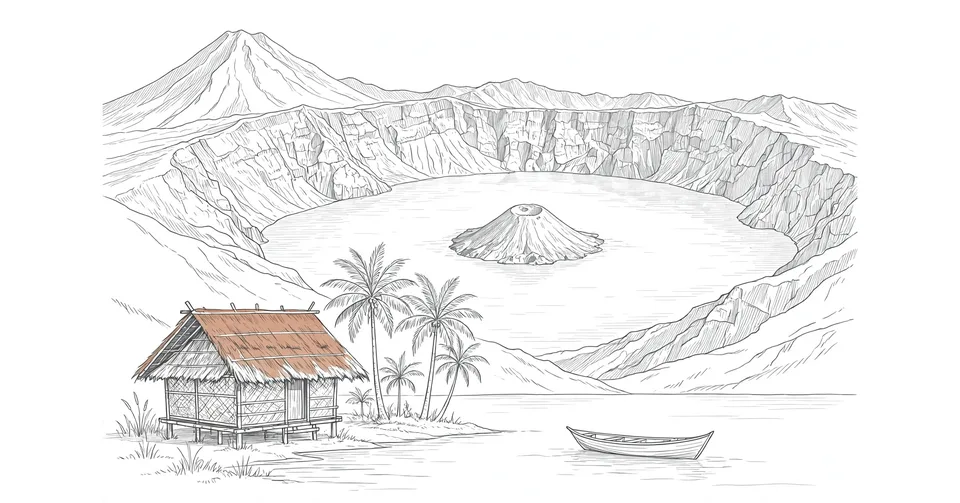
Everything in Lombok bends around Mount Rinjani. At 3,726 metres, it is the second highest volcano in Indonesia, and it dominates the north of the island so completely that you can use it to find your bearings anywhere. Inside its vast crater sits Segara Anak, a crescent lake about 2,000 metres above sea level, with a small active cone called Barujari rising out of the water. Barujari last erupted in 2016, and the whole mountain is protected as Gunung Rinjani National Park, a 41,330 hectare reserve that UNESCO added to its Global Geoparks Network in 2018.
The trek to the crater rim takes two or three days, and it is one of the great walks in Southeast Asia, with sunrise over Bali and Sumbawa from the summit ridge. For a fuller account of the climb, including the routes, the fees and the permits, see the companion guide to Mount Rinjani. Even if you never climb it, Rinjani shapes a Lombok trip. The waterfalls on its slopes, Sendang Gile and Tiu Kelep near the village of Senaru, are the easiest way to feel the mountain up close, and the rice terraces of the interior are watered by its rivers.
Rinjani is also a sacred mountain. Sasak and Balinese Hindus both make offerings at the crater lake, and the volcano appears in local legend as the home of Dewi Anjani, a goddess who watches over the island. That mix of reverence and daily life is typical of Lombok. The mountain is not a backdrop. It is part of how people here understand their home.
Three small islands with no cars at all
Off the north-west corner of Lombok lie the three Gili islands, Gili Trawangan, Gili Air and Gili Meno, and they are the closest thing the island has to a postcard. There are no cars and no motorbikes on any of them. People move by bicycle or by cidomo, a small horse-drawn cart, and the loudest sound on the beach is often the call to prayer drifting across the water from the mainland.
Each of the three has its own character. Gili Trawangan is the liveliest, with beach bars, dive schools and a small party scene. Gili Air is the middle ground, with good snorkelling, sunset views and a slower pace. Gili Meno is the quietest, the one people choose for honeymoons and for doing very little. All three are ringed by coral reefs where green turtles feed in water so clear you can spot them from the shore.
The Gilis are only the famous three. Lombok has about 35 small islands in total, and the quieter ones off the south-west coast, Gili Nanggu, Gili Sudak and Gili Kedis, are known locally as the secret Gilis. They have calm water, almost no crowds and snorkelling that beginners can enjoy, and they make a good day trip from the mainland when the famous three feel too busy.
Kuta, Mandalika and the new south coast of Lombok
The south coast of Lombok is where the island is changing fastest. Kuta Lombok, a fishing village turned surf town, sits in a bay of pale sand between green headlands, and it has grown into the island's main hub for surfers, cafes and guesthouses. A short ride away are Tanjung Aan, Selong Belanak and Mawun, wide white beaches that are still far quieter than anything on Bali's southern peninsula.
The biggest change is Mandalika, the resort development built around the Pertamina Mandalika International Circuit, a 4.3 kilometre track with 17 turns that has hosted the Indonesian round of MotoGP since 2022. Race weekends bring thousands of visitors and big resorts to the bay, and on ordinary days the circuit runs paddock tours for anyone curious about the track. The MotoGP guide to the island calls Mandalika one of the most exciting up and coming areas in the country, and the crowds on race week prove the point.
The development has brought jobs and new roads, and it has also brought the usual worries about land, prices and who benefits. For now the south coast still feels open. You can surf Gerupuk in the morning, eat grilled fish in Kuta at noon and watch the sun drop behind the Merese hills in the evening, and the day will cost you far less than the same day in Bali. The contrast with Ubud, Bali's crowded inland valley, is hard to miss, and it is the clearest argument for choosing Lombok when you want the same scenery with room to breathe.
Pink sand and the quiet east of Lombok
East Lombok is the part most visitors never reach, and it holds one of the island's strangest sights. Pantai Tangsi, usually called Pink Beach, gets its colour from fragments of red coral mixed into the white sand, and on a bright day the shore really does look pink. It is one of only a handful of pink beaches in the world, and the snorkelling off its reef is among the best on the island.
The east is also the gateway to the small sandbank islands of Gili Kondo and Gili Kapal, which appear and disappear with the tide, and to mangrove forests that shelter a very different Lombok from the surf towns of the south. Getting here takes effort, a long drive from Mataram over roads that narrow as they go, and that is exactly why it stays quiet. If the south coast is Lombok's future, the east is a reminder of how the island looked before the resorts arrived.
The Sasak heart of Lombok
Lombok belongs to the Sasak people, who make up about 85 percent of the population, and their culture is the part of the island that no beach can match. The villages of Sade and Ende, near Kuta, still keep traditional houses with bamboo walls and thatched roofs, and lumbung rice barns raised on stilts that have become the symbol of the island. In Sukarara village, women weave songket cloth on wooden looms in the same patterns their grandmothers used, and visitors can watch a sarong take shape thread by thread.
The most vivid Sasak tradition is Bau Nyale, the sea worm festival held every year, usually in February or March, on the beaches of Kuta. Thousands gather before dawn to catch the nyale worms that rise with the tide, following the legend of Princess Mandalika, who threw herself into the sea rather than choose between her suitors, and whose hair became the worms. The festival is part harvest, part pilgrimage and part party, and it is the best single day to understand what Lombok means to the people who live there.
That living culture is also why Lombok feels different from its neighbour. Bali's Hindu temples give it a visual identity that photographs well, but Lombok's identity is quieter, carried in language, food, weaving and prayer. I find that quietness more rewarding than spectacle. A place that does not perform for visitors asks you to slow down and pay attention, and Lombok rewards that attention again and again.
What to eat in Lombok
Lombok's food is hot, smoky and unapologetic. The dish to start with is ayam taliwang, grilled chicken rubbed with a paste of chilli, garlic, shallot and shrimp paste, served with plecing kangkung, water spinach in a spicy tomato and chilli sambal, and warm rice. It comes from the Sasak kitchen and it is served everywhere from roadside stalls to hotel restaurants, and it is the taste most visitors remember first.
Sate bulayak is the other classic, skewers of beef or chicken satay served with bulayak, rice cakes wrapped in palm leaves, and a peanut sauce that is thinner and sharper than the Javanese version. In the morning markets, look for nasi balap puyung, rice with shredded chicken, fried soybeans and a chilli sambal that wakes you up faster than coffee. Lombok's food is not subtle, and that is the point. The island grows some of Indonesia's best chillies, and its cooks are not shy about using them.
Planning a trip to Lombok
| Item | What to know |
|---|---|
| Getting there | Fast boats from Bali take under an hour to the Gilis or to Bangsal on the mainland, and flights land at Lombok International Airport, south of Mataram |
| Best months | May to October, the dry season, when the sea is calm and the Rinjani trails are open |
| Base towns | Senggigi for the west coast, Kuta for the south, Senaru for Rinjani, and the Gilis for the islands |
| How long | A long weekend covers one coast, a week covers the island, two weeks add the Gilis and the east |
| Budget | Cheaper than Bali for rooms, food and transport, with guesthouses and warungs everywhere |
The dry season, from May to October, is the best time to visit Lombok. The sea is calmest then, the Rinjani trails are open, and the south coast surf is at its best. The wet season, roughly November to March, brings heavy afternoon rain, and the Rinjani trekking routes generally close in the wettest months. If you are planning around Bau Nyale, check the dates each year, since the festival follows the Sasak lunar calendar and moves between February and March.
Getting around is easy. Scooters are the usual choice, and the roads are quieter than Bali's, but distances are longer than they look on a map, so plan for slow travel. The fast boats from Bali run to the Gilis and to Bangsal, and the airport south of Mataram connects Lombok to Jakarta, Surabaya and Singapore, so the island works well as either a first stop or a second one after Bali.
Why Lombok still feels like itself
Lombok has had its share of hard years. The earthquakes of 2018, a 6.4 magnitude shock on 29 July followed by a 7.0 magnitude quake on 5 August, killed more than 550 people and damaged homes across the north of the island. Recovery was slow, and then the pandemic emptied the beaches just as rebuilding gathered pace. The island has come back, but the experience left its mark, and it shows in the way people here talk about tourism. They want visitors, but they want the kind who stay a while, eat in the warungs and learn a few words of Sasak.
That attitude is part of what makes Lombok worth the crossing. Bali became a global destination and then a byword for overtourism, with the remote work crowds and the traffic to match, as the story of how Bali became the world's remote work capital shows. Lombok is still at the stage where a traveller can be a guest rather than a number, where a beach can be empty at noon and a village weaving cooperative can be the highlight of the day.
Lombok will not stay this quiet forever. Mandalika is growing, the airport is expanding, and the world is slowly finding out what the island offers. Go now, while the roads are still empty and the pink sand is still a local secret, and go slowly. Lombok does not rush, and it does not reward rushing. The island keeps its own pace, and the best thing a visitor can do is match it.
More in Food & Travel
- Ubud and the Valley Where Bali Slows Down
- Durian, the King of Fruits That Divides Southeast Asia
- Banda Islands and the Nutmeg That Changed the World
- Martabak and the Pancake Indonesia Eats Two Ways
- Indonesian Coffee and the Islands Behind Every Cup
- Mount Rinjani, the Volcano Trek That Tests Every Hiker
Latest posts
- Sendai Tanabata Turns Three August Days Into Japan's Grandest Star Festival
- Tanzaku Carries Japan's Wishes on a Strip of Paper
- The Ainu People, Japan's Indigenous North
- Koi-Koi Is the Card Game Where Knowing When to Stop Wins
- Yogyakarta and the City Where Java Keeps Its Soul
- Reog Ponorogo and the Giant Lion Mask That Dancers Carry With Their Teeth
- Doraemon, the Blue Robot Cat Japan Still Cannot Live Without
- Shirakawa-go, the Village of Praying Hands
- Hanafuda Turns Twelve Months of Flowers Into a Card Game
- Nintendo, the Playing Card Maker That Became a Gaming Giant
- Tana Toraja and the Funerals That Last for Days
- Tempeh and the Fermented Bean Cake Indonesia Gave the World
- Gado-Gado, the Peanut Sauce Salad That Feeds All of Indonesia
- The Washlet Made the Japanese Bathroom the Warmest Room in the House
- Bakso and the Meatball Soup Indonesia Eats Everywhere