Koi-Koi Is the Card Game Where Knowing When to Stop Wins
· 15 min read
Koi-koi is the best known game played with hanafuda, and its whole drama fits in two words: stop, or come on. This guide explains the deck, the deal, the scoring combinations, and the gamble at the heart of the game.
Most card games reward the player who grabs the most. Koi-koi rewards the player who knows when to stop grabbing. It is a two player game played with hanafuda, the Japanese flower cards, and the entire contest turns on a single decision that comes up again and again: take the points you have, or say the words that give the game its name and risk them all for more.
The name itself is the dare. Koi-koi means come on in Japanese, and a player says it when they choose to keep playing after completing a scoring combination instead of banking the points. Every hand of koi-koi is a small argument between greed and patience, and the cards are only the excuse. The real game is the judgment call, made in the open, with the points sitting right there on the table.
That is why koi-koi has lasted. It is simple enough to teach in ten minutes, yet the decision at its center never gets old, because no two hands offer quite the same trade. A safe three points now, or a shot at eight that might hand your opponent double? The answer changes with the cards, the score, and how much nerve you have left.
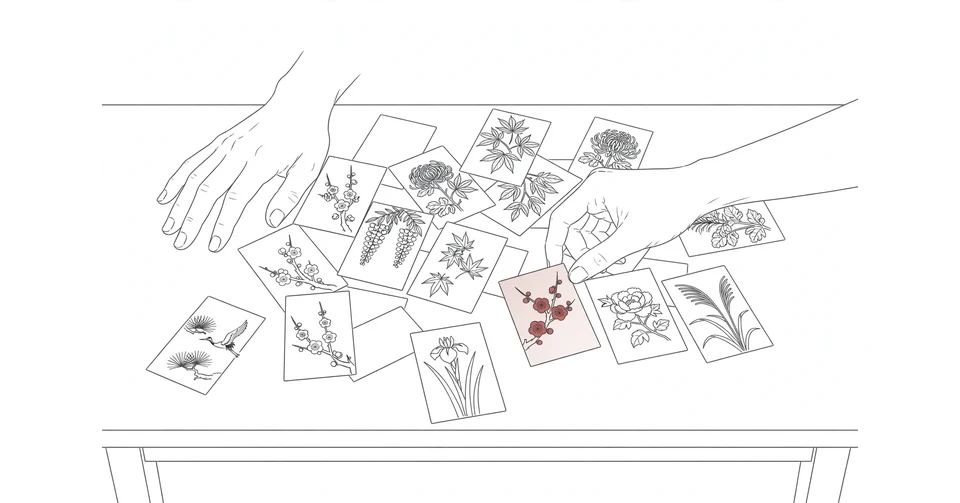
The game grew out of the hanafuda deck, and it helps to understand the deck first. Hanafuda means flower cards, and the deck holds 48 cards divided into 12 suits, one for each month of the year. Every month has four cards sharing a flower or plant, so January is pine, February is plum blossom, March is cherry blossom, and so on through December, which is paulownia. The months are the suits, and matching always means matching the month. There are no numbers anywhere on the cards, and that is part of the charm. You learn the flowers, not the ranks, and after a few hands the months start to feel like old friends.
What koi-koi actually is
Koi-koi is a two player matching game, and it is the best known game played with hanafuda. Each player tries to capture cards from the table by matching them with cards from their hand, then builds scoring combinations called yaku from the cards they have captured. The first player to complete a yaku faces the choice that defines the game: stop and score, or call koi-koi and keep playing to build a bigger score.
A full game usually runs for 12 hands, with each hand standing for one month of the year, though players can agree on a different number before they start. The points from each hand are added up, and the player with the highest total at the end wins. Some groups play for 6 hands instead, which keeps a session short enough for a lunch break. The structure is flexible, but the rhythm is always the same: deal, match, capture, decide.
The dealer is called the oya, which means parent, and the other player is the ko, which means child. Players decide who deals first in whatever way they agree on, and one hanafuda method is to draw a single card each, with the player who draws the card from the earliest month becoming the oya. If both draw from the same month, the higher value card decides. The winner of the last hand becomes the new oya, so dealing is a small reward for winning, and the roles keep shifting as the game goes on.
The deck is a calendar you can hold
The 48 cards fall into four ranks by point value, and in koi-koi the ranks matter because the yaku are built from them. There are 5 bright cards worth 20 points each, 9 animal cards worth 10 points each, 10 ribbon cards worth 5 points each, and 24 plain cards worth 1 point each. The bright cards are the prize pictures of the deck: the crane with the sun, the cherry blossom curtain, the moon, the rain man, and the phoenix. The animal cards include the boar, the deer, and the butterflies, along with the nightingale, the cuckoo, the bridge, and the sake cup. The ribbons are the poetry slips called tanzaku, narrow strips of paper that carry written poems.
One card deserves a special note. The sake cup from September is officially a 10 point card, but it also counts as a 1 point card at the same time, which makes it unusually flexible when you are counting toward a yaku. Some rule sets even let it count as a 10 point card and two 1 point cards at once. It is a small quirk, and it is the kind of detail that makes experienced players smile when the cup turns up at just the right moment.
Hanafuda itself has a long history, and the deck that koi-koi uses is the same one Nintendo was founded to sell. In 1889, Fusajiro Yamauchi founded the Nintendo Koppai company to commercialize hanafuda, long before the company ever made a video game. The cards had been banned at various times because they were used for gambling, and they were declared lawful again after the Meiji government opened Japan to the world. A full account of the deck and its months is worth reading if you are new to the cards, and the hanafuda guide on this site walks through all twelve months and what each one shows.
How a round of koi-koi plays
In koi-koi, the oya deals eight cards to the ko face down, eight cards face up on the table, and then eight cards to themselves face down, usually dealing two or four cards at a time. The rest of the deck sits aside as the draw pile, and the oya plays first. If a player is dealt four cards of the same month, or four pairs of matching months, that is an instant win worth 6 points, and the hand ends before it starts. The same combinations dealt to the table instead make the hand void, and the cards are redealt.
On a turn in koi-koi, a player matches one card from their hand with a card on the table that shares its month, and takes both into their capture pile. If no card in hand matches anything on the table, the player must discard one card face up onto the table instead. Then the player draws one card from the draw pile and places it face up. If that drawn card matches a card now on the table, the player must take the pair as well. If it matches two cards on the table, the player chooses which one to take. If three cards of one month are already on the table and the player plays the fourth, they collect all four cards of that month at once.
The matching rule of koi-koi sounds simple, and it is, but it creates a quiet kind of strategy. Every card played is public, and every capture is public, so both players can count what is gone and what is left. When three cards of a month have already been captured, the fourth is a guaranteed pickup for whoever holds it. When a month has two cards on the table, the player who holds the other two knows they can take both in sequence. Good players watch the months the way chess players watch the board, and the counting is half the game.
After each turn, the player checks whether their captured cards form a yaku, and this check is where koi-koi turns from matching into gambling. If no yaku is possible yet, the turn simply ends and play passes to the opponent. If a yaku has been formed, the player must choose: stop and score, or call koi-koi and continue. That choice is the heartbeat of the game, and everything before it is only the setup.
If both players run out of cards without anyone forming a yaku on the last play, the hand ends with no points for either side, except for one special case. If neither player managed a yaku, the oya gains one point, a rule called oya-ken, which means the dealer's privilege, and the next hand begins with the same oya. It is a small consolation, but it keeps the dealer from feeling that a scoreless hand was entirely wasted.
The yaku are the point of the game
The word yaku means a scoring combination, and the whole game of koi-koi is a hunt for them. The individual point values printed on the cards have no effect on the score by themselves. They only matter because the yaku are built from groups of cards, and the groups are defined by rank and by theme. The table below lists the main yaku with the point values given in the Wikipedia article on koi-koi, which is the most complete English reference for the game. One warning belongs here: different rule sets give different point values for the light combinations, and some sources score five lights at 15 points rather than 10. The values below follow the Wikipedia table, which is the conservative and most widely cited version, so treat them as the standard and confirm the house rules before you play for stakes.
| Yaku | What it takes | Points |
|---|---|---|
| Goko, five lights | All five bright cards | 10 |
| Shiko, four lights | Four bright cards without the rain man | 8 |
| Ame-shiko, rainy four lights | Four bright cards including the rain man | 7 |
| Sanko, three lights | Three bright cards without the rain man | 5 |
| Inoshikacho, boar deer butterfly | The boar, the deer, and the butterflies | 5 |
| Akatan, red poetry ribbons | The three red poetry ribbons | 5 |
| Aotan, blue ribbons | The three blue ribbons | 5 |
| Tsukimi-zake, moon viewing | The moon card and the sake cup | 5 |
| Hanami-zake, cherry blossom viewing | The cherry blossom curtain and the sake cup | 5 |
| Tane, animals | Any five animal cards | 1, plus 1 per extra animal |
| Tanzaku, poetry slips | Any five ribbon cards | 1, plus 1 per extra ribbon |
| Kasu, chaff | Any ten plain cards | 1, plus 1 per extra plain card |
| Akatan and Aotan together | All three red poetry ribbons and all three blue ribbons | 10 |
A few combinations deserve a closer look, because they show how much poetry is packed into the scoring of koi-koi. Inoshikacho brings together three animal cards, the boar from July, the deer from October, and the butterflies from June, and its name is simply the three animals joined into one word. Akatan and aotan are the two ribbon sets, the three red poetry ribbons from pine, plum, and cherry blossom, and the three blue ribbons from peony, chrysanthemum, and maple. Tsukimi-zake and hanami-zake are the two drinking combinations, moon viewing with the sake cup and cherry blossom viewing with the sake cup, and both are worth 5 points. They are the most seasonal yaku in the game, pairing a beautiful card with the cup, and they reward the player who notices that the moon and the cup belong together.
The small yaku matter too in koi-koi, because they are the ones that actually appear in most hands. Five animal cards score 1 point, with one more point for each additional animal. Five ribbon cards score 1 point, with one more for each extra ribbon. Ten plain cards score 1 point, with one more for each extra plain card. These slow builders are how most hands reach a decision point, and a player who has been quietly collecting ribbons all hand may suddenly find themselves holding a yaku while their opponent is still chasing lights.
One more detail from the hanafuda rules reference is worth keeping in mind: a yaku can extend into another one, so the three red poetry ribbons that make akatan can also count toward the five ribbon yaku if the player holds two more ribbons. Some groups award points for both combinations, while others count only the single highest scoring yaku, so this is another rule to agree on before the first deal. The game is generous with combinations, and the arguments about counting are part of the fun, as long as they happen before the cards are dealt rather than after.
The koi-koi call is the whole game
Here is the decision that gives the game its name. When a player completes a yaku on their turn, they have two choices. They can stop, which ends the hand and adds the value of their yaku to their point total. Or they can call koi-koi, which means come on, and keep playing in the hope of forming another yaku for more points. The call is a dare aimed straight at the opponent, and the risk is real. If the opponent completes a yaku before the caller completes another one, the opponent scores double, and the caller earns nothing at all.
That doubling is what makes the call so tense. In some versions of the game, a player may only call koi-koi once per hand. In others, a player may call it again on later turns, stacking the risk higher each time. The rule sets differ, and players should settle this before they start, because the whole texture of a hand changes depending on whether the dare can be repeated.
The scoring has two more multipliers that reward bold play. If a player ends a hand with yaku worth 7 or more points, the score is doubled. If the opponent had called koi-koi and the player scores anyway, the score is doubled too. If both apply at once, if the player scores 7 or more points against an opponent who had called koi-koi, the score is quadrupled. A small hand can turn into a big swing in a single turn, and that is exactly what the koi-koi call is gambling on. The player who calls it is betting that their next yaku will come before their opponent's, and the arithmetic punishes the loser twice over.
This is where koi-koi stops being about the cards and starts being about people. A cautious player stops early and banks small points, hand after hand, and often wins by steady accumulation. A bold player calls koi-koi on thin hands and sometimes loses everything, but sometimes lands a quadrupled score that erases a whole game of careful play. Neither style is wrong, and that is the point. Koi-koi asks you to know yourself as much as it asks you to know the cards. I have always liked games that punish greed in plain sight rather than hiding the punishment in fine print, and koi-koi does it with a single word. Say come on, and the game holds you to it.
The koi-koi decision also changes with the score. When you are far behind, calling koi-koi is almost free, because the points you would bank are not enough to matter. When you are far ahead, stopping is the wise move, because a doubled loss could hand the game away. The best players feel the score the way sailors feel the wind, and they let it change their answer from hand to hand. A beginner can learn the matching in an evening, but learning when to stop takes much longer, and that is the real skill koi-koi teaches.
Where people play koi-koi today
Koi-koi is still played at family gatherings and over drinks in Japan, usually with a physical deck of hanafuda, and it remains the first game most beginners learn when they pick up the cards. The deck is cheap, the rules fit in a few minutes of explanation, and a full game of 12 hands takes about half an hour, which makes it a natural fit for an evening at home. It is a game that works best face to face, where you can see your opponent hesitate before the call, and where the dare lands with a look as much as with words.
Koi-koi has also found a second life on screens. Nintendo's Clubhouse Games and Clubhouse Games: 51 Worldwide Classics both feature koi-koi, which introduced the game to players who had never held a hanafuda deck. The Yakuza games and the Sakura Wars series include it as well, so a generation of players first met the flower cards in a video game minigame before ever seeing the real thing. Online versions exist too, and they are a good way to learn the yaku, because the software counts the combinations for you while you play. The screen versions teach the rules, but they cannot teach the nerve, and that is the part you only learn across a real table.
There is something quietly Japanese about koi-koi, a game whose most important move is deciding to stop. Many Japanese traditions prize restraint, the held note, the empty space, the gesture not made, and koi-koi belongs to that family. The game even shares a spirit with kemari, the ball game Japan played without trying to win, where the point was to keep the ball in the air gracefully rather than to beat anyone. Both games ask the player to value the quality of the play over the score, and both reward the person who knows when enough is enough.
That is the lesson koi-koi leaves with you after the cards are put away. In koi-koi, as in most things worth doing, the win does not always go to the person who takes the most. It goes to the person who can look at a good hand, say that it is enough, and stop while stopping is still a choice. The next time the cards offer you a yaku, try stopping once, just to feel what it is like to walk away with the points in hand. You may find that the quietest move in the game is also the most satisfying one.
More in Culture & Society
- Reog Ponorogo and the Giant Lion Mask That Dancers Carry With Their Teeth
- Hanafuda Turns Twelve Months of Flowers Into a Card Game
- Tana Toraja and the Funerals That Last for Days
- Rangda Is the Witch Queen Bali Never Lets Win
- The Japanese School Uniform and the Story Behind the Sailor Suit
- Aikido and the Martial Art That Refuses to Fight Back
Latest posts
- Mount Rinjani, the Volcano Trek That Tests Every Hiker
- Yogyakarta and the City Where Java Keeps Its Soul
- Doraemon, the Blue Robot Cat Japan Still Cannot Live Without
- Shirakawa-go, the Village of Praying Hands
- Nintendo, the Playing Card Maker That Became a Gaming Giant
- Tempeh and the Fermented Bean Cake Indonesia Gave the World
- Gado-Gado, the Peanut Sauce Salad That Feeds All of Indonesia
- The Washlet Made the Japanese Bathroom the Warmest Room in the House
- Bakso and the Meatball Soup Indonesia Eats Everywhere
- Kecak Dance and the Hundred Voices That Tell the Ramayana
- Sapporo Snow Festival and the Ice City That Rises Every February
- Satay and the Smoke That Carries Indonesia to the World
- Barong Is the Lion Bali Calls Out When the Village Needs Protection
- Tumpeng Is the Rice Cone Java Serves When It Wants to Say Thanks
- Onsen Etiquette and the Unwritten Rules of Japan's Hot Springs