Durian, the King of Fruits That Divides Southeast Asia
· 12 min read
Durian is the most divisive fruit on earth, banned from hotels and trains yet crowned king of fruits across Southeast Asia. Here is why the smell, the price, and the love affair all make sense.
No fruit in the world starts arguments the way this one does. One person opens one and smiles like they have found treasure. Another person, standing three metres away, wrinkles their nose and asks who left the rubbish out. Durian has been called the king of fruits for centuries, and it has also been banned from hotels, airports, and trains. Both reactions are honest, and both are part of the story.
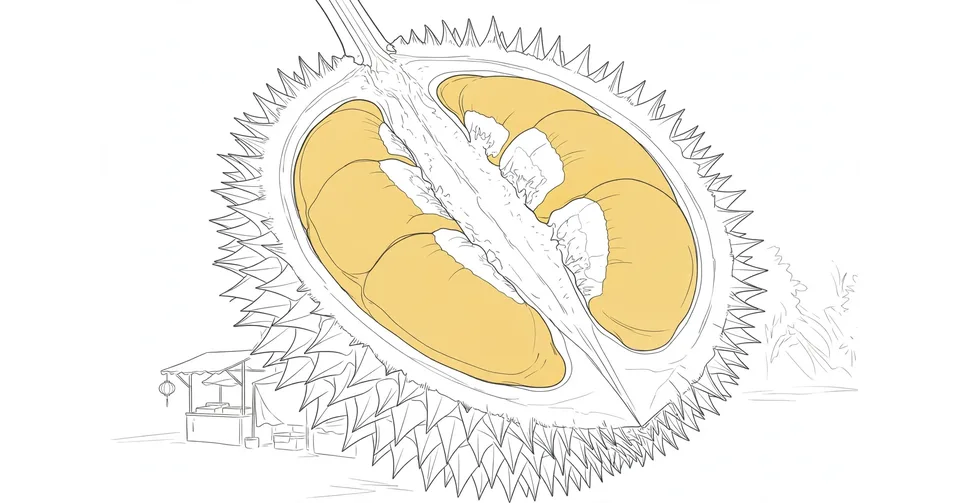
If you have never tried durian, the first thing to know is that the smell is not a flaw in the fruit. It is the fruit. The second thing to know is that millions of people across Southeast Asia plan their year around durian season, pay serious money for the best varieties, and consider a good one one of the great pleasures of life. This is a fruit that demands a verdict, and the only fair way to reach one is to understand what it is, where it comes from, and how to eat it properly.
The fruit with a crown and a warning sign
Durian is the edible fruit of trees in the genus Durio, and the species sold around the world is Durio zibethinus. It is large, often weighing 2 to 3 kilograms, with a thick rind covered in sharp thorns. The name comes from the Malay word duri, meaning thorn, with the suffix an. In other words, the fruit is literally named after its spikes, and anyone who has carried one home in a plastic bag understands why.
Across Southeast Asia, it is known as the king of fruits, while the mangosteen, sweet and delicate, is called the queen. The title is not a marketing slogan. It comes from centuries of regard in Malay, Indonesian, Thai, and Chinese food culture, where durian is a delicacy served at celebrations and offered to honoured guests. At Borobudur, the ninth century Buddhist temple in Java, relief panels show durian as a symbol of abundance, which suggests the fruit was already prized more than a thousand years ago.
The crown comes with a warning sign. Durian is the only fruit routinely banned from enclosed public spaces. Hotels across Southeast Asia post no durian signs at their entrances. Singapore banned it from its MRT trains in 1988, after the smell lingered in air conditioned carriages, and fines still apply. In 2018, a Sriwijaya Air flight in Indonesia was delayed after passengers refused to board because the cargo hold carried the fruit, and the airline had the fruit unloaded before takeoff. No other fruit has this kind of record, and none inspires this kind of loyalty either.
Where durian comes from
The fruit is thought to have originated in the rainforests of Borneo and Sumatra, with wild trees also growing on the Malay Peninsula. From there it spread through cultivation across Southeast Asia, from India to New Guinea, and it has been traded for at least four hundred years. The earliest known European reference comes from Niccolo de Conti, an Italian merchant who travelled through Southeast Asia in the fifteenth century and wrote about it with a mixture of admiration and disgust that has barely changed since.
The first scientific name arrived much later. The Swedish botanist Carl Linnaeus named the species Durio zibethinus in the eighteenth century, and the second part of the name refers to the civet, an animal whose musky scent reminded early naturalists of the fruit. That comparison tells you everything about how outsiders experienced durian: they reached for the strongest smell they knew.
The British naturalist Alfred Russel Wallace, who travelled through the Malay Archipelago in the nineteenth century, gave the most quoted description of all. He called the flesh like a buttery custard flavoured with almonds, mixed with wafts of flavour that called to mind cream cheese, onion sauce, brown sherry, and other incongruities. He added that it was neither acid, nor sweet, nor juicy, yet one feels the want of none of these qualities, for it is perfect as it is. Wallace loved it, and his praise has been quoted by fans ever since, usually right before they offer a sceptic a piece.
Why durian smells like that
The smell of durian is not one smell. Researchers have identified more than fifty volatile compounds in the flesh, including sulphur compounds also found in onions, cheese, and even skunk spray. The result is a layered aroma that different people describe in completely different ways: rotten onions, gym socks, turpentine, almonds, vanilla, and honey have all been used, sometimes by the same person in the same sentence.
The chemistry explains the disagreement. Our noses are wired differently, and the same compound can read as delicious or revolting depending on the person. That is why arguments about it never end. The fan and the hater are not disagreeing about the fruit in front of them. They are reporting two genuinely different sensory experiences, and neither one is wrong.
There is also a practical side to the smell. The flesh is rich and energy dense. A hundred grams contains about 147 calories, with roughly 27 grams of carbohydrate, 5 grams of fat, and useful amounts of potassium and vitamin C. It is a filling food, not a light snack, and in villages across Indonesia and Malaysia it has long been eaten as a meal in itself, not as a dessert. The smell, the richness, and the thorns all point to the same thing: this is a fruit that evolved to be noticed.
The varieties that matter
Hundreds of cultivars exist, but a small number dominate the trade, and knowing them changes how you shop. The most famous is Musang King, registered in Malaysia as D197. It comes from Gua Musang in Kelantan, and it is known for deep golden flesh with a bitter sweet taste and an almost alcoholic complexity. Musang King retails for three to five times the price of ordinary varieties, and in Malaysia it sells for roughly 50 to 80 ringgit per kilogram, more in export season. A single premium fruit in a Bangkok market can cost 80 dollars or more.
The second variety to know is Monthong, also called Golden Pillow, from Thailand. It is the most widely exported durian in the world, mild, sweet, and custardy, with the least polarising flavour of any major variety. If you are trying it for the first time, Monthong is the sensible choice. It is the variety most often used for ice cream, pastries, and bubble tea, precisely because it offends the fewest people.
Then there is D24, a Malaysian variety that sits between the two: creamier than Monthong, less intense than Musang King, and a favourite for durian buffets. Black Thorn, another Malaysian cultivar, has gained a following for its reddish orange flesh and custard like texture. In Indonesia, local varieties from Sumatra and Kalimantan rarely reach international markets, but they are prized at home, and a roadside stall in Medan or Pontianak will have strong opinions about which village grows the best fruit. That local pride is part of the pleasure. It is not one flavour. It is a whole family of flavours, and the variety on the label matters as much as the fruit itself.
How to eat durian for the first time
The best first taste is eaten the right way, in the right place, and that makes more difference than most people expect. Buy it from a vendor who opens it in front of you, because one that has been open for hours loses its best qualities. Eat it outdoors or in a well ventilated space, with your hands, the way it is eaten across Southeast Asia. The flesh should be soft and custardy, not hard and not fermented. If it smells like alcohol, it is overripe.
Take a small piece first. Let it sit on your tongue for a moment before you chew. The first flavour is usually sweet and creamy, and the sulphur notes arrive second. Many first timers find the second bite much easier than the first, because the shock of the smell fades once the taste takes over. If you still hate it, that is fine. It is an acquired taste, and acquiring it is optional.
A few practical rules help. Do not eat it with alcohol, a combination that traditional advice warns against and that most vendors will mention with a smile. Drink water, not beer, with your first durian. Do not store an opened one in a hotel room unless you want the smell to follow you for days, which is exactly why the bans exist. And if you buy a whole fruit, ask the vendor to choose it for you. A good vendor can tell a ripe one by shaking it gently and listening for the flesh moving inside, and by smelling the stem end. That skill is worth more than any guide.
The price of a king
Durian used to be a local fruit, eaten near where it grew. It is now a global commodity, and the change has been fast. China is the largest importer by a wide margin, taking more than 90 percent of global imports, and in 2024 it imported the fruit worth nearly 7 billion dollars, about 1.56 million tonnes. Thailand supplies the largest share, with Vietnam close behind after gaining official market access to China in 2022. Malaysia, the home of Musang King, began exporting fresh durian to China more recently, and premium Malaysian fruit now commands the highest prices in the trade.
The global market for the fruit was valued at about 8.25 billion dollars in 2024, and demand keeps growing at roughly 8 to 10 percent a year. That growth has a visible effect on the ground. Orchards are expanding across Malaysia, Thailand, Vietnam, and Indonesia. Farmers who once sold to local markets now sell to exporters. Prices rise, and so do complaints that ordinary families in producing countries can no longer afford the best fruit. It is the familiar story of a local treasure becoming a luxury export, and durian is living it in real time.
For a traveller, the price is part of the experience. One bought at a roadside stall in Indonesia might cost a few dollars. The same weight of Musang King in Shanghai or Singapore can cost ten times as much. That gap is why the fruit feels different depending on where you eat it. In a night market in Penang, durian is street food. In a shopping mall in Beijing, it is a gift.
Durian beyond the fresh fruit
Fresh durian is only the beginning. Across Southeast Asia, durian appears in pancakes, ice cream, mooncakes, coffee, and candy. Tempoyak, a fermented paste made from the fruit from Sumatra and Malay cooking, is used as a cooking ingredient and a condiment, and it tastes nothing like the fresh fruit. In Indonesia, it is blended into drinks and mixed into sticky rice desserts. In Thailand, durian sticky rice is a seasonal favourite.
The processed market is also how the fruit reaches people who would never buy a whole spiky fruit. Frozen pulp, vacuum packed and shipped cold, is sold in Asian supermarkets around the world, including in Japan, where a frozen pack is often the first taste a newcomer gets. The freeze dried version, light and crisp, travels even further. These products keep the flavour and lose some of the smell, which is exactly the compromise many first timers need.
There is a small irony here. The fruit famous for being impossible to ignore has become easiest to love in its most processed forms. But the fans will tell you that none of it replaces the real thing: one opened at a night market, eaten with your hands, while the vendor watches your face for the verdict.
A fruit worth the argument
This fruit divides people, and that is precisely why it matters. Most foods are easy to agree about. This one is not, and the disagreement has produced centuries of stories, from Borobudur reliefs to Wallace in the nineteenth century to a delayed flight in 2018. It is a fruit with a history, a chemistry, an economy, and a culture, all wrapped in a shell covered in thorns.
If you visit Southeast Asia, trying it is one of the simplest ways to understand the place. The fruit grows in the same rainforests that shaped the region, it is sold in the same markets where rendang and Indonesian coffee are traded, and it carries the same pride as any dish the region claims as its own. Like the temples of Borobudur, it is older than the countries that now argue over it, and it belongs to all of them at once.
My own view is simple: a fruit that can empty a hotel corridor and fill a night market on the same day deserves respect, even from people who will never learn to love it. Try it once, properly, from a good vendor, with an open mind. If you love it, you will understand why Southeast Asia calls it a king. If you do not, you will still have a story, and a smell, that you will never forget. Either way, it will have done its job, which is to make sure you never confuse it with any other fruit on earth.
For the curious, the Wikipedia entry on durian covers the botany and history in detail, and the National Library Board of Singapore has a good account of the fruit in Singaporean life, including the 1988 MRT ban.
More in Food & Travel
Latest posts
- Tanzaku Carries Japan's Wishes on a Strip of Paper
- The Ainu People, Japan's Indigenous North
- Koi-Koi Is the Card Game Where Knowing When to Stop Wins
- Reog Ponorogo and the Giant Lion Mask That Dancers Carry With Their Teeth
- Doraemon, the Blue Robot Cat Japan Still Cannot Live Without
- Hanafuda Turns Twelve Months of Flowers Into a Card Game
- Nintendo, the Playing Card Maker That Became a Gaming Giant
- Tana Toraja and the Funerals That Last for Days
- Tempeh and the Fermented Bean Cake Indonesia Gave the World
- Gado-Gado, the Peanut Sauce Salad That Feeds All of Indonesia
- The Washlet Made the Japanese Bathroom the Warmest Room in the House
- Bakso and the Meatball Soup Indonesia Eats Everywhere
- Kecak Dance and the Hundred Voices That Tell the Ramayana
- Sapporo Snow Festival and the Ice City That Rises Every February
- Rangda Is the Witch Queen Bali Never Lets Win