Ubud and the Valley Where Bali Slows Down
· 12 min read
Ubud sits in the green hills of central Bali, far from the beach clubs, and it rewards travellers who slow down. Here is what to see, eat and do in Bali's cultural heart.
Bali has two speeds. On the south coast, the day is measured in sunset tables, surf lessons and beach clubs that charge for a sunbed. An hour inland, the island changes gear entirely. Ubud is the town where Bali slows down, and it has been slowing visitors down for nearly a century, first artists, then writers, then everyone else who arrived looking for a beach and found a valley instead.
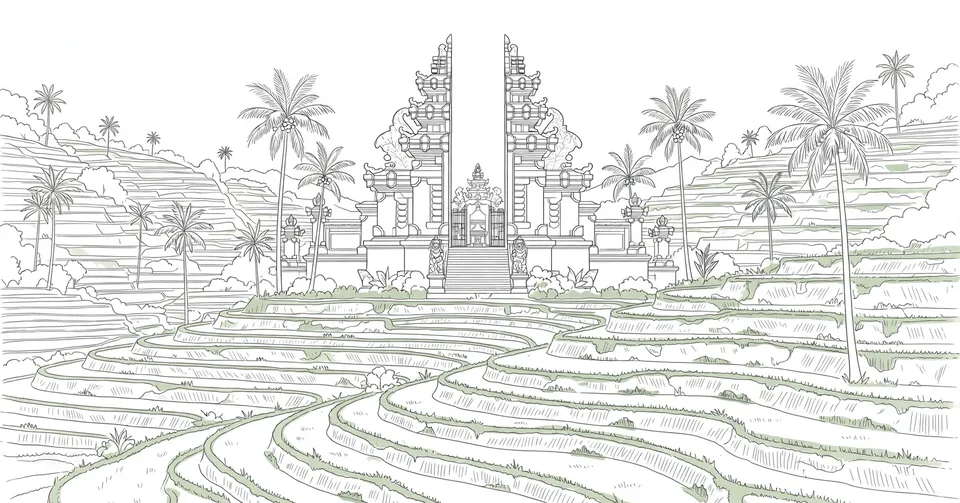
Ubud sits about 200 metres above sea level in the Gianyar regency of central Bali, roughly 35 kilometres north of Ngurah Rai International Airport. The drive takes 60 to 90 minutes depending on traffic, and the change is obvious long before arrival. The flat coastal roads give way to jungle, river ravines and rice terraces, and the air turns a few degrees cooler. There is no beach in Ubud, no surf and almost no nightlife. What there is instead is the densest concentration of temples, galleries, craft villages and rice fields anywhere on the island, and a town centre that empties out by 10 pm. For many travellers that sounds like a drawback. For the people who keep coming back, it is the whole point.
Ubud is not a beach town, and that is the point
The first thing to understand about Ubud is what it is not. It is not a resort town in the usual sense, and it never tried to be one. The town grew up as a royal centre and then as an artists' colony, not as a holiday strip. In the 1930s, the German painter Walter Spies settled here and helped turn Ubud into a meeting place for Balinese and foreign artists. The Dutch painter Rudolf Bonnet followed, and the two of them, together with the Ubud royal family, built the art scene that still defines the town. The Ubud of today, with its galleries, dance performances and craft shops, is a direct descendant of that colony.
The name itself hints at the town's character. Ubud is said to come from the Balinese word ubad, meaning medicine, because the area was once known for its healing herbs and plants. Whether or not the etymology is exact, the association fits. People still come to Ubud to feel better, only now the medicine is yoga classes, rice field walks, temple ceremonies and long slow meals. The town has become the centre of Bali's wellness scene almost by accident, because the setting was already doing the work.
That is also why Ubud makes a poor base for a beach holiday and an excellent base for almost everything else. The nearest beach is about 45 minutes away by car, so anyone who wants to swim every morning should stay on the coast. But anyone who wants to understand Bali, its religion, its art, its food and its farming, will learn more in three days in Ubud than in a week in a beach resort. The island's most famous remote workers figured this out years ago, and Ubud became one of the places where Bali turned into the world's remote work capital, with cafes full of laptops between the rice fields.
The forest in the middle of town
The most famous sight in Ubud is also the strangest, because it sits right in the middle of town. The Sacred Monkey Forest Sanctuary, known locally as Mandala Suci Wenara Wana, is a 12.5 hectare nature reserve on Monkey Forest Road, about ten minutes' walk from the Royal Palace. Inside it live around 1,200 long-tailed macaques, moving freely through banyan trees and moss-covered stone, and three 14th-century Hindu temples that are still in daily use.
The monkeys are the reason most people come, and they are also the reason to arrive early. By 10 am the forest is crowded, and the macaques are at their boldest, grabbing anything dangling, including phones, sunglasses and water bottles. The staff advise visitors to keep everything zipped away and to avoid eye contact with the larger males, which the monkeys read as a challenge. Entry costs around 80,000 rupiah for adults, and the sanctuary opens at 9 am. It is worth the price for the temples alone. Pura Dalem Agung, the main temple, stands in a clearing of enormous banyan roots, and the atmosphere is unlike anywhere else in Bali, half jungle and half cathedral.
There is a temptation to treat the Monkey Forest as a zoo. It is not one. The forest is a sacred site, and the monkeys are considered the guardians of the temples, not exhibits. The Balinese staff feed them, and the animals are protected rather than tamed. Visitors who respect that, keep their distance and watch quietly, get a much better experience than those who wave food around for a photograph. My own view is simple: the forest rewards patience. Sit on a stone wall for twenty minutes and the place shows you things that the quick walk-through misses, like a mother macaque grooming her baby in the shade of a temple wall while the tour groups stream past.
The terraces that made Ubud famous
If the Monkey Forest is Ubud at its wildest, the rice terraces are Ubud at its most photographed. The Tegallalang rice terraces lie 8 to 9 kilometres north of the town centre, a twenty minute drive, and they are the single most reproduced landscape in Bali. The paddies fall down a steep valley in emerald steps, and at sunrise, before the heat and the crowds arrive, the place earns every photograph taken of it.
The terraces are part of something older and more interesting than a viewpoint. They are watered by the subak system, the centuries-old cooperative irrigation network that Balinese farmers have used to share water fairly between fields. The subak landscape was inscribed by UNESCO as a World Heritage Cultural Landscape in 2012, and Tegallalang is one of its five primary sites. That matters, because it means the terraces are not a theme park. They are working farms, and the farmers who tend them were there long before the swings and the cafes arrived.
That is the honest warning about Tegallalang. The main viewpoint is now lined with cafes, entrance fees and jungle swings that charge extra, and by midday it feels commercial. The way around it is to arrive at sunrise, walk down into the valley instead of staying at the top, and then keep going. The quieter terraces around the village of Sebatu, a little further north, see a fraction of the visitors, and the Jatiluwih terraces, about ninety minutes west of Ubud, are far larger and quieter still, a half day trip rather than a quick stop. Ubud rewards the traveller who goes one valley further than the crowd, and the rice fields are where that rule pays off most.
Temples, palaces and the art colony
Back in the town centre, the three sights that fit in a single slow walk are the Ubud Royal Palace, the Saraswati Temple and the art market opposite the palace. The palace, Puri Saren Agung, was built in the 16th century as the home of the Sukawati royal line, and descendants of the family still live in the inner courtyard. The outer courtyard hosts nightly traditional dance performances, Legong and Kecak among them, starting at 7:30 pm, with tickets sold at the gate for around 100,000 rupiah. The setting does half the work: carved stone demons, flame torches and gamelan music under open sky.
A two minute walk away stands Pura Taman Saraswati, the lotus temple, where a pond of pink lotus flowers sits in front of an ornate carved facade. It is the most photographed temple in Ubud and also one of the calmest, especially in the early morning before the tour groups arrive. The temple honours Saraswati, the goddess of knowledge and art, which makes it a fitting symbol for the town. Ubud has always been a place where art was treated as a sacred activity, not a souvenir trade, and the temple says so without a word.
The art itself is everywhere, in the galleries along Jalan Raya Ubud and in the craft villages that ring the town. Mas is known for woodcarving, Celuk for silver and gold, and Batuan for painting, and each village has practised its craft for generations. A visit to one of these villages is a better souvenir hunt than the central market, because the work is made where it is sold, and the makers will usually show you how it is done. The island's great stone temples are a short drive north too, and Borobudur, the world's largest Buddhist temple, sits on a different island entirely, but the same impulse built both places: stone, patience and faith, arranged to last centuries.
What to eat in Ubud
Ubud eats well, and it eats differently from the coast. The warungs here serve the food of the Balinese interior: nasi campur, a plate of rice with small portions of chicken, vegetables, egg and sambal, for around 25,000 rupiah; babi guling, roast suckling pig, at the specialist warungs that sell out by early afternoon; and lawar, the minced meat and coconut salad that is a ceremonial dish as much as a meal. The town also has some of the best vegetarian and vegan food in Southeast Asia, a legacy of the yoga crowd, and the cafes along Monkey Forest Road and in Penestanan village serve everything from smoothie bowls to wood-fired pizza.
The honest advice is to eat where the locals eat. The warung with the plastic chairs and the handwritten menu will usually serve better food than the restaurant with the infinity pool, and at a third of the price. The most famous dish in the country is the fried rice that every visitor should try once, and nasi goreng, Indonesia's fried rice the world loves, tastes better in Ubud than in most places, because the rice here comes from the fields you can see from the table. Drink the local coffee, eat the tropical fruit while it is in season, and save room for the night market, which sets up near the palace in the evenings and sells satay, corn and sweet snacks for a few thousand rupiah each.
A first day in Ubud
| Time | What to do | Why it works |
|---|---|---|
| 06:30 | Campuhan Ridge Walk at sunrise | Cool air, empty path, valley views |
| 08:00 | Breakfast at a warung in Penestanan | Rice field views, local prices |
| 09:00 | Sacred Monkey Forest Sanctuary | Arrive at opening, before the crowds |
| 11:30 | Ubud Palace and Saraswati Temple | Short walk, shaded courtyards |
| 13:00 | Lunch and a slow afternoon | Rest, gallery browsing, a massage |
| 16:00 | Tegallalang rice terraces | Softer light, fewer day trippers |
| 19:30 | Dance performance at the palace | Legong or Kecak under torchlight |
The table is deliberately slow. Ubud punishes the traveller who tries to fit ten sights into one day, because the heat, the traffic and the narrow roads all conspire against it. The town's best moments are the unplanned ones: a ceremony glimpsed through a temple gate, a farmer inviting you to look at his field, a gamelan rehearsal drifting over a wall. Leave gaps in the schedule on purpose. They are where Ubud actually happens.
When to go and how long to stay
The dry season, from April to October, is the best time to visit Ubud. The skies are blue, the humidity is lower and the rice terraces are at their greenest just after the rains. The wet season, from November to March, brings short heavy showers, usually in the afternoon, and the town is quieter and cheaper. Either season works. The worst time is the peak of the Christmas and New Year holidays, when the town is at its most crowded and the traffic on Jalan Raya Ubud barely moves.
Three days is the right amount of time for a first visit. One day for the town centre, the Monkey Forest and the palace. One day for the terraces and the temples to the north, including Tirta Empul, the holy spring temple where Balinese Hindus perform purification rituals, and Goa Gajah, the elephant cave a short drive east. One day for something slower: a cooking class, a cycling tour through the villages, or the waterfalls south of town, Tegenungan being the closest at about 15 kilometres. Stay longer and Ubud starts to feel like a place to live rather than a place to visit, which is exactly why so many people never leave on schedule. Practical details change often, so check a current guide before you go, like the Ubud travel guide at MapSorted or the Ubud guide at My Best Places to Visit, which both keep their prices and hours updated.
Ubud does not try to impress you quickly, and that is its strength. The beach towns of Bali compete to be louder, newer and more photographed. Ubud competes on nothing at all. It offers a valley, a forest full of monkeys, terraces that farmers have tended for centuries, and a town that goes quiet by ten at night. Travellers who need constant stimulation will be bored by the second day. Travellers who are ready to slow down will find that the place gives back more than it takes, and that is a rare thing in a destination this famous. Go for the terraces, stay for the quiet, and leave a little slower than you arrived.
More in Food & Travel
- Durian, the King of Fruits That Divides Southeast Asia
- Banda Islands and the Nutmeg That Changed the World
- Martabak and the Pancake Indonesia Eats Two Ways
- Indonesian Coffee and the Islands Behind Every Cup
- Mount Rinjani, the Volcano Trek That Tests Every Hiker
- Yogyakarta and the City Where Java Keeps Its Soul
Latest posts
- Tanzaku Carries Japan's Wishes on a Strip of Paper
- The Ainu People, Japan's Indigenous North
- Koi-Koi Is the Card Game Where Knowing When to Stop Wins
- Reog Ponorogo and the Giant Lion Mask That Dancers Carry With Their Teeth
- Doraemon, the Blue Robot Cat Japan Still Cannot Live Without
- Shirakawa-go, the Village of Praying Hands
- Hanafuda Turns Twelve Months of Flowers Into a Card Game
- Nintendo, the Playing Card Maker That Became a Gaming Giant
- Tana Toraja and the Funerals That Last for Days
- Tempeh and the Fermented Bean Cake Indonesia Gave the World
- Gado-Gado, the Peanut Sauce Salad That Feeds All of Indonesia
- The Washlet Made the Japanese Bathroom the Warmest Room in the House
- Bakso and the Meatball Soup Indonesia Eats Everywhere
- Kecak Dance and the Hundred Voices That Tell the Ramayana
- Sapporo Snow Festival and the Ice City That Rises Every February