Reog Ponorogo and the Giant Lion Mask That Dancers Carry With Their Teeth
· 11 min read
Reog Ponorogo is East Java's spectacular dance built around a lion mask up to 2.5 metres wide that one dancer carries with his teeth. Here is the legend, the characters, and why UNESCO put it on its urgent safeguarding list in 2024.
Picture a dancer walking into a village square carrying a lion's head that is wider than he is tall. The mask is about 2.5 metres across, framed by a fan of real peacock feathers, and it weighs 30 kilograms or more. He is not holding it with his hands. He is holding it with his teeth.
That is the first thing anyone remembers about Reog Ponorogo, the traditional dance of Ponorogo in East Java. It is loud, strange, funny, and physically absurd, and it has been performed at weddings, village cleansings, and festivals for centuries. In December 2024, UNESCO added Reog Ponorogo to its List of Intangible Cultural Heritage in Need of Urgent Safeguarding, a recognition that the dance is both extraordinary and fragile.
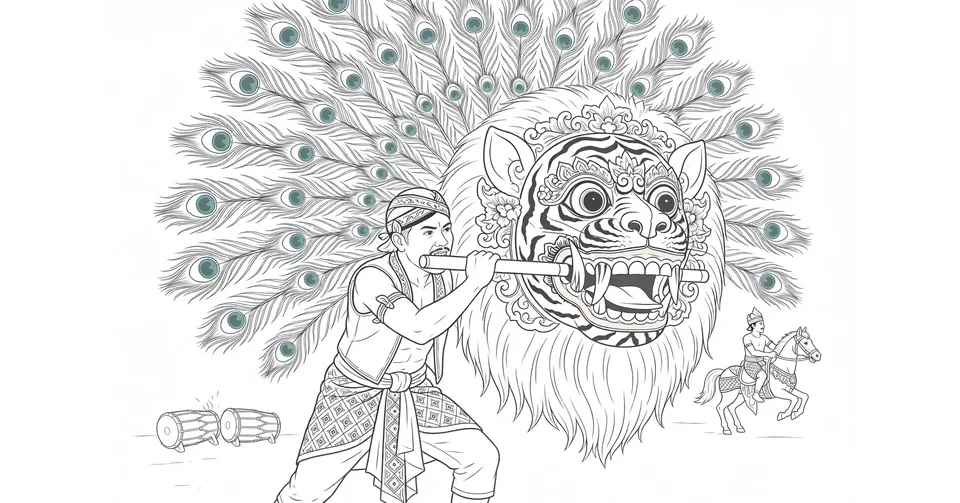
The first time you watch Reog Ponorogo, the mask seems impossible. It sways, it dips, it seems to roar at the crowd, and all the while the dancer underneath is biting down on a wooden bar, his neck and jaw doing the work of a crane. Then the drums pick up, the horse riders gallop in circles, and a red-masked clown tumbles across the ground. It is a street party, a history lesson, and a strongman act at the same time. This is the story behind it, and why it matters that it survives.
The Mask That Weighs More Than a Child
The heart of Reog Ponorogo is the mask called the Dadak Merak, worn by the lion figure known as Singo Barong. The mask is built around a tiger or lion head, traditionally made with a real tiger or leopard skin, topped with a huge fan of peacock feathers that spreads out like a peacock's tail. The whole thing measures around 2.5 metres wide, according to descriptions of the dance. Accounts of its weight vary, from about 30 kilograms to as much as 50 kilograms, which is roughly the weight of a ten-year-old child.
The dancer who wears it is called a warok. He carries the mask by biting a wooden bar called the cokotan, which is fixed inside the mask, and he steers it with his teeth, neck, and shoulders. His hands are free, which lets him dance, gesture, and shake the great feathered head from side to side. It takes years of training to build the strength and the technique, and the warok is traditionally a figure of great respect in Ponorogo, a strong man, a teacher, and a guardian of the tradition.
The peacock feathers are not decoration for its own sake. In the story the dance tells, the peacock sits on the lion's head as a symbol of beauty and pride, and the feathers shimmer above the crowd long before the mask itself comes into view. When the warok shakes his head, the feathers ripple like water. It is the single most recognizable image in East Javanese performance, and it is also the reason the dance is so hard to keep alive. A mask like this is expensive to make, heavy to carry, and impossible to perform without a trained warok.
Reog Ponorogo is often compared with other Indonesian performance arts, and the comparison is fair. Like wayang, it tells a royal story through stylized characters. Like the Kecak dance of Bali, it turns a whole crowd of performers into a single pulsing spectacle. But no other Indonesian dance asks one man to carry a lion with his teeth, and that is why visitors remember Reog Ponorogo long after the drums stop.
A King, a Princess, and a Lion
Every performance of Reog Ponorogo tells the story of King Kelono Sewandono of the Bantarangin kingdom and his quest to marry Princess Songgo Langit of Kediri. The princess set him a condition: he had to stage a grand and spectacular performance to win her hand. So the king created a dance, and the lion mask was its centrepiece.
The story is told in movement rather than words. The king appears in his finery, the princess is represented by the beauty of the peacock, and the lion stands for power and courage. The dance is not a literal retelling with dialogue. It is a parade of characters who enter, show off, clash, and make the crowd laugh, while the gamelan drives the whole thing forward. The plot matters less than the feeling it creates, which is exactly how a village performance should work.
The legend gives the dance its characters, but the people of Ponorogo give it its meaning. Reog Ponorogo is performed to mark the moments that matter to a community: weddings, circumcisions, village cleansing ceremonies, disaster aversion rituals, public festivities, and the welcoming of honoured guests. It is not a museum piece performed only for tourists. It belongs to the calendar of village life, and that is the first thing UNESCO noted when it described the art form.
The Cast Around the Lion
The Singo Barong is the star, but Reog Ponorogo is an ensemble. Around the lion, a whole cast of characters enters the square, each with a role the crowd knows by heart.
| Character | Role in the dance |
|---|---|
| Singo Barong | The giant lion mask with the peacock fan, carried by the warok |
| Warok | The strong dancer who carries the mask with his teeth and leads the performance |
| Klono Sewandono | The king of Bantarangin, in ornate royal dress, who seeks the princess |
| Jathil | Horse riders who gallop, spin, and dance around the lion |
| Bujang Ganong | The red-masked clown, young, agile, and funny, who tumbles and jokes with the crowd |
The jathil, the horse riders, were traditionally played by young women, though today men often take the role too. They ride woven hobby horses and move in fast, circling patterns that contrast with the slow, heavy sway of the lion. Bujang Ganong is the crowd's favourite, a comic figure who somersaults, teases the other dancers, and breaks the tension whenever the performance gets too grand. The king, Klono Sewandono, arrives with the confidence of a man who believes the lion will win him a princess.
The music is a gamelan ensemble with drums, gongs, and wind instruments, and it sets the pace for everything. When the drums are slow, the lion prowls. When they quicken, the horse riders spin and the clown flips. The musicians watch the dancers as closely as the crowd does, because in Reog Ponorogo the music and the movement answer each other.
Watching the cast work together explains why the dance is so hard to replace with a recording. The lion needs the horses to make its slow power visible, and the clown needs the king to make his jokes land. It is a small theatre company in which every role exists to make the others shine, and the whole square becomes the stage.
Why UNESCO Put Reog Ponorogo on Its Urgent List
Indonesia recognised Reog Ponorogo as a National Intangible Cultural Heritage in 2013. The international step came later. In January 2024, the Indonesian government submitted the dossier for Reog Ponorogo to UNESCO, and on 3 December 2024, during the 19th session of the Intergovernmental Committee in Asuncion, Paraguay, UNESCO inscribed Reog Ponorogo performing art on the List of Intangible Cultural Heritage in Need of Urgent Safeguarding. It became the 14th Indonesian element on UNESCO's intangible heritage lists, as reported when the inscription was announced.
The word "urgent" is the important part. UNESCO does not put a tradition on this list because it is famous. It puts it there because the tradition is at risk. The official listing notes that the safeguarding process has not progressed as expected, in part because it is increasingly difficult to find Reog masters willing and able to teach the next generation. The mask is heavy, the training is long, and young people in Ponorogo, like young people everywhere, have other ways to spend their time.
This is a pattern across Indonesia's heritage. Batik was inscribed by UNESCO in 2009, gamelan followed in 2021, and both now benefit from schools, festivals, and commercial demand that keep their makers employed. Reog Ponorogo has the festival and the fame, but the chain of teaching is thinner. A warok cannot be trained in a weekend, and a Dadak Merak mask cannot be bought off a shelf. The UNESCO listing is meant to bring funding, training programmes, and attention to exactly that gap.
There is also a quiet pride in the listing that matters to people in Ponorogo. For years, the dance was known mostly inside East Java. Now it sits on a world list alongside traditions from every continent, and the town that created it is on the map for a reason that has nothing to do with industry or politics. That kind of recognition changes how a community sees its own art, and it gives parents a reason to let their children learn it.
My own view is that the UNESCO label is useful but not sufficient. Lists do not train warok, and certificates do not pay for peacock feathers. What keeps Reog Ponorogo alive is the same thing that has always kept it alive: a village that wants it at its weddings, a festival that fills the town square, and a young dancer who decides that carrying a lion with his teeth is a worthy way to spend his years. The listing helps, but the dancing does the work.
Where to See Reog Ponorogo
The best place to see Reog Ponorogo is Ponorogo itself, a regency town in East Java roughly 200 kilometres southwest of Surabaya. The town's biggest stage is the Festival Nasional Reog Ponorogo, held each year around Grebeg Suro, the celebration of the Javanese New Year month of Suro. The 31st edition of the festival ran from 11 to 14 June 2026 at the Paseban pavilion, with nightly performances, and the festival draws troupes from across the region.
Outside the festival, Reog Ponorogo appears wherever the community gathers. If you are travelling in East Java and hear drums from a village square, it is worth following the sound. Performances at weddings and village ceremonies are often open to onlookers, and the dancers are used to an audience that includes strangers. The etiquette is simple: watch from the edge of the square, do not step into the performance space, and ask before photographing a dancer up close while he is wearing the mask.
Ponorogo is not on the usual tourist trail, which is part of its charm. It is a working town, not a resort, and the dance is part of daily life there rather than a show put on for visitors. Travellers who make the trip usually combine it with the wider East Java circuit, and the reward is a performance that feels unrehearsed in the best sense, a tradition performed because the town wants it, not because a ticket was sold.
If you cannot get to Ponorogo, recordings of the festival are widely shared online, and they give a fair sense of the scale. But a recording cannot show you the weight of the mask. The moment that stays with people is not the feathers or the music. It is the instant the warok lifts the lion with his teeth and the whole square goes quiet for a second, because everyone watching understands exactly how much strength that takes.
A Dance That Refuses to Sit Down
Reog Ponorogo is easy to describe and hard to forget. A lion mask wider than a man is tall, a fan of peacock feathers, a dancer who carries it all with his teeth, and a story about a king who built a performance to win a princess. It is spectacular without being polished, and that roughness is the point. The dance was made for village squares, not concert halls, and it still belongs there.
The UNESCO listing in 2024 gave Reog Ponorogo a new kind of protection, but the dance does not need pity. It needs audiences, students, and masks. As long as a young warok in Ponorogo is willing to bite down on the wooden bar and lift the lion, the tradition will keep walking into the square on its own feet. The rest of us just need to show up and watch.
More in Culture & Society
- Hanafuda Turns Twelve Months of Flowers Into a Card Game
- Tana Toraja and the Funerals That Last for Days
- Rangda Is the Witch Queen Bali Never Lets Win
- The Japanese School Uniform and the Story Behind the Sailor Suit
- Aikido and the Martial Art That Refuses to Fight Back
- Barong Is the Lion Bali Calls Out When the Village Needs Protection
Latest posts
- Doraemon, the Blue Robot Cat Japan Still Cannot Live Without
- Shirakawa-go, the Village of Praying Hands
- Nintendo, the Playing Card Maker That Became a Gaming Giant
- Tempeh and the Fermented Bean Cake Indonesia Gave the World
- Gado-Gado, the Peanut Sauce Salad That Feeds All of Indonesia
- The Washlet Made the Japanese Bathroom the Warmest Room in the House
- Bakso and the Meatball Soup Indonesia Eats Everywhere
- Kecak Dance and the Hundred Voices That Tell the Ramayana
- Sapporo Snow Festival and the Ice City That Rises Every February
- Satay and the Smoke That Carries Indonesia to the World
- Tumpeng Is the Rice Cone Java Serves When It Wants to Say Thanks
- Onsen Etiquette and the Unwritten Rules of Japan's Hot Springs
- Japan's Winter Illuminations Turn Dark Nights Into Light
- Setsubun, the Bean Throwing Festival That Chases Winter Away
- Karate, the Empty Hand That Became Japan's Most Exported Martial Art