Tana Toraja and the Funerals That Last for Days
· 12 min read
Tana Toraja in South Sulawesi treats death as a journey, not an ending, with boat-shaped houses, cliff graves and funerals that can last for days.
In the highlands of South Sulawesi, about 328 kilometres north of Makassar, there is a place where the dead are not rushed out of the house. In Tana Toraja, a person who has died may stay at home for months, sometimes years, while the family prepares a farewell worthy of them. They are not called dead yet. They are called the sick one, and they are still fed, still spoken to, still part of the household. When the funeral finally comes, it is not a quiet afternoon. It is a festival that can last for days, with hundreds of guests, chanting, dancing, feasts and buffalo.
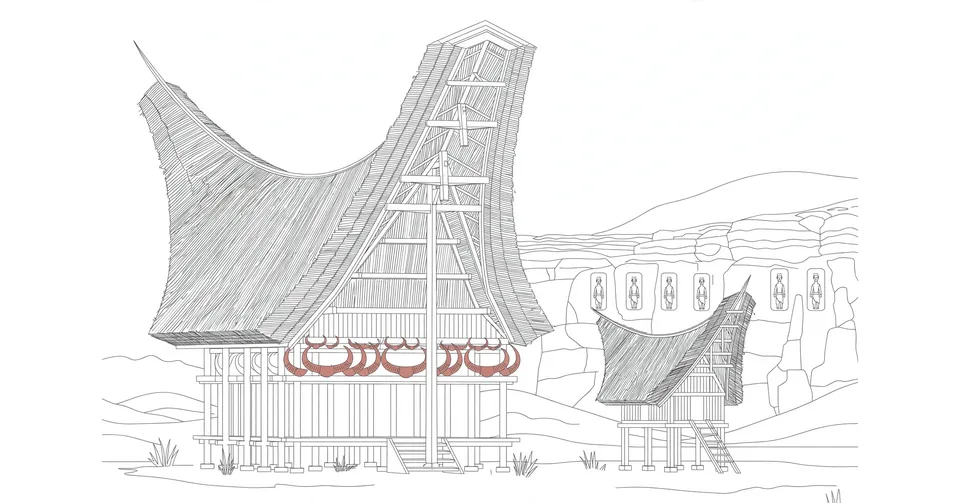
Tana Toraja means the land of the Toraja people, and it is one of the most distinctive cultures in Indonesia. The region sits in folded green mountains, dotted with rice terraces and villages of tongkonan, the ancestral houses with steep saddle roofs that look like the hulls of boats. The Toraja believe their ancestors arrived from the north by boat, and after landing they turned the boats into shelter. That story is still visible in every village, where each tongkonan faces a smaller twin, the alang rice barn, across the yard.
What makes Tana Toraja famous, though, is not the architecture alone. It is the way the Toraja people treat death. For them, a funeral is the most important event in a person's life, more important than a wedding or the building of a house. The ceremony is called Rambu Solo, and understanding it means understanding how Tana Toraja sees the world.
The houses that look like boats
A tongkonan is more than a house. It is the centre of a family, the place where ancestors are remembered and where the living gather. The houses are raised on wooden pylons and decorated with carvings painted in red, black, yellow and white, the four colours of Toraja art. The motifs show buffalo, roosters, rice grains and human figures, each with a meaning tied to the family's history and standing.
The most famous village to see them is Ke'te Kesu, a few kilometres southeast of Rantepao, the main town of Tana Toraja. Its rows of tongkonan and alang are centuries old, and one of the houses is said to be around 400 years old. The village is a cultural preservation site, and behind the houses a path climbs a small limestone hill to a burial ground where old wooden coffins hang from the cliff on beams or rest stacked on ledges. Some have split with age, and bones are visible inside. Newer family vaults are cut into the rock lower down and are still in use, because this is an active burial site, not a museum.
Buffalo horns hang in rows on the front of a tongkonan, and they are a public record. Each pair of horns stands for a buffalo sacrificed at a family funeral, so a house fronted by many horns belongs to a family that has honoured its dead generously. In Tana Toraja, status is measured less by what you own in life than by how well you are sent off in death.
To Makula, the sick one who is not yet dead
The heart of Toraja belief is Aluk Todolo, the Way of the Ancestors. It teaches that death is not a sudden end but a gradual journey, and that the soul needs help, ceremony and community to reach Puya, the afterlife where the dead become small gods. Christianity has tempered some of the old beliefs over the past century, and most Toraja people today are Christian, but the funeral customs have survived, adapted and still followed with pride.
When a person dies in Tana Toraja, the family does not say the person is dead. They say the person is To Makula, the sick one. The body is kept in the family home, sometimes in the tongkonan itself, and cared for as if the person were still ill. Family members bring food, drink and cigarettes every day, a practice described in detail by travellers who have spent time with Toraja families. The body may be preserved with formalin and kept for weeks, months or even years, while the family saves money, gathers relatives from far away and waits for the dry season, when travel is easier and the ceremonies can run outdoors.
Only when the Rambu Solo ceremony begins is the person formally considered To Mate, the dead one. The long waiting period is not neglect. It is respect. A rushed funeral would be a poor farewell, and in Tana Toraja a poor farewell is a failure of the whole family.
Rambu Solo, the funeral that takes days
Rambu Solo, which can be translated as smoke descending, is not a single event but a sequence that can stretch over several days. Families usually hold it in the dry season, from June to September, after the harvest, when guests can travel and the ceremonial field is dry. There is no fixed calendar. A ceremony happens when a death, a family's readiness and the season line up, and a large one can draw thousands of people.
The preparations begin with a family council, where both sides of the family agree on the scale of the ceremony, the number of buffalo and pigs to be sacrificed, and the place, usually the family tongkonan. Then the village builds the venue together. Temporary bamboo huts called lantang rise around the ceremonial ground, the rante, to shelter guests, and carpenters build a raised platform called the lakkian, where the coffin will rest, higher than all the other structures as a mark of respect.
One of the early stages is Ma'pasurruk, a parade in which buffalo are walked three times around the tongkonan, showing that the family is ready, financially and emotionally, to proceed. Another is the raising of a menhir stone, pulled by hundreds of men to the rante as a monument to the family's fulfilment of the funeral rites. The main procession, Ma'palao, carries the coffin from the rice barn to the rante on a bamboo litter shaped like a miniature tongkonan, while the crowd chants and drums sound. On the day of guests, relatives, nobles and villagers arrive in formal groups to pay their respects, and the Ma'badong, a long mournful chant sung in a circle, accompanies the rites through the night.
The ceremony is loud, crowded and joyful in a way that surprises first-time visitors. People eat, talk, laugh and renew ties with relatives they have not seen in years. Grief is there, but so is celebration, because the funeral is also a reunion, and a successful Rambu Solo proves that the family and the village still hold together.
The buffalo and the price of a good goodbye
No part of Rambu Solo matters more than the buffalo. In Toraja belief, the buffalo carries the soul to Puya, and the more buffalo sacrificed, the faster and safer the journey. A modest funeral might involve a handful of animals. A grand one for a person of high standing can involve dozens, sometimes more than a hundred, along with many pigs for the feasts.
The animals are not cheap. An ordinary buffalo can cost tens of millions of rupiah, and a rare piebald buffalo, the tedong bonga with its black and white patches, can fetch around 50,000 dollars. Families save for years, and relatives contribute animals as a form of support and social obligation. The horns of every sacrificed buffalo are later nailed to the front of the family tongkonan, where they stay for generations as proof of the family's devotion.
This is also why the funeral is so expensive that it shapes Toraja life. A family may spend years preparing, and the ceremony itself can cost more than a house. Outsiders sometimes ask whether the expense is wasteful, but that question misses the point. In Tana Toraja, a funeral is the single largest investment a family makes, and it is an investment in memory, standing and the soul of the person they loved. The cost is the point. It shows the community how much the dead person mattered.
Cliff graves and the wooden guardians
After the ceremony, the body is not buried in the ground. Toraja graves are carved into cliffs or placed in caves, high above the valley floor, closer to the heavens. The higher the chamber, the higher the status of the person inside.
At Londa, one of the best known burial sites, the coffins of ordinary people rest in caves and crevices at the foot of the hill, while the remains of people of higher rank lie in chambers carved from the limestone cliff, some as high as 50 metres from the ground. Wooden effigies called tau-tau stand guard beside the chambers. Each tau-tau is carved to resemble the person buried within, dressed in their clothes, and relatives wash and replace those clothes from time to time, just as they would care for a living elder.
Lemo, another cliff burial site, is a sheer rock face lined with rows of tau-tau in galleries, with a compound of four granaries and one tongkonan to the north. The sight is startling at first, a wall of small wooden figures staring out over the valley, but it is also deeply moving once you understand what it means. In Tana Toraja, the dead are not hidden away. They stay visible, watching over the villages they came from.
The whole region has been recognised for this heritage. Tana Toraja sits on UNESCO's Tentative List as the Tana Toraja Traditional Settlement, a nomination of 10 sites that includes houses, granaries, burial sites, ceremonial grounds with menhirs, rice fields, bamboo forest and buffalo pasture. It is not yet a World Heritage Site, but the listing itself says something about how rare this culture is. Few places on earth still practise funeral traditions on this scale, in the open, as a living part of daily life.
Visiting Tana Toraja as a guest
For travellers, Tana Toraja is not a place to rush. Rantepao is the base, and the main sites sit within a short drive of it. Ke'te Kesu, Lemo and Londa can be combined into a single day, and a good local guide is worth every rupiah, because the meaning of each carving, each horn and each cliff chamber is invisible without someone to explain it.
| Place | What to see | Getting there |
|---|---|---|
| Ke'te Kesu | Centuries-old tongkonan, alang barns, hanging coffins | A few kilometres southeast of Rantepao, 10 to 15 minutes by car |
| Lemo | Cliff face lined with tau-tau effigies | South of Rantepao on the Makale road |
| Londa | Burial caves, cliff chambers, tau-tau balcony | A short drive from Rantepao, lamp guide at the entrance |
| Rantepao | Markets, tongkonan hotels, funeral season base | 328 kilometres north of Makassar by road |
The best time to visit is the dry season, from June to September, when Rambu Solo ceremonies are most likely to be happening. There is no published schedule, and ceremonies depend on deaths and family readiness, so visitors cannot plan a funeral the way they plan a festival. The usual way in is through a guide or a hotel in Rantepao, who will know whether a ceremony is taking place and whether guests are welcome. Visitors are welcome at many funerals, but they are guests at a real family's farewell, not an audience at a show. Bring a small gift, dress modestly in dark colours, ask before taking photographs, and follow the guide's lead on where to sit and when to move.
I think that is the right way to approach Tana Toraja in general. It is easy to treat the funerals as a spectacle, and the scale of them invites that mistake, but the people holding them are grieving, celebrating and spending their savings on someone they loved. The ceremony is open to outsiders because Toraja culture is generous, not because it is a performance. Go as a guest, and the place gives you something no museum can, a living culture that still believes the dead deserve the best farewell a family can give.
Tana Toraja rewards slow travel. The mountains are beautiful, the food is rich, and the coffee is strong, but the thing that stays with you is the attitude toward death itself. In most of the world, death is hurried, hidden and feared. In Tana Toraja, it is faced slowly, together, in the open, with music, feasting and a whole village doing the work. That is a different way of loving the dead, and it is worth the long road north from Makassar to see it.
Like the shadow theatre of wayang, which also carries old Javanese beliefs into the present, the funeral rites of Tana Toraja show how Indonesian culture keeps its ancestors close. The same is true of the Kecak dance in Bali, where a story is told by a hundred voices at once, and of Lake Toba, where a whole landscape still carries the memory of an ancient eruption. Indonesia is full of places where the past is not past at all, and Tana Toraja is one of the strongest examples. If you want to understand the country beyond its beaches, start with its highlands, and start with the funerals that last for days.
More in Culture & Society
- Rangda Is the Witch Queen Bali Never Lets Win
- The Japanese School Uniform and the Story Behind the Sailor Suit
- Aikido and the Martial Art That Refuses to Fight Back
- Barong Is the Lion Bali Calls Out When the Village Needs Protection
- Setsubun, the Bean Throwing Festival That Chases Winter Away
- Karate, the Empty Hand That Became Japan's Most Exported Martial Art
Latest posts
- Tempeh and the Fermented Bean Cake Indonesia Gave the World
- Gado-Gado, the Peanut Sauce Salad That Feeds All of Indonesia
- The Washlet Made the Japanese Bathroom the Warmest Room in the House
- Bakso and the Meatball Soup Indonesia Eats Everywhere
- Kecak Dance and the Hundred Voices That Tell the Ramayana
- Sapporo Snow Festival and the Ice City That Rises Every February
- Satay and the Smoke That Carries Indonesia to the World
- Tumpeng Is the Rice Cone Java Serves When It Wants to Say Thanks
- Onsen Etiquette and the Unwritten Rules of Japan's Hot Springs
- Japan's Winter Illuminations Turn Dark Nights Into Light
- Kemari Is the Ball Game Japan Played Without Trying to Win
- Chagama Is the Kettle That Never Leaves the Tea Room
- Judo, the Gentle Way Japan Gave the World
- Lake Toba and the Supervolcano That Made the World's Largest Volcanic Lake
- Raja Ampat and the Coral Kingdom at the Edge of Indonesia