Tempeh and the Fermented Bean Cake Indonesia Gave the World
· 11 min read
Tempeh is Indonesia's fermented soybean cake, born in Central Java centuries ago and now a global plant-based staple. Here is how it is made, why it is so nutritious, and how to cook it.
Tempeh is a firm cake of whole soybeans bound together by a white mold, and it comes from Indonesia. It is high in protein, rich in fiber, cheap to make, and it has been feeding ordinary Indonesian families for centuries, long before the rest of the world discovered plant-based eating.
What makes this cake special is that it is not a modern invention dressed up as tradition. It is the other way around. Indonesian cooks in Central Java worked out how to ferment soybeans hundreds of years ago, and the modern food world caught up only recently, when chefs and nutritionists started looking for protein that does not come from animals. Today you can buy it in supermarkets from Amsterdam to Sydney, but the best place to understand it is still a morning market in Java, where sellers stack fresh cakes wrapped in banana leaves and cut them to order.
What tempeh actually is
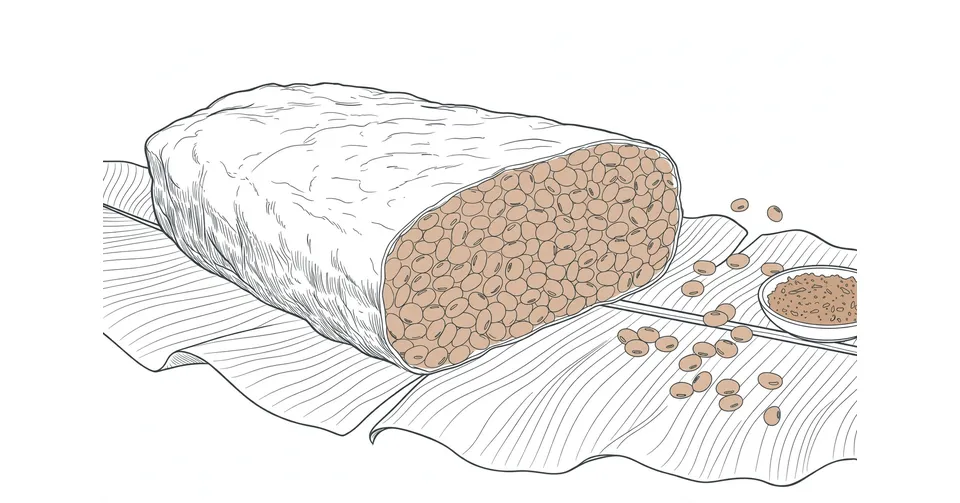
Tempeh, spelled tempe in Indonesian, is made by fermenting cooked soybeans with a mold called Rhizopus oligosporus. The mold grows a fine white network through the beans and binds them into a dense, sliceable cake. Unlike tofu, which is made from soy milk, it keeps the whole bean, so it has more fiber, more texture, and a nutty, earthy flavor that survives cooking.
A hundred grams of the cake carries roughly 19 to 21 grams of protein, about 7 to 8 grams of fiber, and around 190 to 200 calories. It also brings iron, magnesium, calcium, and B vitamins. Some cakes contain small amounts of vitamin B12, produced by bacteria that live alongside the mold during fermentation, though the amount varies and it is not a reliable sole source of the vitamin. The fermentation itself does useful work too. It breaks down phytic acid, a compound in raw soybeans that blocks mineral absorption, so the nutrients in the finished cake are easier for the body to use than the nutrients in plain cooked soybeans.
The texture is the first thing people notice. A fresh cake is firm and slightly springy, with the beans still visible under a thin white skin. Cut it open and it smells faintly mushroomy and clean. Cooked, it turns golden at the edges and stays chewy inside, which is why it works so well fried, grilled, crumbled into sauces, or sliced into sandwiches. It does not pretend to be meat. It is its own thing, and that is exactly why it lasts.
A happy accident in Central Java
Nobody knows exactly who made the first cake, and that is part of its charm. The most widely accepted story is that it was an accident. Javanese cooks, it is said, left partly cooked soybeans wrapped in hibiscus or banana leaves overnight in the tropical heat. The leaves carried the Rhizopus mold, the mold colonized the beans, and by morning the loose beans had become a solid cake that kept longer and tasted better than the beans alone. Once cooks understood what had happened, they learned to repeat it on purpose, saving a piece of the previous batch as a starter for the next.
The earliest written mention of it appears in the Serat Centhini, a Javanese literary work from the early nineteenth century that describes life at the court of Mataram. Historians believe the food itself is much older, possibly dating back to the 1600s or earlier, with its roots in the villages around present-day Klaten in Central Java. Soybeans had arrived in Indonesia centuries before that, carried by trade with southern China around the year 1000, and Javanese cooks adapted Chinese soy fermentation techniques into something distinctly their own.
It reached Europe surprisingly early. A German article about soy foods mentioned it in 1896, long before tofu or soy sauce became familiar in Western kitchens. But it stayed a curiosity for most of the twentieth century. The real boom came in the 1980s, when Indonesia's tempeh industry grew rapidly and vegetarian cooking began to spread in Europe and North America. Today Indonesia has more than a hundred thousand small tempeh producers, most of them family businesses, and the average Indonesian eats about 42 grams of it a day, according to a 2023 study cited by Merah Putih Bali. That is a remarkable number for a food that costs a fraction of a dollar per serving.
How tempeh is made
Making it is simple in principle and fussy in practice, which is why the best tempeh still comes from small producers who have done it thousands of times. The process starts with dry soybeans, soaked overnight, dehulled by hand or machine, and then boiled until they are partly cooked but still firm. The beans are drained, cooled to around 30 degrees Celsius, and mixed with a starter culture of Rhizopus spores.
Then comes the part that matters most: incubation. The inoculated beans are packed loosely into banana leaves or perforated plastic bags and left somewhere warm, around 30 to 32 degrees, for one to two days. In that time the mold grows through the beans and knits them into a cake. The temperature has to stay steady. Too cold and the mold stalls. Too hot and unwanted bacteria take over. Experienced makers can tell the cake is ready by smell and by touch, a clean mushroom scent and a firm, even bind.
Banana leaves are still the traditional wrapping, and they do more than look good. They let the beans breathe while keeping them moist, and they give the finished cake a faint green, herbal note. Modern producers often use perforated plastic instead, which is cheaper and more consistent, but many sellers in Javanese markets still prefer leaves, and buyers notice the difference. A cake wrapped in a leaf will keep for a day or two at room temperature, longer in the fridge, and it freezes well for months.
The same basic method works with other beans and grains, and producers now experiment with chickpeas, black beans, and even mixed grains. Purists will tell you that soy is the only true tempeh, and they have a point. Soybeans give the cake its protein and its classic flavor. But the variations show how flexible the technique is, and they have helped tempeh travel to kitchens that never grew soybeans at all.
Why the world fell for tempeh
It arrived in Western supermarkets at exactly the right moment. Plant-based eating stopped being a niche interest and became a mainstream habit, and shoppers started asking hard questions about protein. This fermented cake answered most of them at once. As ProVeg puts it, tempeh is exceptionally high in protein and fiber, with a balanced amino acid profile that makes it a strong meat alternative. It is a complete protein, meaning it contains all nine essential amino acids. It is high in fiber, which most plant proteins are not. It is minimally processed, a short list of ingredients instead of a laboratory formula. And it is cheap, which matters more than food writers sometimes admit.
The health research backs up the enthusiasm, with the usual caveats. A 2023 study found that eating 25 grams of tempeh a day for six weeks lowered cholesterol in people with high cholesterol. The fermentation produces bioactive peptides and isoflavones that show antioxidant and anti-inflammatory effects in laboratory studies. The fiber feeds gut bacteria, and the probiotics from fermentation support digestion. None of this makes tempeh a medicine, and no single food can carry a whole diet. But as one part of a varied diet, it is unusually strong value for money.
There is also a cultural reason for its success, and it is the one I like best. It does not ask you to give anything up or to pretend. It is not a fake burger or a laboratory steak. It is a centuries-old food from a real place, made by real people, and it tastes like itself. That honesty is rare in the plant-based aisle, where so many products are imitations of something else. It never imitates. It simply is.
Tempeh and tofu are not the same food
People outside Indonesia often lump this cake and tofu together, and the confusion is understandable. Both come from soybeans, both are plant proteins, and both are staples of Indonesian and East Asian cooking. But they are different foods made by different processes, and they behave differently in the kitchen.
Tofu is made from soy milk. The milk is heated, a coagulant is added, and the curds are pressed into blocks. It is smooth, mild, and soft, and it takes on the flavor of whatever it is cooked with. Tempeh is made from whole beans, fermented, and pressed into a cake by mold. It is firm, nutty, and earthy, and it brings its own flavor to a dish. Tofu is a blank canvas. Tempeh is a voice.
Nutritionally, it usually wins on protein and fiber per hundred grams, because the whole bean stays in the food. Tofu wins on versatility and on calcium, when it is set with calcium sulfate. Indonesians do not choose between them. A typical warung serves both, often on the same plate, and the two foods have coexisted for centuries without competing. If you like tofu, you will probably like this cake too, once you stop expecting it to taste like tofu.
How to cook tempeh
The most common mistake is under-seasoning it. The cake is mild on its own, so it needs salt, acid, or heat to wake up. The classic Indonesian way is tempe goreng, fried tempeh. Slice the cake thin, rub it with garlic, coriander, and salt, then fry it in hot oil until the edges are crisp and golden. Eat it hot with rice and sambal, and you will understand why Indonesians eat it every day.
It also loves marinades. Slice it, soak it for twenty minutes in soy sauce, lime juice, garlic, and a little palm sugar, then grill or pan-fry it. The marinade soaks into the porous cake in a way it never would with tofu, and the outside caramelizes while the inside stays tender. Crumbled cake makes a good filling for tacos or a rich base for a Bolognese-style sauce, and cubed tempeh holds its shape in curries and stir-fries where tofu would fall apart.
A few practical notes. A fresh cake should smell clean and mushroomy. If it smells strongly of ammonia, it is over-fermented and best thrown away, though a faint ammonia note on a very mature cake is normal and disappears with cooking. Black or grey spots on the surface are harmless, they are just mature mold spores, but the cake should be white through most of its body. Store it in the fridge and use it within a few days, or freeze it, where it keeps for months without losing much texture.
If you are visiting Indonesia, the best introduction is not a restaurant but a market stall. Buy a cake still warm from the maker, eat a piece fried on the spot, and then try it again at home in a dish you already know. Tempeh rewards that kind of slow, ordinary familiarity more than any grand first impression.
Where tempeh fits on the Indonesian table
It sits at the center of everyday Indonesian eating in a way that few foods do. It appears in gado-gado, the peanut sauce salad that turns vegetables into a meal. It shares the plate with bakso at street stalls, fried crisp beside the soup. It shows up in nasi goreng as a cheap, filling addition, and in satay stalls as a vegetarian skewer that holds its own next to the chicken. It is the food of warungs and home kitchens, not of fine dining, and that is precisely its power. It feeds people every day, without ceremony, for very little money.
That everyday quality is also what it exports best. It does not need a special occasion. It needs a hot pan, a little salt, and someone hungry. The rest of the world has spent the last decade learning what Indonesian families have known for centuries, that a humble fermented bean cake, made carefully and eaten simply, can be one of the most satisfying foods on earth.
I think it deserves its place alongside rendang and nasi goreng as one of Indonesia's great food exports, not because it is fancy but because it is honest. It is a food that grew out of a specific place and a specific way of life, and it carries that origin with it wherever it goes. Try it fried with sambal first, the way millions of Indonesians eat it every morning, and then make it your own. That is how a food becomes a habit, and how a habit becomes a tradition.
More in Food & Travel
- Gado-Gado, the Peanut Sauce Salad That Feeds All of Indonesia
- Bakso and the Meatball Soup Indonesia Eats Everywhere
- Sapporo Snow Festival and the Ice City That Rises Every February
- Satay and the Smoke That Carries Indonesia to the World
- Tumpeng Is the Rice Cone Java Serves When It Wants to Say Thanks
- Japan's Winter Illuminations Turn Dark Nights Into Light
Latest posts
- The Washlet Made the Japanese Bathroom the Warmest Room in the House
- Kecak Dance and the Hundred Voices That Tell the Ramayana
- Rangda Is the Witch Queen Bali Never Lets Win
- The Japanese School Uniform and the Story Behind the Sailor Suit
- Aikido and the Martial Art That Refuses to Fight Back
- Barong Is the Lion Bali Calls Out When the Village Needs Protection
- Onsen Etiquette and the Unwritten Rules of Japan's Hot Springs
- Setsubun, the Bean Throwing Festival That Chases Winter Away
- Karate, the Empty Hand That Became Japan's Most Exported Martial Art
- Kemari Is the Ball Game Japan Played Without Trying to Win
- Chagama Is the Kettle That Never Leaves the Tea Room
- Judo, the Gentle Way Japan Gave the World
- Lake Toba and the Supervolcano That Made the World's Largest Volcanic Lake
- Raja Ampat and the Coral Kingdom at the Edge of Indonesia
- Tokyo Skytree and How Japan Built the World's Tallest Tower