Banda Islands and the Nutmeg That Changed the World
· 11 min read
The Banda Islands were once the only place on Earth where nutmeg grew, and that small fact redrew maps, built an empire, and cost thousands of lives.
There is a place in eastern Indonesia where a single spice once mattered more than gold. The Banda Islands are ten small volcanic islands in the Banda Sea, about 140 kilometres south of Seram and roughly 2,000 kilometres east of Java, and for more than two centuries they were the only place on Earth where nutmeg grew.
That monopoly shaped the modern world in ways that still surprise me. A pound of nutmeg bought in the Banda Islands could sell in Europe for sixty times its price. Empires fought over it, thousands of people died for it, and one tiny island in the chain was once traded for Manhattan, the land that would become New York City.
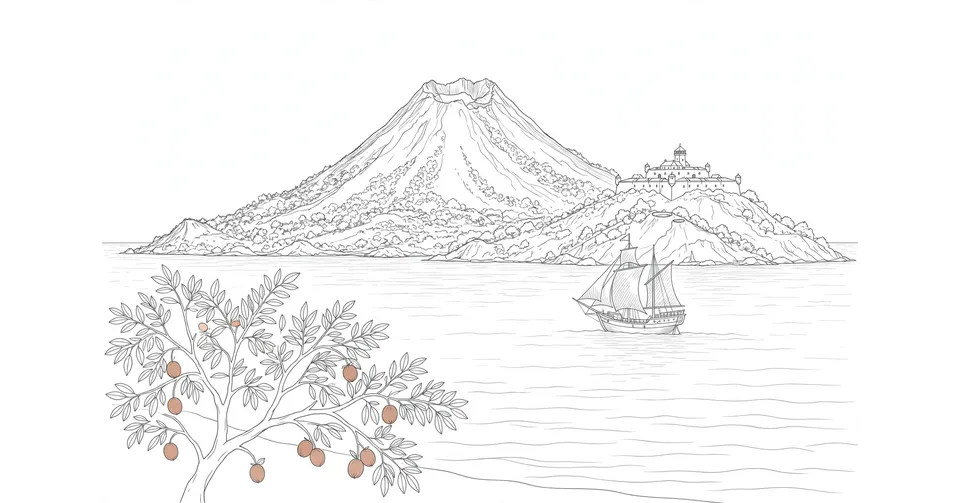
Today the Banda Islands are quiet. Fishing boats cross a calm harbour, nutmeg still dries on racks in the sun, and divers come for reefs that grew back over black lava. The islands are hard to reach and easy to love, and their story is one of the strangest in the history of food.
The spice the world wanted
Nutmeg comes from the fruit of the Myristica fragrans tree, and it gives two spices at once. The seed inside the fruit is nutmeg. The red lace that wraps the seed is mace. Both were prized in Europe, and both grew in only one place. Until the middle of the 1800s, the Banda Islands were the only source of nutmeg and mace in the world.
Europeans in the 1600s believed nutmeg could cure the plague, preserve meat, and flavour the food of the rich. It was carried in silver boxes, grated at the table, and sold by the pound at prices that look absurd today. The arithmetic was simple and brutal. A spice that grew on ten small islands, and nowhere else, was worth fighting for. Nutmeg is not the only Indonesian flavour the world fell for. Rendang, a slow cooked beef dish from West Sumatra, was voted the best food in the world, and it shares the same story of a local recipe travelling far beyond its home.
The Bandanese had traded nutmeg for centuries before any European arrived. Arab, Chinese, and Javanese merchants sailed to the Banda Islands and carried the spice across Asia. The islands were not an empty prize waiting to be found. They were a trading hub with their own leaders, the orang kaya, and their own rules. The full story of the spice and the war it caused is told well in this account of the nutmeg trade.
How the Dutch took the Banda Islands
The Portuguese were the first Europeans to reach the Banda Islands, when Antonio de Abreu arrived in 1511. They traded, they built a small presence, and they never managed to control the islands. The Dutch arrived in 1599 with a different plan. In 1602 they founded the Dutch East India Company, the VOC, with one clear goal. It wanted to control every nutmeg tree, every harvest, and every shipment leaving the Banda Islands.
The VOC pressed the Bandanese to sign contracts that bound them to sell only to the Dutch. The islanders resisted, and the Dutch answered with force. In 1616, a Dutch force of 240 men and 23 Japanese troops took the island of Ay. Many defenders were killed, and another 400 people, including women and children, drowned while trying to reach the nearby island of Run.
The worst came in 1621. Governor-General Jan Pieterszoon Coen sailed to the Banda Islands with 19 ships carrying 1,655 European and 286 Asian troops. What followed was not a battle. It was a massacre. Before 1621, the population of the Banda Islands was estimated at about 15,000 people. After Coen's campaign, fewer than 1,000 remained. The rest had been killed, enslaved, or driven into the sea.
Coen had 44 orang kaya, the community leaders, beheaded. Villages were burned. Survivors were enslaved and put to work on the plantations the VOC created. The company divided the Banda Islands into 68 plantations, called perken, and made it a capital offence to move a nutmeg seedling off the islands. The monopoly was total, and it was built on terror.
I find it hard to write about the Banda Islands without sitting with that fact for a moment. The spice in a kitchen jar today is ordinary. The price paid for it, by the people who grew it, was not. The beauty of these islands and the violence of their history live side by side, and any honest account has to hold both.
The island that was traded for Manhattan
One island stayed outside the Dutch system, and it produced one of the strangest footnotes in history. The English had set up a trading post on the island of Run in 1603, and in 1616 Run became England's first overseas colony. The Dutch wanted it. The English would not give it up. The argument lasted for decades.
The Second Anglo-Dutch War, fought from 1665 to 1667, ended with the Treaty of Breda on 31 July 1667. The popular version of the story says the Dutch traded Manhattan for Run in that treaty. The record is a little more precise, and more interesting. At Breda, each side kept what it held. England kept Manhattan, which it had seized from the Dutch in 1664 and renamed New York. The Dutch kept their monopoly in the spice trade. A supplemental agreement in 1677 then formalised the exchange, with the Dutch giving up their claim to Manhattan in return for the English abandoning their claim to Run.
Either way, the judgement of the time is clear. A one square mile island with nutmeg trees was considered a fair trade for the land that would become New York City. The Dutch believed they had made the better deal. Run had nutmeg. Manhattan was a swampy fur trading post. The story of the tiny island traded for Manhattan is still told today because the swap sounds impossible, and yet the documents confirm it.
The story is often told as a joke about a bad bargain, but I think it says something else. It shows how completely a single spice could bend the decisions of empires. The Banda Islands were so valuable that the map of the world was redrawn around them, and the city that became the centre of global finance was, for a moment, the smaller prize.
How the monopoly finally broke
No monopoly lasts forever, and the Banda Islands monopoly broke the way most monopolies break. Nature helped first. The nutmeg imperial pigeon ate the fruit and carried undigested seeds across the sea to neighbouring islands, slowly spreading the tree beyond Dutch control.
People helped too. In 1769, the French horticulturalist Pierre Poivre smuggled live nutmeg seedlings out of the Banda Islands and planted them in Mauritius. During the Napoleonic Wars, the British seized the Banda Islands and carried seedlings on to Grenada and other colonies. Grenada is still known today as the Spice Isle, a title it owes to seeds stolen from the Banda Islands.
By the middle of the 1800s, nutmeg grew in many places, and the price fell. The VOC itself was gone by then, dissolved in 1799 after nearly two centuries of trade built on violence. The Banda Islands kept growing nutmeg, but the world no longer depended on them alone. The spice that had once been worth more than Manhattan became an ordinary kitchen ingredient.
The Banda Islands today
The Banda Islands today are a place of volcanoes, forts, and some of the clearest water in Indonesia. The main town and administrative centre is Banda Neira, on the island of the same name. The whole island is only about three kilometres long, and you can walk from the small airfield to Fort Belgica in about fifteen minutes.
Gunung Api, the fire mountain, rises about 640 metres above the sea on its own island across a narrow strait from Banda Neira. It is an active volcano, and its last major eruption came in May 1988, when lava flowed into the Banda Sea and destroyed the coral reefs nearby. Indonesia has a habit of changing world history from its volcanoes. The eruption of Mount Tambora in 1815 cooled the planet and caused the Year Without a Summer, as told in the story of the eruption that changed the world, and Krakatoa was heard around the world in 1883. What happened next at Banda is remarkable. The reefs grew back over the lava, and the Lava Flow dive site is now one of the most famous in Indonesia, with cabbage leaf corals, Napoleon wrasse, and schools of batfish. The Banda Sea itself plunges to a depth of 7,440 metres, one of the deepest places on Earth.
Fort Belgica was built by the VOC in 1611 on a hill above Banda Neira town. Its five pointed star shape is unusual for a Dutch fort, and it is one of the best preserved seventeenth century fortifications in Asia. From its walls you can see the harbour, the town, and Gunung Api across the water. Fort Nassau, the older fort below it, survives as a ruin. The Banda Islands are now under review by UNESCO as a potential World Heritage Site, a recognition that would cover both the forts and the landscape that made them worth building. A good guide to Banda Neira today describes the fort, the volcano, and the diving in one trip, which is how most visitors experience the islands now.
Getting to the Banda Islands takes patience. Ambon is the gateway, and from there the fast ferry from Tulehu harbour takes about six hours. The large Pelni ships take around nine hours and run about twice a week. Charter flights from Ambon take about 45 minutes on certain weekdays. The best season is October to April, when the seas are calm and the dive boats run every day. The islands are remote, and that is part of the point. The same isolation that once made the Banda Islands easy to control now keeps them quiet, and the quiet is what makes them worth the journey.
Why the Banda Islands still matter
The Banda Islands matter because they show how much of history turns on small things. A tree that grew in one place, a seed that could not be moved, a spice that Europe wanted and could not get anywhere else. Those facts produced a massacre, a monopoly, and a trade that swapped an island for a city. They also produced the forts, the plantations, and the harbour town that still stand today. The Banda Islands are not the only Indonesian caldera with a violent past. Lake Toba was formed by a supervolcanic eruption about 74,000 years ago, the largest known explosive eruption on Earth in the last 25 million years.
They matter for another reason too. The Banda Islands are a warning about what happens when the whole world wants what only one place has. The Dutch did not conquer the Banda Islands because the islands were rich in the usual sense. They conquered them because nutmeg grew there and nowhere else, and that scarcity turned a small archipelago into a prize worth killing for. Scarcity still drives the same kind of thinking today, over minerals, over water, over land, and the Banda Islands are a reminder of where that thinking leads.
But the islands also show that places recover. The reefs came back over the lava. The nutmeg trees still grow. The town of Banda Neira is small and calm, and the people who live there now sell the spice to visitors instead of losing their lives over it. I like that the Banda Islands end up as a travel destination rather than a monument to a monopoly. The history is still there, in the forts and the plantations and the stories, but it no longer decides what the islands are for.
If you go, go slowly. Walk up to Fort Belgica in the late afternoon, when the light turns the harbour gold. Climb Gunung Api at dawn, starting around 5.30 in the morning, and look back at Banda Neira from the rim. Dive the Lava Flow and watch coral grow on rock that was molten in 1988. The Banda Islands reward the traveller who takes the trouble to reach them, and they have been doing that for four hundred years, for better and for worse.
More in Food & Travel
- Martabak and the Pancake Indonesia Eats Two Ways
- Indonesian Coffee and the Islands Behind Every Cup
- Mount Rinjani, the Volcano Trek That Tests Every Hiker
- Yogyakarta and the City Where Java Keeps Its Soul
- Shirakawa-go, the Village of Praying Hands
- Tempeh and the Fermented Bean Cake Indonesia Gave the World
Latest posts
- Tanzaku Carries Japan's Wishes on a Strip of Paper
- The Ainu People, Japan's Indigenous North
- Koi-Koi Is the Card Game Where Knowing When to Stop Wins
- Reog Ponorogo and the Giant Lion Mask That Dancers Carry With Their Teeth
- Doraemon, the Blue Robot Cat Japan Still Cannot Live Without
- Hanafuda Turns Twelve Months of Flowers Into a Card Game
- Nintendo, the Playing Card Maker That Became a Gaming Giant
- Tana Toraja and the Funerals That Last for Days
- Gado-Gado, the Peanut Sauce Salad That Feeds All of Indonesia
- The Washlet Made the Japanese Bathroom the Warmest Room in the House
- Bakso and the Meatball Soup Indonesia Eats Everywhere
- Kecak Dance and the Hundred Voices That Tell the Ramayana
- Sapporo Snow Festival and the Ice City That Rises Every February
- Rangda Is the Witch Queen Bali Never Lets Win
- The Japanese School Uniform and the Story Behind the Sailor Suit