Hanafuda Turns Twelve Months of Flowers Into a Card Game
· 17 min read
Hanafuda is a Japanese deck of 48 flower cards that turns the twelve months of the year into a game of matching, memory, and nerve.
A deck of hanafuda holds a whole year in your hand. Forty-eight small cards, twelve suits, one for every month, each painted with the flower or scene that belongs to that time of year. There are no numbers, no kings, no queens, only pine and plum, cherry blossom and maple, a crane, a deer, and a full moon.
Hanafuda is simple to start and slow to master. You match cards by month, collect the sets that score, and decide again and again whether to stop while you are ahead or call out for one more card. That single decision, made with a smile and a small risk, is the heart of hanafuda.
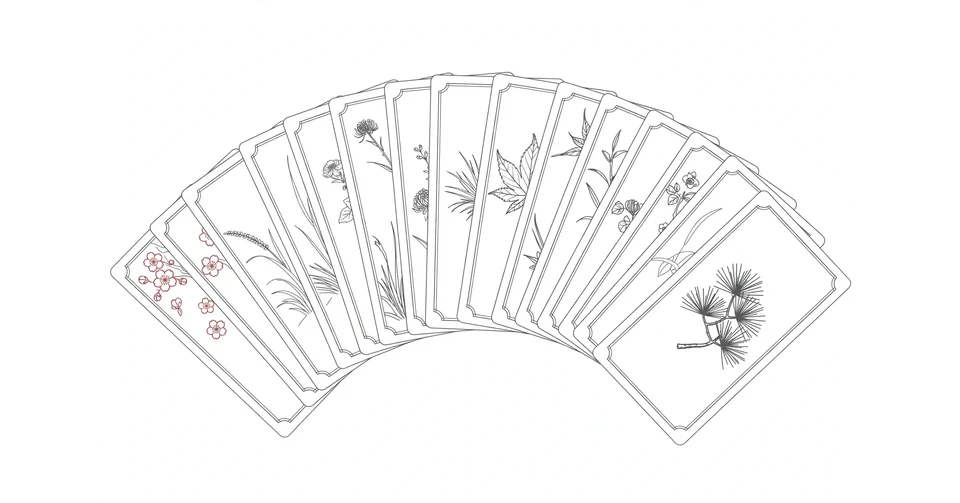
Hanafuda has been played in Japan for more than two centuries, and it is still played today, at family tables, in game shops, and on screens around the world. It began as a gambler's trick, survived a string of bans, and ended up as the first product of the company that would become Nintendo. A deck of flower cards is a small thing, but it carries a long story, and it is worth learning to read it.
How hanafuda turns a year into twelve suits
The first thing to understand about hanafuda is that the deck is a calendar before it is a game. Each of the twelve suits stands for one month, and each month is shown by a plant, so the whole year sits in the deck in order, from the pine of January to the paulownia of December. A player who knows the months can read a hand at a glance, while a beginner learns the year simply by playing.
The suits run like this:
- January, pine, with a red-crowned crane flying past the rising sun
- February, plum blossom, with a bush warbler among the branches
- March, cherry blossom, with a flower curtain
- April, wisteria, with a lesser cuckoo
- May, water iris, with an eight-plank bridge
- June, peony, with butterflies
- July, bush clover, with a boar
- August, susuki grass, often called moon grass, with a full moon and geese
- September, chrysanthemum, with a sake cup
- October, maple, with a sika deer
- November, willow, with a figure under an umbrella in the rain
- December, paulownia, with a phoenix
Each suit has four cards, and the four are not equal. Within every month there is a hierarchy of value that every hanafuda player learns by heart. Five cards in the deck are Bright cards, worth 20 points each, and they show the grandest images, the crane and sun, the cherry curtain, the full moon, the rain man, and the phoenix. Nine are Animal cards, worth 10 points, with creatures like the warbler, the cuckoo, the butterflies, the boar, the geese, and the deer. Ten are Ribbon cards, thin paper strips called tanzaku, worth 5 points, some plain, some blue, some carrying short lines of old poetry. The remaining twenty-four are Chaff cards, worth 1 point each, plain flowers with no animal and no ribbon. Five plus nine plus ten plus twenty-four makes forty-eight, and every card has its place in the count.
The cards themselves are small and thick, about 5.4 by 3.2 centimetres, noticeably smaller than a Western playing card but stiffer in the hand. The backs are usually plain, often red or black, with no pattern at all. That plainness is part of the design. When you hold hanafuda, the decoration is all on the face, and the face is a small painting. I think that is the first lesson the deck teaches. It does not shout. It asks you to look closely, and it rewards the looking.
A deck born from bans and loopholes
Hanafuda did not arrive fully formed. It grew out of two centuries of cat and mouse between Japanese card players and the government that kept trying to stop them, and its flower designs are the disguise that survived.
Playing cards came to Japan with the Portuguese in the middle of the 16th century. The Portuguese deck had 48 cards, four suits divided into twelve ranks, and Japanese makers soon copied it. The first Japanese made decks, from the Tensho period of 1573 to 1592, were called Tensho Karuta, and they mimicked the Portuguese cards closely. But Japan was moving toward isolation. In 1633 the country closed off contact with the Western world, and foreign playing cards were banned. In 1648 the Tokugawa shogunate banned Tensho Karuta itself.
The ban did not end card playing. It changed it. Gambling with cards stayed popular, so each time a deck design became too popular the government banned it, and the players answered with a new design. Through the late 1600s the disguised decks were called Yomi Karuta, after a popular game of the time, and through the years from about 1764 to 1789 a game called Mekuri took over, and the decks were renamed Mekuri Karuta. Cards became so widely used for gambling that they were banned again in 1791, during the Kansei era.
The loophole that saved the game was poetry. Uta-garuta, the poem playing cards built around anthologies like the Hyakunin Isshu, were officially permitted because they were considered educational. So early flower cards were made with old poems on some of them, dressed up as poetry cards, and the habit left a trace that survives today in the tanzaku cards, the paper strips that still carry fragments of verse. The earliest known reference to hana awase, an earlier version of the game, dates to 1816, when it was recorded as a banned gambling tool. The earliest decks came in many sizes, with twelve, twenty, or even thirty-two suits, but over time the design settled into the form we know now, twelve months with four cards each.
By the Meiji period the authorities had grown tolerant of playing cards, and the hanafuda deck that emerged from all those bans was stranger and more beautiful than the Portuguese original. It had dropped numbers and court figures entirely and replaced them with flowers, animals, and the moon. A deck built to dodge the law had become a small gallery of the Japanese year, and nobody needed to hide it anymore.
There is a quiet wisdom in that history that I keep coming back to. The players who were told to stop did not argue with the law. They painted flowers over their cards and kept playing. The result was better than what they started with. Restrictions do not always kill a good idea. Sometimes they force it to become something nobody would have invented on purpose.
The workshop in Kyoto that became Nintendo
The most famous chapter in the story of hanafuda begins with a craftsman in Kyoto. Fusajiro Yamauchi opened a small workshop in the Shimogyo ward of Kyoto on 23 September 1889 to make hanafuda, the traditional Japanese flower cards. His business was called Nintendo Koppai, a name often translated as leave luck to heaven, and he sold his handmade decks to gambling halls and shops around the city. The full story of that workshop and what it became is told in Nintendo, the playing-card maker that became a gaming giant, but the heart of it belongs here, because without hanafuda there would be no Nintendo.
For its first seventy years Nintendo stayed a card company. It grew into the biggest playing card maker in Japan, it made cards for the imperial court, and it survived by understanding that a game must be fun within seconds and playable by anyone in the room. That belief carried it from paper cards to video games, from the Famicom to the Switch, but it never abandoned the cards. Nintendo still produces hanafuda in Japan today, including themed sets based on Mario, Pokemon, and Kirby, and the two long standing makers that dominate the craft are Nintendo, founded in 1889, and Oishi Tengudo, founded in 1800.
The company now treats its own beginning as something worth showing. In October 2024 it opened the Nintendo Museum in Uji, near Kyoto, in a renovated factory, where visitors can play through more than a hundred years of its products, from hanafuda cards to the Famicom. One of the exhibits lets visitors make their own hanafuda cards and learn the rules of the game while they play with them, which feels exactly right. The museum presents the deck not as a relic but as the first chapter of a living story, and according to the Nintendo Museum the history on display runs from hanafuda to the Nintendo Switch. A card company that became a gaming giant still starts its story with flowers.
How to play koi-koi, the game most people learn first
Koi-koi is the best known game played with hanafuda, and it is the one most beginners meet first. It is a two player game of matching and nerve, and the whole thing can be explained in a few minutes, though it takes much longer to play well.
The setup is simple. The hanafuda deck is shuffled, eight cards are dealt face up onto the table to form the field, eight cards go to each player, and the rest form a face down draw pile. On your turn you play one card from your hand. If a card on the table shows the same month, you take both cards and keep them in front of you. If nothing matches, your card stays on the table and joins the field. Then you flip the top card of the draw pile and do the same thing again, matching it against the field if you can. Every turn is two chances to capture, one from your hand and one from the deck, and every capture builds toward the scoring combinations called yaku.
A yaku is a set of captured cards worth points, and learning the yaku is learning the game. Five Brights, collecting all five of the brightest cards in the deck, is the rarest and most valuable hand. Three Brights is worth fewer points but far more common. Boar Deer Butterfly, the boar of July, the deer of October, and the butterflies of June, is the most charming combination in the deck, three animals from three different months that somehow belong together. There are also yaku for the red paper strips, the blue paper strips, and the sake cup combinations, and the simple sets of Animal cards and Ribbon cards score a point for each extra card beyond the set. A full list is worth keeping beside the table for the first few games, and most players learn it by heart within a week.
The moment you complete a yaku, the game asks its famous question. You can stop, bank your points, and end the round, or you can call koi-koi, which means come on, and keep playing for a bigger score. Calling koi-koi doubles the risk. If your opponent completes a yaku first and stops, you score nothing and their score is doubled. If you keep going and complete another yaku, you can stop later with a larger total, and a round worth seven points or more is doubled in any case. A full match of hanafuda runs for twelve rounds, one for each month, and the player with the highest total at the end wins.
That decision, stop or continue, is where hanafuda earns its reputation. The rules fit on a single page, but the judgment takes years. Do you take the safe points or chase the Five Brights? Do you call koi-koi when your opponent is one card from a yaku of their own? I find the game honest about risk in a way that few games are. It never hides the price of greed. It shows it to you, in points, on the table, and lets you choose anyway. The players who win most often are not the ones who take the most risks. They are the ones who know exactly when a risk is worth taking and when it is only vanity.
Hana-awase, the older game behind koi-koi
Koi-koi is not the only game in a hanafuda deck, and it is not the oldest. Hana-awase, the flower matching game, is older, and koi-koi grew out of it. The name goes back to at least 1816, when hana awase was recorded as a banned gambling tool, and most hanafuda games played today descend from the same family of matching games.
Hana-awase is played on the same idea as koi-koi but in a simpler, older shape. Players match cards by month and capture them, building their score from the sets they collect, and the game moves at a gentler pace, with less of the sudden doubling and stopping that defines koi-koi. It is the game that grandparents teach first, because the matching itself is the whole lesson, and the scoring can stay in the background until the players are ready for it. Other games exist too, including hachi-hachi, a game for more players, but koi-koi and hana-awase are the two that carry the tradition.
The relationship between the two games is worth noticing. The older game survives inside the newer one. Every time a koi-koi player matches a card from hand to field, they are repeating a move that players were making two centuries ago. Traditions do not usually survive by staying frozen. They survive by letting a new generation reshape them while keeping the gesture that made them worth keeping.
Hanafuda belongs to a wider family of Japanese card games, and its closest cousins are the karuta decks, the poetry and picture cards played competitively across Japan. The top karuta players compete for a title that carries real prestige, as described in Meijin is the title every karuta player dreams of wearing. Karuta tests memory and speed, while hanafuda tests patience and nerve, but both games treat a deck of cards as a way of carrying Japanese literature and nature in your hands.
What the cards mean, month by month
A hanafuda deck is a calendar, but it is also a way of seeing. Japan has a long habit of paying attention to the small changes of the seasons, and the deck turns that habit into a game you can hold. Each month has its flower, its animal, and its mood, and the pictures reward anyone who slows down enough to notice them.
January opens with the pine and the red-crowned crane flying past the rising sun, the brightest card in the deck and the traditional image of a good beginning. March brings cherry blossom behind a flower curtain, the image of spring at its peak. August has the full moon rising over susuki grass while geese fly across the sky, a card that holds the whole feeling of an autumn evening. October pairs the maple with the sika deer, and November shows a figure with an umbrella walking under a willow in the rain, a card once painted as a folk villain and later remade as the calligrapher Ono no Michikaze. December closes the year with the phoenix on the paulownia, a mythical bird for the last month, as if the year ends not with a flower but with a promise.
Some cards carry words as well as pictures. The paper strips of January and February read akayoroshi, an old phrase meaning truly wonderful. The cherry blossom strip of March reads mi-Yoshino, beautiful Yoshino, naming the famous cherry country in Nara. The sake cup of September reads kotobuki, long life. These are small wishes printed onto playing cards, and they survive from the days when the deck had to pretend to be a book of poems. A game that began as a disguise kept the poetry even after the disguise was no longer needed.
That is what I like most about hanafuda. It never treats the seasons as decoration. The flowers are the game. You cannot play well without learning which flower belongs to which month, and learning that means learning to notice the year as it passes. A deck of cards that teaches you to watch the plum blossom in February and the maple in October is doing more than passing the time. It is keeping you in touch with the world outside the window.
Hanafuda in modern life
Hanafuda is not a museum piece. It is still played, still sold, and still finding new players, and its modern life is surprisingly easy to join.
In Japan a hanafuda deck turns up at family gatherings, at New Year, and in game shops, where handmade sets sit beside the mass produced ones. Nintendo sells Mario themed hanafuda that put familiar characters onto the old flower designs, and the game itself has been built into Nintendo consoles, appearing in Clubhouse Games for the Nintendo DS in 2006 and again in Clubhouse Games 51 Worldwide Classics for the Nintendo Switch in 2020, so a new generation meets the deck on a screen before it ever holds the cards. Online versions let players learn the yaku with the rules explained as they play, which has lowered the barrier for beginners outside Japan.
Hanafuda has travelled as well. In Korea it is known as hwatu and is played widely, especially at holidays like Lunar New Year and Chuseok, and in Hawaii it is played as Sakura. The flower cards even have their own place in the digital world. The Unicode symbol for flower playing cards was added in 2010 and became an emoji in 2015, so a hanafuda card now sits in the same character set as the rest of modern writing. According to Wikipedia, the deck has 48 cards in twelve suits, and the same article records the history from Portuguese traders to the Nintendo workshop. A deck that was once banned as a gambling tool now ships on phones, and that is a strange and happy ending.
If you want to start, the honest advice is simple. Buy a cheap hanafuda deck, learn the twelve months first, and play koi-koi with someone patient. Do not try to memorise every yaku before your first game. Play a few rounds, lose a few rounds, and let the flowers teach you their order. The rules will settle in your hands faster than they will settle in your head, and the moment you recognise the maple without thinking is the moment the deck starts to feel like yours.
A year you can hold
Hanafuda turns twelve months of flowers into a card game, and in doing so it keeps something that the modern world is good at losing. It keeps the habit of noticing. The pine of January, the cherry of March, the moon of August, the maple of October, each card is a small reminder that the year has a shape and that you are living inside it. Hanafuda began with Portuguese traders, survived two centuries of bans, and became the first product of Nintendo, and it is still, at its heart, a way for two people to sit down, match a flower to its month, and decide together whether to stop or keep going. That is a small thing, and it is enough. It has been enough for more than two hundred years, and there is no reason to think it will stop being enough now.
More in Culture & Society
- Tana Toraja and the Funerals That Last for Days
- Rangda Is the Witch Queen Bali Never Lets Win
- The Japanese School Uniform and the Story Behind the Sailor Suit
- Aikido and the Martial Art That Refuses to Fight Back
- Barong Is the Lion Bali Calls Out When the Village Needs Protection
- Setsubun, the Bean Throwing Festival That Chases Winter Away
Latest posts
- Shirakawa-go, the Village of Praying Hands
- Nintendo, the Playing Card Maker That Became a Gaming Giant
- Tempeh and the Fermented Bean Cake Indonesia Gave the World
- Gado-Gado, the Peanut Sauce Salad That Feeds All of Indonesia
- The Washlet Made the Japanese Bathroom the Warmest Room in the House
- Bakso and the Meatball Soup Indonesia Eats Everywhere
- Kecak Dance and the Hundred Voices That Tell the Ramayana
- Sapporo Snow Festival and the Ice City That Rises Every February
- Satay and the Smoke That Carries Indonesia to the World
- Tumpeng Is the Rice Cone Java Serves When It Wants to Say Thanks
- Onsen Etiquette and the Unwritten Rules of Japan's Hot Springs
- Japan's Winter Illuminations Turn Dark Nights Into Light
- Karate, the Empty Hand That Became Japan's Most Exported Martial Art
- Kemari Is the Ball Game Japan Played Without Trying to Win
- Chagama Is the Kettle That Never Leaves the Tea Room