Tanah Lot and the Temple That Rises From the Sea
· 11 min read
Tanah Lot is the sea temple Bali photographs most, a 16th-century shrine on a rock in the surf. Here is its story, the tides, the sunset crowds, and how to visit it well.
Tanah Lot does not look like a temple that was built. It looks like a temple that grew out of the sea, a tiered shrine balanced on a rock while the waves keep trying to take it back. That is the first thing most visitors feel, and it is the reason this one rock off the Tabanan coast has become the most photographed place in Bali.
The temple is small, the rock is not large, and the whole site takes about two hours to see properly. Yet Tanah Lot carries more meaning per square metre than almost any other place on the island. It is a working shrine, a piece of 16th-century history, and a sunset ritual that thousands of people share every evening. Understanding all three makes the visit far better than simply showing up for a photo. Tanah Lot rewards the visitor who knows a little before arriving, because the place looks simple from the cliff and turns out to be layered once you know what to look for.
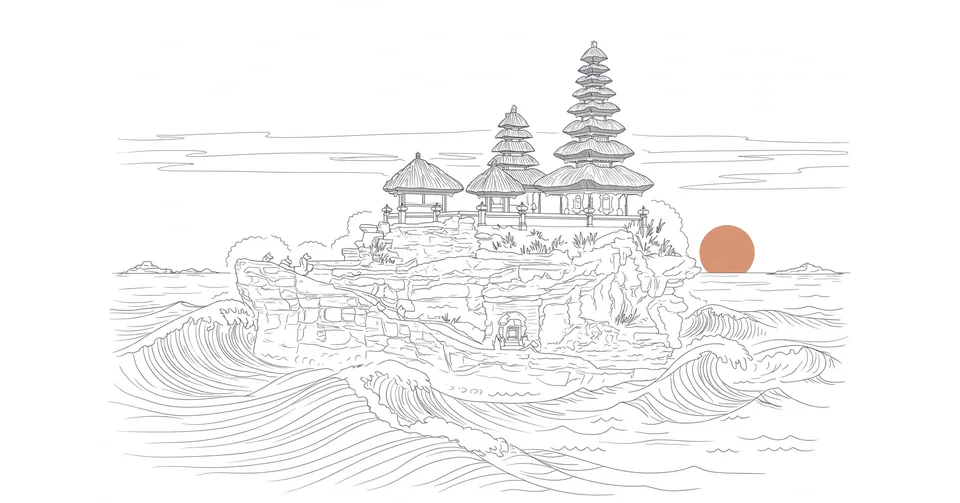
The name itself is a clue to what you are looking at. In Balinese, Tanah Lot is usually read as land in the sea, and the temple sits about 20 metres off the shore at Beraban village in Tabanan Regency, roughly 22.7 kilometres from Kuta. At high tide the rock is an island. At low tide you can walk across the wet sand to its base. The sea decides what kind of visit you get, which is part of the charm and part of the planning.
The priest who moved a rock into the sea
Tanah Lot traces its story to Dang Hyang Nirartha, a Hindu priest from Java who travelled across Bali in the 16th century, founding temples wherever he sensed strong spiritual energy. According to tradition, he rested on this stretch of coast, felt the holiness of the rock, and asked the local fishermen to build a shrine there to the sea gods. Local legend adds a sharper detail. The village headman of Beraban opposed his teaching, so the priest is said to have moved a piece of the shore out into the sea, which is how the temple got its name.
The shrine is dedicated to Dewa Baruna, the god of the sea, and Dewi Danu, the goddess of water. The tiered meru roofs you see from the cliff are the classic Balinese form, but the setting is what makes Tanah Lot different from the island's inland temples, including the great Borobudur temple across the sea in Java, which impresses by scale while Tanah Lot impresses by setting. A small museum near the entrance tells Nirartha's story with statues, heirlooms, and coins, and it is worth ten minutes before you walk to the cliffs.
Another legend guards the site. Venomous sea snakes are said to live in the caves at the base of the rock, created from Nirartha's sash to protect the temple from evil spirits. You will not meet them, but the story is told to every visitor, and it explains why the rock feels watched over rather than simply scenic. The snakes, the tide, and the priest all point to the same idea: this is a holy place first and a viewpoint second.
One of seven temples in a ring
Tanah Lot is not alone. It is one of seven sea temples that ring the coast of Bali, each placed within sight of the next so that the whole circle protects the island from negative spirits coming from the ocean. The chain runs along the south and west coasts, and from Tanah Lot you can see the logic of it: a temple on every headland, a line of shrines facing the same sea.
The temple's own calendar follows the Balinese pawukon cycle. Its anniversary, the piodalan, comes round every 210 days on the day called Buda Wage Langkir. The last one fell on 1 July 2026, and on that day the site belongs to worshippers rather than tourists. If your visit coincides with a temple festival, expect ceremony, offerings, and crowds of a different kind, the kind that reminds you the temple is alive.
That living quality is the honest difference between Tanah Lot and a ruin. People still pray here, still bring offerings, still ask the sea gods for protection. The shrine on top of the rock is for Balinese Hindus at prayer, and nobody else climbs its steps. Visitors stop at the base, and that boundary is not a disappointment. It is the point.
What the tide decides
The tide is the single most useful thing to check before you go to Tanah Lot. At low tide, you can walk to the base of the rock and receive a holy water blessing from a priest at the small cave shrine there. At high tide, the rock is cut off, and you watch it from the cliffs instead. Neither version is wrong, but they are different visits, and most people who arrive unhappy arrived at the wrong tide. A quick look at a tide table for the day of your visit is the cheapest upgrade Tanah Lot offers.
The practical rhythm is simple. The site opens daily from 7 in the morning to 7 in the evening. The morning is quiet, the light is soft, and you can walk the coastal paths without the crowds. The afternoon belongs to the sunset crowd, which builds from about 4.30 in the afternoon as buses arrive from Seminyak and Canggu, a drive of 45 to 60 minutes depending on traffic. Sunset itself falls between about 6.07 in May and 6.45 in January and February, and the cliffs fill up well before it.
If you want the classic photograph, the silhouette of Tanah Lot against the setting sun, arrive 60 to 90 minutes early and claim a spot on the cliff paths or the Enjung Galuh headland, which looks straight at the rock. Bring cash for the entrance, because the ticket booth does not take cards, and bring small bills for parking. The site is open to everyone, but the temple proper is not, and that is worth knowing before you go so the boundary feels like respect rather than a surprise. For current hours and ticket details, the Bali Guideline's Tanah Lot page is updated regularly and matches what the gate charges.
Sunset at Tanah Lot and the Kecak dance
Most visitors come for sunset, and the evening has its own choreography. As the sun drops between about 6 and 6.45, depending on the month, the cliffs turn into a long row of cameras. Then, at about 6 in the evening, the Kecak fire dance begins at the open-air stage near Pura Batu Bolong, a short walk north along the coast. Tickets cost about IDR 100,000 per person, separate from the entrance ticket, and the show runs for about an hour.
The Kecak at Tanah Lot is the same form you find at Uluwatu, a circle of chanting men telling a story from the Ramayana without instruments, only voices and fire. I wrote about the dance itself in my article on the Kecak dance, and seeing it here, with the sea behind the stage, is a different experience from seeing it in a theatre. The choice most visitors face is real: you cannot watch the sunset and the whole Kecak at once, because the sun sets during the show in every month. Pick one, and do it properly, rather than rushing between the two.
The crowd leaves slowly, down a single road, so the hour after sunset is the slowest part of the day. If you drove yourself, that is the time to be patient. If you hired a driver, agree on a meeting point before the show, because the car park is large and dark, and everyone is looking for the same car.
The practical side
A short table covers the numbers that matter at Tanah Lot. Prices were checked in October 2026, and a rise to IDR 100,000 for foreign adults that was announced for April 2026 was postponed, so check the board at the gate in case it has started. The TravelTriangle guide to Tanah Lot keeps the same figures and is a useful cross-check before you travel.
| Item | Price |
|---|---|
| Foreign adult | IDR 75,000 |
| Foreign child, age 5 to 10 | IDR 40,000 |
| Indonesian adult | IDR 30,000 |
| Indonesian child | IDR 20,000 |
| Car parking | IDR 5,000 |
| Motorcycle parking | IDR 2,000 to 3,000 |
| Kecak dance | About IDR 100,000 |
The ticket covers the whole complex: the main rock, the cliff paths, Pura Batu Bolong to the north, and the smaller shrines along the shore. There is no official way to buy a ticket online, so do not pay anyone who offers one. Allow two to three hours if you are staying for sunset, and add an hour if you are watching the Kecak. The site is about 20 kilometres northwest of Denpasar, and the drive from the airport area takes roughly an hour in normal traffic, longer at sunset.
Batu Bolong and the walk north
The second temple is easy to miss, and it should not be. Pura Batu Bolong sits on a rock arch a short walk north of the main temple, and its name means the temple of the hollow rock. It is smaller, quieter, and often nearly empty while the main cliff is packed. The Kecak stage sits beside it, which makes it a good place to settle in before the show.
The coastal path between the two temples is the best walk on the site. It runs along the cliff edge, past small shrines and food stalls, with the sea on one side and the temple on the other. In the morning, fishermen work the rocks below. In the late afternoon, the light turns the cliffs gold. If you only came for the one famous photograph, the walk is where the visit becomes something more than a photograph, because it shows you the temple in its landscape rather than as a postcard.
The museum near the entrance is the other quiet corner. It is small, and most visitors walk past it, but it holds the objects that explain why this rock matters to Balinese Hindus, and why the temple is maintained as a shrine rather than a monument. Ten minutes there changes how the rest of the visit reads.
How to visit without ruining it
Tanah Lot is crowded because it is beautiful, and the crowds are the price of that beauty. But there are ways to visit that make the place better rather than worse. The first is to come in the morning at least once, if your trip allows it. Tanah Lot at 8 in the morning, with the tide low and the cliffs nearly empty, is a different place from the temple at 6 in the evening, and it is the version that shows you why Nirartha stopped here. It is the same lesson I learned in Ubud, where the valley is a different place before the day-trippers arrive.
The second is to treat the boundary at the rock with respect. Do not climb the steps, do not pose on the shrine, and do not wade into the caves. The blessing at the base is open to visitors, and the priests who give it are patient, but the temple itself is not a photo prop. Bali's temples are used, and the people who use them notice how visitors behave.
The third is to stay for the place rather than the picture. The stalls along the cliff sell the same souvenirs you find everywhere in Bali, but the warungs with a view of the rock are worth an hour, and the walk to Batu Bolong is worth the steps. Tanah Lot rewards the visitor who slows down, which is a strange thing to say about a site famous for a single sunset, but it is true. The temple has survived five centuries of waves. It can survive an extra hour of your attention, and Tanah Lot will give that hour back in the walk, the museum, and the quiet corners most visitors never reach.
That patience is the honest lesson of the place. A temple on a rock in the sea should not still be standing after 500 years, and yet it is, because people kept caring for it, kept rebuilding it, kept praying in it. The crowds come and go, the prices change, the road out is slow, and the temple stays. If you visit Tanah Lot and leave with only a photograph, you have seen the postcard. If you leave having understood why the rock matters, you have seen the temple. The difference is worth the drive, the ticket, and the wait for the tide.
More in Food & Travel
- Ijen Blue Fire and the Volcano That Burns Blue at Night
- Lombok, the Island Next Door to Bali That Keeps Its Own Pace
- Ubud and the Valley Where Bali Slows Down
- Durian, the King of Fruits That Divides Southeast Asia
- Banda Islands and the Nutmeg That Changed the World
- Martabak and the Pancake Indonesia Eats Two Ways
Latest posts
- Sendai Tanabata Turns Three August Days Into Japan's Grandest Star Festival
- Tanzaku Carries Japan's Wishes on a Strip of Paper
- The Ainu People, Japan's Indigenous North
- Indonesian Coffee and the Islands Behind Every Cup
- Mount Rinjani, the Volcano Trek That Tests Every Hiker
- Koi-Koi Is the Card Game Where Knowing When to Stop Wins
- Yogyakarta and the City Where Java Keeps Its Soul
- Reog Ponorogo and the Giant Lion Mask That Dancers Carry With Their Teeth
- Doraemon, the Blue Robot Cat Japan Still Cannot Live Without
- Shirakawa-go, the Village of Praying Hands
- Hanafuda Turns Twelve Months of Flowers Into a Card Game
- Nintendo, the Playing Card Maker That Became a Gaming Giant
- Tana Toraja and the Funerals That Last for Days
- Tempeh and the Fermented Bean Cake Indonesia Gave the World
- Gado-Gado, the Peanut Sauce Salad That Feeds All of Indonesia