Martabak and the Pancake Indonesia Eats Two Ways
· 11 min read
Martabak is one Indonesian word for two opposite dishes, a thick sweet pancake and a crisp savoury fold, and both trace back to traders, migrants, and one night cart.
Say the word martabak in Indonesia and you have ordered two completely different things at once. One is a thick, spongy pancake soaked in butter and condensed milk, cut into squares and eaten with your fingers. The other is a crisp, golden fold of thin pastry stuffed with egg, minced meat, and scallions, served with pickled cucumber and a sharp chilli sauce. Both are called martabak. Both are sold from carts after dark. And both are, in their own way, the same story: a dish that travelled across the sea and became unmistakably Indonesian.
If you only remember one thing, let it be this. Martabak is not one recipe. It is one name that Indonesia gave to two dishes, one sweet and one savoury, and the sweet one was invented on the island of Bangka while the savoury one arrived with traders from Yemen and India. Order either one after nine in the evening and you will understand why Indonesians treat the martabak cart as an institution.
The Sweet One That Indonesia Invented
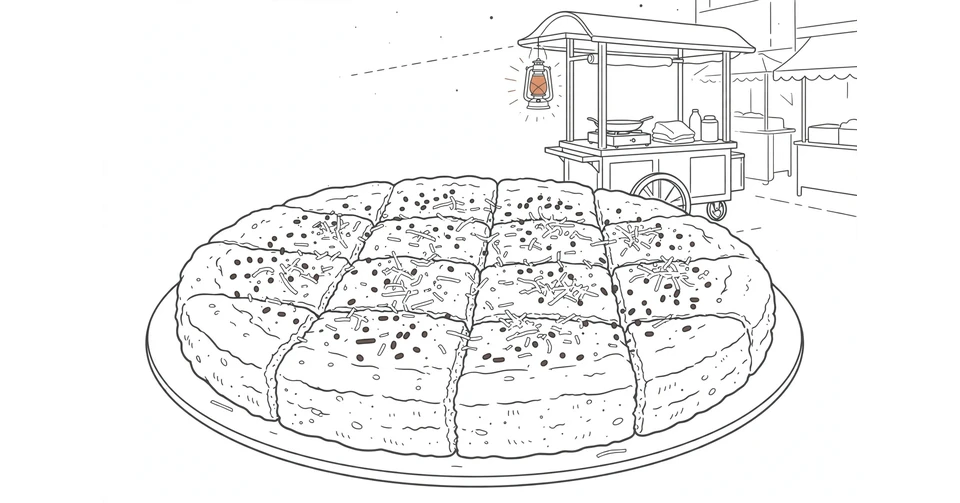
Martabak manis is the version most Indonesians picture first. A yeasted batter is poured into a heavy, lidded pan and cooked low and slow until the surface turns honeycombed with tiny holes. The cook brushes it with butter, showers it with sugar, adds a filling, and folds it in half. Then it is cut into squares, drizzled with condensed milk, and handed over still warm. The outside is soft and slightly chewy. The inside is rich, sweet, and unapologetically heavy.
The classic fillings are chocolate sprinkles, crushed peanuts, and grated cheese, often combined in one order. A half chocolate and half cheese martabak is the standard compromise for a group that cannot agree. Newer carts add green tea, red velvet, Nutella, Oreo crumbs, and even slices of banana, but the old combinations still sell the most. The pancake itself is the point. The fillings are the argument.
The sweet martabak was born in the Bangka Belitung Islands, off the east coast of Sumatra. Chinese Hokkien and Khek migrants who settled there in the late 19th century made a thick, leavened pancake they called Hok Lo Pan, the cake of the Hoklo people. The original topping was simple, roasted sesame seeds and sprinkled sugar. Over time the recipe travelled, the toppings multiplied, and the name changed with every city it reached. In Jakarta and most of Java it is martabak manis. In parts of Sumatra it is terang bulan, which means moonlight. In Central Java it is often called kue Bandung, Bandung cake, after a Bangka seller who set up his stall beside a Bandung noodle cart in Semarang and whose neighbours started calling the pancake by the name of the stall next door.
That tangle of names tells you something important about Indonesian food. Dishes here do not arrive with a fixed label. They arrive with a cook, a cart, and a neighbourhood, and the name is whatever the neighbourhood decides to call it. The same pancake is known as apam balik across the strait in Malaysia, where it is thinner and folded the same way. What makes the Indonesian version distinct is its thickness, its soft sponge, and the sheer generosity of butter and condensed milk.
The Savoury One That Came From the Sea
Martabak telur is the other half of the name, and it could hardly be more different. The cook stretches a thin sheet of dough until it is almost transparent, lays it in a hot pan, and fills it with beaten egg, minced beef or chicken, chopped scallions, and spices. The edges are folded in, the parcel is fried until crisp, and it is cut into squares and served with acar, pickled cucumber and carrot, and a bottle of chilli sauce. It is salty, rich, and best eaten hot, with the pastry still crackling.
The savoury martabak is the older of the two, and its roots lie far from Indonesia. The word comes from the Arabic mutabbaq, which means folded. Murtabak, as it is spelled elsewhere, is a stuffed pancake from Yemen, and it travelled to Southeast Asia with Tamil Muslim traders who carried it from the Arabian Peninsula through India and into the ports of the archipelago. A 13th century cookbook from Baghdad, the Kitab al-Tabikh, already contains recipes for mutabbaq, two layers of bread wrapped around a sweet filling. The dish is old enough to have a paper trail in medieval cookbooks.
In Indonesia, the savoury version kept the folded shape and the egg, but it adapted to local tastes. The filling became heavier on scallions and spice, the pastry thinner and crisper, and the accompaniment became acar instead of curry. You will find it in the same night markets as its sweet cousin, often from the very next cart. In some cities the two sellers share a stretch of pavement and take turns calling out to the same passing crowd.
Two Dishes, One Word
It is worth pausing on the oddness of this. In most food cultures, a shared name means a shared recipe. Here it means a shared shape. Both dishes are folded. Both are cooked on a flat pan. Both are cut into squares and eaten by hand. Everything else, the batter, the filling, the flavour, the meal they belong to, is different. The sweet martabak is dessert, a late night treat shared after dinner. The savoury martabak is a meal in itself, or a heavy snack that can stand in for dinner entirely.
| Martabak Manis | Martabak Telur | |
|---|---|---|
| Batter | Thick, yeasted, spongy | Thin, stretched, crisp |
| Filling | Chocolate, peanut, cheese | Egg, minced meat, scallions |
| Flavour | Sweet, buttery, rich | Salty, savoury, spiced |
| Served with | Condensed milk | Pickled cucumber, chilli sauce |
| Best eaten | After dinner, shared | As a meal, hot from the pan |
The table makes the split look neat, but in practice the two dishes blur at the edges. Some carts sell a martabak telur with a cheese filling. Some sweet carts offer a savoury cheese and egg combination that sits halfway between the two. Indonesians are relaxed about the boundary, and the boundary is relaxed about them. What matters is the fold, the pan, and the hour.
There is a practical reason the two share a name and a street. Both are night food. The carts roll out in the late afternoon and do their real business after dark, when the day's heat has faded and people are out walking, meeting friends, or looking for something to eat on the way home. A martabak cart is a small theatre. The cook works in the open, stretching dough or pouring batter in front of a small crowd, and the smell does the advertising. If you have ever walked an Indonesian street at nine in the evening and followed the smell of butter and fried pastry to a glowing cart, you have already met martabak.
How to Order Like a Local
Ordering martabak is simple, but a few details help. First, decide sweet or savoury, because the carts are usually separate. A sweet cart will have a menu of fillings on a board, often with prices by size. The standard sizes are small and large, and a large feeds three or four people easily. A half and half order is normal. Ask for coklat keju, chocolate and cheese, if you want the classic combination, or kacang coklat, peanut and chocolate, if you want the older one.
Second, expect to wait. A good martabak manis takes time. The batter must cook slowly so the holes form properly, and a rushed pancake comes out dense and pale. The wait is part of the experience, and the regulars know it. Ten minutes is normal. Fifteen is not a complaint.
Third, eat it warm. Martabak manis is at its best in the first minutes after it leaves the pan, when the butter is still melting into the sponge and the condensed milk is still warm. It keeps for a day, and many Indonesians eat the leftovers cold for breakfast, but the first bite is the one that explains the dish. Martabak telur is even more urgent. The pastry goes soft as it cools, so eat it standing by the cart if you can.
Fourth, bring cash and small notes. Most carts take digital payment now, but the night market still runs on cash, and a cart cook with a queue behind you will be grateful for exact change. A large sweet martabak typically costs somewhere between Rp25,000 and Rp60,000 depending on the city and the filling, while a savoury one is usually cheaper per portion. Prices have risen with everything else, but martabak remains one of the cheapest ways to feed a group in Indonesia.
Why Martabak Matters Beyond the Cart
Martabak is worth writing about because it is a small, edible map of Indonesian history. The savoury version records the old trade routes, the Arab and Indian merchants who sailed into the archipelago centuries ago and left a folded pancake behind. The sweet version records the Chinese migration to Bangka, the tin mining island whose Hokkien settlers turned a Fujian pancake into something new. The two versions met on the same streets, under the same name, and became a single tradition that belongs to no single group.
That is a pattern you see across Indonesian food. Rendang carries Minangkabau history in a slow cooked curry. Nasi goreng turns leftover rice into a national dish. Bakso and gado-gado both mix Chinese, Dutch, and local influences into something that is now simply Indonesian. Martabak does the same thing in a smaller package. It is a dish that arrived from elsewhere and stayed long enough to become a local.
I find that genuinely moving, in a way that a recipe alone cannot explain. A country as large and as varied as Indonesia could easily have kept its food traditions separate, one dish per island, one name per people. Instead it folded them together, quite literally, and sold the result from a cart at night. The martabak cart is not a museum. It is a working piece of history, and it is still open.
Where to Find the Best Martabak
The honest answer is that the best martabak is usually the cart nearest to where you are standing, provided there is a queue. Indonesians judge a cart by its line, and a line at nine in the evening is a better review than any guidebook. That said, a few places have earned a reputation that travels beyond their neighbourhood. Bandung, the city that gave the sweet version one of its names, has famous shops that have been running for decades, with long menus and loyal customers who order the same combination every time. Jakarta has its own famous names, including carts that have grown into small chains without losing the open pan and the smell of butter.
If you are visiting Indonesia for the first time, do not overthink it. Walk out after dinner, find a cart with a queue, and order a large sweet martabak with chocolate and cheese. Then, on another night, find a savoury cart and order a martabak telur with extra acar. You will have tasted two dishes, two histories, and one word. That is a fair trade for an evening.
The details of the sweet pancake are well documented in food writing, including a clear account of its Bangka origins and its many regional names on Wikipedia, and a traditional recipe with the full story of Hok Lo Pan on 196 Flavors. Both are worth reading before you go looking for a cart, if only to appreciate how much history fits into a folded pancake.
Martabak is not fine dining, and it does not pretend to be. It is hot, sweet or salty, a little greasy, and eaten with your hands from a paper wrapper on a street corner. It is also one of the most honest dishes in Indonesia, because it does not hide where it came from. The fold remembers Yemen. The sponge remembers Bangka. The queue remembers that some things are worth waiting for, even at nine in the evening, even when you have already eaten dinner. Order both versions, eat them warm, and you will understand why one word was never enough, and why Indonesia never bothered to invent a second one.
More in Food & Travel
- Indonesian Coffee and the Islands Behind Every Cup
- Mount Rinjani, the Volcano Trek That Tests Every Hiker
- Yogyakarta and the City Where Java Keeps Its Soul
- Shirakawa-go, the Village of Praying Hands
- Tempeh and the Fermented Bean Cake Indonesia Gave the World
- Gado-Gado, the Peanut Sauce Salad That Feeds All of Indonesia
Latest posts
- Tanzaku Carries Japan's Wishes on a Strip of Paper
- The Ainu People, Japan's Indigenous North
- Koi-Koi Is the Card Game Where Knowing When to Stop Wins
- Reog Ponorogo and the Giant Lion Mask That Dancers Carry With Their Teeth
- Doraemon, the Blue Robot Cat Japan Still Cannot Live Without
- Hanafuda Turns Twelve Months of Flowers Into a Card Game
- Nintendo, the Playing Card Maker That Became a Gaming Giant
- Tana Toraja and the Funerals That Last for Days
- The Washlet Made the Japanese Bathroom the Warmest Room in the House
- Bakso and the Meatball Soup Indonesia Eats Everywhere
- Kecak Dance and the Hundred Voices That Tell the Ramayana
- Sapporo Snow Festival and the Ice City That Rises Every February
- Rangda Is the Witch Queen Bali Never Lets Win
- The Japanese School Uniform and the Story Behind the Sailor Suit
- Aikido and the Martial Art That Refuses to Fight Back