A Canang Sari Is Made Fresh Every Morning and Gone by Night
· 9 min read
A canang sari is the small palm leaf offering Balinese Hindus fold fresh every morning, fill with flowers, rice and incense, and leave to wilt, scatter or be swept away by nightfall.
Spend one morning in Bali and you will step around them before you learn their name. A small square tray of folded palm leaf sits on the doorstep, on the pavement outside a shop, on the dashboard of a parked car, its flowers bright and a stick of incense still smoking. That is a canang sari, the daily offering of Balinese Hinduism, and by the time the sun goes down it will already be fading, scattered or swept away.
It is easy to walk past something so small. A canang sari is only about the size of an open palm, and it asks for almost nothing: a few petals, a pinch of rice, a coin if there is one. Yet it is remade every single morning, in nearly every household on the island, which makes it less a decoration than a heartbeat. Bali does not really start its day until the offerings are down.
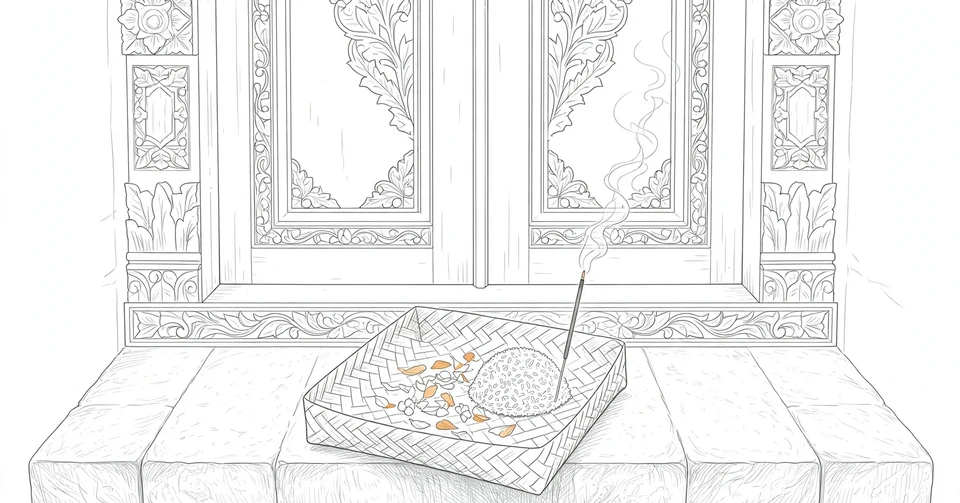
The details reward a closer look. Almost nothing inside a canang sari is random, and its short life is part of the point. It is not made to last. It is made to be given today, and then given again tomorrow.
What goes inside a canang sari
The tray comes first. It is called a ceper, folded by hand from janur, the young leaf of the coconut palm, into a small square with raised edges. The summary of canang sari on Wikipedia notes that the ceper stands for Ardha Candra, the crescent moon, so even the container carries a symbol before anything is put into it. Trays are sold in bundles at the market, but in most homes they are still folded at the kitchen table, often the night before, in patient stacks.
On the tray sits the porosan, a small folded packet of betel leaf with lime and areca nut. It is the core of the offering, and it stands for the Trimurti, the three great gods Brahma, Vishnu and Shiva in one small parcel. The Parisada Hindu Dharma Indonesia, the national Hindu council, reads the porosan as a reminder that an offering must rest on a sincere heart, which is a demanding standard for something assembled before breakfast.
Then come the flowers, and this is where a canang sari turns into a small map of the world. The colours are set by direction. White flowers face east for Iswara. Red faces south for Brahma. Yellow faces west for Mahadeva. Black belongs to Vishnu in the north, and because black flowers are hard to find, blue or purple ones stand in for them. In the centre goes shredded pandan leaf, fragrant and green, holding all four directions together.
A little food completes it. A slice of sugarcane, a piece of banana, a small cake and a few grains of rice, which tradition reads as the soul. Some households add a sweet or a cracker instead. Many canang sari are finished with a coin, an old kepeng or a small banknote, and the money is said to be the sari itself, the essence the whole offering is named after. Last of all, a stick of incense, the dupa, is lit and set down with the tray as a witness, and a few drops of holy water may be sprinkled over everything.
The name says what it is
The word canang names the tray, the small palm leaf basket itself. Sari means essence. An older reading, traced through the Kawi language, splits canang into ca, beautiful, and nang, purpose, so a canang sari comes close to "the essence of a beautiful purpose". I like that the grand name belongs to such a modest object. Nothing in it is precious. Its value lies entirely in the intention and the few minutes of work, which Balinese teaching frames as a small daily act of self sacrifice. The real offering is the time it took to make it.
Raised for the gods, grounded for the spirits
Where a canang sari is placed is a message in itself. Raised ones go on the family shrine, on temple ledges, on the little shelf shrine above a shop counter, facing upward toward the gods and the ancestors. They are thanks, offered every day to Sang Hyang Widhi Wasa, the supreme God of Balinese Hinduism, for peace and for the ordinary gifts of the day before.
Others are deliberately set on the ground: at the gate, beside the front steps, at a crossroads, in front of the shop door where customers must step around them. These are for the bhuta kala, the rough lower spirits of the earth, and they are not leftovers or accidents. Leaving the lower world out would break the very balance the offering exists to keep. A detailed guide to Balinese offerings puts it plainly: some offerings are raised toward the gods and ancestors, others are set on the ground to acknowledge the earth spirits, and neither side is forgotten.
That double placement is the philosophy of tri hita karana in miniature. Tri hita karana names the three balances of Balinese life: harmony with the divine, with other people, and with the natural world. The daily canang sari tends the first of the three before the day has properly begun, and it does so at ground level as faithfully as at the shrine.
An even smaller offering comes first
For all its fame, the canang sari is not the first offering of the day, and not quite the smallest either. After the morning cooking, and before anyone in the family eats, a Balinese household sets aside the saiban, also called yadnya sesa: a pinch of the day's cooked rice and a taste of each dish, laid on squares of banana leaf. Five portions go out, to the gate, the water source, the stove, the rice store and the house shrine. It is the family's own meal, offered first and eaten second. Against the saiban, a canang sari looks almost elaborate, which says something about how finely this culture grades its gratitude.
Made by hand, mostly by women
The making belongs, in most families, to women. Mothers and grandmothers fold the trays and arrange the flowers, and daughters learn by sitting beside them, small fingers copying bigger ones, long before anyone explains the directions of the gods. The skill looks effortless only because it has been practised ten thousand times. A practised hand finishes one canang sari in a few minutes, but a household needs many of them every morning, for the shrine, the gate, the shop and the car, so the round of making and placing can fill the quiet hour before the household wakes up properly.
Not every canang sari is homemade. Women at the market make them to sell, trays and flower bundles ready for families who are short on time, and the bought ones are not treated as worthless. The offering is completed by the placing and the prayer, not only by the folding. There is one kind of morning, though, when no canang sari appears at all. When there is a death in the family or the community, the daily offering is suspended, and the bare doorstep says what everyone already knows.
The one rule for visitors
Anyone who spends time in Bali develops the habit within a day: you watch your feet. A canang sari on the ground is still an active prayer while its incense burns, so the custom is simple. Walk around it. Do not step over it, do not kick it aside, and do not pick it up to tidy the pavement, however helpful that feels. In doorways and on narrow pavements this turns walking into a small daily dance that visitors learn from watching everyone else.
The rule has mercy built into it. Busy paths are busy, offerings get brushed and occasionally stepped on, and an accident is generally understood for what it is. What people notice is carelessness, not clumsiness. There is something healthy in that distinction. The canang sari asks the passerby for a second of attention, nothing more, and a second of attention turns out to be a form of respect that costs nobody anything.
Gone by night
By late afternoon a canang sari has usually finished its work. The flowers have wilted in the heat. The incense is a grey thread of ash. Ants and chickens have taken the rice and cake, a dog may have nosed through what is left, and the trays on a busy pavement have survived a day of feet stepping carefully, or not so carefully, around them. In the evening the remains are swept up without ceremony. Nothing is kept, nothing is stored, nothing is put on display.
This is not carelessness. It is the design. An offering that lasted would only need to be made once, and a canang sari is built to be spent by nightfall so that tomorrow it has to be made again, and the gratitude has to be meant again. On the great days the same hands scale the habit upward, into towers of fruit carried to the temple and whole villages walking their heirlooms down to the sea at melasti. But the festival version rests on the daily one. A community that can keep a palm sized promise every morning can be trusted with the big ceremonies too.
I have come to think the wisest part of the canang sari is its size. It asks for minutes, not hours, and petals, not gold. Almost anyone can afford it, which means almost no one has an excuse to skip it, and a whole island quietly arranges its mornings around a thank you small enough to hold in one hand. Tomorrow there will be a fresh one on the doorstep. That ordinariness is exactly the achievement.
More in Culture & Society
- Suka Duka Means the Banjar Shows Up for Joy and Grief Alike
- Tabuh Rah Spills Blood So the Ground Stays Calm
- The Bendesa Adat Speaks for a Village That Has Two Governments
- Catur Brata Is Four Silences Kept at the Same Time
- Your Weton Is the Day You Were Born, Counted Two Ways
- Rahu and Ketu Still Chase the Sun and Moon Across the Sky
Latest posts
- On Koyasan the Founder Is Said to Be Still Meditating
- Hiwatari Asks You to Walk Across the Fire
- Ngembak Geni Is the Morning Bali Starts Talking Again
- Karang Ayahan Is the Plot of Land a Village Trusts You With
- On Tumpek Landep Bali Blesses Everything Made of Metal
- Sudachi Is the Sharpest of Japan's Sour Citrus
- Shugendo Turns a Mountain Into a Place of Testing
- The Aling-Aling Wall Exists Because Spirits Walk in Straight Lines
- Oi-Nishin Sent Tohoku Farmers Chasing Herring Every Spring
- The Nishin Goten Were Palaces Paid for by Fish
- The Tobi Were Edo's Daredevils Before They Were Its Firemen
- Kabosu Is Oita's Gentle Answer to Yuzu
- A Yamabushi Trains Where the Mountain Is the Temple
- Tri Hita Karana Holds a Village in Three Balances
- Shingon Has Kept Its Fire Ritual Burning for 1,200 Years