Shinnenkai, Japan's New Year Parties That Start the Year Over
· 9 min read
A shinnenkai is a January gathering where Japanese companies, schools, clubs and friends welcome the new year with speeches, sake and promises to do better, the forward looking mirror of December's bonenkai.
In Japan the working year does not really begin when the office reopens after the holidays. It begins a little later, at a table, when colleagues gather for a shinnenkai and agree out loud that the new year has started and that they intend to make something of it.
A shinnenkai is a new year gathering held in January by companies, schools, clubs and groups of friends. Where the December party looks back over the year just finished, this one faces the other way. People exchange greetings, state their hopes, and wish each other health, luck and success before the ordinary routine closes over them again.
If the bonenkai of December exists to forget the old year, the shinnenkai exists to welcome the new one. The two parties bookend the holiday season, and together they say something honest about how a turning point is handled. Close the accounts first. Then, rested, open new ones.
The name points forward
Shinnenkai is written with three characters. Shin means new, nen means year, and kai means a gathering. Wikipedia's entry on the shinnenkai translates the word plainly as a new year gathering, and the plainness is accurate. A gathering, in January, for the new year. That is exactly what happens, with drinks.
Its December partner packs an instruction into its name. Forget. The shinnenkai packs a direction instead. Nothing at this party is about putting the past down or apologising for it. Everything faces the twelve months ahead, which is why the speeches at a shinnenkai tend to be full of targets, resolutions and promises to do better, rather than thanks for having survived. It is less a party than a small ceremony of intent that happens to serve food.
Roots older than the office party
The tradition is traced to the 15th century, in the Muromachi period, when gatherings were held for people to express their thanks to one another. At the time the occasion was known as nokai, a great achievement gathering, a name that already faces both ways at once, gratitude for what has been done and company for what comes next. The words for both parties, bonenkai and shinnenkai, appear in writings from the 18th century, as the pair of them settled into the shape they still have.
The new year itself had long been a ceremonial season in Japan, a time of first visits, offerings and special food, and the gathering grew naturally inside that season. When the custom later moved into the company, it carried the season's formality with it. Underneath the course menu and the fixed price drinks plan, a company shinnenkai is still doing what the older gatherings did. People thank each other, and then they start again, together, on purpose.
There is another reason the gathering carries weight. Gratitude between colleagues is not always easy to express in ordinary working life, and the shinnenkai has long served as an accepted occasion for saying thank you out loud, in public, to the people you work beside. A party built around looking forward turns out to be one of the few formal chances to look sideways as well, and to let the appreciation be heard by the whole room at once.
What happens at a shinnenkai
Most shinnenkai are held in izakaya, the same pubs and restaurants that host work parties all year, though larger firms rent hotel rooms or event halls, and some companies, watching costs, hold the party on their own premises instead. Restaurants plan for the season with special shinnenkai courses, usually with an all you can drink window, and businesses often budget around 5,000 yen a head so the price does not discourage anyone from coming. Where the company is not paying, the bill is commonly split evenly among everyone at the table.
The running order is recognisable to anyone who has survived the December version. Glasses are filled and held, untouched, until the official toast. A senior figure opens with a speech, and here the January difference shows. The speech is not mainly a thank you for the year just survived. It sets out goals and targets for the year ahead. Between the courses there may be New Year colour of a traditional kind, a taiko drum performance or shamisen music, to mark the season rather than merely the end of the working day.
Sake is close to compulsory. It is the drink of celebration in Japan, poured at the new year to bring good tidings and ward off bad fortune, and the food leans the same auspicious way. Traditionally lucky dishes appear, along with mochi, the rice cakes of the New Year season.
Nor is the shinnenkai only a company affair. Classmates, sports clubs, hobby circles and groups of old friends hold their own versions, sharing their aspirations for the year ahead over much the same kind of table. Among friends the arrangements loosen. A self hosted party might run on food ordered in, or on a potluck system where every guest arrives carrying a dish to share.
Underneath the formality, the same release valve operates as at any nomikai, the ordinary after work drinking party. The custom is called bureiko, a deliberate suspension of rank for the evening, under which the boss and the newest hire can speak without the usual care about who outranks whom. People refill each other's glasses before their own, the talk loosens, and the party formally ends with rhythmic clapping, the single beat of ippon-jime or the triple pattern of sanbon-jime. Whoever wants more then drifts on to a nijikai, a second party, somewhere smaller.
Breaking the barrel
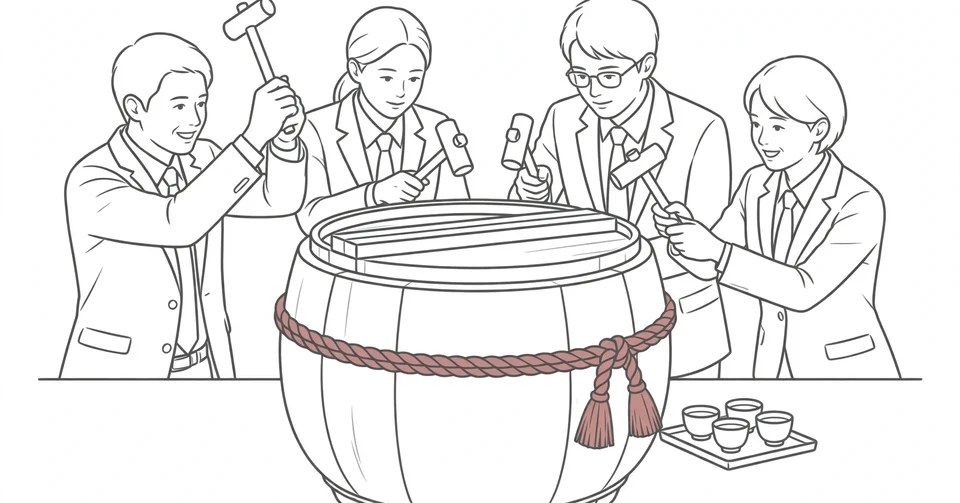
Some shinnenkai borrow a piece of the Shogatsu season itself. Shogatsu, the family new year that runs to January 3, is already over before most of these parties happen, and a shinnenkai is not part of it. But its festivities spill across. A party might include mochitsuki, the pounding of steamed rice into mochi, and above all it might include kagamiwari, the breaking open of a barrel of sake.
The ceremony is better known as kagami biraki. A wooden barrel of iwai-zake, celebration sake, is presented to the room. The round wooden lid, which represents harmony, is broken open with wooden mallets, usually by the senior people present, and the sake is then ladled out and shared with everyone. The name means opening the mirror, and the gesture is read as breaking open good fortune for the year ahead.
The sake version of the ceremony is old. The fourth Tokugawa shogun, Ietsuna, is said to have gathered his lords in his castle on the eve of a war some three centuries ago and broken open a sake cask before them. Victory followed, and a tradition was born. A shinnenkai that opens with mallets and a barrel is borrowing the confidence of that story. Something closed has been opened, in front of witnesses, and now everyone drinks to what comes out of it.
The barrel also has a quieter household twin. The same name covers the breaking of kagami mochi, the pair of round rice cakes displayed as an offering over the New Year holidays and taken down in January, traditionally on January 11. By then the mochi has hardened, and it is broken apart with the hands or a hammer, never cut with a knife, because cutting carries the suggestion of severed ties. One word covers both ceremonies because both do the same work. Something whole is opened, shared out, and only then does the year properly begin.
The quieter of the two parties
For all that, the shinnenkai is the smaller institution of the pair. More people attend a bonenkai than a shinnenkai, and the January party belongs mostly to co-workers rather than friends, since friends have generally had their new year together over the holidays themselves. It is also the more formal party, more serious in tone than December's, and that formality costs it some of the year's end abandon.
The two parties have also begun to compete with each other. Holding both a bonenkai and a shinnenkai used to be the normal pattern for a company or a club. Now many groups hold just one or the other, saving money and sparing everyone a second booking in the busiest social season of the year. When a group has to choose, the choice says something about it. December's party says we need to let this year go. January's says we need to begin properly.
I find the January version the braver of the two. Forgetting is easy to perform over drinks, and nobody checks in March whether you truly let the old year go. A hope spoken aloud at a shinnenkai, in front of the colleagues who will sit beside you for the next twelve months, is a small public debt. You have said what you intend to do in front of the witnesses.
Starting over, together
A shinnenkai does not change the year. The targets in the boss's speech will be missed about as often as they are met, and everyone at the table knows it. What the party does is mark the beginning properly, in company, with the lid broken off something and the first drinks of the year shared rather than taken alone. December closes the door on the old year. January, at a shinnenkai, opens one. There is a quiet wisdom in refusing to do either job without the other.
More in Culture & Society
Latest posts
- Every Prefecture Argues About What Goes in Ozoni
- KRL Commuterline and the Trains That Move Jakarta
- Kecap Manis and the Sweet Soy Sauce of Indonesia
- In Mamoiada, Two Hundred Families Still Make Wine at Home
- Shochu and the Quiet Spirit of Japan
- A Dried Shiitake Is Louder Than a Fresh One
- Loma Linda's Long Lives Run on Saturdays
- Maruten Numazu and the Towering Kakiage Bowl of the Port
- The Three Sisters Grow Better Together
- Tatamiishi Terraces Filter a River Through Stone
- Wasabi-Zuke Puts the Whole Plant in Sake Lees
- Konyoku Is Still Out There, Past the Last Train Station
- Dry January Lasts a Month on Purpose
- Ikaria Runs on Island Time
- Why Nicoya Cooks Its Corn in Lime