Sudachi Is the Sharpest of Japan's Sour Citrus
· 9 min read
Sudachi, the small green citrus of Tokushima, is the sharpest member of Japan's sour citrus family, picked unripe and squeezed over grilled fish, matsutake mushrooms, and soba.
Some fruits ask to be eaten. Sudachi asks to be squeezed. The small green citrus from Tokushima is never peeled and eaten like an orange, and nobody would thank you for trying. What it offers instead is a few drops of the sharpest juice in Japanese cooking, and those drops turn out to be enough.
It is a tiny thing, roughly the size of a golf ball, and it is picked while its skin is still dark green. Yet this unassuming fruit is the symbol of an entire prefecture, the partner that grilled fish and matsutake mushrooms are said to be incomplete without, and the sourest voice in a family of citrus that Japan grows for acidity and aroma rather than sweetness.
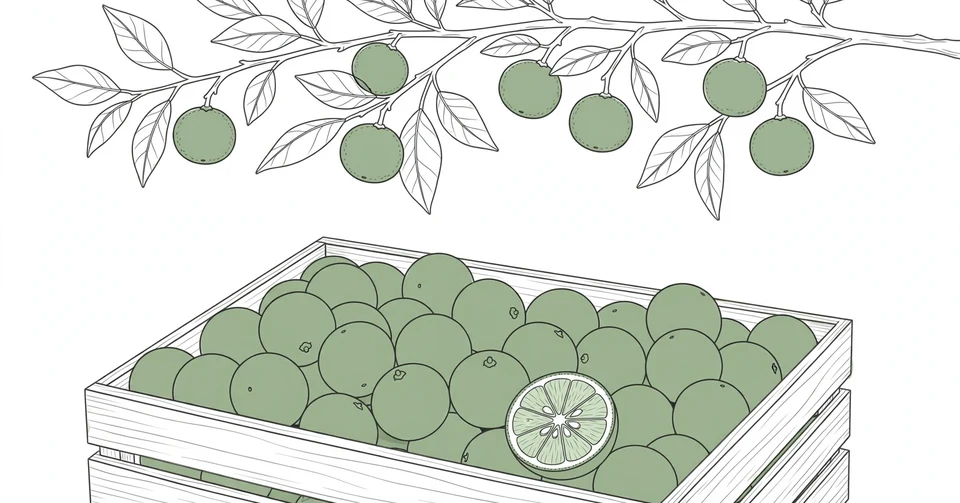
Japan has lemons and limes now, of course, in every supermarket. Kitchens here keep coming back to sudachi anyway, and after enough autumn meals in this country it is not hard to see why. Lemon shouts. A squeeze of sudachi cuts.
One prefecture grows nearly all of it
Almost every sudachi in Japan comes from Tokushima, a prefecture on the island of Shikoku. The agriculture ministry's geographical indication register for Tokushima Sudachi puts the figure at 98 percent of all sudachi shipments in the country, and the prefecture itself rounds that up to effectively the whole market. Two communities, the town of Kamiyama and the village of Sanagouchi, have accounted for nearly half of the prefecture's production between them.
The fruit is not a recent branding exercise. The ministry notes that sudachi has been native to Tokushima since the Manyo period, more than a thousand years ago, under its older name of Sutachibana, and that households grew it for their own use long before anyone sold it. Commercial cultivation only began around 1965, when the prefecture started selecting and improving varieties. In 1974 the sudachi flower was designated the prefectural flower, which tells you something about how deeply this sour little fruit is woven into local identity. Tokushima did not adopt a mascot. It adopted a seasoning.
Genetics explains part of the character. DNA analysis shows sudachi to be a hybrid, with yuzu as one parent and a relative of the koji and tachibana oranges as the other. It inherited the family sharpness and then concentrated it into a fruit a fraction of the size.
The land helps. Tokushima sits in the warm southwest of Japan, with high sunshine and slopes that drain well between the Shikoku and Sanuki mountain ranges, terrain that suits fruit trees. Even so, the modern industry is young and its footprint has already risen and fallen. Plantings grew from about 4 hectares in 1932 to some 660 hectares at the 1992 peak, then shrank as growers aged, settling at around 400 hectares in recent years. The prefecture has held at least 95 percent of the national market since 1964, the earliest year with records, so the shrinking orchards of one small prefecture quietly set the supply for the whole country.
A sudachi is picked green on purpose
Left alone, a sudachi will eventually turn yellow and orange as it ripens. Almost nobody lets it. The fruit is harvested while the skin is still dark green, because that is when its aroma is brightest and its acid at its most direct. A ripe sudachi is a softer, duller thing, and the harvest crews are not interested in it.
The white flowers bloom in May and June, the fruit sets in bunches, and the open field harvest runs from late summer into autumn, roughly August to October. That timing is not a coincidence. Autumn is when Pacific saury, the oily fish the Japanese call sanma, comes into season, and when matsutake mushrooms appear in the pine forests. The two most famous partners of sudachi arrive on the table at exactly the moment the fruit is picked.
The calendar is longer than it used to be. Tokushima's official introduction to its branded foods explains that greenhouse grown sudachi are sold from mid March to mid August, after which the open field fruit takes over, and improved storage now keeps good fruit available all year round. A cook in Tokyo no longer has to wait for autumn. But the autumn fruit, picked green off outdoor trees, is still the one people talk about.
The name is a job description
The su in sudachi is the word for vinegar. That is not a poetic accident. Long before brewed rice vinegar was cheap and everywhere, the juice of sour citrus was the acid a Japanese kitchen reached for, and sudachi juice was widely used as an acidulant in place of vinegar. The older name, Sutachibana, was itself a reference to the fruit's aroma and sourness.
I find something honest in a fruit named after its function. Sudachi makes no promise of sweetness and keeps no schedule for dessert. It exists to be sour, cleanly and without apology, and everything about how it is grown, picked, and sold serves that single purpose.
Sudachi and its two famous cousins
Japan groups its sour citrus under the name kosan kankitsu, the aromatic sour citruses, and three members of that family divide the map between them. Each has a prefecture, a personality, and a job.
Yuzu is the celebrity, the perfumed one, grown in the mountain valleys of Kochi. Its fame rests on aroma as much as acid, and it works both green and ripe, in sauces, sweets, and winter baths. Kabosu belongs to Oita, and as this site has noted before, kabosu is Oita's gentle answer to yuzu, a larger and rounder fruit whose juice stays mild enough to refresh without biting.
Sudachi is the smallest of the three and the sharpest. A sudachi weighs only about 20 to 40 grams, where a kabosu runs to 100 grams or more, yet cooks consistently describe the small fruit as the one with the keenest edge. Kabosu juice averages around 3.2 percent citric acid, the softest of the trio, while sudachi is compared to lemon and found zestier, with more vitamin C and calcium than a lemon besides. Yuzu leads with perfume and kabosu leads with restraint. Sudachi leads with a clean, peppery bite and then gets out of the way, which is exactly what delicate food needs.
The division of labour suits everyone. A fatty fish wants sudachi. A subtle white fish might want kabosu. A winter soup wants the scent of yuzu. None of the three is better in the abstract. Each is best at the moment the dish asks for it.
Where the squeeze lands
The classic presentation is half a sudachi, cut side up, beside a piece of grilled fish. The diner does the squeezing, and the amount is a matter of personal judgement. Grilled sanma is the famous case, its rich oil cut by the acid, but the same half fruit appears next to sashimi, over bowls of soba and udon, and beside simmering hot pots. It turns up in drinks too, in shochu and soft drinks, anywhere a bright sour note is welcome.
The ritual is deliberately small scale. The seeds inside are large, the juice in a single fruit amounts to a spoonful or so, and nobody minds, because a spoonful is the correct dose. One fruit can season a whole plate, and the squeezing happens at the table, by hand, at the last possible second, so the aroma lands on hot food and lifts off it in the steam. Bottled juice exists and has its uses, but the fresh half fruit, still cool from the kitchen, is the version people remember.
Then there is the mushroom. Matsutake, the most prized fungus in Japan, has been described as having sudachi for an indispensable companion, a pairing that was already established before the Second World War. A few drops over grilled matsutake is one of those combinations that sounds simple and tastes inevitable.
Sudachi also disappears quietly into bigger recipes. Ponzu began with a fruit too bitter to eat, and the sauce is still built from whichever sour citrus a region has on hand, with sudachi one of the classic choices alongside yuzu, kabosu, and daidai. In Tokushima itself the fruit is cheap and everywhere, flavouring ice cream, ice pops, and local soft drinks. Elsewhere in Japan the same fruit is treated as a delicacy and priced like one, which is a strange fate for something the size of a golf ball.
It is beginning to travel, too. Exports to the European Union started in 2013, and a few farms in California now grow the fruit commercially, with plantings in Peru as well. Whether a fruit this tied to one prefecture's slopes and habits can keep its character abroad is an open question. The acid travels well enough. The context, the sanma on the grill and the mushroom season outside the window, is harder to pack.
What the juice carries
Part of the sharpness is chemistry worth a second look. The juice is rich in eriocitrin, an antioxidant flavonoid also found in lemons and limes but notably absent from the juices of yuzu and kabosu, which gives the smallest of the trio a chemical signature its cousins do not share. It also carries roughly three times as much narirutin as yuzu juice, about 20 milligrams per 100 millilitres against fewer than 7, a compound researchers keep studying for its effects on the body. Japanese studies have linked the juice to better calcium absorption from small fish eaten whole, one more reason the pairing of this fruit with fish may be older wisdom than anyone realised.
None of that is why a cook reaches for it, of course. Cooks reach for flavour. But it is satisfying when the laboratory keeps agreeing with the kitchen, and when the sharpest juice in the family turns out to be carrying the most interesting cargo as well.
Small fruit, sharp lesson
There is a discipline to sudachi that I have come to respect. It never tries to be a snack, a dessert, or a centrepiece. It is picked before it is ripe, sold before it turns sweet, and used a few drops at a time. Its whole existence is a supporting role, played perfectly.
Most ingredients compete for attention. Sudachi improves whatever it touches and leaves no trace of itself behind except a cleaner flavour. A fruit does not need to be eaten to matter. Sometimes the smallest thing on the plate is the one doing the most work.
More in Food & Travel
Latest posts
- Suka Duka Means the Banjar Shows Up for Joy and Grief Alike
- Tabuh Rah Spills Blood So the Ground Stays Calm
- The Bendesa Adat Speaks for a Village That Has Two Governments
- Catur Brata Is Four Silences Kept at the Same Time
- Your Weton Is the Day You Were Born, Counted Two Ways
- Rahu and Ketu Still Chase the Sun and Moon Across the Sky
- Hiwatari Asks You to Walk Across the Fire
- Ngembak Geni Is the Morning Bali Starts Talking Again
- Karang Ayahan Is the Plot of Land a Village Trusts You With
- On Tumpek Landep Bali Blesses Everything Made of Metal
- Shugendo Turns a Mountain Into a Place of Testing
- A Canang Sari Is Made Fresh Every Morning and Gone by Night
- The Aling-Aling Wall Exists Because Spirits Walk in Straight Lines
- The Tobi Were Edo's Daredevils Before They Were Its Firemen
- A Yamabushi Trains Where the Mountain Is the Temple