Oi-Nishin Sent Tohoku Farmers Chasing Herring Every Spring
· 13 min read
Every spring, oi-nishin sent farmers from Tohoku north to Hokkaido to chase the herring run, work a season in the fishing grounds, and come home in autumn with a winter's wages.
Every spring, when the snow still lay on the beaches of Hokkaido, the farmers of Tohoku packed their bags and went north. They were not leaving farming behind. They were going to chase a fish. The migration had a name, oi-nishin, and for two centuries it set the calendar of whole villages at both ends of the journey. In spring, oi-nishin carried the men and women of the northern Honshu coast to Hokkaido to work the herring season. In autumn they came home, wages in hand, in time for the harvest.
The reason was simple arithmetic, and a nineteenth century traveller spelled it out in plain words. The fisheries paid so well that a season's earnings could keep a family through the winter and pay for the journey both ways, while the farming back home did not pay nearly as well. That is the whole story of oi-nishin in one sentence: a fish that arrived like weather, and a countryside that could not feed its own people without it.
The word itself says what the work was. Oi means to chase or pursue, and nishin is herring. Nobody waited for the fish to come to them. When the sea turned white with spawning herring, the workers were already on the move, and the season belonged to whoever got to the nets first.
The starting gun was a colour. When Pacific herring crowded inshore to spawn, the males released their milt at the same time and turned whole stretches of sea milky white, a phenomenon called kuki. You could read it from the shore with no instrument at all, and for the fishing towns of Hokkaido's Sea of Japan coast it was the announcement that the year's great work had begun. The oi-nishin workers watched for it the way farmers watch for rain.
What oi-nishin actually was
Oi-nishin was migrant work in Ezo, the old name for Hokkaido and its surrounding islands. It was not a holiday and it was not an adventure. It was a season of hired labour in the herring fishery, organised by the fishing grounds and repeated every year for as long as the fish came.
The grounds themselves were run under a contract system. Merchants holding a fishing ground, the basho, first employed the Ainu people who lived around it. But as the fishery grew, the Ainu workforce was no longer enough, and fishermen of the Matsumae domain, suffering poor catches of their own, pressed for permission to bring in workers from Honshu. The request was granted, and Wajin workers, Japanese from the main island, began to travel north to work away from home. That is what oi-nishin was: the seasonal migration of those workers, chasing the herring from one ground to the next.
At first the rules were strict. Workers were only allowed to live in Ezo during the herring season and were not allowed to stay through the year. Gradually that changed, and people began to settle permanently. Herring fishing became possible around Otaru at the end of the eighteenth century, and as the southern grounds faded, the Shiribeshi coast, Otaru and Yoichi and the Shakotan Peninsula, became the centre of the fishery. The Otaru City Museum's history of the trade tells the story through an unexpected document: a petition from 1860, in which bathhouse owners in Matsumae asked to raise their prices because so many migrant workers had arrived that the baths could not keep up. When the bathhouses of a castle town are full of oi-nishin workers in spring, a migration has become an economy.
I find that petition oddly moving. It is not a grand chronicle. It is a complaint about firewood, oil, and too many customers, and it happens to record the exact moment when a seasonal workforce became too big for a town to ignore.
The fields that could not feed them
The workers came, above all, from Tohoku. A study of Tohoku out-migration describes spring herring workers leaving from the whole coastal tract running from the sandy east coast of Aomori down to the Kunohe district of Iwate, a long strip of farming villages with the same problem. The land was cold, the season for outdoor work was short, and there was more labour in the villages than the fields could use. Sending people north in spring turned surplus hands into wages.
Aomori was the great departure point. A nineteenth century traveller passing through the town called it the principal outlet of a large yearly emigration, with country people flocking in large numbers every spring to Hakodate, either to join the fisheries on the coast or to pick up what living they could in the town, and returning as regularly in the autumn to their native places. The writer found the timing strange. Why would people leave home at the very season when farm labour should pay best? The answer, the writer concluded, was that the fisheries were so lucrative that what they earned served not only to keep them through the winter but to pay for the journeys there and back. Agriculture in those northern districts, the writer inferred, was simply not a remunerative pursuit. You can read the passage today in the Transactions of the Asiatic Society of Japan, and its bluntness still holds up. The farmers did the sums, and the fish won.
That calculation is the part of oi-nishin I keep coming back to. Nobody romanticised it at the time. The workers were not chasing a dream. They were chasing a wage that their own fields could not pay, and they did it on a schedule the fish set for them.
A season measured in weeks
The herring did not wait for anyone. The first shoals approached the shore in late March or early April, their arrival heralded by flocks of sea gulls and groups of whales, and the fishing itself came in a few spurts over the course of about a dozen weeks. Even allowing time to set up and close down, the demand for hired labour lasted no more than five months at a time. Oi-nishin was not a job. It was a sprint, repeated every year, and the whole oi-nishin migration had to be timed to it.
The signal that started the sprint was the kuki, the white sea. In the biggest events the milt made the water opaque, and the fish were so dense at the surface that they could be seen thrashing and rolling in it. A kuki was information the whole coast could read at once, and for the oi-nishin crews it meant the year's great work had begun. The season ran from late January to early May and was busiest in February and March, and a heavy kuki was never only a view. Herring eggs cling to the seaweed they are laid on, and seaweed gathered with the roe still attached was salted into festive foods for the winter. The same morning that paid the wages also stocked the pantry.
Esashi, the great herring port of the south, sang about itself. A folk song of the era boasted that spring in Esashi had no equal, not even in Edo. Given the money involved, the boast was probably fair. At the peak, in 1897, Hokkaido landed roughly 970,000 tons of herring, and in the peak years around the turn of the century the catch was reported at about a million tons a year. The oi-nishin workers were the hands behind those numbers, and the ports planned their whole year around their arrival.
The work in the fishing grounds
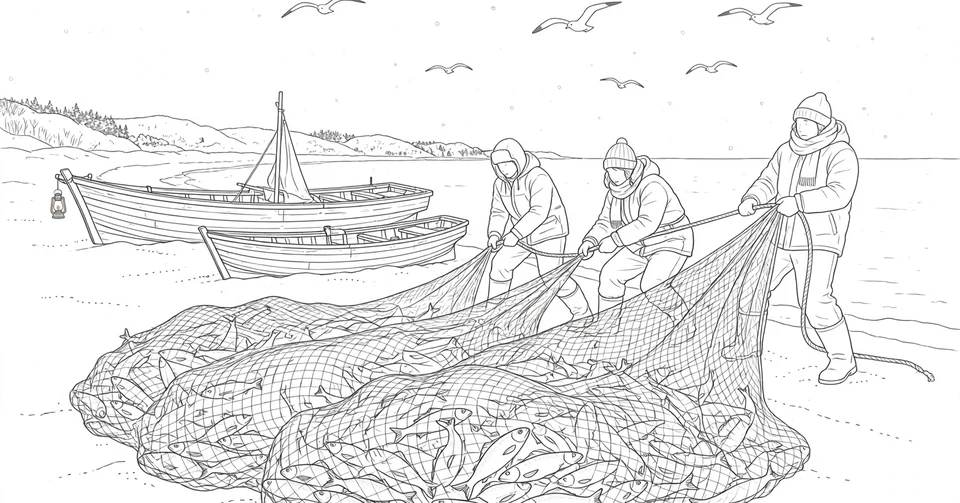
The work was heavy and it was wet, and it was organised around a net. From 1885, when set nets were first put to successful practical use off the Shakotan Peninsula, the fishery ran on tateami, fixed trap nets also called kakuami, set close to the shore where the herring gathered to spawn. In the record year of 1897, more than 80 percent of the catch came from set nets. The oi-nishin crews hauled the nets, emptied them, and carried the fish ashore, and then the second shift began: boiling, pressing, and drying.
Most of the fish was never eaten. In the peak period, 80 to 90 percent of the herring hauled out of Hokkaido's spring seas was processed into fertiliser. Whole herring were boiled and pressed hard, a process that squeezed out the oil and left a dry, dense residue broken into cakes called shimekasu. The cakes kept well and were rich enough to ship across the country, and they went south to feed cotton, indigo, and rapeseed fields hundreds of kilometres away. By 1905, herring sales stood at just over 8.11 million yen, some 66 percent of all marine products sold in Hokkaido, and the pressed meal alone accounted for 5.56 million yen, a figure in the same league as the island's coal output of just over 7 million yen. I have written before about where most of that catch actually ended up, and the point still startles me: the oi-nishin crews were not feeding Japan. They were feeding Japan's fields.
The bosses spent the money where they could see the sea. Up and down the coast they built the great wooden compounds known as nishin goten, herring palaces: part fishermen's dormitory for the seasonal crews, part warehouse and workshop, part villa for the master's family. The crews slept in those compounds for the season, ate in them, and mended nets in them, and the buildings were far grander than a fishing village had any obvious reason to hold. The former Aoyama family villa still stands in the Shukutsu district of Otaru, filled with the art and furniture the fish paid for. The old Tanaka family house was moved from Tomari to Otaru in 1958 and survives as the Otaru City Herring Palace, and the former Fukuhara fishing grounds in Yoichi are preserved as a national historic site.
A visitor to Matsumae in 1739 left a report that shows how rich the fishery already was. The peasants there, he wrote, cultivated no fields but fished herring in place of agriculture, and in the span of about twenty days the people earned enough to support themselves for a year. That was about the residents of Matsumae, not the migrants, but it explains why the oi-nishin migrants came. Twenty days of good fishing could buy a year. Oi-nishin was the chance for a farmer from Tohoku to buy the same arithmetic for his own family.
The women who came too
One detail in the old travel account deserves more attention than it usually gets. The yearly emigration, the writer noted, was not confined to the male portion of the population. The women emigrated in just as large, if not in larger, numbers than the men.
That single sentence changes the picture. Oi-nishin was not a band of young men off on a seasonal adventure. It was a household strategy in the full sense: oi-nishin moved whole families, with everyone weighing the same calculation and travelling together, or with women travelling in their own groups to work the grounds, the processing sheds, and the port towns. The migration ran on women's labour as much as men's, and the wages that came home in autumn were earned by both.
I think this matters because the usual image of seasonal labour is a lone man with a bundle, and the old account refuses that image. The boats to Hakodate carried families, and the villages of Tohoku emptied in spring in a way that touched every household. When we talk about oi-nishin as a migration of farmers, we should remember that the farmers were not only men, and the fields they left behind were not left to no one.
When the herring stopped coming
The fishery had warned the coast before. In 1776 the herring stopped running in the Fukuyama area, and by 1783 catches were bad throughout the southern grounds. The industry answered by moving, first to new grounds and then to new gear, and the set nets of the 1880s bought it another half century. But a fishery that treats abundance as something to be emptied will eventually run out of places to move to.
The end, when it came, was fast. After the Second World War, the white spawning seas of kuki were no longer seen, and by the middle of the 1950s the herring had all but disappeared from Hokkaido's Sea of Japan coast. The last kuki of the old age was recorded in 1954, along a twenty kilometre stretch of coast from Yoichi to Oshoro, and after that, nothing. The causes most often given are the obvious pair: decades of overfishing, and changes in the marine environment that the fish depended on.
When the fish went, oi-nishin went with them. There was no ceremony and no farewell. The oi-nishin workers simply stopped coming, because there was no season left to come for. The palaces outlived the fish, which is why so many of them are museums now, and two generations grew up in those towns for whom a white sea was something grandparents described.
What oi-nishin left behind
The herring, slowly, has begun to come back. A prefectural project has released herring fry along the Sea of Japan coast since 1996, in recent years about 3.4 million fry a year, and fishermen have helped it along with larger mesh nets and shorter seasons. The catch on that coast, down to 200 or 300 tons a year in the early 2000s, rose past 2,000 tons in 2009 and reached 5,326 tons in 2022, the best figure in twenty years. Set against the 970,000 tons of 1897, it is barely half of one percent. Yet the kuki have been seen again, year after year since 2020, and around Otaru the fish has quietly resumed its old role as a taste of spring. You can follow that recovery in the story of the kuki, the white sea itself, which is now measured in mornings when the water changes colour.
The migration, though, has not come back, and it will not. Oi-nishin belonged to a world where a season of fish could pay a winter of wages, and that world ended with the fish. What survived is the pattern oi-nishin left behind. Tohoku's out-migration took other seasonal forms, winter work in sake breweries among them, and the habit of leaving home to chase work never really left the region. The fish taught the villages to move, and the villages kept moving long after the fish were gone.
There is a quiet lesson in oi-nishin, and it is not only about herring. Oi-nishin worked because the sea was generous, and it ended because the sea was treated as if it would always be generous. The oi-nishin farmers who chased the herring were not the ones who emptied the sea, but they were the ones who paid for it when it emptied, losing a season that had fed their families for generations. A calendar set by a fish is a gift, and like every gift from the wild, it only keeps coming while it is looked after. The white water is back in Hokkaido's bays, in patches, a few mornings a year. The workers who once chased it are gone. What remains is the memory of a spring when whole villages moved north, and the hope, modest and practical, that the sea might one day be generous enough to be chased again.
More in Food & Travel
Latest posts
- Suka Duka Means the Banjar Shows Up for Joy and Grief Alike
- Tabuh Rah Spills Blood So the Ground Stays Calm
- The Bendesa Adat Speaks for a Village That Has Two Governments
- Catur Brata Is Four Silences Kept at the Same Time
- Your Weton Is the Day You Were Born, Counted Two Ways
- Rahu and Ketu Still Chase the Sun and Moon Across the Sky
- Hiwatari Asks You to Walk Across the Fire
- Ngembak Geni Is the Morning Bali Starts Talking Again
- Karang Ayahan Is the Plot of Land a Village Trusts You With
- On Tumpek Landep Bali Blesses Everything Made of Metal
- Shugendo Turns a Mountain Into a Place of Testing
- A Canang Sari Is Made Fresh Every Morning and Gone by Night
- The Aling-Aling Wall Exists Because Spirits Walk in Straight Lines
- The Tobi Were Edo's Daredevils Before They Were Its Firemen
- A Yamabushi Trains Where the Mountain Is the Temple