Japanese Calligraphy and the Brush That Turns Writing Into Art
· 10 min read
Japanese calligraphy turns everyday writing into a slow art of brush, ink, and breath. This is how shodo came from China, why its three scripts still matter, and what it feels like to try it yourself.
One character. One breath. One stroke that cannot be undone. That is the whole of Japanese calligraphy in a single moment, and it is why a practice that began as copying sutras still fills classrooms, galleries, and quiet temple halls across Japan today.
Japanese calligraphy, known in Japan as shodo, the way of writing, treats writing as a physical art. The brush, the ink, and the paper matter as much as the words themselves. A character is not only read, it is performed, and the trace of the brush on paper keeps a record of the speed, pressure, and confidence of the hand that made it.
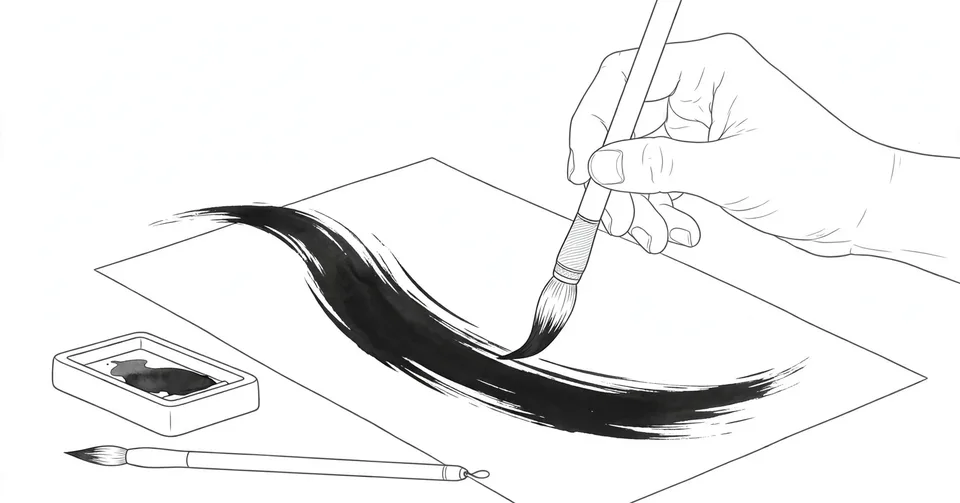
I first tried it at a small workshop in Kyoto, and what surprised me was not the difficulty but the silence. Grinding the ink stick on the stone took a full minute of slow circles, and by the time the ink was ready my hands had stopped rushing. Japanese calligraphy rewards exactly that kind of patience, which is probably why it has survived fourteen centuries of faster ways to write.
How Japanese Calligraphy Came From China
Japanese calligraphy arrived from China around the 6th century, carried across the sea by Buddhist monks who brought sutras and the brush techniques used to copy them. Japan at the time had a spoken language but no writing system of its own, so the imported characters, called kanji, became the foundation of written Japanese.
The oldest surviving calligraphic text in Japan is the halo inscription on the bronze Yakushi Nyorai statue at Horyuji Temple near Nara, written during the Asuka period, which ran from 538 to 710. For roughly five hundred years after that, Japanese brushwork followed the style of the 4th century Chinese master Wang Xizhi, whose flowing standard script set the measure for everyone who picked up a brush.
The turning point came in the Heian period, from 794 to 1185, when Japan began to write in its own voice. Hiragana developed around the 9th century out of cursive kanji, giving writers a script for native Japanese words, and katakana grew from simplified kanji fragments alongside it. Japanese calligraphy stopped being a copy of Chinese practice and became something with its own rhythm, softer, more curved, and closely tied to poetry and court life.
Three courtiers of the Heian period, the monk Kukai, Emperor Saga, and Tachibana no Hayanari, are still remembered as the Sanseki, the Three Brushes, the standard against which later calligraphers measured themselves. Kukai, who founded the Shingon school of Buddhism after studying in China, brought back not only texts but a philosophy of the brush that linked writing to meditation. Copying a sutra by hand, a practice called shakyo, was itself a form of prayer, and that link between writing and the inner life has never quite left Japanese calligraphy.
Three Scripts, One Brush
Modern Japanese calligraphy works in three main script styles, and the same character can look like three different artworks depending on which one the calligrapher chooses. Each style has its own rules, its own speed, and its own mood.
| Style | Meaning | Character |
|---|---|---|
| Kaisho | Standard script | Clear, balanced, every stroke separate |
| Gyosho | Semi-cursive script | Flowing, some strokes connected |
| Sosho | Cursive script | Fast, abstract, strokes reduced to motion |
Kaisho, the standard script, is where every student begins. Each stroke is drawn separately, the brush lifting from the paper between strokes, and the character stands upright and easy to read. It is the script of formal inscriptions, name plaques, and official documents, and learning it teaches the discipline of stroke order, balance, and spacing that every other style depends on.
Gyosho, literally running script, loosens the rules. Strokes connect inside a character and sometimes between characters, so the writing gains speed and a sense of movement without losing legibility. Most everyday handwriting in Japan leans toward gyosho, and it is the style most people picture when they think of a confident signature.
Sosho, the grass script, is the hardest of the three to read and to master. Characters dissolve into continuous motion, sometimes reduced to a single fluid gesture, and only a practiced reader can follow them. Sosho is where Japanese calligraphy becomes pure abstraction, closer to painting than to writing, and it is usually reserved for advanced practitioners who have already mastered kaisho and gyosho.
The three scripts are not a ladder to climb and leave behind. A master moves between them the way a musician moves between tempos, choosing the style that fits the words and the moment. That choice, more than technical perfection, is what separates a careful copy from a work of art.
The Four Treasures of the Study
Japanese calligraphy uses four essential tools, known together as the four treasures of the study, or bunbo shiho. Each one shapes the result, and preparing them is part of the practice itself.
The brush, or fude, is made of bamboo with bristles of animal hair, and a good brush holds a point that can draw a hairline or a broad wash depending on pressure. The ink, or sumi, starts as a solid stick made of pine soot and animal glue, ground on an inkstone, or suzuri, with a little water until it becomes a deep black liquid. The paper, usually washi made from mulberry fiber or thin hanshi, drinks the ink in a way ordinary paper cannot, so the edge of a stroke stays soft and alive.
Grinding the ink is slow on purpose. It takes a minute or two of steady circles, and in that time the calligrapher settles. The same tools serve ink wash painting, called sumi-e, where the goal is to catch the spirit of a subject in a few strokes rather than to describe it in detail. The overlap is no accident. In Japanese tradition, writing and painting were never far apart, and a brush that can write a poem can also draw a mountain.
Buying the tools is easy. A starter set with a brush, inkstone, ink stick, and paper costs little, and many stationery shops in Japan sell them alongside ordinary pens. What costs time is the practice, and Japanese calligraphy is honest about that. There is no shortcut to a steady hand, only repetition, and the repetition itself is the point.
Why Schoolchildren Still Learn Japanese Calligraphy
Japanese calligraphy is a compulsory subject in Japanese elementary schools, which surprises visitors who expect it to be a museum art. Children learn it alongside reading and arithmetic, starting with kaisho and the correct way to hold a brush, sit straight, and breathe before the first stroke.
The reason is not nostalgia. Teachers value what the practice trains: concentration, posture, patience, and respect for process. A child who rushes a stroke sees the mistake immediately, because ink cannot be erased. That feedback is instant and honest, and it teaches something a keyboard never can, that care at the start matters more than correction at the end.
The New Year tradition of kakizome, the first calligraphy of the year, shows how deep the habit runs. On January 2, families and schools write an auspicious word or phrase for the year ahead, often a single character like dream or hope, and display it at home. It is a small ritual, but it ties writing to intention, and it is one of the reasons Japanese calligraphy still feels alive rather than preserved.
Zen Buddhism has shaped the art from the start, and the connection is visible in the work itself. A Zen calligraphy piece, often a single character brushed in one motion, values emptiness as much as ink. The white space around the stroke is part of the composition, and the most admired works are often the simplest ones, a circle drawn in one breath, a word left slightly off center, a stroke that trails away like a thought.
How to Try Japanese Calligraphy Yourself
The best way to understand Japanese calligraphy is to try it once, badly, with a real brush. Workshops for visitors run in Tokyo, Kyoto, and other major cities, and most provide everything, brush, ink, paper, and a teacher who will show you the basic strokes before letting you write a character of your own.
Start with kaisho and a simple character. The character for river, kawa, is a favorite for beginners because its three vertical strokes teach pressure and rhythm without complex turns. Hold the brush upright, rest your elbow, breathe out as the brush moves, and lift at the end of each stroke instead of dragging. Your first attempts will wobble, and that is normal. Even masters warm up with practice sheets before a serious piece.
If you want to see the art at its best, the Taito Calligraphy Museum in Tokyo holds a collection of historical works and runs regular exhibitions, while temples and galleries across Kyoto display calligraphy alongside tea ceremony utensils and gardens. The Japanese tea ceremony shares the same spirit, a slow ritual where preparation matters as much as the result, and seeing the two arts together makes both clearer.
For a deeper sense of the tradition, read about the art of ikigai, which treats a daily practice as a reason to live, or the repair philosophy of kintsugi, where a crack is not hidden but honored. Japanese calligraphy belongs in the same family of ideas, small disciplines that turn ordinary actions into something worth doing well. The same patience appears in ukiyo-e woodblock prints, where a single image passed through many hands, and in origami, where one sheet of paper becomes a crane through folding alone.
Good introductions in English include the GoGoNihon guide to shodo and the EBSCO research overview of Japanese calligraphy, which cover the history, the three styles, and the four tools in more detail.
My own opinion, after that first wobbly workshop session, is that Japanese calligraphy is worth trying precisely because it cannot be hurried or undone. In a daily life full of delete keys and second drafts, there is something grounding about a practice where the first stroke is also the final one. You learn to slow down before you begin, and that lesson stays with you long after the ink dries.
Japanese calligraphy has survived fourteen centuries because it is not only about beautiful letters. It is about attention, and attention never goes out of style. A brush, a stick of ink, and a sheet of paper are all it takes to begin, and the first character you write, crooked as it may be, is already part of a tradition that stretches back to monks copying sutras by lamplight. That is a good place to start.
More in Culture & Society
- An Oyakata Is the Father a Sumo Stable Cannot Replace
- A Tokoyama Spends Ten Years Learning to Dress a Topknot
- A Tegata Is Sumo's Inked Handprint Autograph
- A Rikishi Is a Man of the Sumo World Before He Wins a Single Bout
- Mawashi Carries a Wrestler's Rank Around His Waist
- Yokai, the Strange Spirits That Haunt Japanese Folklore
Latest posts
- Namasu Turns Daikon and Carrot Into a Red and White Wish
- Ebi Bends Like an Old Back and Wishes You a Long Life
- Yokozuna Is the Rank Sumo Never Takes Back
- Kobumaki Rolls Joy Into a Strip of Kelp
- Kurikinton Is the Golden Mash That Wishes You Wealth
- Japanese Beer and the Dry Wars That Changed How Japan Drinks
- Kamaboko Paints the New Year Red and White
- Datemaki Rolls Sweet Eggs Into a Spiral of Good Luck
- Japanese Bento and the Lunch Box That Became an Art Form
- Tazukuri Turns Tiny Sardines Into a Wish for a Good Harvest
- Kazunoko Is the Herring Roe That Promises Children and Plenty
- Kuromame Turns Black Beans Into a Wish for Health
- Gyoji Are Sumo's Referees in Silk and Calligraphy
- Japanese Baseball and the Game Japan Made Its Own
- Jubako Layers a Family's Luck One Box at a Time