The Japanese Tea Ceremony and the Art of Slowing Down
· 9 min read
The Japanese tea ceremony turns a bowl of matcha into an hour of attention. This is what it is, where it came from, and how to experience one.
The Japanese tea ceremony is not really about tea. It is about an hour in which nothing else is allowed to matter. A host prepares powdered green tea for a small group of guests, and every movement has been practiced for centuries. The water is heated, the bowl is warmed, the tea is whisked, and the bowl is passed with both hands. Nothing is rushed, and nothing is extra.
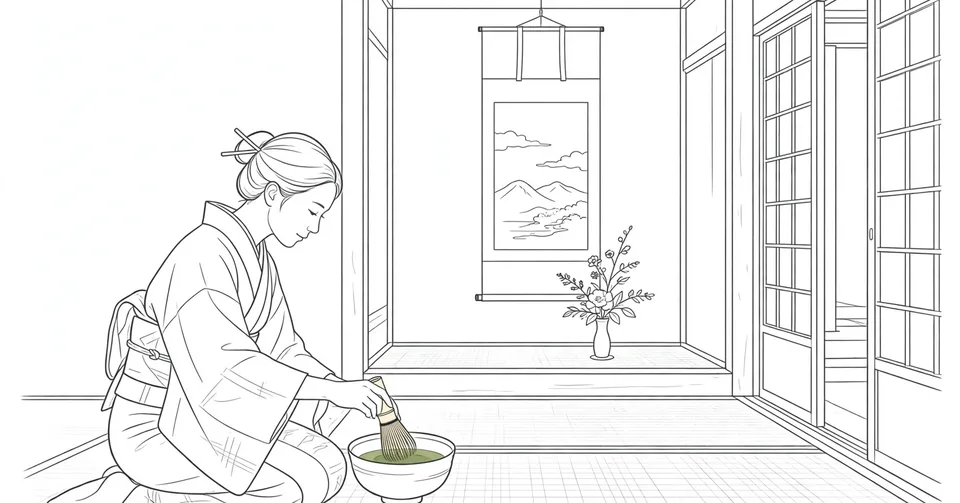
That is the honest answer to the first question most people ask: why does a bowl of tea take an hour? Because the bowl is not the point. The hour is. The Japanese tea ceremony, called chado or sado, the way of tea, is a 500 year old practice of paying full attention to a simple act. It was shaped in the 16th century by the tea master Sen no Rikyu, and it has barely changed since. In a country that runs some of the fastest trains on earth, it is one of the few places where slowness is still treated as a skill.
It is also more approachable than it looks. You do not need to know anything about tea to attend one. You need to arrive on time, take off your shoes, and follow what the host does. The rest is watching, listening, and drinking.
What the Japanese tea ceremony actually is
A Japanese tea ceremony is a formal gathering built around preparing and serving matcha, powdered green tea. The host invites a small number of guests into a tatami room, prepares the tea in front of them, and serves each guest a single bowl. Sweets are served first, then the tea. The whole event usually lasts 45 to 60 minutes.
The Japanese tea ceremony has two main forms. Usucha is thin tea, the lighter and more common version, whisked into a froth and served to each guest in an individual bowl. Koicha is thick tea, a much denser paste of matcha shared from a single bowl, passed from guest to guest. Koicha is reserved for more formal occasions and is an acquired taste, rich, bitter, and intense.
Everything in the room is chosen to match the season: the scroll, the flowers, the bowls, and the sweets. No two ceremonies are exactly alike, because the season is never the same twice.
Sen no Rikyu and the 16th century
The Japanese tea ceremony took its modern shape in the 16th century, in the hands of Sen no Rikyu (1522-1591). Before Rikyu, tea gatherings among the wealthy were often grand displays, with expensive imported bowls, silk, and gold on show. Rikyu stripped all of that away.
He built his tea rooms small, sometimes only two tatami mats, and favored plain, rough, locally made bowls over costly Chinese imports. His ideas still define the Japanese tea ceremony today, more than 400 years after his death.
Rikyu also codified the four principles of the Japanese tea ceremony: harmony, respect, purity, and tranquility. Harmony means the host, the guests, the season, and the room all fit together. Respect is shown in every bow and every careful movement. Purity means the utensils are cleaned in front of the guests, and the room is spotless. Tranquility is what remains when the other three are done well. These four words sound abstract, but in practice they are simple instructions. Prepare carefully, treat people gently, clean everything, and be quiet.
Wabi-sabi, the idea behind the bowl
Underneath the Japanese tea ceremony sits an idea called wabi-sabi, the appreciation of simplicity, imperfection, and the beauty of a single moment. A tea bowl may be uneven, its glaze cracked, its shape slightly off. In the logic of the ceremony, that is not a flaw. It is the point.
The same idea runs through other Japanese crafts. The art of kintsugi repairs broken pottery with lacquer mixed with gold, so the cracks become the most beautiful part of the bowl, and many of the bowls repaired that way were tea bowls, damaged in daily use in the tea room and brought back to life.
The idea also explains why the Japanese tea ceremony refuses to hurry. A bowl of matcha is made and drunk once. The water cools, the foam settles, the moment passes. The ceremony asks its guests to notice that, rather than to fix it. That is a strange thing to practice in a world built on speed, and it may be why the practice has survived for five centuries.
The utensils, and why the bowl matters most
Four utensils do most of the work in a Japanese tea ceremony. The chawan is the tea bowl. The chasen is the bamboo whisk, carved from a single piece of bamboo into dozens of thin tines. The chashaku is the bamboo scoop used to measure the matcha. The natsume is the small lacquered caddy that holds the tea powder.
Of the four, the chawan is the most prized object in the room. Guests are expected to admire it. When a bowl is passed to you, you turn it in your hands and look at it before drinking. You do not drink from the front of the bowl, the most decorated side, but from the side, out of respect for the maker. This small gesture is one of the first things a beginner learns, and it says a lot about the ceremony. The object is not a container. It is a guest of honor.
The whisk matters too. A good chasen turns matcha and hot water into a fine, even foam in seconds, and the sound of it is what visitors often remember longest.
What happens during a Japanese tea ceremony
A Japanese tea ceremony follows a clear sequence, and knowing it in advance makes the experience much easier to enjoy.
| Step | What happens |
|---|---|
| Arrival | Guests remove their shoes, wash their hands at the stone basin, and wait in the garden. |
| Entering | Guests enter through the low entrance and bow to the scroll in the alcove, then sit in silence. |
| Sweets | The host serves sweets, usually wagashi, which are eaten before the tea to balance its bitterness. |
| Preparation | The host cleans the utensils, adds matcha, pours hot water, and whisks. |
| Serving | The first guest bows, receives the bowl with both hands, turns it, drinks, wipes the rim, and passes it back. |
| Closing | The host cleans the utensils again, the guests admire the bowl and the scoop, and the gathering ends with a bow. |
The low entrance deserves a note of its own. It is called the nijiriguchi, and it is so small that every guest must bow to pass through it. Rich or poor, old or young, everyone enters the same way. It was Rikyu's idea, and it is still there in tea rooms today.
The room itself teaches you
The tea room is small on purpose. Most are four and a half tatami mats, about nine square meters, and some are smaller. The size forces closeness: you sit near strangers, you hear the water heating, and there is nothing to look at except the room.
One wall holds the tokonoma, an alcove with a hanging scroll and a simple flower arrangement. The scroll is chosen for the day, often a single line of calligraphy, and the flowers are arranged to suit the season. Together they set the theme of the gathering, the way a title sets the theme of a book. Guests are expected to look at the alcove when they enter and to understand, without being told, what kind of afternoon it will be.
There is no other decoration. The emptiness is deliberate: with so little to look at, the few things in the room get your full attention, and so do the people in it.
How to experience a Japanese tea ceremony
The easiest way to attend a Japanese tea ceremony is to book a session for visitors. In Kyoto, well known places include En and Camellia, both of which offer English language sessions for first timers. Tokyo has similar options, including sessions in historic gardens and hotel tea rooms. A session typically lasts 45 to 60 minutes and must be booked in advance, because the host prepares for a set number of guests.
A short introductory session usually costs a few thousand yen, less than a good dinner. Wear socks without holes, since you will remove your shoes, and arrive a few minutes early. Sitting on the tatami floor can be uncomfortable if your legs are stiff, and many visitor sessions provide small stools.
A few points of etiquette are worth knowing. Bow when the host bows, eat the sweet before the tea, and when the bowl reaches you, turn it so the decorated front faces away from you, drink in two or three sips, and wipe the rim before passing it back. Hosts who welcome beginners expect mistakes and are happy to guide you.
The main schools of the Japanese tea ceremony are Urasenke and Omotesenke, both descended from Rikyu's teaching. The differences between them are small, mostly in how the whisk is moved and how the bowl is handled. A visitor will not need to know which school a session follows. What matters is the shared idea behind both: attention, paid in full, to a simple act.
Why an hour of tea still matters
It is easy to call the Japanese tea ceremony old fashioned, a ritual from a slower age that has no place in a fast one. The people who practice it would probably disagree. Ken Mogi, writing about ikigai, the Japanese idea of a reason to live, found that the traditional tea ceremony was one of only two activities that met all five of his pillars of ikigai, along with becoming a sumo wrestler. A practice that gives people a reason to get up in the morning is not a museum piece. It is a working part of life.
The Japanese tea ceremony survives because it does something modern life rarely offers. It gives an hour a shape. There is a beginning, a middle, and an end. There is one task at a time. For the guests, the reward is not the tea, which is gone in minutes. The reward is the feeling of having been fully somewhere, with other people, for one hour.
That is worth keeping, and it is worth trying once. Book a session, sit on the tatami, and let the hour take as long as it takes.
More in Culture & Society
Latest posts
- Dashi, the Quiet Stock Under Almost Everything Japan Cooks
- Ayu, the Sweetfish That Rules Japan's Clear Rivers
- Gensen Kakenagashi, the Onsen Water That Never Circles Back
- Sumadori, Japan's Smart Drinking for People Who Do Not Drink
- Sake Kasu, the Sake Lees Japan Cooks With Instead of Throwing Away
- Bureiko, the Drinking Party Where Rank Is Left at the Door
- Kopi Tubruk and the Indonesian Way to Drink Coffee
- Capsule Hotels and Sleeping in a Pod in Japan
- Subak and the Rice Terraces of Bali
- Shinnenkai, Japan's New Year Parties That Start the Year Over
- Nara Deer and the Sacred Animals of the Old Capital
- Punakawan, the Clown Servants Who Steal Every Wayang Show
- Kashikiri, the Private Onsen Bath You Book by the Hour
- Nomi-Hara, When After-Work Drinks in Japan Turn Into Harassment
- Shio Koji, Japan's Salted Ferment That Seasons Everything