Wayang, Indonesia's Shadow Puppet Theatre
· 8 min read
Wayang is Indonesia's shadow puppet theatre, performed by a single dalang who voices every character and keeps the story alive until dawn.
In a dark hall in Java, a white screen glows. Behind it, a single oil lamp burns, and between the lamp and the screen, flat leather figures move, fight, and talk. That is wayang, Indonesia's shadow puppet theatre, and it has told stories this way for centuries.
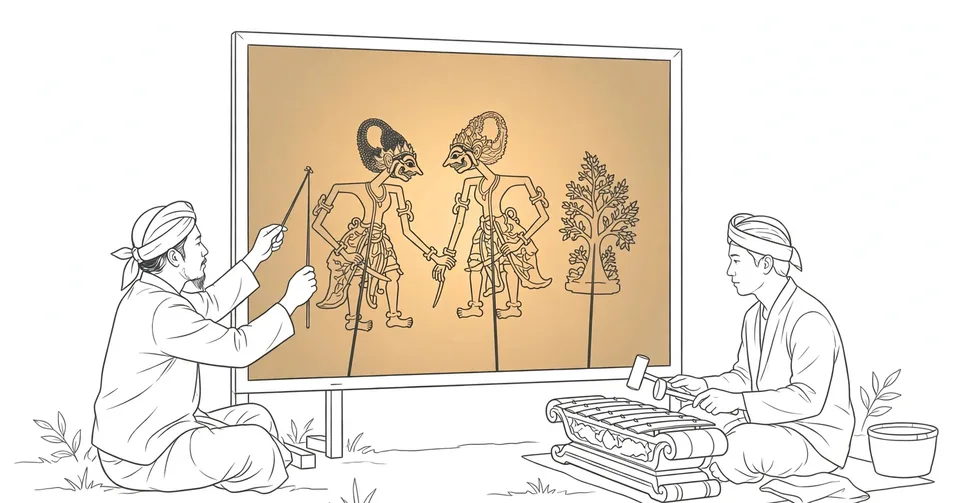
A performance is not a quick show. It can run all night, from around nine in the evening until dawn, and the audience comes and goes, eats, talks, and watches in turns. The story never stops, because one person keeps it alive: the dalang. UNESCO named wayang a Masterpiece of the Oral and Intangible Heritage of Humanity in 2003, and the dalang is the reason it still works.
Wayang is older than the country that now claims it. Its roots reach back more than a thousand years, to a time when Indian epics travelled across the sea and settled into Javanese soil. What Java did with those stories was not copy them. It rebuilt them, gave them Javanese kings and Javanese jokes, and turned them into something that still fills village squares today.
One person, a hundred voices
Everything in wayang depends on the dalang. He sits cross-legged behind the screen, a lamp on one side and a chest of puppets on the other, and for eight hours he does the work of a whole theatre company. He moves the puppets with thin rods, speaks for every character in a different voice, narrates the story, sings the mood songs, and cues the gamelan musicians sitting behind him.
A good dalang must know the epics by heart. The stories are long and branching, with dozens of characters, and the audience knows them too, so there is no hiding behind a script. He must also know when to leave the story alone and when to bend it. The noble characters speak in refined, formal Javanese. Then a clown servant steps forward and speaks in plain, everyday language, and the whole square laughs.
The dalang also conducts with his feet. A small wooden mallet hangs by his toes, and he taps it against a metal plate, the keprak, to signal the musicians. A fast tap means a battle is coming. A slow tap means a king is about to speak. The gamelan follows him, not the other way around. Here, the puppeteer is the orchestra conductor, the cast, and the author at the same time.
Training takes years. A young dalang learns by sitting beside a master, night after night, watching how the puppets are placed in the banana stem, how a voice changes for an old king and a young prince, and how a joke is timed so it lands just before the music swells. There are schools for it now, and universities teach it, but the old way, learning at the feet of a master, is still how most dalang begin.
Leather shadows, wooden dolls, and human actors
The word covers more than one kind of performance. The most famous is wayang kulit, the shadow theatre. Its puppets are cut from buffalo leather, painted in bright colours, and pierced with fine patterns so the light shines through them. The audience watches their shadows on the screen, while the dalang works on the other side. The puppets themselves are works of art. A single figure can take weeks to make, and old ones are treated as heirlooms.
Wayang golek is different. Its puppets are three-dimensional wooden dolls, moved by rods, and the audience watches the dolls themselves, not their shadows. This form comes from Sundanese West Java, and it is louder and more colourful than wayang kulit. The dolls wear real cloth costumes, their faces are carved with big expressions, and the humour is broader. If wayang kulit is a night of shadows, wayang golek is a night of dolls dancing in the light.
Then there is wayang orang, where human actors perform the same stories. Dancers in heavy make-up and elaborate costumes play the kings and demons, and the dialogue is spoken and sung. It is the most demanding form, because the actors must dance, fight, and speak in the old language, and it is the rarest today.
| Form | Puppets | Where you watch it | Character |
|---|---|---|---|
| Wayang kulit | Flat leather, seen as shadows | Java and Bali | Slow, poetic, all-night |
| Wayang golek | Wooden rod dolls, seen directly | West Java | Colourful, funny, musical |
| Wayang orang | Human dancers and actors | Java | Grand, rare, demanding |
The three forms share the same stories and the same music, but they feel like different arts. That is part of what makes it hard to explain in one sentence. It is not one theatre. It is a family of theatres, built around the same epics and the same idea: a story told through figures, whether those figures are leather, wood, or flesh.
Old epics, Javanese jokes
Almost every wayang story comes from two Indian epics, the Mahabharata and the Ramayana. The Mahabharata tells of the Pandawa brothers and their cousins the Kurawa, and the war that destroys their family. The Ramayana tells of Prince Rama, his wife Sita, and the demon king Rahwana. These stories arrived in Java more than a thousand years ago, carried by traders, priests, and travellers, and Java made them its own.
The Javanese versions add characters that India never had. The most loved are the punakawan, the clown servants. Semar is the oldest of them, a short, round figure with a flat face and a wise tongue. His sons Gareng, Petruk, and Bagong follow him everywhere. They serve the noble heroes, but they also translate them. When a king speaks in high, formal language that ordinary people cannot follow, Semar steps in and explains it in plain words, usually with a joke.
This is the secret of wayang. The epics are grand and serious, full of gods and wars and duty. The punakawan are ordinary and funny, full of hunger, gossip, and common sense. The audience gets both at once: the noble story and the commentary on it. A dalang who is good with the clowns can talk about anything, from the price of rice to the behaviour of officials, and the audience will laugh and understand exactly what he means.
The jokes also keep wayang alive. The epics do not change, but the jokes do. A dalang in the 1980s joked about television. A dalang today jokes about phones and traffic. The shadow on the screen is a thousand years old. The joke is from last week. That combination, an old story with a new joke inside it, is why people still come.
Where wayang still lives
Wayang is performed at weddings, circumcisions, village cleansing ceremonies, and state occasions. A family that stages a wayang night is making a statement: this is an important moment, and the whole village is invited. The performance is free, the food is shared, and the night belongs to everyone. In Bali, wayang kulit has its own style, faster and more intense, and it is part of temple ceremonies as well as celebrations.
It is also taught to children. Schools in Java and Bali run wayang clubs, and young dalang perform at festivals. Television and the internet have given it a new stage too. Short clips of famous scenes circulate online, and some dalang have large followings. The full all-night performance is rarer than it was, but the art has not retreated into museums. It is still performed by living people, for living audiences, in the places where it began.
Like batik, wayang is one of the Javanese arts that Indonesia carries into the world as a national treasure. The two arts even share the same cloth: wayang puppets wear batik patterns, and batik cloth sometimes carries wayang figures. Both survived because ordinary people kept using them, not because they were locked away. A culture that is worn and watched every day does not need to be saved. It needs to be used.
That is also why wayang sits beside keroncong in the story of Indonesian music and performance. Waldjinah sang keroncong to audiences who knew every song by heart, and a dalang performs to audiences who know every story by heart. Both arts depend on the same thing: an audience that already loves the material, and a performer brave enough to make it new again.
Why the shadows still matter
It is easy to look at wayang and see only the past: leather puppets, an oil lamp, stories from a thousand years ago. But the people who fill the village square do not come for the past. They come for a story they know, told by someone who knows them, with jokes about their own lives tucked between the battles of kings.
Wayang works because it never pretended the audience was stupid. It gives them gods and clowns in the same night, high language and plain language in the same scene, and trusts them to enjoy both. A tradition that can do that, that can hold an epic and a joke at the same time, does not need protection. It needs a lamp, a screen, and one person willing to stay up until dawn.
More in Culture & Society
- Numazu Imperial Villa and Japan's Seaside Imperial Retreat
- Wabi-Sabi and the Japanese Beauty of Imperfect Things
- Women Only Train Cars in Japan and the Problem They Answer
- Maneki Neko and Japan's Beckoning Lucky Cat
- The Baduy People and Life Without Modern Technology
- The Obon Festival, Japan's Week for Honouring Ancestors
Latest posts
- Love Live Sunshine and How Anime Changed Numazu
- Numazu Deep Sea Aquarium and the Creatures of Suruga Bay
- Numazu Himono and the Art of Dried Fish
- Numazu Port and the Freshest Seafood in Shizuoka
- Disaster Vending Machines in Japan That Give Their Drinks Away
- The E33G Remote Worker Visa and How to Legally Work from Bali
- Bullet Climbing Mount Fuji, the Overnight Ascent Japan Is Trying to Stop
- Climbing Mount Semeru, Java's Highest Volcano
- Tamago Sando and Japan's Konbini Egg Sandwich
- The Salaryman and Japan's Loyal Office Culture
- Onsen Tattoo Rules in Japan and How They Are Slowly Changing
- Key Money in Japan and Why Renting Costs Four Months Up Front
- Sento, Japan's Everyday Public Bathhouse
- The Fuji Five Lakes and the Best Views of Mount Fuji
- Visiting the Ghibli Museum and Ghibli Park in Japan