Bureiko, the Drinking Party Where Rank Is Left at the Door
· 8 min read
When a Japanese boss declares bureiko at a work party, rank and formality are set aside for the evening, and this is what that promise really means.
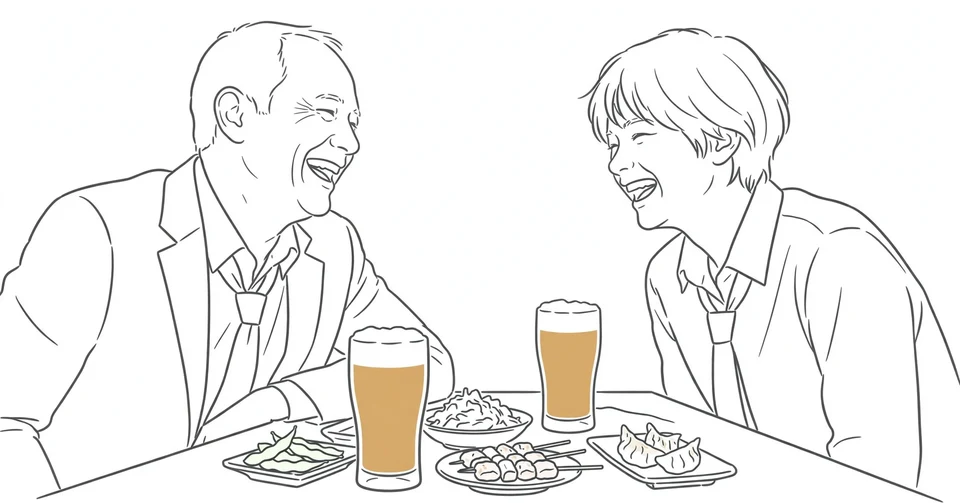
Somewhere near the start of a Japanese office party, after the first glasses have been poured and before anyone has taken a sip, the most senior person at the table sometimes makes a small announcement. Tonight, he says, is bureiko. Ties loosen, literally and otherwise, and the evening is allowed to begin.
Bureiko is the understanding that, for this one evening, rank and formality are set aside. The section chief becomes just another drinker. The newest hire may speak more plainly than the office ever allows. It sounds like a holiday from hierarchy, and in a limited way it is one. But everyone at the table also understands that the announcement carries fine print, and that nobody needs to say the fine print out loud.
The idea is far older than the modern company party. It reaches back to shrine and court gatherings where sake, normally served in strict order of status, was shared without regard to rank at all. Bureiko has survived for centuries because it answers a permanent problem. People who must be careful with each other all year still need a sanctioned place to be a little more honest, and this is the place Japan built for it.
The word bureiko and its Heian roots
The word is written with three characters that lay the promise out plainly: bu, meaning without, rei, meaning courtesy or etiquette, and ko, meaning a gathering. A gathering without etiquette, at least on paper. The older half of the story sits inside that second character. In the Heian period, a reiko was a rite attached to Shinto ceremonies. After sacred sake had been offered to the gods, the participants drank too, and they drank in order, with the sake served from the highest rank downward. Rank was not a decoration on the ritual. Rank was the ritual.
To hold a bureiko gathering was to flip that order away for once, as one Japanese essay on the word's history explains. The same sake, the same people, but poured and received without checking who stood above whom. That origin explains something easy to miss today: bureiko was never the absence of manners. It was a deliberate, declared exception inside a culture that took manners seriously enough to suspend them by name.
There is a catch built into the custom, and the same essay points it out with some humour. Only the senior person can declare bureiko. When the boss says the words, they land as a gift of ease, and the table relaxes on cue. If the organiser or a junior announced the same words, it would not be funny at all. It would read as a small act of gekokujo, the old term for the low overthrowing the high. The permission to drop rank can only be handed down by the person who holds the rank.
Bureiko at the modern office party
Today the declaration belongs to the world of the nomikai, the after work drinks that are part of the job in Japan. A boss is most likely to announce bureiko at a welcome party for new staff, where the whole point is to melt the ice before it sets, but the same words appear at leaving parties, project celebrations, and the big seasonal gatherings. The year end bonenkai runs on this spirit, and so does the shinnenkai, the new year party that starts the year over, where colleagues are expected to talk about hopes rather than duties.
What actually changes when bureiko is declared is smaller and more specific than the announcement suggests. The language drops a register. Polite forms soften, jokes that would die in a meeting get their laugh, and people say things at nine in the evening that they would never say at three in the afternoon. Seniors pour for juniors, which reverses the usual traffic of the bottle. And yet the furniture of hierarchy stays quietly in place. Even the seating keeps its order, with the honoured seat far from the door and the junior near it, close to the waiter and the extra plates. Bureiko loosens the evening. It does not rearrange it.
This is also where bureiko meets nominication, the fond Japanese belief that real communication happens over drinks, when the professional mask slips and colleagues become people. The declaration is the formal starting gun for that belief. It tells the table that the softer, blurrier part of working life has begun, and that what gets said in it will be received in that spirit. Mostly, it is.
The honest talk bureiko is meant to unlock
Japanese working life is often described through a pair of words: tatemae, the public face a person presents, and honne, what they actually think and feel. The office runs on tatemae, and necessarily so. Bureiko is the scheduled exception, a controlled dose of honne served with dinner. Under its cover, a junior can admit that a project worries him. A boss can say a decision was wrong without scheduling a meeting to say it. Small complaints come out while they are still small, which is exactly when they are cheapest to fix.
Seen this way, the real product of a bureiko evening is not drunkenness or even friendliness. It is information and trust. The boss learns what the team actually thinks, at the price of a few beers. The junior learns that the boss is a person, with a family, a bad knee, and opinions about baseball. Guides for foreign workers in Japan tend to put the purpose bluntly: the drinking party exists to strengthen wa, the harmony of the group, not to air grievances until the group cracks. Bureiko serves that harmony by giving honesty a time, a place, and a closing hour.
My own reading is that the evening protects the hierarchy as much as it relieves it, and that this is not a defect. A junior who has laughed with the boss and been listened to, even briefly, goes back to the polite forms the next morning with less resentment stored behind them. The ladder is easier to stand on after you have been allowed, once in a while, to step off it in company. Bureiko is less an escape from the system than one of the ways the system stays bearable.
Why the suspension of bureiko rarely survives the morning
Here is the honest version, and it is the part every experienced drinker in Japan knows. Bureiko genuinely loosens things, but it does not delete the hierarchy. The person who announced it is still your boss tomorrow morning, and everyone in the room knows it, including the boss. A guide to nomikai vocabulary by a Tokyo language teacher gives the practical reading in one line: treat the announcement as permission to relax one notch, not as an invitation to say whatever you think. That one notch is real. It is also the whole offer.
The newcomers who get into trouble are the ones who take bureiko at face value. Advice written for foreign employees in Japan tells the recurring story: someone gets a few drinks in, decides that rank truly no longer applies, and delivers an honest, detailed critique of company policy to the person who wrote it. The party ends warmly enough. Then comes the next morning's greeting in the office, and it is cold and clipped, and the lesson is learned all at once. Nothing said under bureiko is formally counted, but very little of it is entirely forgotten either.
There is a final paradox, and Japanese commentators enjoy it. A party where the boss feels the need to announce bureiko at all is often, underneath, a gathering of people who know etiquette very well. The declaration survives today, but it is heard less often than it was, and frequently half in jest, as if the speaker knows the table knows. Perhaps that is the healthiest stage of the custom. When everyone understands the fiction and plays along kindly, the fiction does its work.
How to accept the invitation well
If you ever sit at a table where bureiko is declared, the skill is calibration. Relax the one notch on offer. Laugh more easily, speak a little more plainly, pour for the people beside you, and let the most senior person at the table set the dial. Say one true thing rather than ten. The invitation is genuine, and declining it completely, staying stiff and silent all evening, misses the point of the party as surely as abusing it does. Bureiko asks for warmth with the manners left on, and it rewards exactly that.
What I like about bureiko, in the end, is its honesty about its own limits. It never claims the ladder is gone. It simply parks the ladder by the door for a few hours, lets everyone breathe, and hands it back in the morning without pretending otherwise. The rank returns, and that is not the custom failing. That was always the arrangement, and a team that can step off the ladder together, briefly and on purpose, usually climbs it more gently the rest of the year.
More in Money & Work
- Nomi-Hara, When After-Work Drinks in Japan Turn Into Harassment
- Nomikai, the After-Work Drinks That Are Part of the Job in Japan
- The E33G Remote Worker Visa and How to Legally Work from Bali
- The Salaryman and Japan's Loyal Office Culture
- Key Money in Japan and Why Renting Costs Four Months Up Front
- Akiya, Japan's Free Houses That Are Not Really Free
Latest posts
- Japan's Population Decline and the Villages It Leaves Behind
- KRL Commuterline and the Trains That Move Jakarta
- Kecap Manis and the Sweet Soy Sauce of Indonesia
- In Mamoiada, Two Hundred Families Still Make Wine at Home
- Shochu and the Quiet Spirit of Japan
- A Dried Shiitake Is Louder Than a Fresh One
- Loma Linda's Long Lives Run on Saturdays
- Maruten Numazu and the Towering Kakiage Bowl of the Port
- The Three Sisters Grow Better Together
- Half the Old Springs in Japan Thank Kobo Daishi
- Tatamiishi Terraces Filter a River Through Stone
- Wasabi-Zuke Puts the Whole Plant in Sake Lees
- Konyoku Is Still Out There, Past the Last Train Station
- Karo Is the Tengger's Other Great Gathering
- Dry January Lasts a Month on Purpose