Karoshi, the Japanese Word for Death by Overwork
· 8 min read
Karoshi means death from overwork, and Japan gave the problem a name because it is real: more than 1,300 cases were documented in 2024 alone. This is what the word means, why it happened, and what is slowly changing.
Japan has a word for dying from working too much. It is karoshi, and it means death from overwork. The word exists because the problem is real enough to need a name, and Japan has been counting its victims for more than fifty years.
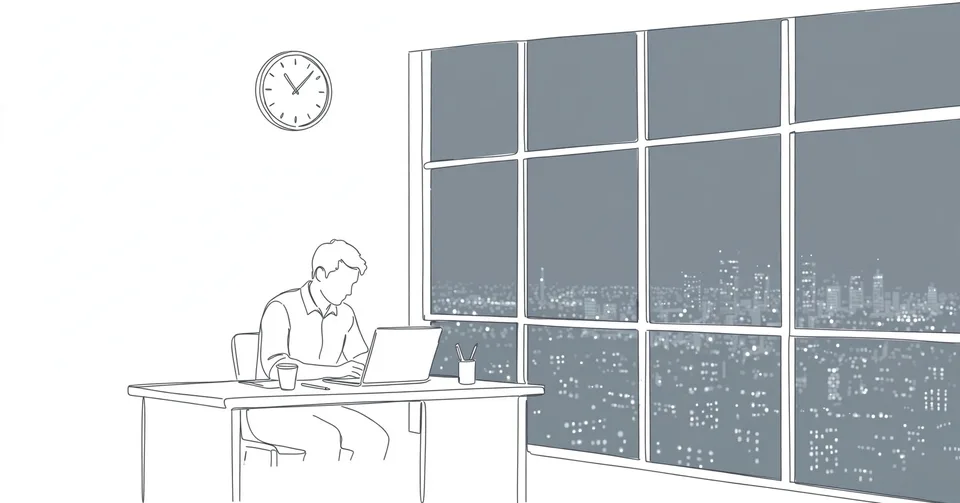
Karoshi is not a metaphor. It describes people who die of heart attacks and strokes brought on by extreme work stress, and it also covers karojisatsu, suicide driven by work-related mental distress. In 2024, at least 1,304 cases were documented in Japan. Behind each number is a person who kept working long after the body had asked to stop.
The honest answer to why this word exists is not only about long hours. It is about a culture that treats endurance as a virtue, where staying late is read as loyalty and leaving on time can feel like letting the team down. That culture is changing, but slowly, and the change is worth understanding on its own terms.
What karoshi means
Karoshi comes from the Japanese words for overwork and death. It refers to fatal heart attacks, strokes, and related conditions caused by prolonged and intense work-related stress, often combined with chronic lack of sleep. Karojisatsu is the related term for suicide caused by the same pressures, usually after depression or another mental health disorder brought on by work.
The problem is not only Japanese, even though the word is. A joint study by the World Health Organization and the International Labour Organization estimated that about 745,000 deaths worldwide in 2016 were linked to long working hours. Working 55 or more hours a week was associated with a 35 percent higher risk of stroke and a 17 percent higher risk of dying from ischemic heart disease, compared with working 35 to 40 hours. Japan simply named the problem first, and more openly, than most countries. The same pattern is now documented far beyond Japan, and a detailed account of how karoshi became a global warning puts the Japanese experience in a worldwide context.
Where the word came from
The first case was reported in 1969, when a 29-year-old man working in the shipping department of a large newspaper died of a stroke after heavy overtime. His death was attributed to occupational sudden death, the name used before karoshi entered the language. The term karoshi itself was coined in the 1970s, and by the early 1980s the problem was widespread enough that it could no longer be treated as a series of isolated tragedies.
The roots go back further, to the decades after the Second World War, when Japan rebuilt itself into an economic power through sheer effort. Long hours became a point of pride, and the salaryman became a cultural archetype: a white-collar worker who arrived early, skipped lunch, drank with his bosses until late, and slept a few hours before doing it all again. The model built a great deal, and it also broke a great many people.
The numbers behind karoshi
Japanese research has settled on a grim benchmark. Working 80 hours of overtime in one month sharply increases the risk of death, and about 10 percent of Japanese workers log at least that much overtime in a month. As of 2023, 10.1 percent of men and 4.2 percent of women worked more than 60 hours a week, which means 12-hour days, five days a week, before overtime is even counted.
| Figure | What it means |
|---|---|
| 80 hours | Monthly overtime linked to a sharply higher risk of death |
| 10 percent | Share of workers logging at least 80 hours of overtime a month |
| 1,304 | Documented karoshi cases in 2024 |
| 883 | Recognized work-related mental health disorder cases in 2024, a record high |
| 745,000 | Deaths worldwide in 2016 linked to long working hours |
The 2024 white paper on karoshi recorded a record high of 883 recognized cases of work-related mental health disorders, while cerebrovascular and cardiovascular cases exceeded 200 for the first time in four years. The numbers are not falling. If anything, the recognition of the problem is rising faster than the solution.
Why it happens
Karoshi is rarely the result of one bad boss or one cruel month. It grows out of habits that are woven into working life. One is ganbaru, the idea of persevering no matter what, which turns rest into something that feels like giving up. Another is service overtime, unpaid extra work that is expected rather than requested, and therefore never appears on any timesheet. A third is the after-hours drinking with bosses, where refusing to attend can cost more, career-wise, than attending.
Underneath it all is a simple equation that many workplaces still accept, and it is the engine of karoshi: long hours equal dedication. The equation is wrong, but it is powerful, because it is easy to measure. Hours are visible. Output is harder to judge, and rest is invisible. So the person who stays latest looks like the person who cares most, even when the extra hours add little and cost a great deal.
The pressure is sharpest in big cities, where the cost of living leaves little room to step back. Tokyo is the clearest example: high rent, long commutes, and a job market that rewards endurance all push in the same direction, and the arithmetic of what it really costs to live in Tokyo shows how little slack most workers have. When the rent is due every month, saying no to overtime can feel like a luxury.
The case that changed the conversation
For many years, karoshi was discussed in statistics. Then, in 2015, it gained a face. Matsuri Takahashi, a 24-year-old employee at the advertising giant Dentsu, died by suicide after months of extreme overtime. Her case drew national attention because she was young, talented, and new to the company, and because her suffering had been visible to those around her while the system around her kept moving.
Her death did not end karoshi, and it would be wrong to pretend that it did. But it changed the tone of the conversation. After Takahashi, it became harder to describe karoshi as a personal failure or a private choice. The company was held to account, and the public began to ask whether a workplace that drives a 24-year-old to despair is a workplace worth defending. That question has not gone away since.
What Japan is doing about it
Japan has not ignored karoshi. The Karoshi Prevention Act of 2014 requires the government to run awareness campaigns and provide counselling services. The Work Style Reform Law of 2019 caps overtime at 720 hours a year, about 60 hours a month. In April 2025, the Tokyo Metropolitan Government introduced a four-day workweek for its employees, a step that would have been unthinkable a generation ago.
These are real changes, and they matter. But laws set ceilings, and ceilings only help if someone enforces them. The caps exist on paper, yet the 2024 figures show that recognition of overwork cases is still climbing, which suggests the gap between the rule and the reality remains wide. A law can limit overtime. It cannot, by itself, change a culture that still reads long hours as loyalty.
A quieter choice
Something else is changing, and it is coming from below rather than from above. Many young Japanese are choosing a different path from the salaryman model their parents followed. They take part-time work, or become freeters who move between jobs, trading security for flexibility and time. Older generations sometimes read this as a lack of ambition. It looks more like a recalculation: if a lifetime of loyalty can still end in karoshi, why not keep some part of life for yourself?
This is where the idea of ikigai becomes relevant, not as a slogan but as a practical question. A reason to live is rarely found in overtime alone. The research on ikigai points in the same direction: people who feel their life has purpose tend to live longer and healthier lives, and purpose usually involves more than a job title. The young workers stepping off the salaryman track are not abandoning purpose. They are looking for it in more than one place.
There is a lesson here that has nothing to do with Japan alone. A culture that measures dedication in hours will always find more hours to demand, because hours are the cheapest thing a workplace can ask for and the most expensive thing a person can give. Karoshi is what happens when that demand never stops. The countries that learn this slowly pay for it in the same currency Japan has been counting since 1969.
Karoshi is a warning written into a single word. It says that work should fund a life, not consume it, and that rest is part of work rather than its opposite. Japan is learning this in public, case by case and law by law. The rest of the world, which is working longer hours than ever, would do well to listen before it needs a word of its own.
More in Money & Work
- The E33G Remote Worker Visa and How to Legally Work from Bali
- The Salaryman and Japan's Loyal Office Culture
- Key Money in Japan and Why Renting Costs Four Months Up Front
- Akiya, Japan's Free Houses That Are Not Really Free
- Why Bali Became the World's Remote Work Capital
- What It Really Costs to Live in Tokyo
Latest posts
- Love Live Sunshine and How Anime Changed Numazu
- Numazu Deep Sea Aquarium and the Creatures of Suruga Bay
- Numazu Himono and the Art of Dried Fish
- Numazu Imperial Villa and Japan's Seaside Imperial Retreat
- Numazu Port and the Freshest Seafood in Shizuoka
- Disaster Vending Machines in Japan That Give Their Drinks Away
- Wabi-Sabi and the Japanese Beauty of Imperfect Things
- Bullet Climbing Mount Fuji, the Overnight Ascent Japan Is Trying to Stop
- Women Only Train Cars in Japan and the Problem They Answer
- Climbing Mount Semeru, Java's Highest Volcano
- Maneki Neko and Japan's Beckoning Lucky Cat
- Tamago Sando and Japan's Konbini Egg Sandwich
- The Baduy People and Life Without Modern Technology
- Onsen Tattoo Rules in Japan and How They Are Slowly Changing
- Sento, Japan's Everyday Public Bathhouse