Nomi-Hara, When After-Work Drinks in Japan Turn Into Harassment
· 8 min read
Nomi-hara is the name Japan gives to the pressure around work drinking parties, from forced attendance to criticism for ordering a soft drink, and it has moved into the centre of the country's power harassment debate.
An invitation to after-work drinks in Japan is rarely just an invitation. For decades, the office party after hours was treated as part of the job itself, a place where the real conversations happened and where loyalty was quietly measured. When that expectation turns into pressure, Japan now has a word for it: nomi-hara, short for nomikai harassment. It names the moment a friendly drink stops being friendly.
The behaviours covered by nomi-hara are everyday ones. They include being pressed to attend a party you would rather skip, being pushed to drink alcohol when you do not want it, being criticised for ordering a soft drink, or being mocked for not pouring drinks for others. A close relative, aru-hara, or alcohol harassment, focuses on the drinking itself rather than the party around it. Neither term describes a wild office scandal. Both describe the low level coercion that used to pass as normal.
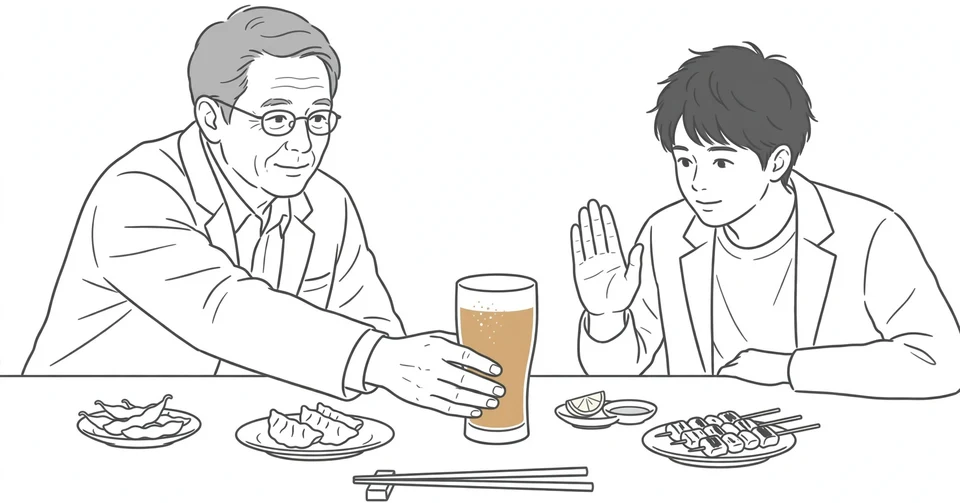
What makes nomi-hara interesting is not that Japan invented workplace pressure. It is that a culture famous for drinking with colleagues decided to draw a line inside its own ritual, give the crossing of that line a name, and then back the name with law and survey data. The party has not disappeared. The permission to refuse it, however, is new.
What nomi-hara covers
Part of the usefulness of nomi-hara is how ordinary the examples are. Forcing attendance is the most obvious one: an invitation worded so that declining feels dangerous. Pressuring someone to drink is another, whether through refills nobody asked for, drinking games with no exit, or the simple act of ordering a beer for someone without checking what they wanted. Criticism is the third form, and surveys suggest it is the one workers feel most strongly about. Being teased for choosing tea or orange juice, being scolded for leaving early, or being told that skipping the party shows a lack of commitment all fall under nomi-hara as the term is commonly used.
There are reasonable explanations for why people cannot or will not drink, and none of them are a colleague's business. Some people have medical conditions or take medication. Some are pregnant and have not told the office yet. Some simply do not like alcohol, and a growing number of younger Japanese drink little or nothing at all. A rule that treats the contents of a glass as a team loyalty test will eventually collide with all of these people, and nomi-hara is the name for that collision.
The ritual it grew out of
To understand nomi-hara, it helps to understand what it is pushing against. The nomikai, the work drinking party, has been a fixture of Japanese office life since the high growth decades, built on the idea of nominication, communication through drinking. I wrote about that world in my piece on nomikai and how after-work drinks became part of the job in Japan, where the same table that relaxes a team can also extend the working day long past its official end. At the party, juniors pour for seniors, the boss receives the favour first, and honesty is expected to flow once the glasses do.
The pressure peaks at the end of the year. The bonenkai season fills izakaya across the country, and my article on bonenkai, Japan's year-end parties looks at how those gatherings are meant to bury the year's troubles. A ritual designed to forget stress can easily create a fresh supply of it when attendance is compulsory and the bill, in money and in dignity, is shared unevenly. Nomi-hara grew in exactly that gap between the party as it is described and the party as it is experienced.
When nomi-hara met the law
The legal backdrop changed in two steps. Japan's power harassment prevention rules, introduced through an amendment to the Act on Comprehensive Promotion of Labor Policies, first obliged large companies to act in June 2020, and the duty was extended to every employer, including the smallest businesses, in April 2022. A guide to the legal framework published by the Stellex Law Firm summarises the definition: conduct based on a superior position, going beyond what is necessary and reasonable for business, that harms the working environment. Employers must state a policy, run awareness efforts, provide a consultation channel, and respond properly when something is reported.
The law does not mention drinking parties, and it carries no direct fines for companies that fall short. What it does is change the meaning of a boss's behaviour at the party table. A manager who punishes a subordinate for skipping drinks, or who ridicules a junior for not drinking, is using a superior position in a way that has little to do with reasonable business needs, which places the conduct close to the legal definition. Companies have responded the way companies do, with training sessions and party guidelines, because the labour ministry can issue advice and recommendations, and can publicise the names of employers who ignore them. Nomi-hara stopped being only a slang word once compliance departments started writing it into slides.
What workers actually think
The surveys behind nomi-hara are striking because they come from workers, not campaigners. A survey by the Persol Research Institute, reported in a Nippon.com article on Japan's changing drinking culture, found that almost 80 percent of respondents considered criticism for not attending drinking parties, or for not pouring drinks for others, to be harassment. Around half said the same about someone ordering a beer for them without asking. Read those numbers again and the shift is clear. Behaviours that were once sold as bonding are now judged, by a large majority of the people at the table, as overstepping. Nomi-hara, in other words, is not a fringe complaint.
The same research landscape complicates the lazy story that young Japan hates parties. In a 2024 Job Soken survey, 68.8 percent of employees in their twenties said they would like to attend a year-end party, well ahead of those in their forties at 51.9 percent and their fifties at 40.3 percent. The generation most associated with nomi-hara complaints is also the generation most willing to show up. What they object to is not the party. It is the compulsion, and the difference between those two things is the whole point of the word.
The parties are shrinking, not vanishing
None of this has emptied the izakaya. A 2024 survey by Tokyo Shoko Research found that 59.6 percent of companies held end-of-year or New Year parties, almost twenty points below the level before the pandemic, which reflects weaker demand and open opposition from employees as much as any law. Nomi-hara risk is now part of the calculation when a manager plans the evening. Workers who do attend go often: one 2023 survey put the average at seventeen work drinking parties a year, at an average cost of 4,237 yen each. Alcohol itself is also fading from the centre of the ritual. Per capita consumption in Japan fell to 75.4 litres in fiscal 2022, a drop of 25 percent over thirty years, and bars aimed at nondrinkers, such as Asahi's Sumadori Bar in Shibuya with its 0, 0.5 and 3 percent drinks, have appeared since 2022 to serve people who want the table without the alcohol.
Businesses, meanwhile, still believe in the original promise. Around 60 percent of firms in one HR survey admitted to internal communication problems, and the most popular remedy they named was holding or subsidising parties where employees eat and drink together. So the nomikai survives, because the problem it was invented to solve, colleagues who barely talk, is still real. Nomi-hara is less a threat to the party than an editing of it, removing the parts that depended on nobody being free to leave.
A party people can actually refuse
My own view is that the healthiest detail in this story is the existence of the word itself. A complaint that has a name can be raised in a training session, written into a policy, and answered without anyone having to dramatise it. Before nomi-hara, the new hire staring at an unwanted beer had a private discomfort. Now they have vocabulary, survey data showing most of the room quietly agrees with them, and a legal framework that expects their employer to listen.
The likely future is not the end of drinking with colleagues in Japan. It is a smaller, more deliberate version of it: invitations that can be declined without a speech, tables where a soft drink needs no defence, and bosses who understand that the trust nominication was supposed to build cannot be poured from a bottle. That is nomi-hara working as intended. The ritual survives by giving up the pressure that once held it together, and what remains is closer to what the party always claimed to be, colleagues choosing to spend an evening together.
More in Money & Work
- Bureiko, the Drinking Party Where Rank Is Left at the Door
- Nomikai, the After-Work Drinks That Are Part of the Job in Japan
- The E33G Remote Worker Visa and How to Legally Work from Bali
- The Salaryman and Japan's Loyal Office Culture
- Key Money in Japan and Why Renting Costs Four Months Up Front
- Akiya, Japan's Free Houses That Are Not Really Free
Latest posts
- Kecap Manis and the Sweet Soy Sauce of Indonesia
- In Mamoiada, Two Hundred Families Still Make Wine at Home
- Shochu and the Quiet Spirit of Japan
- A Dried Shiitake Is Louder Than a Fresh One
- Loma Linda's Long Lives Run on Saturdays
- Maruten Numazu and the Towering Kakiage Bowl of the Port
- The Three Sisters Grow Better Together
- Half the Old Springs in Japan Thank Kobo Daishi
- Tatamiishi Terraces Filter a River Through Stone
- Wasabi-Zuke Puts the Whole Plant in Sake Lees
- Konyoku Is Still Out There, Past the Last Train Station
- Karo Is the Tengger's Other Great Gathering
- Dry January Lasts a Month on Purpose
- Urashima's Dragon Palace Had a Name, Ryugu
- Petruk's Nose Arrives Before He Does