Nomikai, the After-Work Drinks That Are Part of the Job in Japan
· 8 min read
A nomikai is the after-work drinking party where Japanese colleagues set the office hierarchy down for an evening, pour drinks for each other, and say what the daytime meeting never allowed, although the tradition is slowly learning to let people go home.
Ask a Japanese office worker what a nomikai is and the first answer is simple. It is a drinking party with colleagues, usually at an izakaya, held after work. Ask whether a nomikai is part of the job and the answer gets slower, because for decades it has been both at once: a night out, and an obligation wearing casual clothes.
The word nomikai (飲み会) joins nomu, to drink, with kai, a gathering. The hope behind it even has its own coined name, nominication, communication built over drinks. The custom grew up inside the world of the salaryman and Japan's loyal office culture, where the evening often belonged to the company as much as the day did, and where trust built over a table could matter as much as anything said in a meeting room.
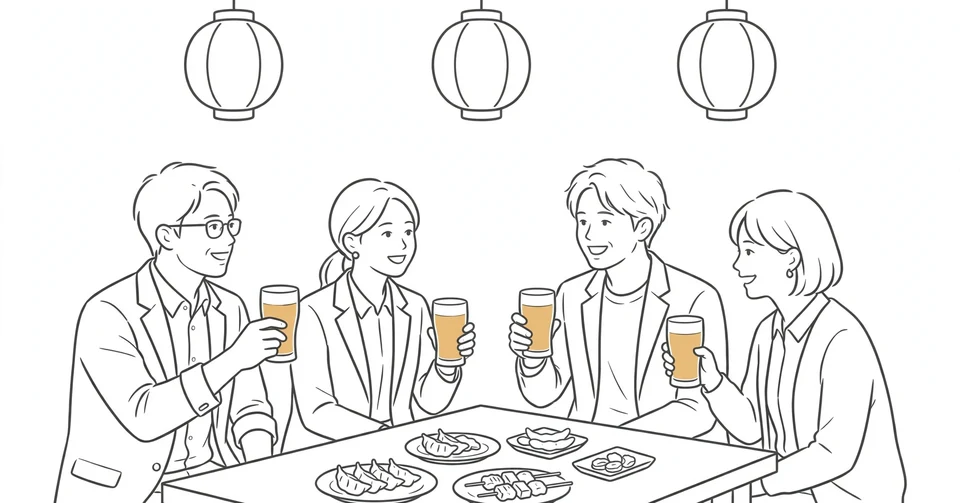
That is the honest shape of a nomikai. Nobody lists it as overtime, and nobody is formally ordered to attend. Yet for many workers it has never felt entirely optional either, and understanding that tension explains most of what happens at the table.
What a nomikai looks like
Most nomikai follow a shape regulars could predict in advance. The group gathers at an izakaya or a restaurant, often on a set course with a nomihodai plan, all you can drink for a fixed time and price. A typical nomikai runs about 90 to 120 minutes, and then the group divides. Some people say their goodnights and head for the train, and the rest move on to a nijikai, a second round at a bar or a karaoke box. A third round, a sanjikai, exists too, although it belongs more to the past than to the present.
Seating is the first quiet lesson. The most senior person sits in the kamiza, the seat furthest from the door, and the juniors take the shimoza seats nearest the entrance, close to the drinks and the waiter. If you are new, you wait to be shown where to sit. When the glasses are full, the senior person or the organizer gives a short speech, everyone calls kanpai, and only then does the drinking start. Nobody touches a drink before that toast.
The unwritten rules of the nomikai table
The best known rule at the table is that you do not pour your own drink. You pour for the people around you, watching for a glass that is running low, and they pour for you in return. With bottled beer or sake, you hold the bottle in both hands, or with one hand supporting it, especially when pouring for someone senior, and you keep the label facing up. When someone pours for you, you lift your glass and receive it with two hands.
The system has a built in pressure valve. A glass that is nearly empty is an invitation to refill it, so anyone who wants to slow down simply leaves the glass full. Experienced drinkers pace themselves this way without saying a word. The next day there is one more small duty: thank the organizer, briefly and warmly, and let anything foolish from the night before stay politely forgotten.
None of this is written in a company manual. A new employee learns the rules of a nomikai the way the rules of the office are learned, by watching the people across the table and quietly copying them.
Why the talk changes after the first drink
Japanese working life makes a distinction between tatemae, the face a person shows in public, and honne, what they actually think and feel. In the office, tatemae runs the meeting. Meetings confirm what has already been agreed, disagreement is softened, and a junior rarely tells a boss plainly that a plan is bad.
The nomikai exists, in large part, to close that gap for a few hours. Alcohol loosens the formal order, ties come off, and people say the things the daytime would not allow: doubts about a project, a complaint about a client, a joke at the boss's expense that the boss is expected to laugh at. There is a long standing understanding that what is said at a nomikai stays at a nomikai, and the next morning everyone returns to their roles as if the evening had filed itself away.
I find this the most understandable part of the whole custom. Every workplace has things that cannot be said in the meeting where they matter most, and a society that runs on indirectness needs somewhere for directness to go. The risk, of course, is that honesty becomes something that only exists after drinking, and that the people who do not drink are locked out of the room where the real talk happens.
What a nomikai costs, and who pays
A nomikai is not free entertainment, and this is where the obligation starts to bite. At most gatherings the bill is not split by who ate what. A flat amount is collected from each person, splitting the total evenly in a style the Japanese call warikan. A full evening commonly runs to a few thousand yen a head, and surveys of why people skip these parties put the usual cost at about 4,000 to 5,000 yen per person.
Once in a while that is a small price for a good evening. Once or twice a week, across a year of welcome parties, farewell parties, project launches and year end parties, it becomes a real line in a young worker's budget. Add the train home, the lost evening and the tired morning after, and the true cost of a nomikai is higher than the receipt suggests.
When the invitation feels like an order
At the height of the old system, in the 1970s through the 1990s, a nomikai was close to compulsory. Declining, especially an invitation from a superior, could be read as not wanting to be part of the team, and careers were quietly helped or harmed by who showed up and poured well. The drinks were social, but the attendance was a signal of loyalty, and everyone understood the signal.
That pressure has a name now, and the name is not kind. Forcing someone to attend, pressuring them to drink, or mocking a colleague for ordering something soft is widely described as nomi-hara, nomikai harassment, or aru-hara, alcohol harassment. A 2023 survey by the Persol Research Institute found that nearly 80 percent of workers would see it as harassment if a boss or colleague criticized someone for skipping a party or for not pouring drinks for others. Since 2022, Japan's power harassment law has covered all employers, which gives the complaint a legal edge it never had before.
The stakes are not only social. In a work culture that also produced karoshi, the word for death by overwork, an evening that cannot be refused is one more claim on a life that may already be short of rest. A pleasant nomikai among friends is one thing. A nomikai a tired person dares not skip is something else, and the line between them is drawn by how free the refusal really is.
The nomikai is loosening its grip
The change did not arrive all at once. Work style reforms in the late 2010s pushed companies to limit overtime and protect private time, which made late nights with the boss harder to justify. Then the pandemic stopped nomikai almost completely for much of 2020 and 2021, and many workers discovered, to their own surprise, that they did not miss them as much as expected. Remote work did the rest, thinning out the shared evenings on which the habit depended.
The numbers tell the same story. The share of workers who say their workplace holds a nomikai of some kind fell from about three quarters in 2017 to about 60 percent in 2025. Tokyo Shoko Research found that 59.6 percent of companies held year end or new year parties in 2024, down from 78.4 percent in 2019. A 2024 survey by Nippon Life found that 56.4 percent of workers consider nominication unnecessary, described in a guide to nomikai etiquette and its legal backdrop as the highest figure on record.
And yet the institution is not collapsing. When a nomikai does happen, a 2025 survey by Recruit found that 87.9 percent of invited employees still attend. Some workers in their twenties, especially those who started their careers on video calls during the pandemic, are keener than their seniors, not for the beer but for the rare chance to sit with colleagues in person. What has changed is not the desire to gather. It is the assumption that gathering is compulsory.
The nomikai is becoming what it perhaps always claimed to be: an invitation. The pouring will continue, the kanpai will still open the evening, and colleagues will still learn things about each other that no meeting ever taught them. But the seat by the door is easier to leave empty now, and a tradition that can survive people freely choosing it is probably stronger than one that needed them to be afraid to stay home.
More in Money & Work
- Bureiko, the Drinking Party Where Rank Is Left at the Door
- Nomi-Hara, When After-Work Drinks in Japan Turn Into Harassment
- The E33G Remote Worker Visa and How to Legally Work from Bali
- The Salaryman and Japan's Loyal Office Culture
- Key Money in Japan and Why Renting Costs Four Months Up Front
- Akiya, Japan's Free Houses That Are Not Really Free
Latest posts
- Fuji Ko, the Pilgrim Societies That Climbed Mount Fuji Together
- Dashi, the Quiet Stock Under Almost Everything Japan Cooks
- Ayu, the Sweetfish That Rules Japan's Clear Rivers
- Gensen Kakenagashi, the Onsen Water That Never Circles Back
- Shiko, the Leg Stamp That Starts Every Sumo Day
- Semar, the God Who Chose to Work as a Servant
- Kyushoku and the Japanese School Lunch
- Sumadori, Japan's Smart Drinking for People Who Do Not Drink
- Sake Kasu, the Sake Lees Japan Cooks With Instead of Throwing Away
- Kagami Biraki, Japan's Ceremony of Breaking Things Open
- Kopi Tubruk and the Indonesian Way to Drink Coffee
- Capsule Hotels and Sleeping in a Pod in Japan
- Subak and the Rice Terraces of Bali
- Hiroshima and the City That Chose Peace
- Shinnenkai, Japan's New Year Parties That Start the Year Over