Why Japanese Trains Are Almost Never Late
· 10 min read
Japanese trains are famous for running on time, and the record is real: the Tokaido Shinkansen averages under a minute of delay a year. The secret is a whole system of small habits, not one big invention.
If you stand on a platform in Tokyo at 8:47 in the morning, you will see something that feels impossible in most cities. The train arrives at 8:47. Not 8:48, not "in about a minute", but 8:47, the minute printed on the timetable. The doors stop exactly where the floor markings said they would, the crowd walks in, and the train leaves on time. That is what riding Japanese trains feels like on an ordinary day. Japanese trains run like this every day, on thousands of lines, carrying tens of millions of people.
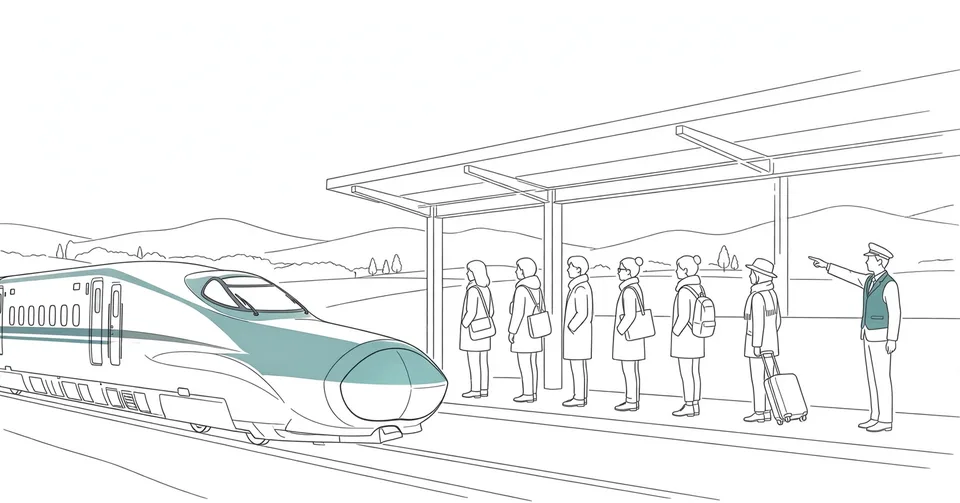
The most quoted number belongs to the Tokaido Shinkansen, the bullet train line between Tokyo and Osaka. JR Central reports that its average delay is under a minute per year. That figure counts delays caused by the railway itself, and it is measured across a whole year of operation, not a lucky week. Ordinary commuter trains are not quite that precise, but they are close enough that a two minute delay is an event worth apologising for. In Japan, lateness is news. Punctuality is the default.
The reason is not one clever technology. Japanese trains are on time because the whole system is built around being on time: the tracks, the timetables, the staff, the passengers, and even the paperwork for when things go wrong. It is worth understanding, because it shows how a culture of small habits can do what no single invention can.
The one minute record of Japanese trains
The Tokaido Shinkansen opened in 1964, and it has been the backbone of Japanese trains ever since. It carries more than 150 million passengers a year between Tokyo and Osaka, with trains leaving every few minutes at peak times. The line is so busy that a small delay would cascade through the whole day, so the railway treats punctuality as an engineering problem, not a hope.
Every part of the operation of Japanese trains is designed to protect the timetable. Trains are inspected and cleaned on a strict schedule. The tracks are maintained at night, when no trains run. Drivers follow a timetable that is planned down to the second, and the signalling system keeps trains at safe distances without wasting a metre of track. When a Shinkansen arrives at Tokyo Station, a cleaning crew boards the moment the last passenger leaves, and the train is cleaned and turned around in about seven minutes. The whole ballet is rehearsed, and it is rehearsed every day.
The under a minute figure is an average, so it hides bad days. A typhoon or an earthquake will stop trains, and the railway does not pretend otherwise. But on an ordinary day, the system holds. That is the point: Japanese trains are not on time because Japan has no bad weather. They are on time because the normal day is engineered so carefully that there is almost nothing left to chance.
Pointing and calling
One of the most famous habits of Japanese trains is also one of the strangest to watch. Railway staff point at signals and call out their status: "Signal green, proceed." They point at the timetable, at the door controls, at the platform edge. This is called shisa kanko, pointing and calling, and it looks like theatre. It is actually one of the most effective safety tools ever invented.
The idea is simple. When a person points at something and says what it is out loud, two senses are engaged instead of one, and the brain is much less likely to slip into autopilot. Studies in Japan have found that pointing and calling cuts errors by a large margin, and the practice has spread to other industries, from factories to hospitals. A 1994 study by Japan's Railway Technical Research Institute found that pointing and calling cut errors to one-sixth of the rate when workers did neither. On Japanese trains, it is part of every departure: the driver points at the signal, the conductor points at the platform, and the train moves only when both have confirmed what they see.
It also makes the work visible. Passengers can see that someone is checking, and staff can see each other checking. In a system where a one minute delay matters, that shared attention is part of the timetable itself. The ritual is slow, deliberate, and the opposite of rushing, and that is exactly why it keeps things fast.
The platform is part of the machine
Step onto a platform in Japan and you will notice the floor is talking to you. Painted lines and numbers show exactly where each car will stop and where its doors will open. For a commuter train, the markings tell you which car you are boarding. For a Shinkansen, they tell you whether you are at an ordinary car or a Green Car. Passengers form neat lines at the markings, and when the train arrives, the doors open in front of them.
This matters more than it looks. Boarding is the slowest part of any train journey, and in a crowded station it is where delays are born. Japanese trains solve it by removing the decision. Nobody has to guess where to stand, nobody has to push toward a door, and nobody blocks the exit while wondering where to go. The crowd sorts itself before the train arrives, and the train can leave in seconds. This is one of the quiet reasons Japanese trains keep their timetable.
The same thinking runs through the whole station. IC cards like Suica, launched in 2001, and Pasmo, launched in 2007, made tap in and tap out travel normal in Japan years before many other countries adopted it. The QR code, invented in Japan in 1994, now handles tickets and payments in stations too. There are no tickets to buy at a machine when you are in a hurry, no fumbling for change at the gate. You tap, you walk through, and the gate is already open for the next person. The technology behind Japanese trains is not exotic. The point is that it removes friction at exactly the places where friction becomes delay.
What happens when Japanese trains run late
No system is perfect, and Japanese trains do run late sometimes. What is different is what happens next. When a train is delayed, the railway issues a delay certificate, a small slip of paper called a chien shoumeisho, which states the train, the date, and how many minutes late it was. Passengers can show it to an employer or a school as proof that the delay was real.
The certificate reveals a large attitude: the railway does not treat lateness as the passenger's problem. It takes responsibility for it in writing, and it gives the passenger something to show for it. In many Japanese workplaces, arriving late without a certificate is still your fault, but arriving late with one is understood. The system accepts that its own failures have consequences for other people, and it owns them.
The stations also help. When a line is delayed, staff make announcements, update the boards, and suggest alternative routes. Other lines absorb the crowd. Because Japanese trains run so frequently, a missed connection usually costs minutes, not hours. The network is dense enough that there is almost always another way to get where you are going. A single line can fail without the city stopping.
The quiet rules of the carriage
Passengers are the last part of the system, and Japanese trains ask a lot of them. Carriages are quiet. Phone calls are frowned upon, and most people set their phones to silent mode. At rush hour, bags come off seats and onto laps or the overhead rack. Some lines have women only cars at peak times, a response to crowding and harassment that is marked clearly on the platform. Eating is rare on commuter trains, and drinking is rarer still.
None of this is enforced by fines. It is enforced by the shared understanding that the train belongs to everyone on it, and that one person's noise or mess slows everyone down. A visitor riding Japanese trains for the first time sometimes finds the silence strange, even cold. But the silence is doing work. It keeps the carriage calm, it keeps boarding smooth, and it keeps the journey predictable. Japanese trains are on time partly because the people on them behave as if the timetable is a promise they are all keeping together.
That promise extends to the little things. People step aside to let others off before boarding. They move to the middle of the car instead of standing in the doorway. They hold their backpacks in front of them in a crowd. Each small habit saves seconds, and across millions of passengers, seconds become the difference between a timetable that works and one that does not.
Why it works
It is tempting to explain Japanese trains with one word, like discipline, and leave it there. That misses the point. The system works because every part of it reinforces the others. The engineers build tracks that can be maintained at night. The staff follow rituals that catch mistakes. The stations are designed so crowds sort themselves. The passengers behave in ways that keep the train moving. And when something does go wrong, the railway says so and gives you a piece of paper to prove it.
Other countries have fast trains, and other countries have polite passengers. What Japanese trains have is a system where punctuality is not one department's job but everyone's habit. The timetable is not a wish. It is a contract between the railway, its staff, and the people who ride it, and all three sides keep it.
That is also why it is hard to copy. You can buy the same trains and build the same tracks, and several countries have. What you cannot buy is the century of small habits that make the trains run on time: the pointing, the queuing, the quiet carriage, the certificate for a late train. Those habits grew up with the railway, and they are now part of how people move through the day.
The next time you ride Japanese trains, watch the platform for a minute before you board. You will see the whole system in miniature: the markings on the floor, the line of people, the conductor pointing at the signal, the doors opening exactly where they were supposed to. It looks effortless, and that is the achievement. A system that runs on time for millions of people should look effortless. The effort is hidden in the habits, and the habits are the point.
More in Tech & Internet
Latest posts
- Love Live Sunshine and How Anime Changed Numazu
- Numazu Deep Sea Aquarium and the Creatures of Suruga Bay
- Numazu Himono and the Art of Dried Fish
- Numazu Imperial Villa and Japan's Seaside Imperial Retreat
- Numazu Port and the Freshest Seafood in Shizuoka
- The E33G Remote Worker Visa and How to Legally Work from Bali
- Wabi-Sabi and the Japanese Beauty of Imperfect Things
- Bullet Climbing Mount Fuji, the Overnight Ascent Japan Is Trying to Stop
- Women Only Train Cars in Japan and the Problem They Answer
- Climbing Mount Semeru, Java's Highest Volcano
- Maneki Neko and Japan's Beckoning Lucky Cat
- Tamago Sando and Japan's Konbini Egg Sandwich
- The Baduy People and Life Without Modern Technology
- The Salaryman and Japan's Loyal Office Culture
- Onsen Tattoo Rules in Japan and How They Are Slowly Changing