Yokai, the Strange Spirits That Haunt Japanese Folklore
· 12 min read
Yokai are the strange spirits of Japanese folklore, from the river-loving kappa to the nine-tailed kitsune, and they still shape how Japan tells stories today.
Every culture has monsters, but Japan gave its monsters a home address. The strange spirits called yokai live in rivers and mountains, in old houses and abandoned tools, and sometimes in the corner of a quiet room at night. They are not quite ghosts and not quite gods, and that in-between quality is exactly why they have survived for centuries.
A yokai can be a fox that turns into a beautiful woman, a river creature that challenges you to a sumo match, or an umbrella that hops away on one leg after a hundred years in a cupboard. Some yokai are frightening, some are funny, and some are strangely kind. What they share is a job: they explain the things that cannot be explained, and they give a face to the fear, wonder, and mischief of everyday life.
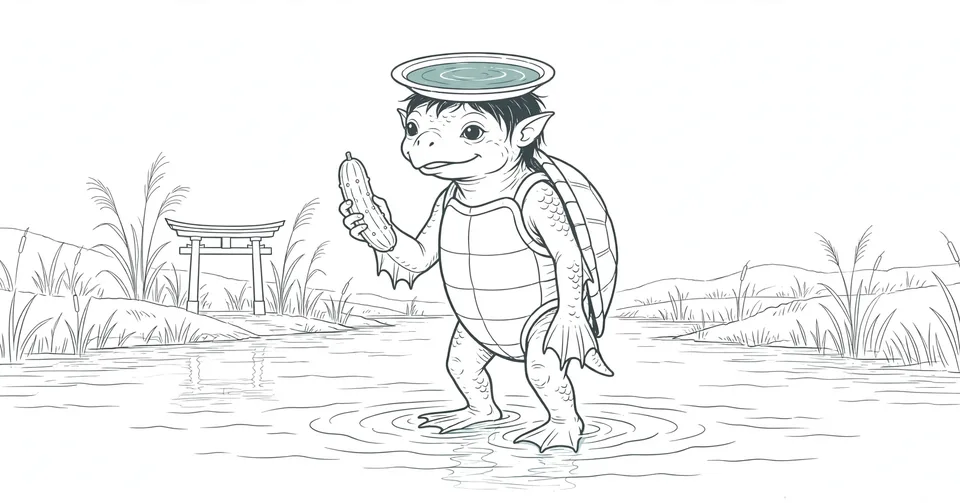
That is the part I find most charming about yokai. They were never locked away in a holy book or a museum. They belong to farmers, fishermen, children, and travelers, and anyone could meet one on the road home. A culture that keeps its monsters this close to daily life is a culture that is comfortable with mystery, and I think that is a healthier way to live with the unknown than pretending it does not exist.
What a Yokai Actually Is
The word yokai (妖怪) joins two characters that suggest something strange and suspicious, but the English translation "monster" or "demon" is too narrow. A yokai can be malevolent, benevolent, or completely neutral, and many of them are neither good nor evil in any simple sense. Some guard places, some play tricks, some bring luck, and some simply exist, like weather.
Scholars usually describe yokai as the embodiment of unexplained moments: footsteps behind you when no one is there, an object that vanishes and reappears, a shadow that moves on its own, or nature behaving in a way that does not fit the pattern. Before science offered other explanations, a yokai was a reasonable answer, and a memorable one.
It helps to separate yokai from two nearby words. Obake and bakemono mean "thing that changes", and they usually refer to shapeshifters such as foxes and raccoon dogs. Kami are the gods of Shinto, honored at shrines. Yokai sit somewhere between the two: too earthly to be gods, too strange to be animals, and too familiar to be ignored. The same fox that is a messenger of Inari at a shrine can be a trickster yokai on the road, and nobody in the old stories found that contradiction strange.
The Night Parade That Started It All
Yokai are old, but they were not always drawn. For centuries they lived in spoken stories told at night, and the most famous image of them is a parade. Hyakki yagyo, the Night Parade of One Hundred Demons, imagines a procession of yokai marching through the streets after dark, and anyone unlucky enough to see it would be carried away or driven mad. The idea appears in picture scrolls from the Muromachi period, and it became the single most famous scene in the whole tradition.
The parade got its definitive catalog in 1776, when the artist Toriyama Sekien published Gazu Hyakki Yagyo, "The Illustrated Night Parade of One Hundred Demons". It was the first visual guide to yokai, and it did for these creatures what a field guide does for birds: it gave each one a name, a face, and a place in the order of things. Many of the yokai we recognize today, from the long-necked rokurokubi to the one-eyed umbrella karakasa, first became widely known through Sekien's woodblock prints. The Edo period printing boom turned them into pop culture, and they have never really left.
Two later writers gave yokai their modern second life. Lafcadio Hearn, a Greek-born writer who settled in Japan, published Kwaidan in 1904, a collection of ghost stories that carried yokai like the snow woman yuki-onna to readers outside Japan. Kunio Yanagita, the founder of Japanese folklore studies, collected village tales in Tono Monogatari in 1910, grounding the creatures in real places and real voices. Then, in the 1960s, the manga artist Shigeru Mizuki almost single-handedly revived the whole world with GeGeGe no Kitaro, which debuted in 1960 and made a one-eyed boy and his yokai friends into household names.
Six Yokai You Will Meet Everywhere
Not all yokai are equal. A handful appear again and again, in stories, festivals, anime, and souvenir shops, and learning them is the fastest way into the tradition.
| Yokai | What it is | Where you meet it |
|---|---|---|
| Kitsune | A fox that shapeshifts, grows more tails with age, and serves the god Inari | Inari shrines, fox statues, and countless folktales |
| Kappa | A river creature with a dish of water on its head, fond of cucumbers and sumo | Rivers, ponds, and warning signs near water |
| Tengu | A long-nosed mountain goblin, proud and dangerous, yet a master of the sword | Mountain temples such as Kurama-dera near Kyoto |
| Tanuki | A raccoon dog that shapeshifts, loves sake, and carries a big belly and a bigger sense of humor | Pottery shops, restaurants, and folktales |
| Oni | A horned ogre with a club, the classic villain of Setsubun bean throwing | Festivals, temples, and children's stories |
| Yuki-onna | A beautiful woman of the snow who appears in blizzards | Snow country tales, and Hearn's Kwaidan |
The kitsune is probably the most famous of all. Foxes in Japanese folklore can turn into beautiful women, and the most powerful grow nine tails. They are also messengers of Inari, the god of rice and business, which is why stone foxes guard Inari shrines all over Japan. The same creature can be a loyal guardian in one story and a dangerous trickster in the next, and that double nature is the point. A kitsune is not a symbol with one meaning. It is a character with moods.
The kappa is the most practical of the famous yokai, and the one I would least like to meet in a river. It is green and turtle-like, with a beak and a dish of water balanced on its head, and it loves cucumbers and sumo wrestling. Folk wisdom says the dish is the source of its strength, so a polite bow makes the kappa bow back, spill its water, and lose its power. Parents once used kappa stories to warn children away from deep water, which may be the most useful thing a monster has ever done.
The tengu lives in the mountains, red-faced with a very long nose, dressed like a mountain monk and carrying a feather fan. Old stories treat the tengu as proud and dangerous, a creature that punishes arrogance and leads travelers astray. Yet the same tengu is also a guardian of the mountains and a master swordsman, and serious martial artists once claimed to have learned from them. Kurama-dera, the temple on Mount Kurama near Kyoto, is still associated with tengu today, and the mountain air there does feel like a place where something old might be watching.
The tanuki is the comic relief of the group. A raccoon dog with a talent for shapeshifting, a love of sake, and a cheerful belly, the tanuki turns into teapots, monks, and pretty women, usually for a joke rather than for harm. Pottery tanuki statues stand outside restaurants and shops across Japan, one paw raised in welcome, and they are closer to mascots than monsters. If the kappa teaches caution and the tengu teaches humility, the tanuki teaches that a little mischief keeps life interesting.
The Quiet Ones in the Corners
Beyond the famous six, there is a quieter family of yokai that I find even more interesting, because they live inside the house. Tsukumogami are household objects that come alive on their hundredth birthday: an umbrella that hops on one leg, a paper lantern with a long tongue, a pair of sandals that wanders off at night. The idea is oddly tender. It suggests that things we use every day gather a kind of spirit, and that throwing them away without thanks is a small rudeness.
The baku eats nightmares. If you wake from a bad dream, tradition says you can call on the baku, a creature with an elephant's trunk and a lion's body, to devour the dream before it comes back. Children in Japan still learn the rhyme that summons it. The zashiki-warashi is a child spirit that lives in old houses and brings good fortune to the family it chooses, leaving quietly when it is ignored. None of these creatures wants to hurt anyone. They ask, in their strange way, to be noticed and treated with respect.
That respect is the thread that runs through the whole tradition. Yokai are not defeated with swords in most stories. They are outwitted, bargained with, thanked, or simply left alone. The old advice for meeting one was often to be polite first and curious second, which is not bad advice for meeting anything unfamiliar.
How Yokai Survived Into the Modern World
Yokai should have faded away. Japan modernized fast, electric light pushed back the dark, and science explained the noises in the night. Instead, the creatures adapted, and Shigeru Mizuki deserves much of the credit. Born in 1922 in Sakaiminato, a small port town in Tottori Prefecture, Mizuki spent decades collecting folk tales from every corner of Japan and drawing them into manga. GeGeGe no Kitaro made yokai funny, sad, and brave, and it gave postwar children a version of folklore that felt like theirs.
Mizuki's work also kept the details honest. He drew the kappa with its dish, the tengu with its fan, and the rokurokubi with its stretching neck, all in the forms the old stories described. He was not inventing monsters. He was recording them before the last people who believed in them were gone, and his encyclopedias of yokai are still used as references today. Mizuki died in 2015 at the age of 93, by then recognized with major manga prizes in Japan and abroad, and his hometown still honors him.
Cinema carried the tradition further. Studio Ghibli filled Spirited Away with yokai, from the masked No-Face who devours everything in sight to the river spirit who arrives covered in filth and leaves clean. The film treats these creatures the way the old stories did, as beings with jobs, appetites, and feelings, not as villains to be slain. The success of that film introduced yokai to audiences who had never heard the word, and many of them went looking for more.
Video games finished the job. The Yo-kai Watch series turned the creatures into collectible companions for a new generation, and Pokemon's designers have borrowed from yokai for decades. A child today may meet a kappa first in a game, then in a manga, and only later in a folktale, but the creature is the same one that haunted the rivers of the Edo period.
Where to Meet Yokai in Japan
The best place to start is Sakaiminato, Mizuki's hometown. Mizuki Shigeru Road is an 800-meter shopping street lined with 177 bronze statues of yokai from his manga, and walking it feels like stepping into one of his pages. The town leans into the theme without embarrassment, and the statues are photographed constantly, which is a strange kind of afterlife for creatures that once hid in the dark.
Tono, in Iwate Prefecture, is the other classic stop. Yanagita's Tono Monogatari collected its tales here, and the town still markets itself as the home of kappa, with a kappa shrine and a stream where visitors leave cucumbers as offerings. It is a quiet place, far from the tourist crowds, and that suits the stories. Yokai belong to the countryside, to the hours after the last bus leaves and the road goes dark.
Closer to the cities, Fushimi Inari in Kyoto offers the kitsune in its grandest form, with thousands of vermilion gates and fox statues tucked into every corner. Kurama-dera offers the tengu. And for the simplest encounter of all, any old shopping street in Japan will have a maneki neko in a window, a close cousin of this world, beckoning customers with one raised paw. The lucky cat is not usually counted as a yokai, but it comes from the same imagination, the same belief that a small figure can carry a large hope.
If you go looking for yokai, go with the attitude the old stories recommend. Walk slowly, look at the small things, and do not assume that every strange shape has a boring explanation. Japan is a country that still leaves room for mystery, and the yokai are the proof. They survived the printing press, the railroad, the television, and the smartphone, not because people are afraid of them, but because people like them. A world with a kappa in the river and a tanuki in the shop is a richer world than a world without them, and the Japanese have known that for a thousand years.
More in Culture & Society
Latest posts
- Namasu Turns Daikon and Carrot Into a Red and White Wish
- Ebi Bends Like an Old Back and Wishes You a Long Life
- Kobumaki Rolls Joy Into a Strip of Kelp
- Kurikinton Is the Golden Mash That Wishes You Wealth
- Japanese Beer and the Dry Wars That Changed How Japan Drinks
- Kamaboko Paints the New Year Red and White
- Datemaki Rolls Sweet Eggs Into a Spiral of Good Luck
- Japanese Bento and the Lunch Box That Became an Art Form
- Tazukuri Turns Tiny Sardines Into a Wish for a Good Harvest
- Kazunoko Is the Herring Roe That Promises Children and Plenty
- Kuromame Turns Black Beans Into a Wish for Health
- Jubako Layers a Family's Luck One Box at a Time
- Osechi Packs a Whole Year of Luck Into Stacked Boxes
- Kojiri Is the End Cap That Takes Every Knock for a Katana
- Kurikata Is the Chestnut Knob That Holds a Katana at the Hip