Yadnya Kasada, the Festival That Feeds the Crater of Mount Bromo
· 8 min read
Yadnya Kasada is the night the Tengger people of East Java climb Mount Bromo and throw offerings of food, flowers, and livestock into its smoking crater. Here is the legend behind it, how the night unfolds, and how visitors should behave around a living rite.
Once a year, in the coldest hours of the night, thousands of people climb an active volcano in East Java and throw food, flowers, and livestock into its smoking crater. This is Yadnya Kasada, the most important festival of the Tengger people, and it is not a performance for visitors. It is a promise being kept.
The Tenggerese believe that what they give to Mount Bromo comes back as protection and a good harvest. So families save for months, prepare their best produce, and walk up the mountain in the dark, carrying offerings that a less devoted eye might see as a small fortune being thrown away.
To understand the festival, it helps to know the mountain first. Most visitors meet Bromo on a sunrise tour, crossing the sea of sand by jeep and climbing the steps to the rim, as described in our guide to Mount Bromo, the volcano you can walk into. On the night of Yadnya Kasada, that same rim belongs to the people who live in its shadow.
The Tengger people of the highlands
The Tenggerese are a Hindu community living in villages scattered across the highlands around Mount Bromo, inside and around the Bromo Tengger Semeru National Park. Reference accounts put their villages at around sixty, spread over the regencies of Probolinggo, Lumajang, and Pasuruan, and the city of Malang. They are Hindus on an island where most people are Muslim, and they have kept that faith in these mountains for centuries.
Their own history traces the community back to the Majapahit kingdom, the great Hindu empire of Java that fell in the early 1500s. As the lowlands changed around them, the ancestors of the Tenggerese withdrew into the high country and held on to their temples, their calendar, and their way of praying. The name Tengger itself is said to come from the names of the founding couple of their most famous legend, Roro Anteng and Joko Seger. It is that legend, more than anything else, that explains Yadnya Kasada.
Daily life here is farming life. The volcanic soil is rich, and the slopes grow potatoes, cabbages, onions, and other highland vegetables. That harvest is the community's wealth, and it sits at the center of what Yadnya Kasada is about: gratitude for abundance received, and a request that the mountain keep providing it.
A promise made on the mountain
Every account of the festival begins with the same story. Roro Anteng, a princess of Majapahit, and her husband Joko Seger settled in the Tengger mountains, but after many years of marriage they still had no children. So they climbed Mount Bromo and meditated, asking the mountain gods for help.
The gods answered. The couple would be given many children, but on one condition: the youngest must be given back to the volcano. Indonesia's official tourism portal tells the common version, in which the gods granted 24 children and the 25th was surrendered to the crater as promised. In that telling, the tradition of throwing offerings into Bromo began as a way of continuing the sacrifice with animals and crops instead of a human life, and every Yadnya Kasada since then has repeated that exchange.
There is a second version, and it is the sadder one. In it, the couple could not bring themselves to keep the bargain. The mountain erupted in anger, and their youngest son, Kesuma, was taken into the crater. Before he vanished, his voice was heard asking his brothers and sisters to remember him: to live in peace, to worship Sang Hyang Widhi, and to make offerings in the crater every year on the 14th day of the month of Kasada.
Both versions end with the same instruction, and Yadnya Kasada is the community still obeying it. Whichever version a family prefers, the meaning lands in the same place. The offerings are not superstition dressed up for tourists. They are the yearly renewal of a covenant between a community and the mountain that feeds and threatens it in equal measure.
When Yadnya Kasada falls
Yadnya Kasada does not follow the calendar on your phone. The Wikipedia entry on Yadnya Kasada gives the fixed point plainly: the festival is held on the 14th day of Kasada, a month in the traditional Tengger calendar, and Kasada is the month from which the festival takes its name. Because that calendar moves against the Gregorian one, the date shifts from year to year. In recent years the main night has fallen somewhere between late May and July, so anyone planning around it has to check the announced dates for that specific year.
The festival is also longer than its famous night. The wider season of Yadnya Kasada stretches across roughly a month of rituals organised around Pura Luhur Poten, with prayers and preparations building toward the 14th day. Tenggerese from villages across the highlands begin gathering at the temple well before the peak, and the atmosphere around Bromo changes gradually from ordinary tourism to something much more like a homecoming.
That slow build matters. Yadnya Kasada is not a single evening of spectacle but the high point of a season of devotion, and the night itself is simply when the promise comes due.
The night at Pura Luhur Poten
The ceremony centers on Pura Luhur Poten, a Hindu temple standing alone on the Segara Wedi, the sea of sand at the foot of Mount Bromo. It is a striking building, made from natural black volcanic stone rather than the red brick of Balinese temples, and on the main night of Yadnya Kasada it fills with worshippers who have crossed the dark plain on foot, on horseback, and by jeep.
There, the Tenggerese pray together and ask for blessings from Sang Hyang Widhi Wasa, the Almighty, and from the god of Mahameru. Mahameru is Mount Semeru, Java's highest volcano, whose plume is often visible on the horizon from Bromo's rim. The two mountains are linked in Tenggerese belief, and the prayers at Poten treat the whole volcanic landscape as sacred ground, not just the crater that receives the offerings.
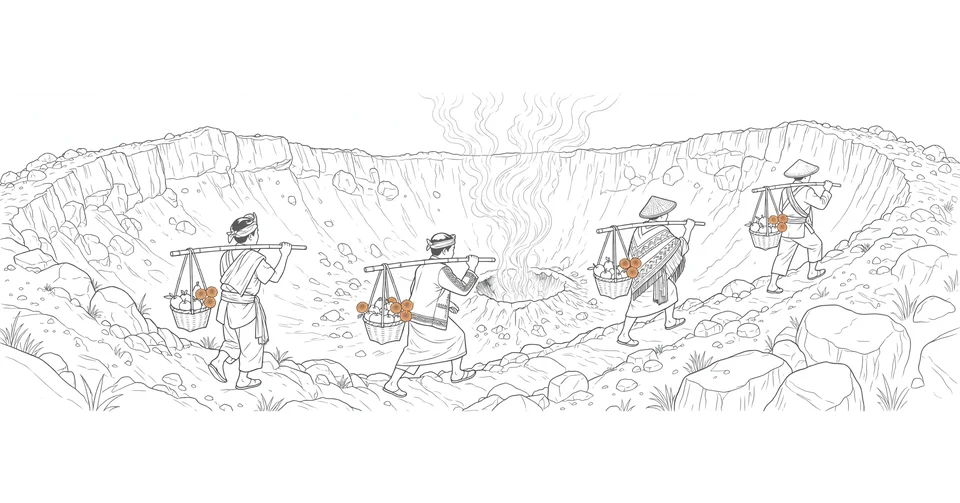
After the prayers, the Yadnya Kasada procession climbs. Families carry their offerings up the roughly 250 steps to the crater rim in the last hours of the night, wrapped against a cold that surprises visitors who think of Java as uniformly hot. At the rim, priests and shamans lead final prayers, and then the giving begins.
What goes into the crater
The offerings given at Yadnya Kasada, called ongkek in some accounts, are the produce of a farming year: vegetables, fruit, rice, and flowers, along with livestock such as chickens and goats, and sometimes money. They are offered in thanks for agricultural and livestock abundance, and they go over the rim one family at a time, into the smoke and ash below.
Then comes the part that startles first time witnesses. Stationed on the steep inner slopes of the crater, below the rim, are local men, the catchers of Yadnya Kasada, with nets, sacks, and tarps, waiting to catch what the worshippers throw. It looks, at first glance, like the offerings are being stolen. The Tenggerese view it differently. The gift is complete the moment it leaves the giver's hands. What happens after that is the mountain's business, and the catchers, who risk a dangerous perch on loose ash, believe what they retrieve brings good luck. Some locals have long climbed down toward the crater to recover sacrificed goods for exactly that reason.
I find that double movement the most honest thing about the night. One family throws away its best goat as an act of faith, and a poorer neighbour catches it as an act of survival, and neither act cancels the other out. The crater, for a few hours, is both an altar and a livelihood.
Watching as a guest, not an audience
Visitors are not the point of Yadnya Kasada, and the mountain makes that clear. In recent years the national park authority has closed the Bromo tourist area to general tourism for several days around the main rites, keeping the caldera for the Tenggerese and those involved in the ceremony. Dates and the exact scope of the closure are announced each year, so the practical rule is simple: check the park's announcement before planning a trip that overlaps Yadnya Kasada.
If you are present for the parts that remain open to watching, behave as you would inside any place of worship. Stay where rangers and local guides direct you, keep your voice down during prayers, dress warmly and modestly, and never reach for, buy, or interfere with an offering. The men on the crater slopes are not a photo opportunity to climb down after, and the rim is a dangerous place even on a quiet morning.
It also helps to come with the right expectations. The night is cold, crowded, and long, and the most important moments are prayers, not spectacles. What you are witnessing is a community keeping a promise it believes its survival depends on.
Stand back, watch quietly, and let the mountain be fed. Long after the sunrise crowds have gone home, it is this night of Yadnya Kasada, repeated every year for as long as anyone can remember, that explains why the Tenggerese still call this volcano theirs.
More in Culture & Society
Latest posts
- Dashi, the Quiet Stock Under Almost Everything Japan Cooks
- Ayu, the Sweetfish That Rules Japan's Clear Rivers
- Gensen Kakenagashi, the Onsen Water That Never Circles Back
- Sumadori, Japan's Smart Drinking for People Who Do Not Drink
- Sake Kasu, the Sake Lees Japan Cooks With Instead of Throwing Away
- Bureiko, the Drinking Party Where Rank Is Left at the Door
- Kopi Tubruk and the Indonesian Way to Drink Coffee
- Capsule Hotels and Sleeping in a Pod in Japan
- Subak and the Rice Terraces of Bali
- Shinnenkai, Japan's New Year Parties That Start the Year Over
- Nara Deer and the Sacred Animals of the Old Capital
- Punakawan, the Clown Servants Who Steal Every Wayang Show
- Kashikiri, the Private Onsen Bath You Book by the Hour
- Nomi-Hara, When After-Work Drinks in Japan Turn Into Harassment
- Shio Koji, Japan's Salted Ferment That Seasons Everything