The Tengger People, Keepers of Mount Bromo
· 9 min read
The Tengger people are a Hindu community farming the volcanic slopes around Mount Bromo in East Java, holding on to the faith of Majapahit for five centuries. Meet the priests who farm, the legend behind their name, and the promise they still keep.
High on the cold slopes around Mount Bromo in East Java, the Tengger people farm and pray in villages that have been Hindu for some five centuries, on an island where the large majority of people are Muslim.
The Tengger people are farmers and priests, sometimes both in the same person, and their calendar turns around a single obligation. Once a year they climb their volcano and feed it, keeping a promise that their founding legend says was made before their community existed.
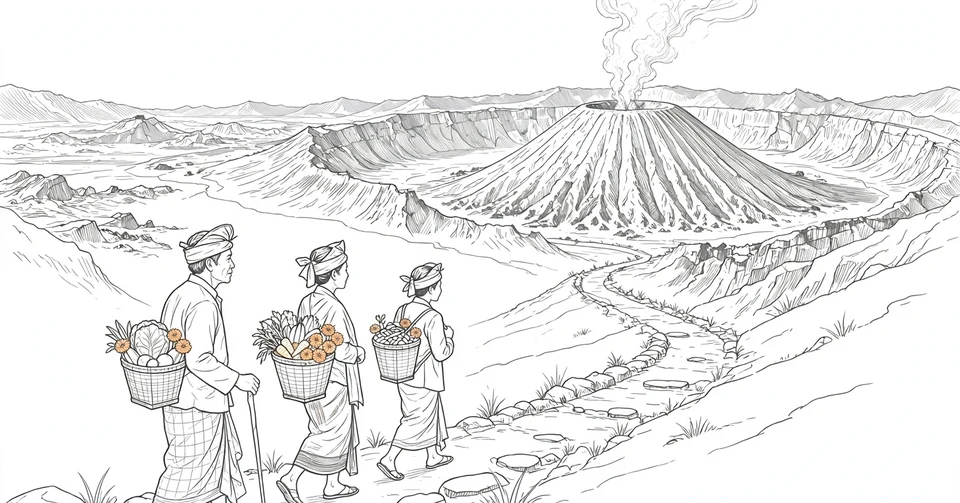
To most visitors, Bromo is a sunrise viewpoint. To the people who live on its slopes, it is a god, a landlord, and a neighbour all at once. Understanding the Tengger people means understanding that relationship, and it begins with where they live and what their name remembers.
Where the Tengger people live
The Tengger people are a subgroup of the Javanese, centred on the isolated Tengger mountains inside the Bromo Tengger Semeru National Park. Their villages are scattered across four regencies of East Java, Pasuruan, Probolinggo, Malang, and Lumajang, at altitudes where the nights turn genuinely cold and a jacket is not a tourist affectation.
Estimates of their number differ widely. Reference accounts often give around 100,000 people in some thirty villages, while guides in the highlands have claimed far more, so any single figure should be read as an approximation. What is not in doubt is the shape of the settlement: small farming villages strung along the rim and slopes of the Tengger caldera, looking inward at the grey sea of sand and the cone of Bromo rising from it.
The Tengger people speak an archaic form of Javanese, a dialect that preserves the language of the Majapahit era, and their religious manuscripts use the old Kawi script. Isolation did much of this preserving for them. The mountains were far enough from the lowland courts, and later from the coastal trading cities, that change arrived slowly.
A name folded into a legend
Tradition traces the Tengger people to a couple. Roro Anteng was a daughter of King Brawijaya of Majapahit, and Jaka Seger was a young man of the Brahmin caste. As the great Hindu kingdom of Java crumbled in the 15th century and Islam spread through the lowlands, the two fled with their followers into these mountains and built a small realm of their own.
The name Tengger is said to be folded out of their names, Anteng and Seger joined together, and the couple is remembered as the ancestors of the whole community. The historical core beneath the legend is plain enough. When Majapahit fell, Hindu communities that would not convert withdrew to places the new order reached last, and the Tengger highlands were among the last refuges.
The legend then turns to the bargain that still organises Tengger life. The couple had no children, so they climbed Bromo and prayed. The mountain gods promised them children, twenty five in the usual telling, on one condition: the youngest, Kesuma, must one day be given back to the crater. The full story, and the night it still produces every year, is told in our account of Yadnya Kasada, the festival that feeds the crater of Mount Bromo.
The faith of the Tengger people
The religion of the Tengger people is a Javanese Hinduism that has never been separated from older layers of belief. They worship Sang Hyang Widhi Wasa, the Almighty, along with the Hindu triad of Shiva, Brahma, and Vishnu, and their practice also carries Buddhist elements gathered during the centuries when the kingdoms of Java honoured both faiths at once.
Alongside the great gods stands a crowd of nearer spirits. The Tengger people honour the cikal bakal, the founders of each village, the guardian spirits who watch over it, and the roh leluhur, the spirits of their own ancestors. In some rites, small figures dressed in batik cloth stand in for these spirits and are presented with food and drink, on the understanding that the spirits take the essence of what is offered.
Mount Bromo itself is sacred ground. The Tengger people treat the volcano as a living power, and an eruption is read as a sign that the god of the mountain is angry. Their temple, Pura Luhur Poten, stands on the sea of sand at the foot of Bromo, an open temple of volcanic stone where the community gathers before climbing to the crater.
I find something steadying in that arrangement. The Tengger people do not treat their volcano only as a hazard to be managed or a view to be sold. It is a member of the moral community, owed honesty like anyone else.
Priests who are farmers first
Each village of the Tengger people has one priest, called a dukun and sometimes styled dukun pandhita, assisted by three helpers whose titles are Legen, Sepuh, and Dandan. The priest guards the sacred knowledge of prayers and rites, much of it memorised rather than written for everyday eyes, and the office usually passes from father to son. The Wikipedia overview of the Tenggerese people notes that this knowledge of the gods and spirits is carefully guarded from ordinary villagers.
Above the village priests stands a chief dukun for the whole region. When a reporter from Hinduism Today visited the highlands, the chief priest, Dukun Sutomo, explained that his father and grandfather had held the role before him, and said of his own service: "When I work as a priest, I am performing my duty, not to make money."
That sentence explains itself once you know how the priests live. The dukun of the Tengger people are farmers. Sutomo spent his days on his own fields unless the community called, and the priests who serve at Poten rotate their temple days with days spent tending their farms. Authority here is not a profession. It is a duty laid on top of the same working life everyone else leads.
Farming the volcanic slopes
The Tengger people farm some of the most dramatic soil in Indonesia. Volcanic ash makes the slopes fertile, and the altitude keeps them cool, so the fields grow the vegetables of a temperate garden rather than a tropical one: potatoes above all, with cabbage, onions, carrots, and scallions filling the terraces. Rice, the lowland staple, does not thrive up here, and corn takes part of its place.
Farming is shaped by altitude. Households lower down work the fields, while the higher settlements have traditionally kept herders moving across the slopes with small horses. In recent decades the mountain has added a second harvest. Visitors arrive in the dark for the Bromo sunrise, and Tengger families now rent out jeeps and horses, run guest houses, and staff the small economy that tourism built, without giving up the fields that were there first.
There is a risk in that double life, but so far the Tengger people seem to have taken tourism on their own terms, selling the view of the mountain while keeping its meaning for themselves.
A calendar of promises
Yadnya Kasada is the peak of the year, a festival season of about a month that builds toward the 14th day of the month of Kasada in the Tengger calendar. Families pray at Pura Luhur Poten, then climb to the rim and give the crater rice, fruit, vegetables, flowers, and livestock, renewing the bargain their ancestors made. During the same season, the community examines its medicine men on their memorised prayers, and the one who passes the test is recognised as a spiritual leader.
Kasada is not the only obligation. Other rites honour the ancestors through the year, including the Karo festival and ceremonies such as Entas Entas, where a clay vessel wrapped in leaves represents the soul of the dead and is carried out of the village with offerings for its journey. The dead here are buried, not cremated, a custom the Tengger people trace to the days of the Hindu kingdoms, when cremation was reserved for royalty.
Seen from outside, the festivals can look like folklore. From inside, they are bookkeeping of the most serious kind: debts to gods and ancestors, recorded in prayer and paid in produce.
Keeping the faith in a changing landscape
The Tengger people have not kept their world by accident. In the last century, settlers from Madura cleared reserve land at the edges of the highlands, and some Tengger communities in the more accessible lowlands converted to Islam under missionary pressure. The declaration of the Bromo Tengger Semeru National Park slowed the logging and the land pressure, protecting the villages along with the landscape.
Pressure has also come in a gentler form, from fellow Hindus. In the 1980s and 1990s, Balinese style temples were built in Tengger villages as part of a national effort to organise Hindu worship, sometimes directly in front of the older Tengger prayer houses, the sanggar. Most Tengger people still worship at the sanggar. True to their reputation for quiet endurance, they did not publicly oppose the new temples. They simply continued with their own.
That patience may be the defining trait of the community. The same old Java that produced the gamelan orchestras and the shadow plays of the epics survives in these villages in daily form, not as performance but as routine.
The Tengger people ask little of the visitor who comes to watch their volcano at dawn. But it is worth knowing, standing on the rim, that the mountain below is not scenery to the families climbing past with their offerings. It is the keeper of a promise, and they are its keepers. Five centuries after their ancestors climbed into these hills to hold on to a faith, the Tengger people are still there, farming the ash, feeding the crater, and keeping the bargain.
More in Culture & Society
Latest posts
- Kombu Is the Quiet Half of Dashi
- Manza Onsen Bathes at 1,800 Metres
- Every Prefecture Argues About What Goes in Ozoni
- KRL Commuterline and the Trains That Move Jakarta
- Kecap Manis and the Sweet Soy Sauce of Indonesia
- In Mamoiada, Two Hundred Families Still Make Wine at Home
- Shochu and the Quiet Spirit of Japan
- A Dried Shiitake Is Louder Than a Fresh One
- Loma Linda's Long Lives Run on Saturdays
- Maruten Numazu and the Towering Kakiage Bowl of the Port
- The Three Sisters Grow Better Together
- Tatamiishi Terraces Filter a River Through Stone
- Wasabi-Zuke Puts the Whole Plant in Sake Lees
- Konyoku Is Still Out There, Past the Last Train Station
- Dry January Lasts a Month on Purpose