A Tegata Is Sumo's Inked Handprint Autograph
· 19 min read
A tegata is the inked handprint autograph of a sumo wrestler, pressed onto a shikishi board and signed with his ring name in calligraphy. Only a sekitori may make one, which is why fans treasure it.
A sumo wrestler never signs his name the way other athletes do. He does not reach for a pen, and he does not scribble across a shirt or a ball. Instead he dips his open hand in ink, presses it firmly onto a board, and writes his ring name beside the print in bold calligraphy. The result is called a tegata, and it is the most personal autograph in Japanese sport.
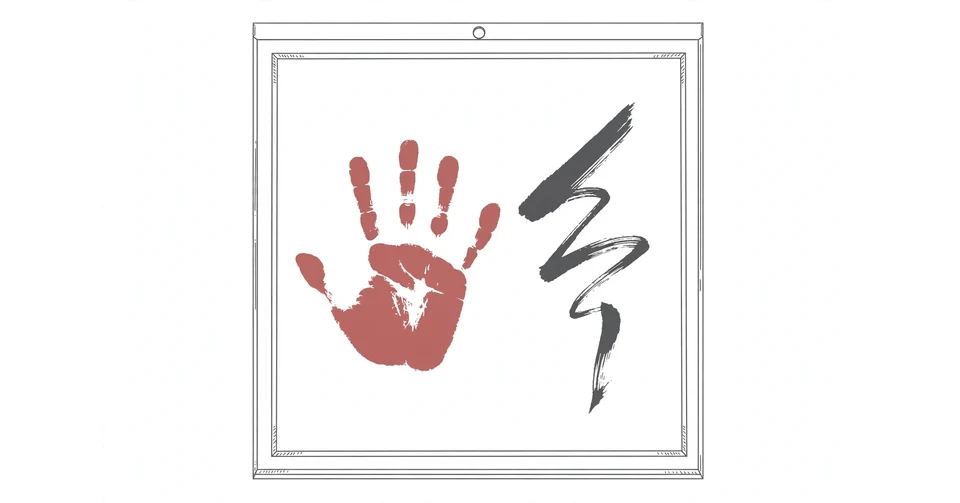
A tegata is simple to describe and hard to forget once you have seen one. A large dark handprint fills most of a square board, and beside it sits the wrestler's shikona, the ring name he fights under, brushed in black ink. Nothing else is needed. The hand itself is the signature, and no two prints are ever alike.
Fans treasure these boards because they carry something a printed photo cannot. A tegata holds the literal touch of the wrestler, made by his own hand in a quiet moment away from the ring. It is at once a souvenir, a mark of rank, and a small piece of sumo history, and understanding it opens a window into how the sport honours its own.
What a tegata actually is
The word tegata means hand print, and the object lives up to the name with complete honesty. A tegata is a wrestler's handprint in red or black ink, made on a square paperboard, with his shikona written by the wrestler himself in calligraphy. The print and the writing belong together. The handprint proves the wrestler was there, and the calligraphy says who he is.
Most examples come on a standard shikishi board, the thick square card used for autographs and celebratory messages across Japan. The Japan Times notes that a tegata normally comes on a board measuring 27 cm by 24 cm, a size large enough for a wrestler's broad hand and his brushwork to share the space without crowding each other. The board is sturdy, easy to frame, and made to last, which matters because a tegata is meant to be kept, not used and thrown away.
A tegata can be an original or a copy. The original is the board the wrestler pressed his own hand onto, and it carries the small imperfections that prove a human hand made it. Copies are printed reproductions of an original, and they let many more fans own the image of a famous wrestler's hand. A copy of a tegata may even be imprinted onto other memorabilia, such as porcelain dishes, so the handprint travels further than a single board ever could. Collectors learn to tell the difference, and they value the original far above the copy, but both forms keep the tradition alive.
What makes a tegata different from an ordinary autograph is that it cannot be faked by practising a signature. A handprint records the size of the hand, the spread of the fingers, the lines of the palm, and the weight of the press. It is a portrait in ink, and it says more about the man than a written name ever could. When you look at a tegata, you are looking at the same hand that grips a mawashi and pushes an opponent across the ring.
How a wrestler makes a tegata
Making a tegata looks simple, and in one sense it is. The wrestler sits at a table with an ink pad, a stack of shikishi boards, and a brush. He coats his open palm with ink, presses it down onto the board with steady pressure, and lifts it away in one smooth motion. Then he picks up the brush and writes his shikona beside the print. The whole act takes less than a minute, yet every step carries meaning.
The ink matters. Handprints are made with black or red ink, and the wrestler's name is always written afterward in black. Red ink used to be much more common, but in recent years wrestlers have preferred black, and a modern tegata is usually a black handprint with black calligraphy. The older red prints, made when red was the fashion, now stand out in collections as reminders of an earlier style.
The pressing itself is harder than it looks. A sumo wrestler's hand is large and heavy, and the ink must spread evenly across the palm and fingers without pooling in the creases. Too little pressure and the print comes out faint, with broken lines where the hand never touched the board. Too much pressure and the ink smears, blurring the edges of the fingers. Assistants often hold the board steady and hand the wrestler a fresh ink pad, because the work is repetitive and the wrestler may make many boards in a single session. The Japan Times reports that tegata are made in batches, and a wrestler who sits down to make them will produce a stack of boards before he stops.
The calligraphy is the second half of the craft. A shikona is not a name the wrestler was born with. It is a ring name, often given by his stablemaster, and it carries the identity he fights under. Writing it in brush strokes beside the handprint turns the board from a simple print into a signed work. The strokes are bold and confident, the way a man writes a name he has carried through years of training and tournaments. A shaky signature would embarrass a wrestler, so the brushwork is practised until it looks effortless.
There is something quietly moving about the process. A wrestler spends his days in a world of noise and impact, of crowds and collisions. Making a tegata asks him to sit still, to be careful, and to leave a gentle mark instead of a forceful one. The hand that shoves opponents out of the ring is the same hand that presses softly onto paper. That contrast is part of why fans find the tradition so touching.
Only sekitori may make a tegata
Not every sumo wrestler can make a tegata. The privilege belongs only to sekitori, the wrestlers ranked in the top two divisions, juryo and makuuchi. A wrestler in the lower divisions, however talented and however hard he trains, must wait. He cannot press his hand onto a board and call it a tegata until he has earned promotion into the salaried ranks.
This rule is one of the clearest lines in sumo. Reaching sekitori changes a wrestler's life in many ways. He starts to earn a salary, he gains attendants, and he wears the white silk mawashi that marks his new status. Only sekitori are allowed to make tegata, and the handprint joins that list of honours as one of the most visible signs that a man has arrived. The white silk article on this site explains what that promotion means, and a tegata is one of the rewards that comes with it. You can read about that moment in White Silk Means You Made It as a Sekitori, which describes how the rank transforms a wrestler's daily life.
The restriction gives the tegata its value. If every wrestler could make one, the boards would be common, and fans would collect them the way they collect any souvenir. Because only sekitori may make them, each tegata is proof of a career that reached the top two divisions. A young wrestler who dreams of making his first tegata is really dreaming of promotion, and the board becomes a goal as much as a keepsake.
The rule also protects the tradition from being cheapened. Sumo guards its honours carefully, and the right to make a tegata sits alongside other privileges that separate sekitori from the rest of the stable. A fan who receives one knows that the hand on the board belongs to a man who fought his way into the salaried ranks, and that knowledge is part of the gift.
I think this restraint is wise. Modern sport often gives everything away at once, and the result is that nothing feels special. Sumo does the opposite. It makes a wrestler wait, and when he finally presses his hand onto a board, the moment means something because it was earned. A tegata is not just ink on paper. It is a certificate written by the wrestler's own hand, and the rule that only sekitori may make one keeps that certificate honest.
Why fans treasure a tegata
A tegata is the most desirable item of sumo memorabilia, and the reason is not hard to understand. A fan can buy a towel, a trading card, or a miniature figure at any tournament, but none of those objects were touched by the wrestler. A tegata was. The wrestler's own hand pressed the ink onto the board, and the fan who owns it holds something the wrestler himself made.
The boards are also scarce by design. The real thing is never officially sold, and the only way to get a tegata is from the wrestler himself or his stable. Wrestlers make them in batches and give them to members of their supporters clubs and a few other select individuals. A fan cannot simply walk into a shop and buy an original. He needs a connection, a membership, or a stroke of luck at a fan event. That scarcity makes each board feel personal, as if it were made for the person who receives it.
There is also the question of luck. Many fans treat a tegata as a good luck charm, a piece of a strong man's power to hang on the wall. The handprint of a champion is thought to carry something of his strength, and a board from a yokozuna is prized above all others. Whether or not you believe in that kind of luck, the feeling behind it is easy to respect. People have always wanted to keep a piece of the people they admire close by, and a tegata lets a sumo fan do exactly that.
The emotional side of collecting matters more than the money. A tegata often marks a memory. A fan may have received one after a tournament, at a stable open house, or from a friend who knew a wrestler. Years later the board still recalls the day it changed hands, the crowd, the weather, the excitement of standing near a man who seemed larger than life. The ink does not fade from the memory even if the years pass.
I find this the most human part of the tradition. Sport is full of merchandise, and most of it is forgotten within a season. A tegata survives because it is not merchandise in the ordinary sense. It is a meeting between a wrestler and a fan, recorded in ink. The wrestler gives a piece of himself, and the fan keeps it with care. That exchange is simple, and it is the reason the boards are still treasured centuries after the practice began.
How a tegata is collected and displayed
Collecting a tegata starts with knowing where the boards come from. Since originals are never officially sold, a collector has a few honest routes. Fan events and stable open house days sometimes offer the chance to receive one, and specialty retailers sell both printed reproductions and authenticated originals for fans who cannot attend in person. The guide at SumoSumoSumo explains that you can sometimes obtain a tegata at official fan events, during stable open house days, or through specialty sumo retailers, and it lists the shops in Ryogoku where sumo goods change hands all year round.
Serious collectors treat a tegata like a small work of art. The board is framed, usually under glass, and hung where the handprint and the calligraphy can both be seen clearly. A single board from a favourite wrestler may hang alone in a living room or a study, while a dedicated collector may line a wall with dozens of boards, each one a different hand and a different name. Some foreign collectors own hundreds of handprints, building collections that cover generations of wrestlers. A wall of tegata is a visual history of sumo, told one hand at a time.
Framing protects the ink and the board from sunlight, dust, and damp, and collectors who care about their boards keep them out of direct sun. The shikishi board is sturdy, but ink can fade over decades if it is left in harsh light. A good frame with glass is a small investment that keeps a wrestler's handprint clear for the next generation. The board is light enough to hang anywhere, and its square shape fits neatly beside photographs and other memorabilia.
Display is also a matter of respect. A tegata is not a poster to be pinned up carelessly. Collectors hang it straight, at eye level, where visitors can see it and ask about it. The board invites conversation, and the owner will usually have a story about how it came into his hands. That story is part of the collection, and it is often retold each time a guest notices the handprint on the wall.
The market for originals exists because the supply is small and the demand is steady. Prices fluctuate, and they are influenced by the popularity of the wrestler and the rarity of the handprint. A board from a famous yokozuna costs far more than one from a wrestler who spent a single tournament in juryo, and a board from a retired legend costs more still. The most expensive of all are the legendary figures from the Edo era, whose handprints survive as rare pieces of history. A collector who buys on the secondary market should check the seller carefully, because the value of a tegata depends on it being genuine, and a printed copy is worth far less than an original.
For a new collector, the honest advice is to start with a wrestler you genuinely admire, and to prefer a board whose story you know over a famous name with no history attached. A tegata is worth most when you know whose hand made it and why it came to you. The price matters less than the connection, and a modest board with a real story will give more pleasure than an expensive one bought only for its name.
What a tegata says about rank and career
A tegata is a record of a career as much as a souvenir, and a collector who knows how to read one can learn a great deal from it. The most obvious lesson is the rank. Only sekitori make them, so a board proves its maker reached juryo or higher. But the details on the board say more than that, because higher ranked wrestlers add marks that lower ranked men do not use.
Ozeki and yokozuna also put their official name and rank stamps on the boards, alongside the handprint and the shikona. These stamps, pressed in red ink, are formal seals that declare the wrestler's standing. A tegata from a yokozuna carries stamps that a tegata from a juryo wrestler does not, and the difference is visible at a glance. The stamps turn the board into a document, and the rank is written into the object itself.
There is an even finer detail for the very top of the sport. The word Hinode, the nickname of Akashi Shiganosuke, the first yokozuna, appears stamped only on the tegata of yokozuna to signify their rank. It is a small mark with a long history, connecting every modern yokozuna to the first man who held the title. A collector who spots that stamp knows at once that the hand on the board belonged to the highest rank in sumo.
The career of a wrestler can also be read in the collection of his boards over time. A wrestler who changes his shikona will sign later boards with a different name, and collectors keep both versions as records of the change. A wrestler who rises from juryo to makuuchi, then to ozeki and perhaps to yokozuna, will make boards at each stage, and the stamps on them change as he climbs. A set of tegata from one man, made across the years, tells the story of his career in a way no written record quite matches.
Retirement changes the meaning of a tegata, too. Once a wrestler leaves the ring, he will never make another board, and the ones he made become fixed in number. A tegata from a retired legend is therefore a closed set, and its value grows as the years pass and the wrestler's fame settles into history. The board becomes a memorial as well as a souvenir, a reminder of a career that is finished and cannot be repeated.
This is why the rank of yokozuna matters so much to collectors. The highest rank in sumo is never taken back, and a tegata from a yokozuna carries that permanence. A fan who owns one holds the handprint of a man whose rank is forever, and the board gains meaning from that fact. You can read about the permanence of the rank in Yokozuna Is the Rank Sumo Never Takes Back, which explains why the title stays with a wrestler for life.
Originals, copies, and the market for a tegata
The market for tegata is unusual because the most desirable object in it was never meant to be sold. The Japan Times calls the tegata the item of memorabilia most desirable to sumo fans, and it notes that while a mass produced replica can be picked up at a tournament, the real thing is never officially sold. That gap between desire and supply is what creates the market. Originals change hands through supporters clubs, through gifts, and through the secondary market, where collectors buy and sell them like art.
A buyer must learn the difference between an original and a copy, because the price depends on it. An original shows the slight unevenness of a real hand pressed onto a board. The ink is thick where the palm pressed hardest and thin where the fingers lifted first. A printed copy is flat and even, with every line equally sharp, because a machine made it. The calligraphy on an original has the texture of brushwork, with strokes that thicken and thin as the brush moves. A copy flattens all of that into a single layer of print.
Copies still have a place. A fan who cannot obtain an original can own a reproduction of a famous wrestler's hand, and the image is the same even if the touch is not. Replicas sold at tournaments let ordinary visitors take home the shape of the tradition. They are honest about what they are, and nobody mistakes them for originals when they are sold as replicas. The trouble only begins when a copy is presented as an original, and a buyer who pays an original's price for a printed board has been cheated.
The secondary market rewards patience. Prices move with the popularity of the wrestler and the rarity of the handprint, and a board bought quietly from a retiring supporter's collection may cost less than the same board offered by a dealer. Online marketplaces list vintage and rare items, including authentic tegata from retired wrestlers, and the usual rules of any second hand market apply. Check the seller, ask for the story of the board, and be wary of a price that seems too low for the name on it.
There is also an ethical side to collecting that deserves a moment of thought. A tegata was made to be given, not sold, and the wrestler who pressed his hand onto the board did so for a supporter, not for a dealer. Collectors who respect that origin will treat the board as a trust as much as a possession. Buying and selling is part of how the boards survive and reach new owners, and there is nothing wrong with it, but the best collectors remember that the handprint began as a gift. Keeping that in mind is what separates a collector from a speculator.
A handprint that outlasts the hand
A tegata endures because it is simple, honest, and personal. It asks nothing of technology and nothing of fashion. A hand, some ink, a board, and a name written in brush strokes are enough. Centuries after the practice began, wrestlers still sit down at a table, coat a palm in ink, and press it onto a board for someone who admires them.
The tradition also teaches something worth carrying beyond sumo. In a world where signatures are digital and memorabilia is mass produced, a tegata remains stubbornly physical. It cannot be copied by typing, and it cannot be sent as a file. The wrestler must be present, the ink must be wet, and the hand must touch the board. That demand for presence is the heart of the object, and it is why a fan who owns one keeps it for life.
If you ever stand in front of a wall of tegata, take a moment to look at the hands rather than the names. The prints are all different. Some are broad and square, some long fingered, some with a palm so wide it nearly fills the board. Each one belonged to a man who trained before dawn, who fought in front of thousands, and who sat down quietly to leave his mark for a supporter. The names matter, but the hands tell the real story, and that story is written in ink that will outlast the men who made it.
More in Culture & Society
- An Oyakata Is the Father a Sumo Stable Cannot Replace
- A Tokoyama Spends Ten Years Learning to Dress a Topknot
- Japanese Calligraphy and the Brush That Turns Writing Into Art
- A Rikishi Is a Man of the Sumo World Before He Wins a Single Bout
- Mawashi Carries a Wrestler's Rank Around His Waist
- Yokai, the Strange Spirits That Haunt Japanese Folklore
Latest posts
- Namasu Turns Daikon and Carrot Into a Red and White Wish
- Ebi Bends Like an Old Back and Wishes You a Long Life
- Yokozuna Is the Rank Sumo Never Takes Back
- Kobumaki Rolls Joy Into a Strip of Kelp
- Kurikinton Is the Golden Mash That Wishes You Wealth
- Japanese Beer and the Dry Wars That Changed How Japan Drinks
- Kamaboko Paints the New Year Red and White
- Datemaki Rolls Sweet Eggs Into a Spiral of Good Luck
- Japanese Bento and the Lunch Box That Became an Art Form
- Tazukuri Turns Tiny Sardines Into a Wish for a Good Harvest
- Kazunoko Is the Herring Roe That Promises Children and Plenty
- Kuromame Turns Black Beans Into a Wish for Health
- Gyoji Are Sumo's Referees in Silk and Calligraphy
- Japanese Baseball and the Game Japan Made Its Own
- Jubako Layers a Family's Luck One Box at a Time