Mawashi Carries a Wrestler's Rank Around His Waist
· 19 min read
A mawashi is the thick belt every sumo wrestler wears, and its colour, cloth, and fold tell you at a glance whether the man wearing it is a sekitori or still climbing.
A mawashi is the thick belt a sumo wrestler wears, and it is the one piece of clothing he cannot do without. Take away the ring, and wrestlers can still practise in a park with a circle drawn in chalk. Take away the mawashi, and there is no sumo at all, only two large men in ordinary clothes. The belt is the sport itself, wrapped around the waist.
Look closely at a tournament and the belt starts talking. A sekitori in the top two divisions wears coloured silk in competition and white cotton in training, while a wrestler in the lower divisions wears black cotton for both. The fold at the front is different too, a rolled loop for a sekitori and a flat triangle for a junior. Our earlier article on the topknot put it neatly when it said, "The white silk mawashi marks the same rank from the waist down," and that sentence is the key to this whole subject. The hair marks rank from above, and the mawashi marks it from below.
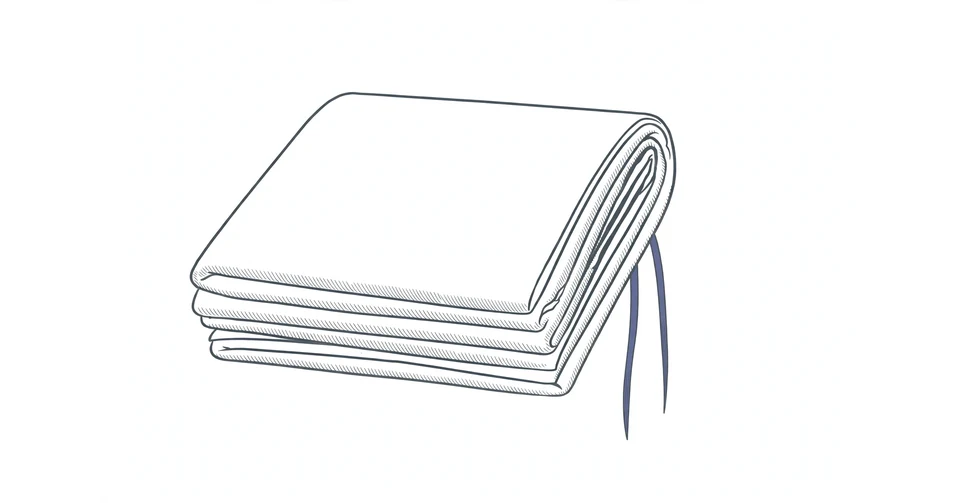
That is why a belt deserves a whole article. A mawashi is cloth, but it is also a ranking sheet, a set of handholds, a lucky charm holder, a sponsor's canvas, and a piece of tradition that has barely changed while the world around it changed completely. This guide explains what a mawashi is made of, how it is folded and tied, why the colours matter, what the cords hanging from it mean, what happens when it comes loose in a bout, and why the most decorated version of all is never worn in a fight.
What a mawashi is
A mawashi is a long strip of heavy cloth, wound several times around the waist and between the legs, then knotted at the back. For a sekitori in competition it is about 9 metres long when unwrapped, about 60 centimetres wide, and it weighs about 4 to 5 kilograms. That is a heavy thing to wear, and the weight is part of its character. A mawashi does not flutter or drape. It holds the body in, it gives an opponent something solid to grip, and it stays where it is put through collisions that would tear ordinary clothing apart.
The belt grew out of the fundoshi, the traditional Japanese loincloth worn by labourers, festival participants, and martial artists. Over time the fundoshi evolved into something wider, stronger, and more supportive, a garment shaped by the needs of the sport rather than by fashion. The change was practical. Sumo is a grappling sport, and a wrestler needs handholds. A thin loincloth gives an opponent nothing to hold. A thick, tightly wound mawashi gives him a belt to seize, pull, lift, and throw with, and those grips are the heart of belt sumo. Without the mawashi, half the techniques in the sport would be impossible.
Professional wrestlers wear nothing under a mawashi, apart from bandaging or taping for an injury. That rule surprises newcomers, and it is worth stating plainly because it explains so much about the belt. The mawashi has to do the work of clothing on its own, and it has to do it while two men weighing well over a hundred kilograms push, pull, and throw each other. Amateur wrestlers are different. In amateur sumo men may wear shorts underneath and women wear a leotard or similar clothing, and the belt is often white or in school colours. The professional rule is stricter, and the strictness is part of the tradition. A professional wrestler presents himself to the crowd wearing only the belt, and the belt has to be enough.
The white cotton mawashi of a sekitori
The clearest division in sumo runs between the sekitori, the wrestlers in the top two divisions, juryo and makuuchi, who receive a salary, and everyone below them. That division is visible in the hair, in the clothing a wrestler wears in public, and in the mawashi. A sekitori in training wears a heavy white cotton mawashi. A wrestler in the lower divisions wears a black cotton mawashi for training and for competition alike. The colours are not a matter of taste. They are a uniform, and they tell the audience exactly where a wrestler stands.
The training mawashi is made of heavy cotton drill or canvas, a stiff, coarse cloth built for durability rather than glamour. It has to survive daily practice, the keiko, in which wrestlers train hard every morning on the clay ring. The cloth is folded, creased, and rolled for storage, and it is prepared with care before its first use. According to the detailed guide at Tachiai, a sekitori's practice mawashi is boiled for about thirty minutes on each side, which can take up to three hours in total depending on how soft the wrestler likes his belt, and then compressed under a heavy weight for three days. That is a long preparation for a piece of training gear, and it shows how seriously the stable takes the belt.
The fold at the front is the detail that separates a sekitori from a junior, and it is easy to miss if you do not know to look for it. Lower division wrestlers and amateurs fold the front end of the mawashi and tuck it into the belt from below, so it forms a kind of triangle. A sekitori rolls the front of his belt and tucks it into the top, creating a rolled loop that Tachiai memorably calls toilet paper roll style. Only sekitori and former sekitori, including oyakata, the retired wrestlers who have become coaches, are supposed to wear the belt that way. If you see a man with short hair wearing a white mawashi folded in that rolled style, he is very likely an oyakata.
A sekitori does not wear his sagari, the stiffened cords described below, during training. The training belt is plain, practical, and unadorned, and that plainness suits its purpose. Training is the part of a wrestler's day that the audience never sees, and the belt he wears for it is the working version of the garment, built to be used hard and to last.
The black cotton mawashi of the lower ranks
Below the sekitori ranks, every professional wrestler wears a black cotton mawashi, and he wears the same belt for training and for competition. The cloth is the same heavy cotton drill, and the belt is prepared in the same way, but the colour and the fold mark him as a man who has not yet reached the salaried divisions. In competition he inserts cotton sagari into the belt, but those cords are not stiffened the way a sekitori's are, and the difference is visible to anyone who looks closely.
The price of these belts is strikingly modest. A black cotton mawashi for a lower division wrestler costs about 800 yen, and a white cotton mawashi for a sekitori in training costs about 950 yen, and both are bought from the Japan Sumo Association, which keeps 100 metre rolls of the cloth ready to dispense. The wrestler buys his belt from his employer, which is an odd arrangement by modern standards, and yet it fits the world of sumo, where the association supplies the standard and the wrestler supplies the effort. The low price also explains one practical rule of the sport. If a practice belt becomes too dirty or too worn, it is cheaper to replace it than to wash it, and washing is in any case against tradition, as the next sections explain.
The silk mawashi of competition
When a sekitori competes, he changes belts. The competition mawashi is called the shimekomi, and it is made of satin silk in a colour the wrestler chooses. It is about 80 centimetres wide and weighs about 4.5 kilograms, and it is a very different object from the cotton training belt. The silk is softer, brighter, and far more expensive, and it is made by hand on a traditional loom. Most shimekomi are made by the same artisan, Mr Nakagawa of Nagahama City in Shiga Prefecture, and it takes two men about ten days to complete one on a manual loom. The busiest time for his workshop is just after a new juryo promotion is announced, because the new sekitori needs his silk belt ready in about a month, and the workshop can barely handle more than three new promotees on the same ranking sheet.
The price reflects the craft. A shimekomi costs in the range of 1,000,000 yen, and the money usually comes from supporters, in the same way that the ceremonial kesho-mawashi described below is funded by supporters. The wrestler does not buy this belt the way he buys a cotton one. It is given to him, often by a supporter who wants to be part of his rise, and the gift carries an expectation. A man who wears a million yen belt into the ring is wearing the trust of the people who paid for it, and he is expected to fight like a man who understands that.
The rules once limited the colours of the shimekomi to purple or dark blue, but wrestlers have been defying that rule ever since colour television arrived, and the association has largely looked the other way. Today a sekitori may wear many colours, from pink to green to gold, and the colour has become part of his identity. A fan can recognise a favourite wrestler by the colour of his belt before reading the name on the ranking sheet. One colour, though, remains taboo. White is not worn in competition, and the reason is simple. White belongs to the training belt, and the competition belt is meant to look different. A wrestler may change the colour of his silk mawashi to change his luck, sometimes after a poor run of results, sometimes even during a tournament, and that superstition is part of the sport's texture. The belt is a tool, but it is also a charm, and a man who is losing will try anything that might turn his fortune.
How a mawashi is folded and tied
Putting on a mawashi is a skill, and it is also a workout. The belt is long, heavy, and stiff, especially when it is new, and no wrestler ties his own belt alone. He needs assistance, and assistance with muscles, because the cloth has to be wound tight enough to stay put through a bout and loose enough to let him move. A beginner learning the technique will often have a coach or a senior wrestler help him, and the help is physical, not ceremonial. Two men pull, fold, and knot, and the result has to be exactly right.
The preparation starts before the belt ever touches the body. The cloth is folded in half, leaving about one centimetre at one edge to allow for the width of the next fold, and then a crease is made, often using beer bottles to press the fold, which Tachiai calls the sumo world's equivalent of a Swiss Army knife. The belt is then folded once more, creating four layers along most of its length. The part that covers the front is opened up so it is only two layers, and the part that goes between the buttocks is folded again into eight layers. The four layered belt is rolled like a hose, flattened, bound tightly with strings, and left overnight under a heavy weight. The creases for the front and for the tie at the back are then made, and the belt is ready to wear.
The tying itself follows the fold. The belt is wound several times around the waist and between the legs, and the end is fastened at the back with a large knot. The front end is the part that shows the rank, rolled and tucked into the top for a sekitori, folded flat into a triangle for a junior. The back is entirely dependent on the strength of the tie, and if the knot loosens in the middle of a bout, the wrestler is in trouble. The belt is not decoration. It is a piece of engineering, and the engineering has to hold.
The sagari cords hanging from the front
Hanging from the front of a competition mawashi is a set of cords called the sagari. They are the most eye catching part of the belt after the colour, and they are easy to mistake for mere decoration. They are not. The sagari are a stiff strip of fabric into which an uneven number of colourful strings are sewn, evenly spaced, and the strip is tucked into the folds of the belt so that only the strings hang down. For a sekitori, the strings are made from the same silk as the belt, and the weaver leaves long loose strands which are braided into thick tufts and stiffened with glue. That is why they stick out like a bunch of skewers when the wrestler crouches down for the tachiai, the initial charge. The stiffness is deliberate. The cords are meant to stand upright during the squat at the start of a bout, and they do.
Their number is always odd, and it varies from 13 to 25. The exact number depends on the wrestler and the belt, and the range is wide enough that two wrestlers in the same tournament may have very different cords. Lower division wrestlers also wear sagari in competition, but theirs are cotton and are not stiffened, so they hang limply instead of standing out. The difference is another small signal of rank, visible to anyone who knows to look, and it is part of the way the mawashi carries information that the ranking sheet carries in words.
The sagari have one more role, and it is a practical one. They mark out the only part of the mawashi that it is illegal to grab, the vertical part covering the groin. A wrestler who seizes that part commits a foul, and if the cords fall out during competition, the gyoji will throw them from the ring at the first opportunity. The cords are therefore not only decoration and not only a rank signal. They are part of the rules of the bout, a visible boundary drawn on the belt itself.
The kesho-mawashi worn for ceremony
A sekitori has a third type of mawashi, and it is the most spectacular of all. The kesho-mawashi is a decorative apron style belt worn during the dohyo-iri, the ring entering ceremony, and it is the only type of mawashi that is not worn directly on the body. The silk belt opens out at one end into a large apron, heavily embroidered and finished with thick tassels at the bottom, and it is worn over a fundoshi, a simple loincloth, rather than against the skin. The embroidery may show dragons, tigers, cherry blossoms, a hometown landscape, or a sponsor's logo, and the design is often chosen by the supporter who paid for it.
Only wrestlers in the two upper divisions, makuuchi and juryo, are allowed to wear a kesho-mawashi during the ring entering ceremony. The fringe and tassels are usually gold, but they may be any colour except purple, which is reserved for use by yokozuna and ozeki only. That reservation is a small rule, and it tells you how seriously sumo takes colour. Even on a ceremonial apron, a colour can be a rank, and a rank can be a colour, and the wrong man wearing the wrong colour would be noticed at once.
A yokozuna's kesho-mawashi comes in a set of three, one for the yokozuna himself and two for the attendants who accompany him during his ceremony. The rope that gives the highest rank its name is the subject of our guide to Yokozuna Is the Rank Sumo Never Takes Back, and the matching aprons show the same idea at work, that what a wrestler wears around his waist tells you who he is. The attendants may vary, so the same belt may be worn by different wrestlers over time, and the set is shared rather than owned by one man. The arrangement is practical, but it is also symbolic. The yokozuna does not enter the ring alone. He enters with two men beside him, and the three matching aprons say that the ceremony belongs to the rank, not only to the man.
The mawashi that is never washed
One of the most surprising facts for newcomers is that a mawashi is never washed. Not rinsed, not dry cleaned, not put through a machine. The belief is that washing would remove the fighting spirit and the good luck accumulated over time, and the tradition is taken seriously enough that it has survived into the modern era, when every other piece of sports clothing is washed after every use. Practice belts may be scrubbed for mud with a deck brush, but no soap or water is used. Competition silk belts are spot cleaned with damp cloths or stain remover. That is all.
There are only two occasions on which a mawashi may be washed. The first is before its first use, when the new cloth is prepared for the wrestler. The second is when the stablemaster, the shisho, dies. Those are the only exceptions, and they are telling. A belt is washed at the beginning of its life and at the end of an era, and never in between. The smell, as Jasumo puts it with admirable understatement, is part of the culture, and it is another reason a wrestler takes his own belt everywhere he goes. The belt is his, in a way that a shared uniform never could be.
The rule has a practical side too. A cotton practice belt is cheap, and if the smell becomes unbearable, the wrestler may simply dispose of it and buy a new one. Sekitori do that more often than lower division wrestlers, because they can afford to, and because their belts are replaced more easily. The silk belt is different. It is too expensive to throw away, and too personal, so it is kept, spot cleaned, and worn again. The contrast between the cheap cotton belt and the million yen silk belt is a reminder that the same tradition can mean different things at different ranks, and that the rule is not about hygiene. It is about respect for the object and for the career it represents.
When a mawashi comes loose in a bout
The belt is tied tight, but it can still come loose, and when it does, the bout stops. The pause is called a mawashi-matta, and it is one of the most distinctive moments in sumo. Our earlier guide to the referees explains it well. If a belt works loose, the gyoji alone can halt the bout, in a pause called a mawashi-matta, and he reties the belt himself, the cord of his fan held between his teeth while he works. That image, a referee in silk robes kneeling in the clay ring with his fan cord in his teeth, is one of the most memorable in the sport, and it shows how seriously sumo takes the belt. The bout is not allowed to continue with a loose belt, because the belt is the bout.
The rules for the pause are precise. The gyoji calls out "Matta", meaning wait, and both wrestlers must freeze in their positions until the bout is restarted. The gyoji must not order the temporary halt during an offensive move, so a wrestler cannot use a loose belt to escape an attack. After tightening the belt and confirming with the judges that neither wrestler has shifted from his position, the gyoji places his hands on the backs of both men, calls out "Hikimasuyo", meaning get ready, and restarts the bout by lightly tapping their backs and calling "Hakkeyoi", meaning get moving. The bout resumes from exactly the same position, and the pause is treated as an interruption, not as a fresh start.
There is a harder rule behind the pause. If a wrestler's mawashi comes completely off during a bout, he is disqualified. That is extremely rare, and it happened in May 2000, when the sandanme wrestler Asanokiri was embarrassed during a match with Chiyohakuhou, but the rule exists and every wrestler knows it. For most of sumo's history, whether a belt came off was considered irrelevant, and the policy of disqualification only came into place when Japan began adopting European attitudes towards nudity. The history is a reminder that even the most traditional parts of sumo have changed, and that the belt has always sat at the boundary between sport and ceremony, between the body and the public eye.
Why a belt can carry a career
A mawashi is cloth, but it is also a record. It records the rank of the man who wears it, in its colour and its fold. It records his career, in its wear and its stains. It records his supporters, in the silk they paid for and the apron they embroidered. It records his luck, in the colour he chose and the charm he hid inside it. And it records his discipline, in the care with which it is folded, creased, tied, and hung out to dry. Few objects in sport carry so much meaning in so little material, just cotton or silk, a knot, and a set of cords.
The next time you watch a sumo tournament, look at the belt before you look at the bout. Find the colour of the silk, count the cords if you can, and notice the fold at the front. A rolled loop means a sekitori, a flat triangle means a junior, and a bright silk belt means a man who has earned the right to be seen. Look a little longer and you will see the referee's work, the years of craft behind a single belt, and the quiet promise that the belt will be there, tied tight, when the next bout begins. The mawashi is the simplest thing in sumo, and it is also the most honest. It wraps a wrestler's rank around his waist, and it lets everyone in the arena read it at a glance.
More in Culture & Society
Latest posts
- Namasu Turns Daikon and Carrot Into a Red and White Wish
- Ebi Bends Like an Old Back and Wishes You a Long Life
- Kobumaki Rolls Joy Into a Strip of Kelp
- Kurikinton Is the Golden Mash That Wishes You Wealth
- Japanese Beer and the Dry Wars That Changed How Japan Drinks
- Kamaboko Paints the New Year Red and White
- Datemaki Rolls Sweet Eggs Into a Spiral of Good Luck
- Japanese Bento and the Lunch Box That Became an Art Form
- Tazukuri Turns Tiny Sardines Into a Wish for a Good Harvest
- Kazunoko Is the Herring Roe That Promises Children and Plenty
- Kuromame Turns Black Beans Into a Wish for Health
- Jubako Layers a Family's Luck One Box at a Time
- Osechi Packs a Whole Year of Luck Into Stacked Boxes
- Kojiri Is the End Cap That Takes Every Knock for a Katana
- Kurikata Is the Chestnut Knob That Holds a Katana at the Hip