Shingon Has Kept Its Fire Ritual Burning for 1,200 Years
· 15 min read
Shingon, the esoteric school Kukai brought back from Tang China in the ninth century, has kept its fire ritual burning in Japan for more than 1,200 years.
Somewhere in the mountains of Wakayama, a fire has been burning, in one form or another, for more than twelve centuries. It is not a campfire or a furnace. It is a ritual fire, lit inside a temple hall by priests in robes, fed with wood, grain and written prayers, while drums beat and a monk chants the name of a wrathful god. The school that tends it is called Shingon, and it has never been the largest school of Buddhism in Japan. It has simply been the most stubborn about keeping its flame alive.
Shingon means "true word", the Japanese reading of a Chinese term that translates the Sanskrit word mantra. It is a school of esoteric Buddhism, known in Japanese as mikkyo, and it is one of the few surviving Vajrayana lineages in East Asia. Where other schools ask their followers to study, meditate and wait for enlightenment across many lifetimes, Shingon promises something bolder. It says the body you already have is enough, and the fire in front of you is part of the path.
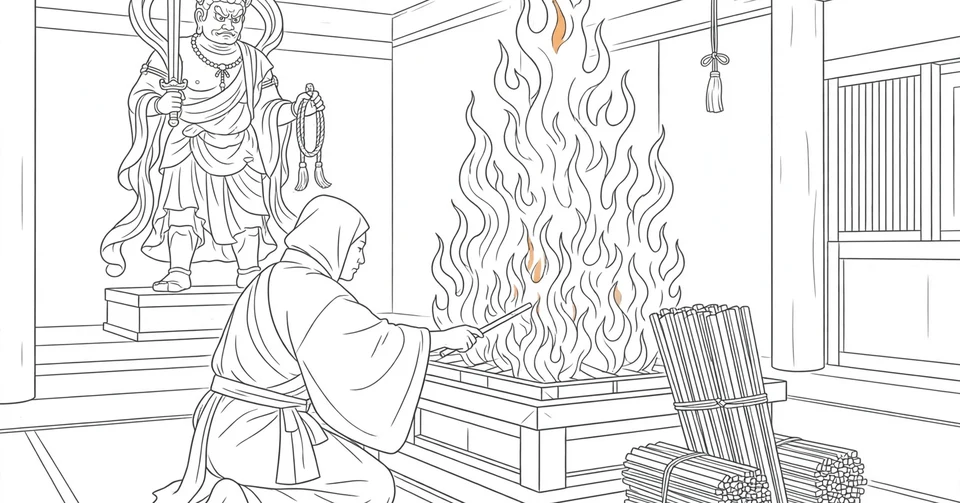
That promise is the reason Shingon still matters, twelve centuries after it arrived. The school has been attacked by warlords, squeezed by shoguns, stripped of its land by a modernising government and split by its own internal quarrels, and it is still here. Its temples still fill with smoke on festival days, its mountain headquarters still takes in overnight guests, and its priests still perform the same fire rite their founder brought home from China in the year 806. Longevity like that is not an accident. It comes from a school that was built, from the beginning, around doing things rather than only believing them.
How shingon reached Japan
The story begins with a monk named Kukai, who lived from 774 to 835 and is known to most Japanese people by the name he received after his death, Kobo Daishi. In 804 he sailed to Tang China on a fleet of four ships, looking for someone who could explain a sutra he had found in Japan but could not fully understand. The future founder of the Tendai school, Saicho, was on the same fleet, which means the two most important Buddhist schools in Japanese history crossed the sea together and came home as rivals.
In the city of Chang'an, now Xi'an, Kukai met the Chinese master Huiguo at Qinglong Temple in the fifth month of 805. Huiguo was sixty years old and close to death, and according to the tradition he told Kukai that he had been waiting for him. In the space of three months he initiated Kukai into the esoteric mandalas and taught him everything he knew about the doctrine and practice of the school. Huiguo died the following year, and Kukai sailed home in 806 carrying texts, mandalas and ritual implements, the whole working kit of a tradition that had taken centuries to build in India and China.
Back in Japan, Kukai had to wait. He spent three years in Kyushu before the imperial court allowed him to settle near the capital at Takaosanji, now Jingo-ji, in 809. His fortunes rose when Emperor Saga became his patron, and in 810 he was appointed head of Todai-ji, the great temple in Nara. But Kukai wanted a centre of his own, far from the noise and politics of the capital. In 818 he asked Emperor Saga to grant him Mount Koya, a remote wooded peak in what is now Wakayama Prefecture, and the request was granted. That mountain became the heart of Shingon, and it has held that place ever since.
The timing matters for the title of this article. Kukai returned from China in 806, which puts the arrival of Shingon in Japan more than 1,200 years ago, and the school counts its history from that crossing. The Chinese lineage it came from had been founded in the seventh and eighth centuries by Indian masters like Subhakarasimha, Vajrabodhi and Amoghavajra, so the teachings were already old when Kukai received them. What was new was that they now had a home in Japan, a mountain, and a founder who knew how to organise.
What shingon actually teaches
At the centre of Shingon stands a Buddha most people outside Japan have never heard of. His name is Mahavairocana, known in Japanese as Dainichi Nyorai, the Great Sun Buddha, and in Shingon teaching he is the universal Buddha who is the basis of all phenomena. He is not a distant god. The teaching says his light is present in everything, including the person sitting in front of the altar, and that every being is already originally enlightened. The task of practice is not to become something else. It is to realise what is already there.
That idea has a name, sokushin jobutsu, which means attaining buddhahood in this very body. It is the boldest claim in Shingon, and it is what sets the school apart from forms of Buddhism that treat enlightenment as a reward for many lifetimes of effort. The way to realise it, according to Kukai, is through what are called the three mysteries, or sanmitsu: mudra, the hand gestures; mantra, the chanted syllables; and mandala, the sacred diagrams that map the cosmos. Body, speech and mind are all put to work at once, which is why Shingon practice looks so different from silent sitting meditation. It is physical, vocal and visual all at the same time.
The two mandalas that matter most are the Womb Realm and the Diamond Realm, and Dainichi sits at the centre of both. Kukai even imagined the layout of his new mountain monastery on their pattern, which means the whole of Mount Koya was designed as a mandala you can walk through. The key scriptures behind the teaching, as set out in the standard overview of the school, are the Mahavairocana Sutra, the Vajrasekhara Sutra and the Susiddhikara Sutra, and Kukai wrote commentaries on all of them, along with his own works like the ten volume Treatise on Ten Levels of Mind. He was not only a ritual master. He was a scholar, a calligrapher and a system builder, and the school he founded carries all of those habits at once.
There is one more piece of the teaching that explains why Shingon feels so different from the Buddhism most visitors expect. Because the Buddha is understood to be present in the world itself, the natural world, the arts and even ordinary actions can all be read as expressions of the teaching. Kukai wrote that the source of wisdom is not far away, that it is in our body and in our mind, close at hand. That closeness is the reason a fire in a temple hall can be treated as a holy thing rather than a hazard, and it is the reason the school never saw a hard line between the sacred and the everyday.
The mountain shingon built
Mount Koya, or Koyasan, is where Shingon becomes a place you can visit rather than an idea you can read about. Kukai began building the Garan temple complex there in 826, and over the centuries more than a hundred temples grew up along the streets of the small town on the mountaintop. The most important of them are Kongobu-ji, the head temple of the school, and Okunoin, the cemetery and mausoleum where Kukai himself is enshrined. Pilgrims still walk the cedar lined path to Okunoin in the dark, past thousands of stone lanterns, to pay their respects to a founder who died in 835 and is still treated as if he were only resting.
The mountain is also the start and end point of the Shikoku 88 Temple Pilgrimage, the circuit of eighty eight temples associated with devotion to Kukai, which means that Shingon is not confined to one mountain at all. It runs in a loop around an entire island, and walkers still complete it on foot today. For visitors who want a shorter taste of the life, around fifty temples on Mount Koya offer overnight lodging, where guests eat vegetarian monks' cuisine and attend the morning prayers. It is one of the few places in Japan where a traveller can sleep inside a working monastery and wake to chanting rather than an alarm clock.
Today the mountain is a UNESCO World Heritage site, and that recognition has made it one of the most visited sacred places in Japan. But the crowds are a recent layer on top of something much older. For most of its history Mount Koya was deliberately hard to reach, a refuge chosen precisely because it was far from the capital, and the school kept it that way on purpose. A religion that is built around secret transmission and long training does not need a crowd. It needs a mountain, a hall and a teacher who will pass the teaching on by word of mouth.
That last point is not a detail. Shingon rituals are taught through oral transmission between a master and a student, and the most serious training, the fourfold preliminary retreat known as shido kegyo, must be completed under a qualified master before a priest can go further. The rites themselves are made of hundreds of small segments, each one a mantra or hymn with a hand gesture and a guided contemplation, and the details can differ between lines of transmission. The school is not a book you can buy. It is a relationship, and the relationship is the teaching.
The fire at the centre of shingon
If there is one ritual that explains Shingon to an outsider, it is the goma, the fire rite that stands at the centre of the school. The goma has its roots in the Vedic homa ritual of ancient India, and the tradition itself has always acknowledged the connection. But the Shingon understanding of it is summed up in a line from the Commentary on the Mahavairocana Sutra, which says the meaning of goma is to burn the firewood of delusion with the wisdom flame, consuming it completely. The fire is not a sacrifice to a god. It is a tool for burning away what clouds the mind.
In practice, the rite is performed by qualified priests for the benefit of individuals, the state or all sentient beings. The consecrated fire is believed to carry a powerful cleansing effect, and the central deity invoked is usually Fudo Myoo, the wrathful manifestation of Dainichi himself. Fudo Myoo is the fierce protector who fights fire with fire, and his statue stands behind the altar with his sword raised and his lasso ready. The goma itself is described in detail in our earlier article, where worshippers write their wishes on thin wooden sticks called gomagi and watch a priest feed them one by one into the flames. Larger ceremonies add the constant beating of taiko drums and mass chanting of the mantra of Fudo by priests and lay practitioners together.
What is easy to miss, watching the flames, is how old the pattern is. The goma was already ancient when Kukai received it, and the school has performed it without a break since his return. Other schools adopted it too. The mountain ascetics of Shugendo practise their own versions, and it is still performed in some Zen temples. But Shingon is its home, and the rite is the clearest picture of what the school believes: that wisdom is not a quiet idea but a fire, and that delusion is fuel.
The fire also explains why Shingon has a temple that most travellers know better than Mount Koya itself. Naritasan Shinsho-ji, the great temple in Narita, was founded in 940 around a statue of Fudo Myoo that tradition says was carved by Kukai himself, and its daily goma is the temple's central rite. The goma article on this site describes how temple tradition holds that the rite there has been performed since the tenth century, when it was first offered to quell a rebellion. A thousand years later the hall still fills every day, and worshippers still climb in to sit before the flames.
How shingon survived its worst centuries
A school that lasts 1,200 years does not do so by avoiding trouble. Shingon enjoyed immense popularity in the Heian period, especially among the nobility, and it shaped the art and literature of the age. But success brought division. In the twelfth century the monk Kakuban tried to reform the school and bring Pure Land devotion into it, and the quarrel that followed split Shingon into two great branches, the Kogi school of the ancient teaching and the Shingi school of the reformed teaching. The split has never healed, and the two branches still exist today, each with its own head temples.
The centuries that followed were harder. During the civil wars of the Sengoku period, the Shingon centre at Mount Negoro was sacked by the warlord Toyotomi Hideyoshi in 1585, and Mount Koya itself only survived because it submitted to him and was spared destruction. In the Edo period the Tokugawa shogunate brought the school under strict administrative control, issuing regulations for it in 1615. Then came the Meiji Restoration, and with it the forced separation of Shinto and Buddhism, the anti-Buddhist persecutions known as haibutsu kishaku, and the confiscation of temple land. Temples closed, priests left the priesthood, and the schools that survived had to turn to ordinary people for support for the first time.
The twentieth century added its own blows. In 1941 the government forced the Shingon schools to merge into a single sect, and during the war, prayers for the surrender of enemy nations were held at temples across the country. After the war the schools separated again, and today there are around eighteen major Shingon schools with their own headquarters temples in Japan. A 1988 estimate put the number of followers at around ten million, with sixteen thousand priests in about eleven thousand temples. Those numbers are old, and they should be read as an estimate rather than a census, but they give a sense of scale. This is not a small sect clinging to a single mountain. It is a large, fragmented family of schools that all trace themselves back to one monk and one crossing.
What strikes me about that history is how little of it the school advertises. Shingon does not present itself as a survivor, and its temples do not hang banners about the persecutions they endured. The school simply kept doing the same things: training priests, tending the fire, keeping the mountain open to pilgrims. There is a lesson in that modesty, and it is not a religious one. Institutions that last are usually the ones that treat their core practice as non-negotiable and everything else as weather. Shingon kept the fire and the mountain, and let the rest change around them.
Shingon today
Walk into a Shingon temple today and the first thing you notice is how little has changed about the experience itself. The hall is dim, the drums are loud, the fire is real, and the priest in front of it is doing something that would have been recognisable to Kukai. But look a little closer and the school has adapted in ways that would have surprised him. Shingon temples now stand in Hawaii, Los Angeles, Portland and Seattle, carried overseas by the Japanese diaspora in the early twentieth century. Chinese students have come to Japan to train as Shingon priests and carried the teaching back to Hong Kong, Taiwan and Malaysia, reviving a Chinese esoteric tradition that had died out at home. New religious movements influenced by Shingon, like Shinnyo-en, have grown into major organisations of their own.
None of that changes the centre of the school, and that is the point. A visitor can spend a night on Mount Koya, eat the vegetarian food, sit through the morning service and walk to Okunoin before dawn, and what they take home is not a doctrine but an impression: that a religion can be old without being tired, and secret without being closed. The goma fire is still the best introduction, because it shows the school doing what it has always done, in the open, for anyone willing to sit and watch.
Twelve centuries is a long time for any human institution to last, and most of the ones that do survive by becoming museums of themselves. Shingon has survived by refusing that bargain. It kept its fire burning, its mountain inhabited and its teaching passed from one person to another, and it let the world come to the mountain rather than chasing the world. That is a modest kind of endurance, and it may be the most impressive kind there is. The flame Kukai brought home in 806 is still lit, and as long as someone is willing to tend it, the count of years is the least interesting thing about it.
More in Culture & Society
- Suka Duka Means the Banjar Shows Up for Joy and Grief Alike
- Tabuh Rah Spills Blood So the Ground Stays Calm
- The Bendesa Adat Speaks for a Village That Has Two Governments
- Catur Brata Is Four Silences Kept at the Same Time
- Your Weton Is the Day You Were Born, Counted Two Ways
- Rahu and Ketu Still Chase the Sun and Moon Across the Sky
Latest posts
- On Koyasan the Founder Is Said to Be Still Meditating
- Hiwatari Asks You to Walk Across the Fire
- Ngembak Geni Is the Morning Bali Starts Talking Again
- Karang Ayahan Is the Plot of Land a Village Trusts You With
- On Tumpek Landep Bali Blesses Everything Made of Metal
- Sudachi Is the Sharpest of Japan's Sour Citrus
- Shugendo Turns a Mountain Into a Place of Testing
- A Canang Sari Is Made Fresh Every Morning and Gone by Night
- The Aling-Aling Wall Exists Because Spirits Walk in Straight Lines
- Oi-Nishin Sent Tohoku Farmers Chasing Herring Every Spring
- The Nishin Goten Were Palaces Paid for by Fish
- The Tobi Were Edo's Daredevils Before They Were Its Firemen
- Kabosu Is Oita's Gentle Answer to Yuzu
- A Yamabushi Trains Where the Mountain Is the Temple
- Tri Hita Karana Holds a Village in Three Balances