Samudra Manthana Churned an Ocean to Find the Water of Life
· 13 min read
The samudra manthana is the great churning of the Ocean of Milk, where gods and demons worked together to win amrita, the water of life, and where Bali still fetches that water every year.
The gods were losing, and they knew it. Their strength, their luck, and their goddess of fortune had all drained away after one careless insult, and their enemies now ruled the three worlds. So the gods did the last thing anyone expected of them: they asked their enemies for help. That bargain, and the ocean it churned, is the samudra manthana, the great churning of the Ocean of Milk.
The story is told in the Vishnu Purana and other old texts, and it is one of the most painted and carved episodes in Hindu art, from temple walls in India to a Majapahit era miniature kept in the Museum of Trowulan in East Java. It ends with a trick, a beheading, and a war. But its real ending is quieter, and it happens in Bali every year, when a procession walks down to the sea to fetch the very water the churning was about.
Before the churning, there was a garland. That is where the samudra manthana begins, not with a battle but with a small act of disrespect that cost the gods everything.
How the samudra manthana began
Indra, the king of the devas, was riding his divine elephant Airavata when he met the sage Durvasa, who offered him a special garland given to him by an apsara, a heavenly dancer. Indra accepted the garland and placed it on the trunk of his elephant, as a sign of humility. The flowers had a strong scent that attracted bees, and annoyed by the bees, the elephant threw the garland to the ground.
That small accident was enough. The garland was a dwelling of Sri, the goddess of fortune, and it was to be treated as a prasada, a sacred offering. Durvasa was enraged, and he cursed Indra and all the devas to be bereft of all strength, energy, and fortune. Sri vanished into the ocean, and with her went the luck of the gods. The samudra manthana is the story of how they tried to get it back. In the battles that followed, the devas were defeated, and the asuras, led by Bali, gained control over the three worlds.
The devas went to Vishnu for wisdom, and his advice was not what a god of war would give. He told them to treat the asuras in a diplomatic manner, to form an alliance with them and churn the ocean together for the nectar of immortality, and to share it among themselves. The devas did as he said. But Vishnu had also assured the devas, in private, that he would arrange for them alone to obtain the nectar. The samudra manthana was a partnership built on a promise that was never going to be kept, and the story does not hide that. It tells the lie plainly, in the same breath as the alliance, which is one of the reasons the story has lasted. It is not a tale about good people defeating bad people. It is a tale about desperate people making a dishonest deal, and then living with what the deal cost.
Versions of the story differ in the details, and the old texts do not all agree on the order of events or the full list of what came out of the sea. The episode is also called Sagara manthana and Kshirasagara manthana, the churning of the Ocean of Milk, and it is elaborated in the Vishnu Purana, which gives the fullest account. What follows is that version, with the variations noted where they matter.
The mountain, the serpent, and the turtle
The churning in the samudra manthana needed a rod and a rope, and the gods and demons built them out of a mountain and a snake. Mount Mandara was uprooted and used as the churning rod, and Vasuki, a great naga who lives on the neck of Shiva, became the churning rope, after being promised his share of the reward. The mountain was so heavy that while the devas and asuras were carrying it toward the ocean, several of them fell to their deaths from sheer exhaustion. Vishnu flew upon his mount Garuda, revived them all, and carried Mandara himself to the middle of the ocean.
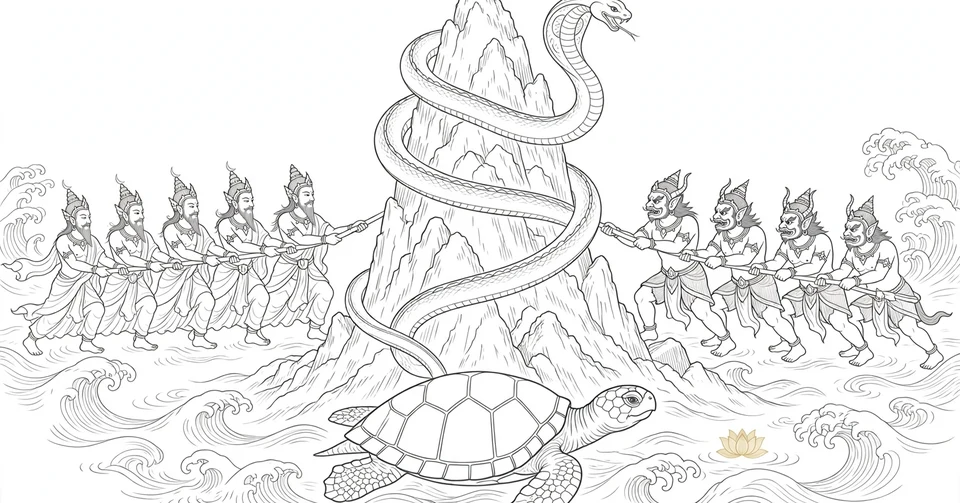
Once there, Vasuki coiled himself around Mandara. Vishnu counseled the devas to tug from the head of the serpent and the asuras from the tail, but the asuras saw the head as inauspicious and refused, so the devas relented and held the tail. Then the churning began, and the first problem appeared at once: Mandara was too enormous and sank to the bottom of the ocean. Vishnu came to the rescue in the form of his Kurma avatar, a great turtle, and supported the mountain on his shell. Only then could the devas and asuras pull back and forth on the body of the snake in the samudra manthana, turning the mountain, and churning the sea.
It is worth pausing on that image, because it is the whole samudra manthana in one picture. A mountain is being spun by a snake, held up by a turtle, and pulled by two armies that hate each other. Nothing in the scene works without the enemy. The gods could not churn the ocean alone, and neither could the demons. The work only moves when both sides pull, and the moment one side stops, the mountain sinks. The samudra manthana is, before anything else, a story about cooperation that nobody wanted and everybody needed.
What the samudra manthana brought up
The churning of the Ocean of Milk in the samudra manthana was an extensive process, and the sea gave up far more than the nectar. Herbs were cast into the ocean, and fourteen ratnas, or divine treasures, were produced from it and divided between the asuras and the devas. The lists in the scriptures range from nine to fourteen, so no single count is the only correct one, but the best known list includes Lakshmi, the goddess of prosperity and wealth, who chose Vishnu as her eternal consort; the apsaras, divine dancers like Rambha and Menaka, who chose the Gandharvas as their companions; and Varuni, the goddess of wine.
Three supernatural animals appeared as well. Kamadhenu, also called Surabhi, the wish granting cow, was taken by Brahma and given to the sages so that the ghee from her milk could be used in rituals. Airavata and several other elephants were taken by Indra. Uchhaishravas, the divine seven headed horse, was given to Bali, the king of the asuras. Among the valuables were Kaustubha, the most valuable jewel in the universe, claimed by Vishnu; Kalpavriksha, the divine wish fulfilling tree, taken to Indraloka by the devas; and Chandra, the crescent moon, claimed by Shiva. The science of archery and military affairs, Dhanurveda, was claimed by the asuras. The samudra manthana is generous with its treasures, and it hands them to both sides, which makes what happens next harder to defend.
But the ocean gave poison before it gave the prize. One of the things the samudra manthana produced was halahala, a lethal poison so powerful that it could destroy all of creation. In some variations of the story, the poison escaped from the mouth of Vasuki as the two sides churned, and the fumes poisoned the asuras. The devas and the asuras were both terrified, and it was Shiva who saved them, drinking the poison to protect the three worlds. The poison gave a blue hue to his throat, and from that day he carried the name Neelakantha, the blue throated one.
That order matters, and it is the part of the story I keep coming back to. The first thing the churning produced was something that could kill everyone, and the only reason the work of the samudra manthana continued was that someone was willing to swallow it. The gods did not get to skip to the reward. They had to survive their own project first, and survival depended on a god who was not even one of the churners stepping in to take the worst of it into his own body.
Finally, Dhanvantari, the physician of the devas, emerged from the ocean carrying a pot containing amrita, the heavenly nectar of immortality. Amrita comes from the Sanskrit a-mrtyu, meaning not death, and it is a cousin of the Greek ambrosia, both words growing from the same old root for the un-dying. Its earliest occurrence is in the Rigveda, where it is one of several terms associated with soma, the drink of the devas. But the nectar is subtler than its name suggests. According to the texts, it does not actually offer true immortality. By drinking it, the devas were able to regain the higher knowledge and power they had lost through the curse of Durvasa. The prize of the samudra manthana was not eternal life. It was the return of what they had already had, and carelessly thrown away.
The trick at the end of the samudra manthana
The moment the pot appeared in the samudra manthana, the alliance ended. Fighting broke out between the devas and the asuras for possession of the nectar, and the asuras seized it from Dhanvantari and ran away with it. The devas appealed to Vishnu, who took the form of Mohini, a beautiful and enchanting woman. She approached the asuras, and they were so fascinated by her that they stopped fighting and handed her the pitcher, asking her to distribute it among them. She warned them, quite openly, that no faith should be put in her, since she was self willed and would distribute the nectar as she pleased. They told her to do as she pleased anyway. The samudra manthana saves its sharpest joke for this moment: the distributor warns the asuras she cannot be trusted, and they insist anyway.
Mohini made the devas and the asuras sit in two separate rows, and then she distributed the nectar among the devas alone, who drank it. One asura named Svarbhanu disguised himself as a deva and sat in the devas row, and drank some of the nectar. The sun and the moon, Surya and Chandra, noticed the disguise and warned Mohini, who cut off his head with her discus, the Sudarshana Chakra. From that day his head was called Rahu and his body Ketu, and that is the Hindu myth behind eclipses: the severed head still chases the sun and the moon across the sky, and swallows them for a little while, because it once tasted what they guard.
When all the devas had been served, Vishnu assumed his true form and departed. Realizing they had been deceived, the asuras attacked, but the devas, rejuvenated by the amrita, emerged victorious and exiled the asuras to Patalaloka, the underworld, regaining Svarga, their heaven. The story does not pretend this victory was fair. The devas won because their god promised them the prize before the work began, and because the distributor of the prize was their god in disguise. The asuras did the same work, pulled the same rope, and went home with nothing. That unfairness is not a flaw in the telling of the samudra manthana. It is the point the telling is making, about how power keeps what it promises only to its own side, and calls it destiny afterward.
One caution is worth keeping. Medieval Hindu theology extended the legend to say that while the asuras were carrying the amrita away, some drops fell at four places on earth, Haridwar, Prayaga, Trimbak, and Ujjain, and that a Kumbha Mela is celebrated at those four places every twelve years for that reason. But the ancient texts, including the various Puranas, do not mention the spilling of the nectar at four places, and they do not mention the Kumbha Mela at all. Scholars who have studied the festival believe the samudra manthana legend was applied to the Kumbha Mela relatively recently, to give the festival scriptural authority. The old story is old. Its use as the origin of the festival is newer than it looks.
The samudra manthana in Bali
The myth of the samudra manthana did not stay in India. A Majapahit era miniature of the churning is kept in the Museum of Trowulan in East Java, which means the story was already being carved and cast in Indonesia centuries ago. But in Bali it did not remain a picture on a wall. It became something people do with their feet, every year.
In Bali the water of life from the samudra manthana has a local name, tirta amerta, and every year at Melasti, a few days before Nyepi, the temple effigies and sacred heirlooms are carried down to the sea, a lake, or a spring to fetch it. The story of that fetching is told in our article about tirta amerta, and the ceremony itself, with its long white processions and its washing of the pratima and pralingga, is described in our article about Melasti. The water that is brought back blesses the temples and the people for the whole year to come, and it is carried home in bottles for daily offerings. Hindu Bali was once called Agama Tirta, the religion of holy water, and the sea is honoured even though it lies in the inauspicious south, because it is there, the Balinese believe, that the gods created amerta.
That is the part of the samudra manthana that moves me most. In the old myth, the water of life is a prize for the winners of a war, divided by a trick, and only the gods are allowed to drink it. In Bali, the same water is fetched in public, carried by whole villages, and brought home for everyone. The myth says the nectar was won by deception. The ceremony says it can be renewed every year, by anyone willing to walk to the sea. The story kept its shape across an ocean and a thousand years, and then a small island changed its ending, from a secret for the victors into a commons that is refilled each spring.
The samudra manthana begins with a garland thrown on the ground and ends with a pot that is stolen, tricked away, and fought over. Nothing about it is clean. The gods lose their fortune through carelessness, win it back through a dishonest alliance, and keep it through a disguise. And yet the story survives, not because its heroes are admirable, but because it tells the truth about how the things people want most are usually won: by working with people you do not trust, by surviving the poison your own work produces, and by accepting that the prize will not be shared fairly unless someone decides, afterward, to share it. Bali made that decision, and it is why the samudra manthana still matters in Bali today. Every Melasti, the water that was once the gods private treasure is carried back up from the beach in ordinary bottles, and that, more than the churning itself, is the part worth remembering.
More in Culture & Society
- Suka Duka Means the Banjar Shows Up for Joy and Grief Alike
- Tabuh Rah Spills Blood So the Ground Stays Calm
- The Bendesa Adat Speaks for a Village That Has Two Governments
- Catur Brata Is Four Silences Kept at the Same Time
- Your Weton Is the Day You Were Born, Counted Two Ways
- Rahu and Ketu Still Chase the Sun and Moon Across the Sky
Latest posts
- On Koyasan the Founder Is Said to Be Still Meditating
- Hiwatari Asks You to Walk Across the Fire
- Ngembak Geni Is the Morning Bali Starts Talking Again
- Karang Ayahan Is the Plot of Land a Village Trusts You With
- On Tumpek Landep Bali Blesses Everything Made of Metal
- Sudachi Is the Sharpest of Japan's Sour Citrus
- Shugendo Turns a Mountain Into a Place of Testing
- A Canang Sari Is Made Fresh Every Morning and Gone by Night
- The Aling-Aling Wall Exists Because Spirits Walk in Straight Lines
- Oi-Nishin Sent Tohoku Farmers Chasing Herring Every Spring
- The Nishin Goten Were Palaces Paid for by Fish
- The Tobi Were Edo's Daredevils Before They Were Its Firemen
- Kabosu Is Oita's Gentle Answer to Yuzu
- A Yamabushi Trains Where the Mountain Is the Temple
- Tri Hita Karana Holds a Village in Three Balances