Why Bali Became the World's Remote Work Capital
· 9 min read
The digital nomad Bali dream looks like a laptop by the beach, but the legal visa is strict, the costs are real, and the island is still deciding what the crowd means for the people who live there.
Bali did not become the remote work capital of the world by accident. It has the right ingredients in one place: warm weather all year, fast wifi in almost every cafe, coworking spaces in every hub, and a cost of living that makes a Western salary stretch much further than it does at home. For a generation that can work from anywhere, it was an easy choice, and the photos did the rest.
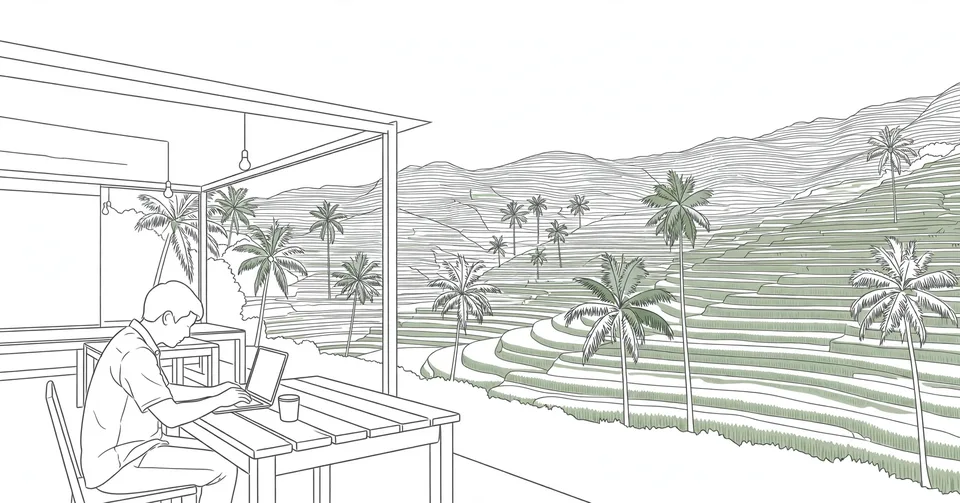
But the photos leave out the second half of the story. The digital nomad Bali dream has a legal side, a price tag, and a cost to the island itself, and none of those fit in a sunset photo. The honest answer is that Bali really is a good place to work remotely, if you go through the legal door, budget honestly, and remember you are a guest on someone else's island.
This is how a small island became the office of the world, what the visa really requires, what a month actually costs, what the boom means for the Balinese who live there all year, and why the digital nomad Bali story is still being written.
How a holiday island became an office
The digital nomad Bali story started quietly, more than a decade ago. Travel bloggers settled in Ubud, surfers with laptops settled in Canggu, and cafes started competing on wifi speed instead of just coffee. Coworking spaces opened, then more of them, and small communities formed around shared desks, shared scooters, and shared sunsets.
The pandemic finished the job. Remote work became normal everywhere at once, and when Bali reopened, the crowd came back bigger than before. Each wave made the digital nomad Bali scene more organised and more visible, and each wave raised the same question: how many remote workers can one small island hold? By the early 2020s the scene had its own infrastructure, with coworking spaces selling day passes, coliving houses, and weekly meetups where newcomers swapped visa tips and landlord warnings. Indonesia noticed and announced a digital nomad visa in 2022, but the real one took longer to arrive. The E33G Remote Worker Visa finally launched in April 2024, and it is the permit the whole scene had been waiting for.
The time zone helps too. Bali lines up well with Australian business hours and much of Asia, so a morning call with Sydney and an afternoon call with Singapore both fit in one workday. That is a practical advantage no beach photo can show, and it is one reason the digital nomad Bali crowd keeps growing instead of moving on.
The visa that actually allows remote work
This is the part most guides skip, and it matters more than anything else. The E33G Remote Worker Visa, a type of KITAS temporary stay permit, is the only Indonesian visa that explicitly authorises remote work for a foreign employer while you live in Indonesia. For the digital nomad Bali crowd, that single fact is what separates a legal stay from a gamble. No other visa does that, including the tourist visa most visitors arrive on.
The E33G is issued for one year and can be extended. To qualify, you must show at least US$60,000 a year, about US$5,000 a month, in income from foreign sources, plus a personal bank balance of about US$2,000 held over the last three months. You may not work for Indonesian companies, and you may not earn Indonesian-source income. The E33G is the visa the digital nomad Bali community had been asking for since the 2022 announcement, and the income bar is deliberately high. The rules are set out on the official e-Visa portal, and any digital nomad Bali newcomer should read them in full before applying. A 2026 guide to the E33G lays out the same requirements in plain language, including the bank balance rule and the extension process.
One claim to ignore: you will still see articles promising a five year digital nomad visa for Indonesia. That version was announced in 2022 but it was never implemented. The E33G, one year at a time, is the visa that actually exists.
The tourist Visa on Arrival does not authorise remote work, and pretending otherwise has become riskier. For years many people worked on a tourist visa and nobody asked questions. That changed in 2025 and 2026, when Bali immigration set up a dedicated task force in Canggu and Seminyak, started checking social media and LinkedIn activity, and stepped up deportations. More than 300 deportations passed through Ngurah Rai airport in a year, and remote workers on the wrong visa were among them.
There is one more thing to check before you stay long term. Spending more than 183 days in Indonesia in a year can trigger Indonesian tax residency, which changes what you owe and where. The rules are complicated and they keep changing, so treat this as a question for a tax adviser, not something to settle from a blog post.
What a month in Bali actually costs
The digital nomad Bali budget is cheaper than a Western capital and more expensive than the backpacker version of the island. A realistic month for one person looks roughly like this.
| Item | Typical monthly cost |
|---|---|
| Rent, one bedroom in Canggu | US$500 to US$900 |
| Coworking membership | US$150 to US$250 |
| Food, cafes plus local warung | US$300 to US$500 |
| Scooter rental | US$50 to US$80 |
| Visa and admin, spread over the year | US$60 to US$100 |
| Total | About US$1,100 to US$1,900 |
Prices move, and the range is wide for a reason. A room in a family guesthouse in Ubud costs far less than a villa with a pool in Canggu, and eating at a local warung costs a fraction of brunch at a beach club. The digital nomad Bali total also leaves out health insurance, which is not a legal requirement for the E33G but is a practical necessity, and the flights that bring you here in the first place. For comparison, my guide to what it really costs to live in Tokyo puts a single person there at 170,000 to 250,000 yen a month, most of it rent, while in Bali rent is the smaller part of the bill and the money goes further on food, transport, and space.
The other side of the boom
Every boom has a second side, and the digital nomad Bali boom is no exception. Its effects are visible if you look past the coworking crowd. Rents have risen sharply in Canggu and Uluwatu, and some Balinese families now struggle to rent in the villages they grew up in. Traffic in Canggu at rush hour is barely moving, and the island's roads, water, and waste systems were not built for this many people.
The Balinese response is mixed, and it should be. Many welcome the income: the guesthouses, the cafes, the drivers, and the landlords all earn from the crowd. Others feel their island is being treated as a backdrop, a pretty place to live cheaply while the people who belong there get pushed to the edges. Both views are true at the same time, and any honest account of the digital nomad Bali boom has to hold both. The digital nomad Bali crowd is not going away, and the debate about what it means for the island is only getting louder.
The fairest way to be part of it is also the simplest. Learn a little Indonesian, rent from local owners when you can, pay the price asked without haggling a warung owner down to nothing, and follow the rules, including the visa rules. A guest who pays fairly and behaves well is welcome. A guest who treats the rules as optional is not, and Bali is now showing that it means it.
Bali is also one island in a huge country, and the nomad crowd rarely sees the rest of it. If the island makes you curious about Indonesia beyond the coworking scene, the dragons of Komodo are a short flight away, and they are a reminder of how much of the country has nothing to do with laptops at all.
Is the digital nomad Bali dream still worth it
For the right person, yes, and the right person is not hard to describe. You qualify for the E33G, or you are honest about the fact that you do not and you plan around it. You know the digital nomad Bali dream is a trade, not a free pass: sunshine and low rent in exchange for paperwork, patience, and respect. You budget for the real costs, not the cheapest version of them. You accept the traffic, the crowds, and the rainy season, and you treat the island as a home you are borrowing, not a service you bought.
Many people come to Bali to escape exactly the life that karoshi describes, the Japanese word for death by overwork, where long hours become an identity and rest feels like failure. Bali offers the opposite setting: sun, sea, and time. But a laptop on a beach can still become a twelve hour day if you let it, and the island cannot give you balance. It can only give you the setting. The balance is still yours to keep.
That is the real lesson of the digital nomad Bali story. The island did not become the remote work capital because it is perfect. It became the capital because it is beautiful, affordable, and welcoming, and because thousands of people decided that working from a place they love beats working from a place they merely tolerate. Go legally, spend fairly, and live like a guest, and the dream is as good as the photos promise.
More in Money & Work
- The E33G Remote Worker Visa and How to Legally Work from Bali
- The Salaryman and Japan's Loyal Office Culture
- Key Money in Japan and Why Renting Costs Four Months Up Front
- Akiya, Japan's Free Houses That Are Not Really Free
- Karoshi, the Japanese Word for Death by Overwork
- What It Really Costs to Live in Tokyo
Latest posts
- Love Live Sunshine and How Anime Changed Numazu
- Numazu Deep Sea Aquarium and the Creatures of Suruga Bay
- Numazu Himono and the Art of Dried Fish
- Numazu Imperial Villa and Japan's Seaside Imperial Retreat
- Numazu Port and the Freshest Seafood in Shizuoka
- Disaster Vending Machines in Japan That Give Their Drinks Away
- Wabi-Sabi and the Japanese Beauty of Imperfect Things
- Bullet Climbing Mount Fuji, the Overnight Ascent Japan Is Trying to Stop
- Women Only Train Cars in Japan and the Problem They Answer
- Climbing Mount Semeru, Java's Highest Volcano
- Maneki Neko and Japan's Beckoning Lucky Cat
- Tamago Sando and Japan's Konbini Egg Sandwich
- The Baduy People and Life Without Modern Technology
- Onsen Tattoo Rules in Japan and How They Are Slowly Changing
- Sento, Japan's Everyday Public Bathhouse