Bakso and the Meatball Soup Indonesia Eats Everywhere
· 14 min read
Bakso is Indonesia's beloved meatball soup, a bowl of springy beef meatballs in clear broth that costs little, feeds everyone, and carries a story of Chinese traders, Javanese vendors, and two rival cities.
Bakso is the bowl Indonesia reaches for when it wants something hot, cheap, and honest. It is a clear beef broth filled with springy meatballs, noodles, bean sprouts, and fried shallots, sold from pushcarts, street stalls, and restaurants in every city in the country. Students eat it between classes, office workers eat it at lunch, and families eat it on rainy evenings when nobody feels like cooking. No other Indonesian dish is quite so ordinary, and no other dish is quite so loved.
The name bakso can mean one meatball or the whole bowl, and that looseness fits the dish. A bowl is never exactly the same twice. The meatballs change size, the noodles change shape, the toppings change with the city, and the vendor changes the recipe to taste. What stays constant is the idea: beef, pounded and shaped into balls, poached in broth, and served steaming hot with whatever the kitchen has on hand.
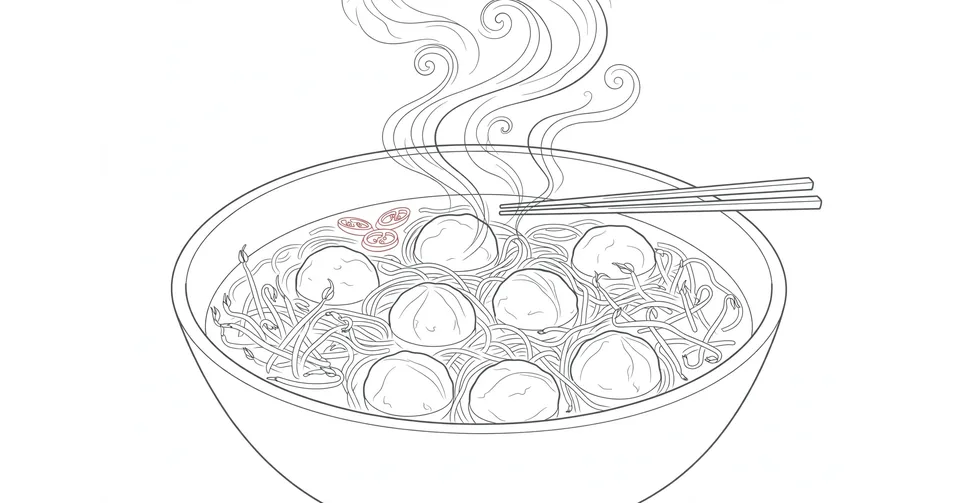
That simplicity is deceptive. Bakso carries a long story of migration, adaptation, and local pride, and it sits at the center of one of Indonesia's friendliest food rivalries. To understand the bowl, it helps to start with the word itself.
What Bakso Actually Is
At its simplest, bakso is a meatball made from beef surimi, a paste of ground beef mixed with tapioca starch, garlic, salt, and pepper, then rolled into balls and cooked in boiling water. The tapioca is what gives the meatball its famous texture: firm, smooth, and springy, with a bounce that a plain ground beef ball never has. A good meatball springs back when you bite it. A bad one is mushy, and every Indonesian has a strong opinion about the difference.
The meatballs are served in a clear beef broth, usually with yellow wheat noodles, rice vermicelli, bean sprouts, and sometimes a boiled egg or a piece of tofu. Fried shallots and chopped celery go on top. On the table, or handed over with the bowl, there are always condiments: sweet soy sauce, chilli sauce, and sometimes vinegar. The diner seasons the bowl to taste, which means no two people eat the same bakso in quite the same way.
Most bakso is beef, because most Indonesians are Muslim and beef is halal, but the form is flexible. Chicken, fish, and even shrimp versions exist, and frozen bakso of every kind is sold in supermarkets across the country. The beef version remains the standard, the one people mean when they simply say the word.
Bakso is also one of the cheapest complete meals in Indonesia. A bowl from a street cart costs a fraction of a restaurant meal, which is why it works as everyday food rather than occasion food. It is not a dish Indonesians save for celebrations. It is a dish they eat on Tuesdays.
A Name From Hokkien, a Dish From Many Hands
The word bakso comes from bak-so, the Hokkien pronunciation of a term meaning minced or fluffy meat. That is the clearest clue to the dish's origin: Chinese traders and migrants brought meatball-making traditions to the Indonesian archipelago, and the dish took root in Peranakan kitchens during the Dutch colonial era. Chinese influence runs through much of Indonesian food, from bakmi and mie ayam to lumpia and kwetiau goreng, and this dish belongs to that same family of borrowed dishes that became local.
But bakso is not simply a Chinese dish that happened to land in Indonesia. Culinary historians point out that the meatball itself may owe something to Dutch cooking as well, and the broth, noodles, and seasonings were shaped by Javanese tastes over generations. The result is a mixture, a dish with several parents, and that mixed heritage is part of why Indonesians treat it as fully their own.
The vendors tell the same story. Today most sellers are Javanese, many of them from Wonogiri, a town near Solo in Central Java, or from Malang in East Java. Whole families have sold it for generations, pushing carts through neighbourhoods or running small stalls that never seem to close. The dish travelled with them, from Java to Sumatra, Kalimantan, Sulawesi, and Papua, until it became one of the few foods you can find anywhere in the country.
A popular story credits a Chinese peddler in Surabaya in the late nineteenth century with inventing the dish, but the evidence for that tale is thin, and historians treat it as folklore rather than fact. What is certain is older and more interesting: meatball recipes appear in Chinese agricultural texts as far back as the sixth century, and the technique travelled with migrants for a thousand years before it reached Java and became bakso.
Solo or Malang, Pick Your Side
Ask an Indonesian which bakso is best and you will start an argument. The two great schools are Bakso Solo and Bakso Malang, named for the Central and East Javanese cities where each style took shape, and their fans are loyal.
Bakso Solo is the simpler bowl. The meatballs are served with yellow noodles and rice vermicelli in beef broth, with bean sprouts and celery, and the flavour leans clean and savoury. Solo vendors are also known for bakso urat, meatballs mixed with tendon that give a chewier, rougher bite, and for the giant meatball stuffed with minced meat or egg that has become a street food spectacle of its own.
Bakso Malang is the fuller bowl. It comes loaded with extras: fried tofu, siomay dumplings, and crispy fried wontons, alongside the noodles and meatballs. In Malang itself, bakso bakar, meatballs grilled on a skewer and brushed with sweet sauce, is a local favourite. The Malang bowl is a meal and a half, and its fans say the Solo bowl looks empty by comparison.
The rivalry is friendly, but it is real, and it has a third contender in Bandung, where bakso cuanki, made with fish or shrimp, has its own devoted following. Other cities have their own versions too, and every region insists its own bowl is the proper one. For a visitor, the rivalry is a gift: it means the same dish can be eaten three different ways in three different cities, and each version is worth trying.
The Anatomy of a Bowl
A bowl of bakso is built from a small set of parts, and each part has a job. The broth must be clear and beefy, never cloudy or greasy. The meatballs must be springy, not soft. The noodles give the bowl its bulk, the bean sprouts give it crunch, and the fried shallots and celery give it aroma. The condiments on the side let the eater finish the job: sweet soy sauce for depth, chilli sauce for heat, and a splash of vinegar for brightness.
| Part | What it does | What to look for |
|---|---|---|
| Meatballs | The star of the bowl | Springy, smooth, firm to the bite |
| Broth | The base everything sits in | Clear, beefy, lightly salted |
| Noodles and vermicelli | The bulk of the meal | Cooked just soft, never mushy |
| Bean sprouts and celery | Freshness and crunch | Crisp, not wilted |
| Fried shallots | Aroma and savoury depth | Golden, not burnt |
| Condiments | The eater's own seasoning | Sweet soy, chilli, vinegar |
The balance matters more than any single part. Too much chilli drowns the broth, too much sweet soy turns it into dessert, and a bowl with great meatballs but weak broth is a disappointment. The best vendors are the ones who get all of it right at once, and Indonesians can tell within one spoonful whether a vendor is serious.
One detail matters more than it seems: the meatball's bounce. That springy texture comes from tapioca starch worked into the beef paste and from vigorous pounding, and it is the mark of the real thing. A meatball that falls apart or feels like ordinary ground beef is a sign the vendor cut corners, and regulars will not come back.
The Cart, the Sound, and the Ritual
Much of bakso's charm has nothing to do with flavour. It is the cart, the sound, and the ritual around it. The classic cart is a pushcart with a glass case, a pot of broth kept hot over a small stove, and a stack of bowls. Vendors push their carts through residential streets in the late afternoon, and regulars know their vendor's route and timing the way they know a bus schedule.
The sound is famous. Many bakso vendors announce themselves by tapping a spoon against a bowl or a small metal plate, a rhythmic clink that carries down the street. Children learn to recognise their vendor's rhythm, and adults who have moved away say the sound is one of the first things they miss about home. It is a small detail, but it is part of why the dish feels like a neighbourhood institution rather than a restaurant dish.
Eating bakso has its own etiquette, and it is simple: sit, season, and eat it hot. The broth cools fast, and the noodles swell if they sit too long, so regulars do not linger over the bowl. They add their condiments, stir once, and start eating while the steam is still rising. The whole meal takes ten minutes, and that speed is part of the point. It is food for people with somewhere to be.
There is also an honesty to the economics that Indonesians appreciate. The cart vendor works long hours for thin margins, and the price stays low because the dish is designed to be cheap: beef stretched with tapioca, broth made from bones, and noodles that fill the bowl. Nobody pretends it is luxury food, and that is exactly why people trust it.
How to Order Bakso Like a Regular
For a first timer, the menu can be confusing, because much of it is unwritten. The safest order is the standard bowl, and from there the choices are simple: ask for bakso urat if you like a chewier meatball, bakso telur if you want one stuffed with egg, and bakso jumbo if you are feeling ambitious. Most stalls will let you mix and match, and the price rises with the extras.
The condiments deserve a moment of thought. Sweet soy sauce is the default, chilli sauce is for those who like heat, and vinegar is for those who want a sharper broth. A good rule is to add a little, taste, and then add more, because the broth underneath is already seasoned and it is easy to overwhelm it. The vendors watch how a customer seasons the bowl, and they will quietly judge a person who drowns it in chilli before tasting it.
If you are eating from a cart, bring small change, because vendors rarely carry much of it, and do not expect a chair. Many people eat standing by the cart or perched on a low stool, and that is normal. If you are in a restaurant, the same bowl arrives with a little more ceremony and a slightly higher price, but the dish is the same.
One warning is worth giving: bakso is addictive in the quiet way that everyday foods are. It is not the kind of dish that impresses you once and is forgotten. It is the kind that becomes a habit, and a habit that follows you home. I have eaten it in Jakarta traffic, in a Malang alley, and in a small town in Central Java where the vendor knew every customer by name, and the bowl was good in all three places, which is more than I can say for most famous dishes.
Why Bakso Travels So Well
Bakso has not conquered the world the way rendang has, and that is worth thinking about. Rendang was named the world's best food in a CNN poll, and nasi goreng is on menus from Amsterdam to Sydney, but it remains mostly an Indonesian secret, served in Indonesian restaurants abroad and eaten by Indonesians far from home. The reason is not quality. It is that the dish is hard to explain in one sentence, and the world loves dishes that fit in a headline.
That is changing, slowly. Indonesian restaurants overseas put it on their menus, frozen packs are sold in Asian supermarkets, and travellers who have eaten it in Jakarta come home looking for it. The dish has everything a global food trend needs: it is cheap, comforting, customisable, and photogenic in its own steaming way. What it lacks is a single famous ambassador, a chef or a television show to carry it abroad.
My own view is that bakso does not need one. Its strength is that it belongs to everyone, not to a single restaurant or a single city, and turning it into a luxury product would ruin what makes it good. The best bowl I have eaten cost less than a bus ticket and came from a cart with a wobbly wheel. If the dish ever becomes fashionable, I hope it stays cheap, because the day a bowl costs as much as a steak is the day it stops being itself.
There is a comparison worth making with soto, Indonesia's other great soup. Soto is turmeric-yellow, aromatic, and tied to breakfast, while this one is clear, beefy, and tied to no hour at all. Both are bowls of broth that feed a crowd for little money, and both show the same Indonesian instinct: take a simple idea, fill it with local flavour, and serve it to everyone. If you have eaten one, you should eat the other, and then decide which bowl you would miss more.
Bakso also shares a family resemblance with the noodle soups of the region. The wheat noodles and the clear broth recall the Chinese soups that shaped it, and the habit of seasoning at the table is shared across Southeast Asia. But the meatball itself, springy and beefy and unmistakably Indonesian, is what makes the bowl different from anything else in the region. It is a small invention with a long history, and it is still being perfected one cart at a time.
A Bowl Worth Seeking Out
Bakso will not change your life, and it does not try to. It is a bowl of soup that does its job well, day after day, for millions of people who never think of it as special. That is the highest praise a dish can earn. The famous foods get the awards and the magazine covers, but the everyday foods get eaten, and it gets eaten more than almost anything else in Indonesia.
If you visit Indonesia, eat bakso at least twice: once from a cart, standing in the street, and once from a restaurant, sitting down with a cold drink. Compare the two, and you will learn more about Indonesian food than any guidebook can teach. Then find a vendor you like, learn his route, and become a regular. That is how it is meant to be eaten, not as a tourist attraction but as a habit, one steaming bowl at a time.
For more on the food that shaped this bowl, the story of how a bowl of noodles changed the world is a good place to start, and the history of bakso itself is worth reading in full. Indonesian cuisine as a whole is a story of borrowed dishes made local, and this dish is one of its best examples, as the broader picture in Indonesian cuisine shows.
More in Food & Travel
- Sapporo Snow Festival and the Ice City That Rises Every February
- Satay and the Smoke That Carries Indonesia to the World
- Tumpeng Is the Rice Cone Java Serves When It Wants to Say Thanks
- Japan's Winter Illuminations Turn Dark Nights Into Light
- Lake Toba and the Supervolcano That Made the World's Largest Volcanic Lake
- Raja Ampat and the Coral Kingdom at the Edge of Indonesia
Latest posts
- Kecak Dance and the Hundred Voices That Tell the Ramayana
- Rangda Is the Witch Queen Bali Never Lets Win
- The Japanese School Uniform and the Story Behind the Sailor Suit
- Aikido and the Martial Art That Refuses to Fight Back
- Barong Is the Lion Bali Calls Out When the Village Needs Protection
- Onsen Etiquette and the Unwritten Rules of Japan's Hot Springs
- Setsubun, the Bean Throwing Festival That Chases Winter Away
- Karate, the Empty Hand That Became Japan's Most Exported Martial Art
- Kemari Is the Ball Game Japan Played Without Trying to Win
- Chagama Is the Kettle That Never Leaves the Tea Room
- Judo, the Gentle Way Japan Gave the World
- Tokyo Skytree and How Japan Built the World's Tallest Tower
- Matsumoto Temari Turns Mountain Cocoons Into Wishes You Can Hold
- Nambu Tekki Is the Iron That Outlasted the Lords Who Ordered It
- Forest Bathing in Japan, the Quiet Science of Shinrin-Yoku