Shiko, the Leg Stamp That Starts Every Sumo Day
· 8 min read
Every sumo day starts with shiko, the high leg stamp wrestlers perform hundreds of times in morning training and as a ring ritual that drives evil out of the clay.
Before two wrestlers ever touch, a sumo bout begins with a sound. One man lifts his leg as high as it will go, holds it there for a breath, and drives his heel into the clay with a crack that carries across the arena. That stamp is shiko, the most repeated movement in sumo, and in its way the most honest summary of what the sport thinks it is doing.
The same shiko opens the working day at every sumo stable, where teenagers perform it hundreds of times before breakfast, and it ends the grandest ceremony in the sport, performed just three times by a yokozuna in front of a hushed crowd. One movement is doing two jobs at once. It is a training exercise, and it is an act of purification, and sumo has never felt the need to separate the two.
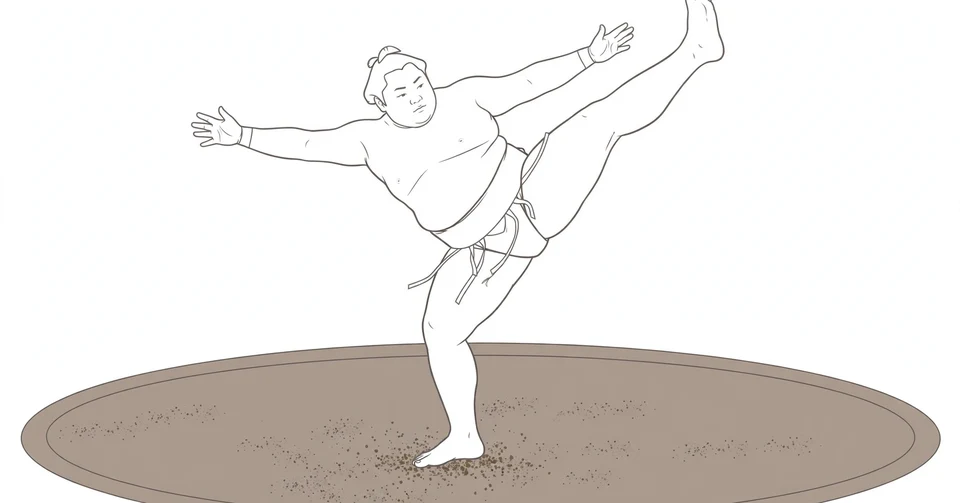
Watch a full day of sumo and you will see shiko at every level of it, from the first apprentice sweating through his morning sets to the last champion of the evening. It takes only a few seconds each time. Understanding why those seconds matter explains more about sumo than most of the throws do.
What shiko is, and how it is done
Start with the mechanics, because shiko is harder than it looks. The wrestler stands with his feet set wide on the clay. He shifts his weight to one side, draws in a breath, and raises the other leg out to the side, as high as his hip will allow. At the top he pauses, balanced on a single leg, then stamps the raised foot down hard as he breathes out. Then he does the same on the other side, and the other, building a slow rhythm of lift, hold, and stamp.
Reference works on sumo describe shiko as one of the three basic exercises of the sport, alongside teppo, the open handed striking of a wooden pillar, and matawari, the punishing splits stretch that every junior dreads. Of the three, shiko is the one coaches call the primary exercise, the foundation everything else is built on. The raised leg in good form reaches horizontal or higher, and getting it there asks for a loose hip, a strong standing leg, and a balance that has to be earned rather than assumed.
Why wrestlers stamp the ground
The ceremony comes first in the wrestlers' own understanding. A dohyo is not treated as ordinary sports flooring. It is consecrated clay, a raised mound of packed earth whose fighting circle measures 4.55 metres across and is marked out in rice straw bales. Before a tournament, a consecration ceremony of its own buries offerings beneath the centre of that circle, salt and washed rice among them, along with kelp and dried chestnuts, so every shiko lands on ground that has quite literally been fed and blessed. The men who compete on it then prepare the surface before they use it. Salt is the famous half of that preparation. The stamp is the other half. One way of putting it, used by guides to the ceremony, is that salt purifies the ring from above while shiko purifies it from below.
Within Shinto thinking, shiko is an act of pacification. The vibration sent through the earth is meant to drive out the evil and disorder believed to lurk beneath the surface, so the bout takes place on settled ground. The same stomping gesture turns up in kagura, the sacred dance performed at shrines, where it carries the same meaning, which suggests the movement was old long before it belonged to sumo alone. It helps that sumo began as ritual rather than entertainment, as the history of sumo, Japan's oldest sport, makes clear. There is a plainer reading layered over the sacred one, too. A champion stamping the clay is also showing, in pantomime, exactly what he intends to do to the man in front of him.
Shiko in the morning, by the hundred
Long before the ceremony, though, shiko is homework. Morning training at a sumo stable, the session called asageiko, starts on an empty stomach, and for the youngest apprentices it starts with the stamp. Visitors who have watched these sessions describe apprentices spending the better part of an hour in endless repetitions, lifting their legs as high as they can and driving their bare heels into the clay two or three hundred times before the real wrestling begins, ending the set panting, their skin coated in sweat and sand.
Older coaching guidance is even less forgiving. One long running sumo reference tells beginners they should work up to at least five hundred stamps a day. The point of the volume is not punishment. Repeated shiko opens the hips, strengthens the standing leg, and rehearses the low, balanced posture that sumo wrestling is fought from. Balance, agility, and flexibility sound like gentle words until you try to hold a heavy leg at shoulder height, still as a statue, on one foot, for the two hundredth time that morning.
The stamp bookends the session, too. After the collision drills and the stretching, practice closes with one final round of shiko, performed together, so the last thing tired legs do is the first thing they did at dawn. Coaches value it for a practical reason as well. The explosive lift and stamp rehearse the hip drive of the tachiai, the opening charge that settles many bouts in the first second, before any grip is taken.
The three stamps everyone watches
At the other end of the scale sits the most famous shiko of all, the one performed not in sets but in a count of three. Before the final bouts of a tournament day, the yokozuna, the grand champion, enters the ring wearing the great white rope that marks his rank, flanked by two attendants, in the ceremony called the yokozuna dohyo-iri, the grand champion's ring entrance. He spreads his arms wide, brings his hands together in a single deep clap, and sweeps his palms upward, in a gesture old enough to carry two meanings, purifying his hands and showing that he hides no weapon. Then he steps to the centre, sets his feet wide, and performs shiko three times, each stamp landing to a roar from the crowd.
You do not have to wait for a yokozuna to see the pattern, either. In every top division bout, the two wrestlers go through their own short version of it during the ritual warm up before the charge. Each man squats facing his opponent, claps once, spreads his arms wide with the palms turned up to show empty hands, then stamps through shiko before crouching again at the starting lines. The yokozuna's version is grander and slower, but the grammar is the same. The whole top division also performs a plainer cousin of it in its own ring entering ceremony, filing into the ring to clap together and raise their hands in unison, yet it is the yokozuna's solo version that audiences hold their breath for. There are even styles to argue about. His ceremony comes in two inherited forms, one with a single arm extended and one with both arms spread wide, handed down through lineages of champions, and sharp eyed fans compare each new grand champion's stamps against the men who came before him. A movement an apprentice does by the hundred has become, at the top of the sport, a signature, the same shiko weighed down with meaning.
Salt from above, shiko from below
Shiko never works alone in the ring. Its partner is salt, the other purification every spectator knows. Before a bout, the wrestlers of the top two divisions return to their corners again and again, taking handfuls of salt and throwing them high over the clay. Only the salaried ranks throw salt at all, and across a fifteen day tournament the bouts get through hundreds of kilograms of it. The salt falls out of the air. The stamp answers from the ground. Between the two of them, the ring is made ready, and only then is anyone allowed to fight on it.
I find something quietly admirable in a sport whose most practised movement is not an attack. Before a wrestler is permitted to throw anyone, he is asked to settle the ground he stands on, and he is asked to do it hundreds of times, in the dark hours, long before anyone is watching. The three stamps of the yokozuna get the applause, and fairly. But they are only the visible tip of the thousands done in silence. Shiko is sumo's way of saying that how you arrive matters as much as what you do when you get there, and the clay, stamped clean every morning, keeps the score of that belief.
More in Culture & Society
Latest posts
- Kecap Manis and the Sweet Soy Sauce of Indonesia
- In Mamoiada, Two Hundred Families Still Make Wine at Home
- Shochu and the Quiet Spirit of Japan
- A Dried Shiitake Is Louder Than a Fresh One
- Loma Linda's Long Lives Run on Saturdays
- Maruten Numazu and the Towering Kakiage Bowl of the Port
- The Three Sisters Grow Better Together
- Tatamiishi Terraces Filter a River Through Stone
- Wasabi-Zuke Puts the Whole Plant in Sake Lees
- Konyoku Is Still Out There, Past the Last Train Station
- Dry January Lasts a Month on Purpose
- Ikaria Runs on Island Time
- Why Nicoya Cooks Its Corn in Lime
- Nobody Eats the Daidai, and That Is the Point
- There Are Only 105 Toshiyori Shares in All of Sumo