Asageiko, Sumo's Dawn Training on an Empty Stomach
· 8 min read
Asageiko is the dawn training of a sumo stable, where wrestlers drill shiko, suri-ashi and butsukari on an empty stomach for hours before the day's first chankonabe.
Before Tokyo has properly woken up, in plain unmarked buildings in districts like Ryogoku, some of the largest athletes in the world are already hours into their working day. The session is called asageiko, the morning practice of a sumo stable, and it begins in near silence, on an empty stomach, with nobody watching except the stablemaster and the wrestlers themselves.
A sumo stable, or heya, is not a gym that wrestlers travel to each morning. It is a dormitory, a training hall and a canteen in one building, where everyone from the newest teenage apprentice to a grand champion lives under one roof and one hierarchy. Asageiko is the fixed point that whole life is organised around, the same session repeated almost every morning of a wrestler's career.
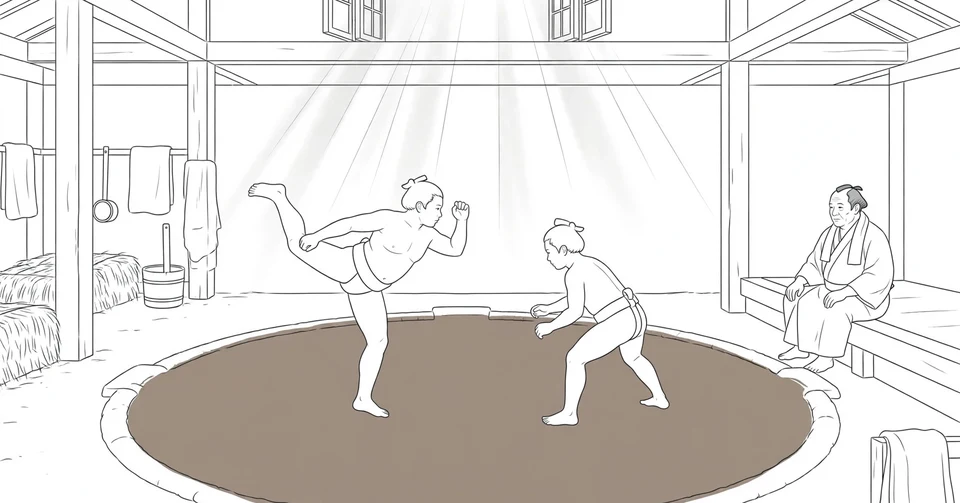
Nothing about asageiko is staged for an audience. There is no music, no commentary and no applause. The room holds a clay ring, the dohyo, which is treated as a sacred Shinto space rather than a piece of sports equipment, and the loudest sounds are bodies colliding, feet stamping the clay flat, and the stablemaster's voice calling a correction. Everything else is work.
The juniors are awake long before the seniors
The order of an asageiko morning is the stable hierarchy made visible. The lowest ranked wrestlers, often teenagers who joined straight from junior high school, are up first, in some stables around five in the morning. Before any real training begins they sweep the sand of the dohyo smooth with handmade brooms, fetch water and prepare the room, because serving the men above them is part of the job at the bottom.
You can read rank at a glance in the training room. The juniors drill in black cotton loincloths, while the salaried senior wrestlers, the sekitori, arrive later, toward seven or eight, wearing white silk and with their hair dressed in the full topknot. The stablemaster, the oyakata, a retired wrestler himself, watches from his seat at the side. For long stretches his is the only voice in the room, and when it rises, everyone in earshot understands that someone has stopped working hard enough.
Only once the room is ready and the basics are under way do the seniors take their turn in the ring. The pattern never really changes, and I think that is the point. Asageiko is not designed to be interesting. It is designed to be survived, morning after morning, until the movements are no longer things a wrestler thinks about.
The room itself tells you how long this has been going on. It smells of damp clay and sweat, and underneath both, faintly sweet, the bintsuke wax that holds the wrestlers' topknots in place. Within half an hour of the start, every man in the room is coated in a film of sweat and fine sand from the ring, and the clay dust hangs in the early light. Nobody wipes it away or comments on it. It is simply what a body looks like partway through asageiko.
Why asageiko happens on an empty stomach
The detail outsiders find hardest to believe is that nobody has eaten. Wrestlers train through the whole of asageiko without breakfast, on purpose. The belief inside the stable is that training hungry keeps the body sharp and builds the edge that serious practice demands, so the first meal of the day waits until the work is done.
That meal, when it finally comes, is the famous hot pot described in my piece on chankonabe, the hot pot that feeds a sumo stable. The same juniors who were sweeping the ring before dawn help cook it, and the eating follows the same order as the training, seniors served first. Seen from the kitchen side, asageiko explains the meal: hours of collision practice on an empty stomach are exactly how a man builds the appetite, and the need, for a pot that size.
There is a hard logic to it that I have come to respect. The hunger is not an accident of scheduling. It is part of the training load, one more discomfort that a young wrestler learns to work through without complaint, like the cold room and the early hour.
Exercises older than the sport itself
The first hour or more of asageiko belongs to exercises so old and so repeated that they look almost like ritual. The best known is shiko, the great leg stamp, where a wrestler raises one leg as high as it will go, holds it for a moment, then drives the heel down into the clay. Apprentices do this two or three hundred times in a session. It builds balance and leg strength, and in the old Shinto sense it also drives evil spirits out of the ring, one stamp at a time.
Then comes suri-ashi, the sliding footwork, where wrestlers cross the ring again and again with their feet skimming the surface, never lifting them clear of the ground. It trains the low, stable posture that everything in sumo depends on. After that, matawari looks impossible until you see it done: men of a hundred and fifty kilos easing into full front splits and pressing their chests to the floor, sometimes with a senior pushing down on their backs, because flexibility is what keeps those huge bodies from tearing themselves apart.
There is also teppo, striking a wooden pillar with open palms, over and over, to condition the hands for the thrusting attacks of a real bout. None of these drills were invented for spectators, and most of them predate the modern tournament system entirely. For the longer story of how ritual became a professional sport, my history of sumo, Japan's oldest sport is the place to start.
Practice bouts and the wall of a senior's chest
Once the seniors are in the ring, asageiko shifts into moshiai, practice bouts in a winner stays on format. Two wrestlers crouch at the starting lines, knuckles to the clay, and explode into the first charge. The winner stays in the middle and the next challenger comes straight in, deliberately giving him no time to recover, so the strongest men end up training the hardest, bout after bout. A dominant wrestler can find himself fighting dozens of consecutive bouts this way, each one against a fresher opponent, and a bout can be over in seconds, a throw or a shove before the next man is already crouching in front of him.
Hardest of all is butsukari-geiko, the drill that ends many mornings. A senior plants himself in the ring like a wall. A junior charges at full speed into his chest and tries to drive him backwards across the clay, then does it again, and again, until his legs simply give out and he collapses in the dirt. There is no whistle and no mercy round. He gets up and charges once more, or the morning has beaten him, and everyone watching understands the difference.
Watching asageiko as a guest
A small number of stables let outsiders watch asageiko, and it is a privilege that has to be arranged, never assumed. Stables do not take walk-ins. Most visitors go through a tour operator with an existing relationship to a stable, as guides like this walkthrough of sumo morning practice in Tokyo explain, and typically watch for an hour and a half to two hours from a tatami area a few metres from the ring. One well known exception is Arashio stable in Nihonbashi, which lets anyone watch its asageiko free of charge through large street facing windows, no booking needed, though the schedule can change at the last minute.
Timing matters as much as permission. There is no viewing at all during the six annual grand tournaments, when the wrestlers are competing instead of training, or in the quiet week of rest that follows each one. The sharpest asageiko sessions come in the build up to a tournament, when the men are deep in preparation and every bout carries a point to prove.
The etiquette inside is strict, and it is about safety and respect rather than ceremony for its own sake. Visitors sit on the floor where they are placed, in seiza or with legs folded, and never point the soles of their feet at the dohyo. They stay completely silent, eat and drink nothing, keep phones silenced and camera flashes off, and do not leave partway through, because coming and going breaks the concentration of men doing something genuinely dangerous. As one account of watching sumo training in Tokyo puts it, you are a guest in someone's home, and you behave accordingly.
What stays with me about asageiko is how little of it needs an audience to justify itself. The tournaments are the public face of sumo, but this silent room at dawn is the thing itself: young men stamping the clay flat, charging at a senior's chest until they fall, all of it before breakfast. Watch it once, respectfully and in silence, and the fifteen seconds of a tournament bout will never look simple again.
More in Culture & Society
Latest posts
- Kombu Is the Quiet Half of Dashi
- Manza Onsen Bathes at 1,800 Metres
- Every Prefecture Argues About What Goes in Ozoni
- KRL Commuterline and the Trains That Move Jakarta
- Kecap Manis and the Sweet Soy Sauce of Indonesia
- In Mamoiada, Two Hundred Families Still Make Wine at Home
- Shochu and the Quiet Spirit of Japan
- A Dried Shiitake Is Louder Than a Fresh One
- Loma Linda's Long Lives Run on Saturdays
- Maruten Numazu and the Towering Kakiage Bowl of the Port
- The Three Sisters Grow Better Together
- Tatamiishi Terraces Filter a River Through Stone
- Wasabi-Zuke Puts the Whole Plant in Sake Lees
- Konyoku Is Still Out There, Past the Last Train Station
- Dry January Lasts a Month on Purpose