Sumo, Japan's Oldest Sport
· 8 min read
Sumo is Japan's oldest sport, a 1,500-year-old Shinto ritual turned into a professional contest with six tournaments a year, strict stables, and one of the hardest lives in sport.
Sumo looks like two large men pushing each other out of a circle. That is the whole contest, and it is also the least of it. Sumo is Japan's oldest sport, about 1,500 years old, and it began as a Shinto ritual long before it became a professional contest. To watch it properly is to watch a ceremony that happens to end in a fight.
The fight itself lasts seconds. Two wrestlers crouch, clap, throw salt into the ring, and then collide with a force that can shake the wooden floor. Most bouts are over in under ten seconds. But everything around those seconds, the rankings, the stables, the diet, the dress, the silence before the charge, is what makes sumo unlike any other sport on earth.
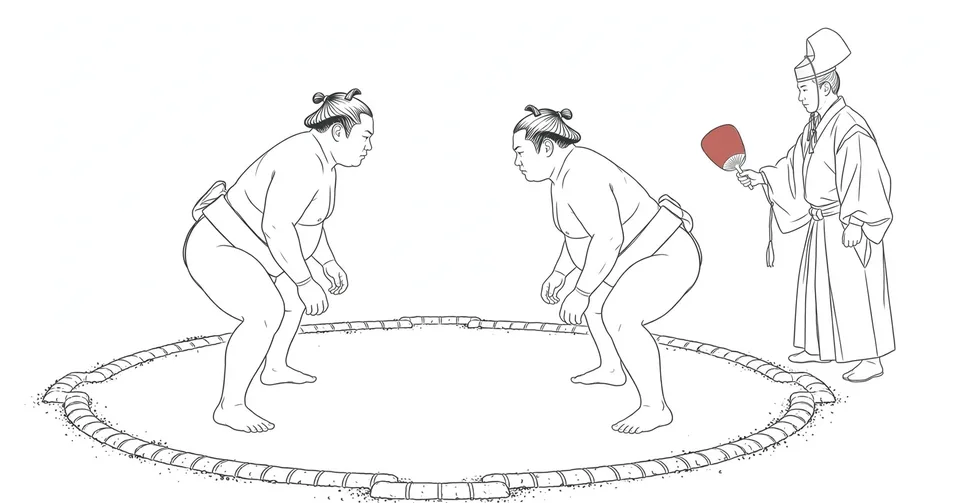
This is a guide to what sumo is, how its six tournaments work, how a wrestler lives, and why a sport this old still fills arenas and still argues with the present day.
A ritual before it was a sport
Sumo began as a Shinto rite, performed at shrines and at the imperial court to pray for good harvests and to drive away evil spirits. The earliest records describe bouts held before the emperor more than a thousand years ago, and the ceremony has never really left the sport. Every tournament bout still opens with purification: the wrestlers clap their hands to attract the attention of the gods, stamp their feet in the shiko leg raise to drive away demons, and scatter salt across the clay to cleanse the ring.
The ring itself, the dohyo, is a circle of clay 4.55 metres across, raised on a square platform. It is treated as sacred ground, which is why the rules about who may enter it are still argued about today. The referee, the gyoji, wears the robes of a medieval court noble and carries a fan, and his calls are part of the ceremony. The wrestlers wear their hair in a topknot, the oichomage, and fight in nothing but a heavy silk belt, the mawashi.
Sumo became a professional sport in the Edo period, when bouts were staged to raise money for shrines and temples and promoters began to organise wrestlers into stables. The Japan Sumo Association, which runs the sport today, still keeps the old structure: stables, rankings, and a calendar built around ritual.
Six tournaments, fifteen days each
The professional year is built around six tournaments, called basho. Each lasts fifteen days, and each wrestler in the top divisions fights once a day. The wrestler with the most wins at the end takes the Emperor's Cup. The schedule never changes, which is part of the sport's rhythm: fans know exactly where the year will take them.
| Month | City | Tournament |
|---|---|---|
| January | Tokyo | Hatsu Basho |
| March | Osaka | Haru Basho |
| May | Tokyo | Natsu Basho |
| July | Nagoya | Nagoya Basho |
| September | Tokyo | Aki Basho |
| November | Fukuoka | Kyushu Basho |
Rankings are published before every tournament on the banzuke, a hand-written sheet that lists every wrestler in order. A winning record, kachi-koshi, means more wins than losses, and it moves a wrestler up the list. A losing record, make-koshi, moves him down. Eight wins against seven losses is the line every wrestler watches. Above the rest sits the top division, makuuchi, with the second division, juryo, just below it. Below them are four more divisions, down to the beginners in jonokuchi.
This system makes every bout matter. A wrestler fighting on day fifteen may be fighting for promotion, for his salary, or simply to stay in the division he has spent years climbing into. There are no friendly matches in sumo. Even a bout between two wrestlers with nothing to gain is fought at full force, because the record is public and the ranking is everything.
The best place to watch is the Ryogoku Kokugikan in Tokyo, sumo's home arena, which hosts the tournaments in January, May and September. Tickets sell out quickly, but same-day seats are often available, and the arena's corridors are full of food stalls selling the bentos and snacks that are part of the day. The crowd is quiet during bouts and loud between them, and the whole day has the rhythm of a festival rather than a match.
The life of a wrestler
Wrestlers, called rikishi, live together in stables, the heya, under a stable master. The youngest do the cooking and cleaning, serve the seniors, and train last. Morning training starts early and is famously hard: hours of practice bouts, drills, and the repeated leg stomps and squats that build the legs sumo depends on.
Food is part of the job. The stable's main meal is chankonabe, a hot pot of chicken, fish, vegetables and tofu, eaten in large quantities at lunch, followed by an afternoon nap. The point is to gain and keep weight: most top-division wrestlers weigh well over 130 kilograms, and the extra mass is what lets a wrestler hold his ground when another man his size charges at him. It is a hard life, and it is a chosen one. Young wrestlers join a stable as teenagers, take a ring name, and give their days to a routine that barely changes for years. That kind of devotion has something in common with ikigai, the Japanese idea of a reason to get up in the morning, though the stable's version is far more physical.
It is worth saying plainly that the stable life is not an office job, and its demands are not the same as the overwork that Japan calls karoshi. A wrestler's hardship is public, communal and chosen, and it ends with retirement and a place in the sport's hierarchy. The office worker's overtime is often invisible, solitary and imposed. Sumo is strict, but its strictness is the sport itself, not a side effect.
Yokozuna, the rank above the ranks
At the top of the banzuke sits the yokozuna, the grand champion. It is the highest rank in sumo, and fewer than eighty men have ever held it. Promotion requires more than winning: a wrestler must win two tournaments in a row, or come close to it with a record that convinces the council, and he must show the dignity the rank demands. The yokozuna is expected to behave like a champion off the ring as well as on it.
There is no demotion from yokozuna. A champion who can no longer win is expected to retire, and the expectation is enforced by tradition rather than by rule. The rank's ceremony, the dohyo-iri, is performed before the day's bouts: the yokozuna enters the ring wearing a heavy braided rope, the tsuna, flanked by two attendants, and performs a slow, deliberate ritual of claps and stomps. It is one of the most photographed moments in Japanese sport, and it is also the clearest statement of what sumo is: a ritual that a wrestler earns the right to perform.
In recent decades the rank has been held mostly by wrestlers from Mongolia, who arrived in the 1990s and went on to dominate the sport. Their success changed sumo, and it also confirmed something about it: the stable system takes in outsiders and turns them into carriers of a Japanese tradition, as long as they accept its rules.
The ring women cannot enter
The dohyo is treated as sacred ground, and by tradition women may not enter it. The rule has drawn public debate for years, and the debate sharpened in 2018, when a mayor collapsed during a speech in the ring in Maizuru, Kyoto, and the women who rushed in to give first aid were asked to leave. The association apologised, but the rule stayed.
Defenders of the rule say the ring's purity is part of the Shinto tradition that sumo comes from. Critics say a sport that sells tickets to everyone should not keep half its audience out of its centre. The argument has not been settled, and it is the clearest sign that sumo, for all its age, is still negotiating with the present. A tradition that never argues is a museum piece. Sumo argues, and that is part of why it still matters.
Why sumo still matters
Sumo survives because it is not nostalgia. The tournaments sell out, the television ratings hold, and the sport keeps producing wrestlers who become national figures. Its appeal is simple: a contest with no equipment, no ball, and no clock, decided in seconds by balance, strength and nerve.
It also survives because it gives Japan a public form of discipline. In a country where work can swallow a life, sumo shows a different kind of devotion: one with a visible end, a shared house, a hot pot at noon, and a record that anyone can read. The wrestlers are not heroes because they win. They are worth watching because they have agreed to a life that is hard in the open, where the effort and the result are the same thing.
Watch one tournament, even on television, and the shape of it stays with you. The salt, the clap, the crouch, the charge. Fifteen hundred years of ceremony, decided in ten seconds. That is sumo, and it is not going anywhere.
More in Culture & Society
- Numazu Imperial Villa and Japan's Seaside Imperial Retreat
- Wabi-Sabi and the Japanese Beauty of Imperfect Things
- Women Only Train Cars in Japan and the Problem They Answer
- Maneki Neko and Japan's Beckoning Lucky Cat
- The Baduy People and Life Without Modern Technology
- The Obon Festival, Japan's Week for Honouring Ancestors
Latest posts
- Love Live Sunshine and How Anime Changed Numazu
- Numazu Deep Sea Aquarium and the Creatures of Suruga Bay
- Numazu Himono and the Art of Dried Fish
- Numazu Port and the Freshest Seafood in Shizuoka
- Disaster Vending Machines in Japan That Give Their Drinks Away
- The E33G Remote Worker Visa and How to Legally Work from Bali
- Bullet Climbing Mount Fuji, the Overnight Ascent Japan Is Trying to Stop
- Climbing Mount Semeru, Java's Highest Volcano
- Tamago Sando and Japan's Konbini Egg Sandwich
- The Salaryman and Japan's Loyal Office Culture
- Onsen Tattoo Rules in Japan and How They Are Slowly Changing
- Key Money in Japan and Why Renting Costs Four Months Up Front
- Sento, Japan's Everyday Public Bathhouse
- The Fuji Five Lakes and the Best Views of Mount Fuji
- Visiting the Ghibli Museum and Ghibli Park in Japan