There Are Only 105 Toshiyori Shares in All of Sumo
· 11 min read
A toshiyori is a sumo elder, and there are only 105 toshiyori shares in the whole sport. This is how the named elder stocks work, who may hold one, and what happens to wrestlers who never get one.
When a sumo wrestler retires, his future depends on a single number: 105. That is all the toshiyori shares there are in the Japan Sumo Association, and the number has not moved since 1927. Each share carries its own name, and the wrestler who holds one becomes a toshiyori, an elder of the association. He can stay in the sport, coach, judge bouts and perhaps one day run a stable of his own.
Everyone else has to leave. A man can give twenty years to the ring, reach the top division and retire to applause, and still find himself outside professional sumo within weeks if no share is waiting for him. A less decorated rival who secured a name in time, meanwhile, settles into a salaried post that runs until he turns 65. Few sports draw the line between staying and going home quite so sharply, or with so old a ruler.
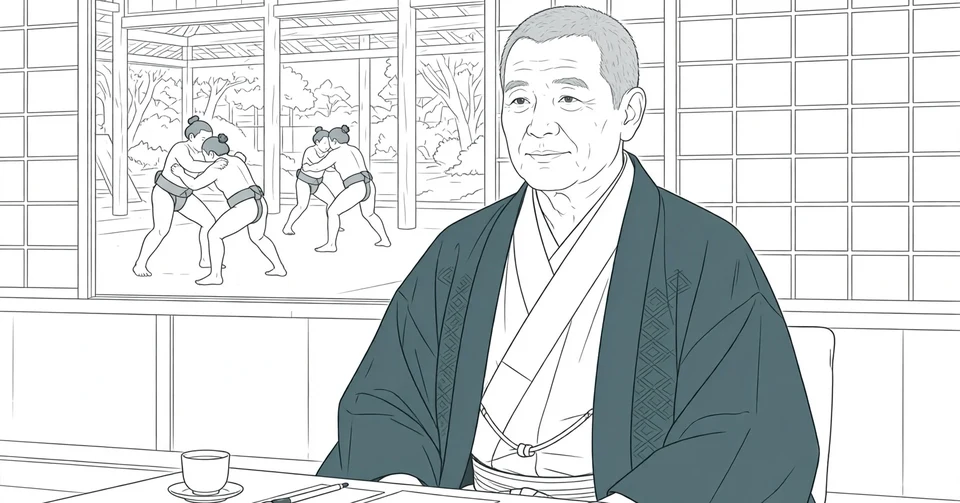
The toshiyori system is easy to criticise. It is closed, expensive and run on private arrangements that are never published. But it also explains how sumo governs itself, because the 105 toshiyori are not merely retired wrestlers with desk jobs. Together they are the association itself: its board of directors, its ringside judges, its department heads and its entire electorate. Follow the shares, and you understand professional sumo.
What a toshiyori is
A toshiyori, also called an oyakata, is a retired wrestler who has inherited one of the 105 elder shares, known as kabu, of the Japan Sumo Association. The word is an old term for a senior citizen or elder, and in sumo it goes back to the Edo period associations that organised the first authorised tournaments. Referees, hairdressers and ushers also work for the association, but they are employees. Only the elders hold a share in it, and only they can manage it.
Inside the 105 there is a full corporate ladder. At the top sits the chairman, the rijicho, elected by the elders themselves. Below him are directors, deputy directors, committee members and senior members, down to the plain toshiyori at the bottom. Every one of them, chairman included, is a toshiyori first; the ladder is climbed entirely from inside the 105. Directors serve two-year terms and run the association's departments, from judging and operations to public relations and the sumo school. Former yokozuna and ozeki who secure a share start out with committee member privileges, a head start carried over from the hierarchy of their wrestling days.
The pay is comfortable rather than spectacular. On the salary scale published for 2018, a plain elder's basic pay was 650,000 yen a month before bonuses, and the average toshiyori income has been reported at around 15 million yen a year. The real prize is not the salary but the security. Short of a serious disciplinary case, a toshiyori keeps his post until the compulsory retirement age of 65, something almost no other job in sport offers.
At 65 the share must be passed on. Since 2014, a retired toshiyori can be rehired for up to five more years as a san'yo, a consultant on reduced pay, but he may no longer run a stable or take part in decisions. By then the name itself has already moved to a younger man.
Where the number 105 comes from
The cap is younger than the names it counts. Most of the 105 myoseki, the hereditary names attached to the shares, date from the early eighteenth century or before, when the masters who organised Edo's charity tournaments began handing their licences down to chosen apprentices. The full list of the 105 names reads like a roll call of Edo sumo. Dewanoumi, Kokonoe, Takasago and Kasugano have been passed from master to successor, sometimes within the same family, for close to three centuries.
What froze the number was a merger. When the Tokyo and Osaka associations combined in 1927 to form the modern national body, Tokyo brought 88 toshiyori and Osaka brought 17. Eighty-eight plus seventeen made 105, and the total was treated from then on as a ceiling, partly to stop the titles multiplying into meaninglessness. The rules had already been tightening around the shares. In 1920 it was decided that only wrestlers who had reached sekitori, the two salaried divisions, could inherit a name at all, and in 1958 referees lost a right to inherit that they had once held.
Who may hold a toshiyori share
Meeting the career test is only the first gate. A retiring wrestler qualifies to inherit a toshiyori share if he held a san'yaku rank, the top ranks from komusubi up to yokozuna, for at least one tournament. Below that, a maegashira needs twenty tournaments in the top division, and a juryo needs thirty tournaments across the top two divisions. Anyone whose career peaked in the unpaid divisions below juryo is not eligible at all, however long and loyally he served. The toshiyori a man is allowed to become is decided entirely by the wrestler he used to be.
He must also be a Japanese citizen. The association made that an internal rule in 1976, so foreign-born wrestlers have to naturalise before they can even apply to become toshiyori. The Hawaii-born Takamiyama became the first foreign-born elder in 1984, under the name Azumazeki, and later the first to open his own stable. The Bulgarian Kotooshu, wrestling as Naruto after retirement, became the first European toshiyori in 2014, and the Mongolian Kyokutenho followed in 2017. In each case the citizenship came first and the share came second.
Passing both gates still guarantees nothing, because a share has to be free. Inheritance is arranged privately between the outgoing toshiyori and the successor he has chosen. The association does not run the succession and, in theory, has no say in picking the heir. It only checks that the man meets the requirements, receives his formal notification of succession, and lets the name change hands. Shares therefore tend to circulate inside the same ichimon, the clans of allied stables, and inside families, passing to sons and sons-in-law. When an elder dies, his family, often his widow, may hold the certificate for a time and decide where the name goes next. An eligible wrestler with no vacancy and no connections simply waits, and some wait in vain.
What the share unlocks
The most visible power a share gives is the right to coach, and above all to run a heya. As our look inside the heya put it, "A heya can only be run by a toshiyori, an elder of the Japan Sumo Association." The stable even takes its master's elder name, which is why a stable can be renamed when the name passes to a new owner. Only about half of the 105 toshiyori actually run stables, and founding a brand new one has its own higher bar: a career that reached yokozuna or ozeki, or san'yaku rank held for twenty-five tournaments, or sixty tournaments as a maegashira. Taking over an existing stable from a retiring master is set a little lower.
Elders also judge the bouts. Twenty toshiyori at a time serve as shinpan, the judges seated around the ring in formal black dress, drawn in rotation from the five ichimon. They are the men who can challenge the referee's call and demand a mono-ii conference, conferring with two more judges who watch from a video room. At the other end of the glamour scale, brand new toshiyori, even former yokozuna, are traditionally put to work as security along the hanamichi entrance path, or staffing the ticket booths at the Ryogoku Kokugikan. The association wastes no chance to remind a new toshiyori that he has started again at the bottom.
A price nobody publishes
Ask what a toshiyori share costs and the honest answer is that nobody outside the deal knows. Prices are never disclosed by the association, and since it became a public interest incorporated foundation in 2014, toshiyori shares are officially not bought and sold at all. They are managed under the association's supervision, and passing one on for money can, on paper, be punished with anything up to expulsion. In practice, Japanese sports papers have reported for years that money still moves, these days often described as a consultancy fee paid to the outgoing elder.
The numbers that have escaped into the open are large. In the late 1990s, shares were commonly valued somewhere between 100 million and 400 million yen. One tax case made the scale concrete, when the former yokozuna Wakanohana had to explain to the Tokyo tax office an undeclared 300 million yen connected with passing the Futagoyama share to his own brother. Wrestlers typically assemble the money from a career of saved bonuses together with funds raised by their koenkai, their official supporter clubs, because banks are not allowed to lend against a share. That rule has teeth. The former yokozuna Wajima was demoted after it emerged that he had used his share as collateral for a loan.
I find the economics hard to defend, honestly. A system in which a coaching licence can cost more than most wrestlers earn in an entire career will always favour the famous and the well connected over the merely gifted teacher, and sumo has surely lost good coaches to that arithmetic. The unspoken counterargument is that scarcity is the point: keeping exactly 105 toshiyori shares keeps the teaching class small, senior, and bound to the institution for life.
Borrowed names, grace periods and one famous exception
Because vacancies are rare and retirements are often sudden, sumo developed workarounds. A retired wrestler who qualified but had no share of his own could traditionally borrow one, a practice called kari-kabu, often from an active wrestler or from an elder holding two names. Borrowers sit at the very bottom of the hierarchy, cannot climb it and cannot run a stable, and when the loan ends they must find another name or leave the sport for good. One former wrestler, Wakajishi, borrowed eleven different names between 1983 and 1996, a record that sounds comic until you realise that each change meant his career had nearly ended. The 2014 statutes banned the loans in theory, just as they banned the sales.
Champions get a short cushion. A retired yokozuna may remain in the association for five years under his ring name, and an ozeki for three, while he looks for a share of his own. Above even that sits the ichidai toshiyori, the one-generation share: a lifetime toshiyori name that stands outside the 105 and dies with its holder. It has been offered only to era-defining yokozuna, and granted just three times, to Taiho, Kitanoumi and Takanohana. Chiyonofuji, offered the honour, turned it down and took the ordinary Kokonoe share instead, because he wanted a name he could hand on. When Hakuho, the most successful wrestler in the sport's history, retired in 2021, many expected the honour to be revived for him. It was not. Association officials indicated that the system no longer exists under the new statutes, and Hakuho entered the elder ranks through the ordinary door, taking the Magaki share after signing a written pledge to uphold sumo's traditional culture and spirit.
For wrestlers who leave with nothing, the association keeps a small safety net: up to eight posts as wakaimonogashira, youth leaders who help stage tournaments and look after young wrestlers, and up to thirteen as sewanin, caretakers who handle equipment and logistics on tour. They are contract jobs held under old ring names, not elder status, and there are only twenty-one of them. Everyone else is out, and since the old junior elder system was abolished in 2006, there is no other way back in.
It is tempting to call the toshiyori system a relic, and in a way it is: a closed guild of 105 names, older than the governing body itself, deciding who may teach the next generation and who must walk away. Yet the cap also does something no open labour market could. It turns coaching into a lifetime inheritance rather than a job, binds every teacher to the institution until he is 65, and makes sure that the men judging from ringside and voting in the boardroom are the same men who once fought on the clay. Whether that amounts to wisdom or simply to habit is the argument sumo has been having with itself for a century. Either way, the number is still 105.
More in Culture & Society
Latest posts
- Kombu Is the Quiet Half of Dashi
- Manza Onsen Bathes at 1,800 Metres
- Every Prefecture Argues About What Goes in Ozoni
- KRL Commuterline and the Trains That Move Jakarta
- Kecap Manis and the Sweet Soy Sauce of Indonesia
- In Mamoiada, Two Hundred Families Still Make Wine at Home
- Shochu and the Quiet Spirit of Japan
- A Dried Shiitake Is Louder Than a Fresh One
- Loma Linda's Long Lives Run on Saturdays
- Maruten Numazu and the Towering Kakiage Bowl of the Port
- The Three Sisters Grow Better Together
- Tatamiishi Terraces Filter a River Through Stone
- Wasabi-Zuke Puts the Whole Plant in Sake Lees
- Konyoku Is Still Out There, Past the Last Train Station
- Dry January Lasts a Month on Purpose