The Nishin Goten Were Palaces Paid for by Fish
· 12 min read
A nishin goten is a herring palace of Hokkaido, a great wooden house built by men who grew rich on fish that almost nobody ate.
On a hill above Ishikari Bay, a two story wooden house looks out over the sea it was built to watch. The roof is plain and dark, the walls are weathered timber, and from the outside it could pass for a large farmhouse. Step inside and the scale changes. The rooms run on and on, the beams are thick enough to hold a ship, and the sleeping quarters once held more than a hundred men. The name on the gate says it all. This is a nishin goten, a herring palace, and it was paid for by fish.
The word itself is a small joke that history played straight. Nishin means herring, the plain silver fish of the cold northern sea. Goten means palace, a word usually reserved for lords and their great houses. Put them together and you get a palace built by fishermen, or more precisely by the men who owned the fishing grounds, in a town that grew rich on a fish most people never put on a plate. The largest surviving example stands in Shukutsu, on the edge of Otaru, and it has been open to visitors since it was moved there in 1958.
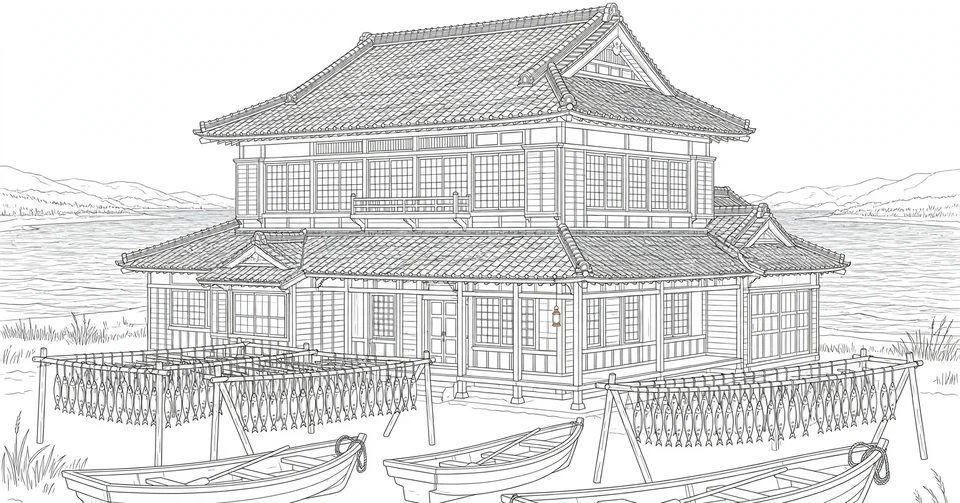
The story of the nishin goten is really the story of a boom that lasted about a century and then stopped, almost overnight. The nishin goten are what is left. They are not ruins. They are solid, handsome, and quietly absurd, the way any palace built from fish would have to be, and they still stand on the Hokkaido coast long after the silver tide that paid for them has gone.
What a nishin goten actually was
A nishin goten was not one kind of building. The name covered everything from a working lodge to a family villa, and the difference between the two tells you most of what you need to know about the herring age. The Otaru City Nishin Goten, the one on the hill above the bay, began life as a banya, a fishermen's lodging and work hut. It was a place to live and a place to work at the same time, under one roof, and that was the point.
The building was first raised in 1897 in Tomari village, on the Shakotan Peninsula, as the home of the Tanaka family fishing grounds. It took seven years to build and used 540 tons of timber. The finished house covered about 612 square metres across two floors, and at the height of the season more than 100 fishermen lived and slept inside it. In 1958 the whole structure was taken apart, moved to Shukutsu in Otaru, and rebuilt on its present hilltop site beside the water. Two years later, in 1960, it became the first private residence in Hokkaido to be designated a tangible cultural property, listed as a construction of a fishery.
Inside the nishin goten, the museum now shows the tools of the trade and the conditions of the life. Nets, presses, and drying racks sit beside the low sleeping platforms where the men lay shoulder to shoulder after a day in the cold water. There is even a hidden room on the second floor. It is not a palace in the sense of silk and ceremony. It is a palace in the sense of size, and of a workforce housed like an army. That is what makes a nishin goten different from a lord's house: the grandeur is the grandeur of the catch, not of ceremony.
The other kind of nishin goten was the master's own house, and the best preserved of those is the Ibaraki family home, still standing in Shukutsu. It has a Western style room and a storehouse of soft tuff stone, a quiet sign that its owner had seen the world beyond Hokkaido and wanted a piece of it at home. The former Fukuhara fishing grounds in Yoichi, a nationally designated historic site, preserve the fullest picture of all: the main house, a guardhouse, warehouses for books and miso, and the drying ground around them, restored so completely that the Otaru City Museum director has written that the place looks as if it could start operating again tomorrow, if only the herring returned.
The fish that paid for it all
None of this makes sense until you understand what the herring were for, and a nishin goten makes no sense at all without that fact. They were not, for the most part, food. The vast majority of the catch was processed into fertilizer and oil, not eaten by humans, and that single fact shaped the whole industry. Herring fed the fields that fed Osaka, and the fields fed a country that was growing fast. The fish were boiled, pressed, and dried into shimekasu, a dense cake of fish meal that travelled south by ship to the cotton, indigo, rapeseed, and mulberry fields of Honshu.
The numbers are hard to believe until you read them twice. The highest catch for all of Hokkaido came in 1897, at about 1.3 million koku, roughly 970,000 tons of herring in a single year. About 30 percent of it was caught in the Shiribeshi region, and Otaru alone accounted for 7 percent of the whole prefecture's catch. More than 80 percent of that fish was taken by tateami, fixed set nets also known as square nets, a method first put to practical use in 1885 at the fishing grounds of Saito Hikosaburo on the Shakotan Peninsula. The nets were set close to shore, where the herring gathered to spawn, and in the peak years they stretched along the coast from Shakotan to Yoichi and Otaru in a tangled, noisy line of small boats.
The work of turning all that fish into fertilizer is described in our article on shimekasu, the herring you never ate. In the peak years, 80 to 90 percent of the catch became meal and oil. The oil lit lamps. The meal fed fields. The fish themselves, the silver bodies that had made the whole thing possible, were the raw material of an industry that treated them like a crop, and every nishin goten on the coast was, in the end, a warehouse for that trade.
The men who slept in the palace
A nishin goten was also a dormitory, and the men who filled it were mostly not from Hokkaido at all. They were seasonal workers, many of them farmers from Tohoku, who travelled north for the season in a migration remembered as oi-nishin, chasing the herring. They were known as yan-shu, the men of the fishing grounds, and they lived in the banya for the whole season, working, eating, and sleeping under the same roof as the catch they processed.
Herring fishing had become possible around Otaru at the end of the 18th century, and at first the workers were only allowed to stay for the season. Gradually they began to settle, and by the mid 19th century the Shiribeshi region had become the centre of the trade. The men arrived each spring, when the sea off the coast turned white with milt in the great spawning the fishermen called kuki, and they left when the season ended, carrying their wages back to farms in the north of Honshu.
Life in a nishin goten was hard in the way that all seasonal labour is hard. The work was cold, wet, and relentless, and the living quarters were crowded. Yet the buildings themselves were built to last, with the care of men who expected to return to them every year for decades. The thick beams, the careful joinery, the sheer amount of timber, all of it speaks of owners who were spending money they expected to keep making. The fishermen slept on low platforms in long shared rooms, and the smell of the sea and the press never quite left the wood.
There is something honest about a nishin goten built this way. It did not hide the work that paid for it. The drying racks stood in front of the house, the boats were pulled up on the beach below it, and the men who did the work slept inside it. A nishin goten was a factory, a dormitory, and a home at once, and the wealth it showed off was the wealth of the catch itself.
The other palace, the one built for beauty
A kilometre inland from the Otaru City Nishin Goten stands the building that shows what the money could become once it stopped being about work. The Former Aoyama Villa, known today as Otaru Kihinkan, was built by Masakichi Aoyama, the second generation head of a family that had made its fortune in herring, together with his daughter Masae. It took about six and a half years to complete, from 1917, and it was never meant to be a banya. It was built, in the words of the Otaru tourism office, not as a mansion for living and working but as a villa pursuing beauty.
The villa is a two story wooden building of about 628 square metres, and unlike the working nishin goten down the hill, the materials were chosen without regard for cost. Zelkova, cypress, and ebony, all difficult to obtain even then, were used without reservation. The sliding screens in each room were painted by leading artists and calligraphers of the day, and no two rooms are alike, so walking through the house feels like walking through a small art museum. The latticework screens were assembled without a single nail, in patterns so fine that modern craftsmen find them difficult to copy. Even the restroom is decorated with lacquer and mother of pearl inlay.
The cost is usually described the way such things always are, as a comparison rather than a number. It is said that the sum spent on the villa would have been enough to build several famous department stores in Shinjuku at the time. Whether or not the comparison is exact, it tells you how the Aoyama family wanted to be seen, and how far herring money could reach. It is the difference between a nishin goten built to house a hundred men and one built to impress a handful of guests. In 2010 the main building, the annex, and the walls of the former Aoyama Villa were designated a National Registered Tangible Cultural Property, valued as a relic of the herring culture that had supported Otaru's prosperity.
The Aoyama family had another house as well, a working herring mansion of their own, and that one was preserved by being moved to Sapporo, where it stands in the Historic Village open air museum. Between the two nishin goten, the villa and the working mansion, you can see the whole arc of the herring age: the house that processed the fish, and the house that spent what the fish had earned.
When the herring left
The boom ended the way booms usually end, not with a single disaster but with a slow failure that suddenly became obvious. The herring stocks had been falling for years, and in the 1950s they collapsed. The great spawning that whitened the sea, the kuki, was last observed in 1954, and after that the sea stayed its ordinary blue. The fishing grounds closed, the banya emptied, and the nishin goten were left standing on a coast that no longer had work for them.
The scale of the fall is still startling. In 1897 Hokkaido landed about 970,000 tons of herring. In 2022 the coastal catch was 5,326 tons, about half a percent of the peak. The fish have begun to return in small numbers around Otaru in recent years, enough to bring back the taste of spring, as the museum director puts it, but nowhere near enough to fill a net, let alone a palace.
What survived of the nishin goten was saved by being moved, or by being loved. The Tanaka family house was carried to Shukutsu in 1958 and became a museum. The Aoyama villa was kept by the family and then opened to the public, and its restaurant now serves herring dishes in the rooms where the family once ate. The Fukuhara grounds in Yoichi were restored as a historic site. Even the Otaru City Nishin Goten found a second life as a place of pilgrimage for fans of Golden Kamuy, the manga and anime set in Hokkaido, which used the building as the model for its own herring palace.
Visiting a nishin goten today is a quiet experience. The Otaru City Nishin Goten is open from early April to late November, from 9 in the morning to 5 in the afternoon, closing an hour earlier from mid October, and admission is 300 yen. The Aoyama Villa keeps longer hours and charges 1,300 yen. Both sit on the same stretch of coast, five kilometres outside central Otaru near the aquarium, reached by city bus from Otaru Station. The tools are still there, the sleeping platforms are still there, and the view from the hill is the same view the fishermen saw every morning.
Standing in the great room of a nishin goten, it is easy to feel the size of what happened here and the speed with which it ended. The houses were built for a harvest that seemed endless, and they were built well enough to outlast it by more than a century. They are not monuments to a fish. They are monuments to the belief, held by a whole coast for a hundred years, that the sea would never stop giving. The sea did stop, and the houses stayed, and that is why they are worth visiting. A nishin goten built by fish is a strange thing to find on a cold northern shore, and it is stranger still that it is still standing, solid and handsome, waiting for a tide that may never come back in the same way.
More in Food & Travel
Latest posts
- Suka Duka Means the Banjar Shows Up for Joy and Grief Alike
- Tabuh Rah Spills Blood So the Ground Stays Calm
- The Bendesa Adat Speaks for a Village That Has Two Governments
- Catur Brata Is Four Silences Kept at the Same Time
- Your Weton Is the Day You Were Born, Counted Two Ways
- Rahu and Ketu Still Chase the Sun and Moon Across the Sky
- Hiwatari Asks You to Walk Across the Fire
- Ngembak Geni Is the Morning Bali Starts Talking Again
- Karang Ayahan Is the Plot of Land a Village Trusts You With
- On Tumpek Landep Bali Blesses Everything Made of Metal
- Shugendo Turns a Mountain Into a Place of Testing
- A Canang Sari Is Made Fresh Every Morning and Gone by Night
- The Aling-Aling Wall Exists Because Spirits Walk in Straight Lines
- The Tobi Were Edo's Daredevils Before They Were Its Firemen
- A Yamabushi Trains Where the Mountain Is the Temple