A Yamabushi Trains Where the Mountain Is the Temple
· 12 min read
A yamabushi is a mountain ascetic of Shugendo who trains in Japan's sacred mountains, walking steep trails, chanting, and standing under waterfalls to gain the power to help others.
Somewhere on a cedar shaded path in Yamagata, a figure in white robes climbs stone steps that never seem to end. A conch shell hangs at his hip, a metal staff rings against the rock with each step, and a small black cap sits on his forehead like a folded box. He is not hiking for exercise. He is not a priest on his way to a shrine. He is a yamabushi, and for him the mountain is not the way to the temple. The mountain is the temple.
A yamabushi is a mountain ascetic of Shugendo, a Japanese spiritual path that trains the body in order to train the mind. The word itself means one who prostrates oneself on the mountain. Shugendo means the way of training and testing, and its goal is plainly stated in its own tradition: to cultivate great compassion and spiritual power, and to use that power to ease the suffering of the practitioner and of all beings. The training is not done in a lecture hall. It is done on foot, in the rain, under waterfalls, and in silence.
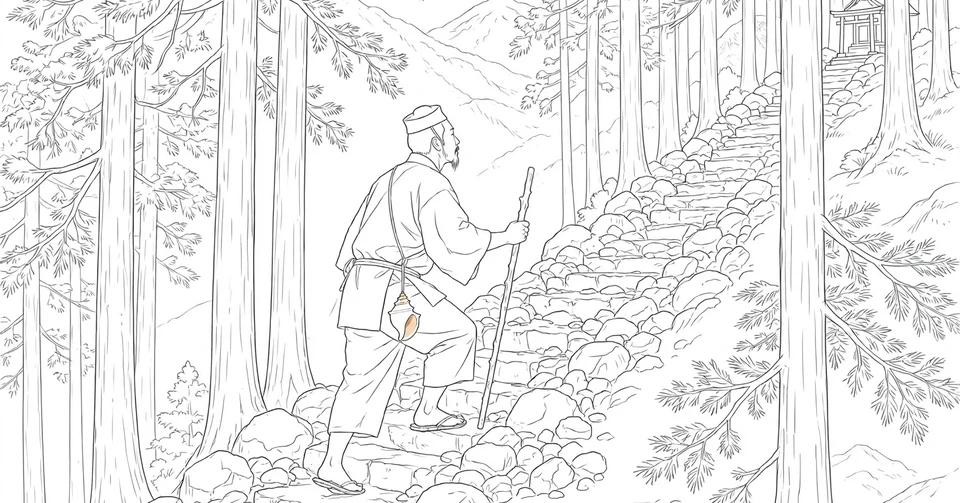
That is the part that stays with me. Most religions build a roof and invite people inside. The yamabushi walks out of the roof and into the weather, and trusts the weather to teach what no sermon can. It is a hard idea to argue with, because it asks nothing of your beliefs and everything of your legs.
What a yamabushi actually is
A yamabushi is a practitioner of Shugendo, and Shugendo is one of the most Japanese things in Japan: a blend that refuses to be one thing. It grew in the seventh century out of local folk religion, Shinto mountain worship, and Buddhism, with smaller threads of Taoism woven in, and from the ninth century it absorbed the esoteric Buddhism of the Shingon and Tendai schools. It has no single scripture and no single founder that historians can pin down. Tradition names a seventh century ascetic and mystic, En no Gyoja, as its patriarch, the first to practise what would later be called Shugendo. His story sits on the border between history and legend, and the tradition itself has never seemed bothered by that border.
The roots of the yamabushi go back further than any single teacher. Their origins can be traced to the solitary yamabito, the wild hill people, and to the hijiri, wandering Buddhist renunciants of the eighth and ninth centuries, who lived outside the great temples and made the mountains their home. A yamabushi inherits both lines: the hermit who lives alone with the mountain, and the monk who carries a teaching into it.
What makes a yamabushi different from a monk or a Shinto priest is where the work happens. A monk studies and meditates in a hall. A Shinto priest serves a shrine and keeps its rites. A yamabushi trains in nature, and the training is the teaching. Shugendo is experiential and practice based, built on rituals, hiking, meditation, and purification, and its practitioners seek enlightenment and lessons from nature by going into nature, especially into the mountains. The mountain does not explain itself. It tests you, and the test is the lesson.
The mountains where a yamabushi trains
Every yamabushi has a mountain, and the mountains of Shugendo are spread across Japan. The historic heart of the tradition is the Omine range, which stretches about 100 kilometres from north to south and connects Yoshino and Kumano. Its highest peak, Mount Hakkyo, rises to 1,915 metres, and along the trail there are 75 places for ascetic practice. At the top of Mount Omine, at 1,719 metres, stands Ominesan-ji, considered the highest sacred site of Shugendo. The whole range is now part of the UNESCO World Heritage listing for the Sacred Sites and Pilgrimage Routes in the Kii Mountain Range, which means the path a yamabushi walks today is protected as a treasure of the world.
In the Heian period it became fashionable among the nobles of Kyoto to visit Kumano Sanzan, the three great shrines of Kumano, which were a common holy place for Shugendo, Shinto, and Buddhism together. The nobles came as pilgrims. The yamabushi were already there, living in the mountains the nobles only visited.
In the north, the other great centre is Dewa Sanzan, the three sacred mountains of Haguro, Gassan, and Yudono in Yamagata Prefecture. This is where most modern training programmes are held, on and around the three peaks that form the historic heart of Haguro Shugendo. The climb up Mount Haguro runs through a cedar forest on stone steps, past a five storey pagoda, to the shrine at the summit. A yamabushi walks it the way a monk walks a temple corridor, because for the yamabushi the corridor is the mountain.
There is something honest about a religion that picks its holiest places by altitude and effort. A shrine in a city can be reached by bus. A shrine at 1,719 metres can only be reached by a body willing to climb. The mountain sets the price of entry, and the price is the same for everyone.
What a yamabushi wears and carries
You can read a yamabushi from across a valley, because the outfit is a uniform with a meaning. The white robes are the most visible part. White is the colour of the dead in Japan, and the robes say something plain about what the training is for: the yamabushi enters the mountain as if entering another world, and comes back changed. The small black cap on the forehead is called a tokin. A sash hung with pom-poms, the yuigesa, crosses the chest. On the back rides a wooden box backpack called an oi, which carries the few things the training allows.
In the hands is a shakujo, a metal staff with rings that chime as it strikes the ground, and at the hip hangs the horagai, a conch shell drilled and fitted to be blown like a horn. The yamabushi blows the horagai to ward off evil spirits, to bind them, and to announce his presence to the mountain and its gods. The sound is low and long, and it carries across valleys the way a temple bell carries across a town. Straw sandals complete the picture, which is why an American writer once described these practitioners as positively medieval looking nature worshippers, carrying metal staves and conch shells in straw sandals, following a mixture of esoteric Buddhism and Shinto.
None of this is costume. Each item is a tool, and each tool has a job. The staff steadies the climb and marks the rhythm of the walk. The conch clears the path. The white robe says the wearer has left ordinary life behind for the duration of the training. A yamabushi does not dress up as an ascetic. The dress is the first part of the discipline.
The training itself
The training of a yamabushi is simple to describe and hard to do. It is hiking, meditation, waterfall meditation, ritual purification, chanting, and silence, repeated over days in the mountains. The body is the textbook. The mountain is the classroom. The lessons are not written down, because the tradition holds that the symbols of highest value are not those learnt from books but those that can be done.
Waterfall meditation, called takigyo, is the practice most outsiders have heard of, and it is exactly what it sounds like. The yamabushi stands under a falling column of cold mountain water, chanting, while the water hammers the shoulders and steals the breath. It is not a test of endurance for its own sake. Cold water leaves no room for wandering thoughts, and the tradition treats that forced attention as a form of purification. The body is shocked into the present moment, and the present moment is the whole point.
Silence is the other great discipline. On the longer training programmes, participants refrain from speaking except for a single word, uketamo, which means roughly I accept, and they give up phones, watches, reading, and writing for the duration. The rules sound severe until you try them, and then they sound like a gift. Without a phone there is nothing to check. Without a watch there is no hour to be late for. Without speech there is no performance to maintain. What is left is the mountain, the walk, and the sound of your own feet.
The yamabushi also practises fire. The open air form of the goma fire ritual, called a saito goma, is performed by yamabushi, and it ends with hiwatari, walking across hot embers. The goma itself is the fire rite of esoteric Buddhism, where worshippers write their wishes on wooden sticks and watch a priest feed them into the flames. Outdoors, on a mountainside, the same fire becomes a test of trust: the body that has been trained by cold water and long walking is asked to trust the training and walk across the coals. The fire does not ask for belief. It asks for the steady foot that the mountain has already taught.
A tradition that was banned and came back
A yamabushi today looks timeless, but the tradition has nearly died more than once, and its survival is part of its story. In 1613 the Tokugawa authorities issued the Shugendo Hatto, a set of regulations that forced the many independent lineages to affiliate with either the Shingon aligned Tozan school or the Tendai aligned Honzan school. The mountain ascetics were brought under the roof of the great temples, and the freedom of the early yamabushi was narrowed into institutions.
The harder blow came in 1872, when the Meiji government, which was building a wall between Shinto and Buddhism, ruled that Shugendo was unacceptable precisely because it mixed the two, and officially forbade it. For more than seventy years the practice was driven underground or folded into other organisations. It was only with the religious freedom that followed the Second World War that Shugendo could be practised openly again, and its lineages could stand on their own.
There is a quiet irony in this. A government banned the yamabushi because their religion mixed Shinto and Buddhism. The yamabushi survived because their temple was not a building the government could close. It was a mountain, and mountains are hard to legislate against. The ban ended. The mountains did not.
The tradition also carries a wound that has never fully healed. Women were long excluded from the most sacred peaks, most famously from Mount Omine itself, and the exclusion is still defended by some and contested by others. Modern training programmes, by contrast, are open to all genders, and women regularly take part in every part of the training they offer. The mountain has not changed its shape. The question of who may climb it is still being argued, one generation at a time.
Who can train today
Here is the surprise for a modern visitor: the yamabushi of today are not only monks. Modern yamabushi include practitioners from many backgrounds, not just monks, and the training programmes at Dewa Sanzan welcome people of all faiths, or of none. The practice is rooted in the spiritual tradition of Shugendo, but the programmes focus on experiential practice rather than belief. Respect for the training and its customs is expected. Belief is not examined at the trailhead.
That openness is not a marketing invention. It fits the logic of the tradition itself. Shugendo has always been a path of doing rather than a path of doctrine, and doing is available to anyone with a body willing to climb. A visitor who joins a programme is given the white robe, the staff, and the silence, and is guided by certified yamabushi through the same mountains the ascetics have walked for more than a thousand years. The training is adjusted to the group and the weather, and no prior experience is required. The mountain does the teaching. The guides only keep you safe while it does.
And when the walking is done, the body needs what the mountain has always provided. The hot springs at the foot of the training mountains are where tired legs recover, and many of those old springs are the same ones legend credits to Kobo Daishi, the monk who brought esoteric Buddhism to Japan from Tang China. The connection is not a coincidence. From the ninth century, Shugendo absorbed the esoteric Buddhism of the Shingon and Tendai schools, and the same Kukai whose teaching shaped the fire ritual also left his name on the waters that heal the walkers. The mountain trains you, the fire tests you, and the spring takes you back.
I find that sequence moving, because it is complete. A yamabushi does not finish the training and return to the world unchanged, and does not finish it and stay on the mountain either. The training ends where ordinary life begins again, in warm water, with the body tired and the mind quiet. That is the whole teaching in one day: climb, endure, be silent, and then come back down and live.
A yamabushi trains where the mountain is the temple, and the temple has no walls, no roof, and no closing time. It asks for nothing but the willingness to walk into it, and it gives back the one thing no hall can give: the knowledge, earned in the legs and the lungs, that you can endure more than you thought, and that the world is larger than the room you live in. The mountain will still be there tomorrow. The question it asks has not changed in more than a thousand years, and it is the simplest question any religion has ever asked. Are you willing to climb?
More in Culture & Society
- Suka Duka Means the Banjar Shows Up for Joy and Grief Alike
- Tabuh Rah Spills Blood So the Ground Stays Calm
- The Bendesa Adat Speaks for a Village That Has Two Governments
- Catur Brata Is Four Silences Kept at the Same Time
- Your Weton Is the Day You Were Born, Counted Two Ways
- Rahu and Ketu Still Chase the Sun and Moon Across the Sky
Latest posts
- On Koyasan the Founder Is Said to Be Still Meditating
- Hiwatari Asks You to Walk Across the Fire
- Ngembak Geni Is the Morning Bali Starts Talking Again
- Karang Ayahan Is the Plot of Land a Village Trusts You With
- On Tumpek Landep Bali Blesses Everything Made of Metal
- Sudachi Is the Sharpest of Japan's Sour Citrus
- Shugendo Turns a Mountain Into a Place of Testing
- A Canang Sari Is Made Fresh Every Morning and Gone by Night
- The Aling-Aling Wall Exists Because Spirits Walk in Straight Lines
- Oi-Nishin Sent Tohoku Farmers Chasing Herring Every Spring
- The Nishin Goten Were Palaces Paid for by Fish
- The Tobi Were Edo's Daredevils Before They Were Its Firemen
- Kabosu Is Oita's Gentle Answer to Yuzu
- Tri Hita Karana Holds a Village in Three Balances
- Shingon Has Kept Its Fire Ritual Burning for 1,200 Years