The Tobi Were Edo's Daredevils Before They Were Its Firemen
· 11 min read
The tobi were the scaffolders and roof men of Edo, and when the wooden city caught fire they became its firefighters, tearing down houses with hooked poles to stop the flames.
Edo burned so often that its people made a joke of it. "Fires and fights are Edo's flowers," they said, and the joke only worked because everybody in the city knew it was true. Between 1601 and 1867 the city suffered 49 big fires, and the Great Fire of Meireki in 1657 destroyed most of it. When the alarm went up, the men who ran toward the smoke were not soldiers and not samurai. They were the tobi, the scaffolders and roof men who had built the burning houses in the first place.
A tobi is a worker in high places. The word means a black kite, the bird of prey that hangs in the sky over Japanese fields, and the name fits the men who earned it. They moved across beams the way the bird moves across the air, and they did it on bamboo scaffolding lashed together with rope, with no harness and nothing below them but the street. Long before they were firefighters, the tobi were the people Edo trusted with its roofs, and that trust is the whole story of how they became its fire brigade.
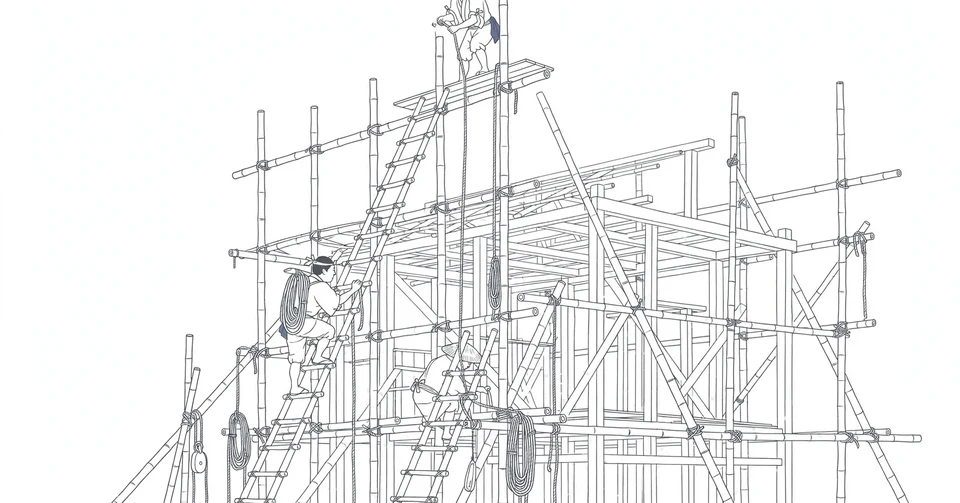
The connection between building and firefighting was not a coincidence of history. It was the logic of a wooden city. Edo was built from timber and paper, and the people who understood that construction best were the ones who could take it apart the fastest. When a fire started, the tobi climbed onto the burning roof with a hooked pole and pulled the building down in front of the flames, and the gap they made was the only firebreak the city had.
What a tobi actually is
The tobi, also called tobishoku in full, are steeplejacks, the construction workers who specialise in working at height. Their trade goes back to the 17th century, when they began as unskilled workmen carrying heavy timber around building sites. By the 18th century they had become the men who put up scaffolding, repaired houses, helped the carpenters, and raised the ridgepole at the topping out ceremony of a new house, and they had been called tobi since that century.
Nobody is quite sure where the name came from, and the two explanations both tell you something about the work. One says the men were named for the black kite because at the ridgepole raising ceremony they seemed to fly from one beam to another, the way the bird crosses the sky. The other says the name came from their tool, the tobiguchi, the long hooked pole they used to pull down burning houses. Either way, the name describes a man who belongs in the air, and the tobi still carry it with pride today.
Their work was not only scaffolding. A tobi crew handled the ground levelling and the foundations, the erection of the scaffold, the assembly of the timber frame, and the demolition of old buildings. They also moved whole buildings without taking them apart, a job called hikiya, and they carried heavy logs as a team, a job called kiyari. They were generalists of the building site, and the common thread in all of it was height, balance and nerve.
A city built to burn
To understand why the tobi mattered so much, you have to understand the city they worked in. Edo, the city we now call Tokyo, was the largest city in the world by 1700, when its population reached about a million people. Its houses were built from paper and wood, with hay or wooden roofs, and only palaces and a few administration buildings had roof tiles. Plastering was something only the daimyo and the wealthiest merchants could afford.
Winter made it worse. Tokyo sits in the centre of the Kanto Plain, and the cold, dry Siberian winds of winter dried the timber out while driving everyone indoors to keep their fireplaces burning and their oil lamps lit. About two thirds of all Tokyo fires happened between November and February, and the fires were so frequent that the city earned its nickname, the city of fires.
The numbers tell the story plainly. Edo had 49 big fires between 1601 and 1867, while Osaka, where almost all the buildings were plastered and roofed with tiles, had only six in the same period. And the worst of them was the Great Fire of Meireki in 1657, which destroyed most of the city and forced the shogunate to rethink how a city could defend itself against its own building materials.
The tobi became the fire brigade
After the Meireki fire, the shogunate started a city fire service, and the tobi were the obvious people to staff it. In the 18th century the Tokugawa shogunate organised a firefighting team in each town in Edo, and the steeplejacks became the firefighters. They kept their day work repairing houses and setting up scaffolding, and when a fire broke out they dropped their tools and ran to it.
The reason was simple, and it was the same reason a modern city hires demolition experts. Edo's firefighters did not fight fire with water. Water extinction was almost never used because it was so inefficient: the hand pumps that appeared in the middle of the 18th century produced only a weak stream through bamboo hoses, and the citizens trusted dry firefighting more. Instead, the hikeshi, as the fire brigades were called, fought fire by demolition. They tore down the buildings in the fire's path so the flames had nothing left to eat, and the fire burned itself out in a long, narrow strip instead of spreading across the whole district.
That was the tobi's job, and it needed exactly their skills. The tobi were the demolition experts inside every hikeshi brigade, hired from the construction workers' guilds and the roofers. They climbed the burning houses and destroyed the roofs with their tobiguchi, the long pike poles with a hook at the end, and they did it with a precision that surprised outsiders. Edo's firefighters were held to the highest standard in Japan: they climbed to the roofs and destroyed only the smallest necessary part of the roof covering or the walls, while the firefighters of Osaka demolished buildings completely. The technique worked best on small fires, but it stayed in use until the 1880s, long after the age of the samurai had ended.
The brigades were organised like a small army, and the tobi stood at the top of its working ranks. Each brigade divided its men into six ranks, and the men received only a small allowance, far too little to live on, so a hikeshi had to keep working in construction or find a patron between fires. Yet the tobi received the biggest salary among the day labourers, because their skill was the one the city could not do without. The other roles in a brigade tell you how the work was divided: the hashigo mochi carried the ladders, the hirabito helped wherever help was needed, and the matoi mochi carried the matoi, the tall standard of paper or fabric ribbons that marked the brigade's claim on a fire. The tobi were the ones who went up.
There was a harder side to all of this, and it is worth saying plainly. The hikeshi were celebrated as city heroes, and they were also feared. Brigades competed fiercely with each other, and sometimes they fought each other at a fire, or demanded payment before they started work, or demolished a building on purpose because its owner was unfriendly with the brigade. Most of the hikeshi came from the lower classes of Edo society and were famously stubborn, and the city both admired them and kept its distance. That is a familiar pattern with people who do dangerous work for a city: gratitude and suspicion, side by side.
From the roof to the ladder top
The most famous image of the tobi is not a fire at all. It is a man standing on top of a tall bamboo ladder, doing acrobatics with nothing under him but air and the hands of his colleagues below. That is hashigo-nori, ladder riding, and it is the tobi's skill turned into a public performance. The performer climbs a ladder about six metres high that is held upright by ropes and forked poles, and once he reaches the top he lets go with both hands and strikes a pose. The ladder does not lean against anything. It stands because the team below holds it, and the man on top trusts them completely.
The performance has its roots in working practice. The poses were once a language between a man posted above a fire and the crews waiting on the ground, and the ladder itself was a working tool, used for spotting fires, reading the wind and signalling to the other brigades. What survives today is the display, and it is still performed every year at dezomeshiki, the New Year ceremony of Japan's fire brigades, where the ladder acrobats share the morning with helicopters, rescue drills and more than a hundred fire engines. The hashigo-nori performers are the direct inheritors of the tobi, and the people who matter most in the act are still not the climbers but the holders below, whose hands are the only support the ladder has.
The tobi had other ceremonial roles too. At the end of every year they put up decoration pines at the gates of buildings and hung sacred straw festoons to celebrate the New Year, and as a firefighting team they performed their ladder stunts at the New Year ceremonies. The work, the festival and the neighbourhood were all part of the same job, and the tobi were at the centre of all three.
The tobi never really left
The tobi did not disappear with the wooden city. When Japan modernised after the Second World War, the great construction boom of the 1960s gave the tobi a new stage. They worked on the Tokaido bullet train, on the stadiums and facilities of the Tokyo Olympic Games of 1964, and on the huge suspension bridges over the straits between Honshu and Shikoku, and a paper on their trade notes that they still play an important role in completing modern civil engineering projects and in the construction of high-rise buildings. The skills were the same, only the height had changed.
The trade had to change too. In 1969 the Law of Occupational Training set requirements for retraining technical professionals, and a certificate examination for the tobi was institutionalised, so that a trade once learned only by following a master could be taught in a classroom as well. In 1977 the Association of the Tokyo Tobi Industry founded the Tokyo Tobi Institute of Higher Training, because apprenticeship alone could no longer keep up with mechanisation and the growing scale of the work. The president of Kajima Corporation, one of Japan's great construction companies, celebrated the institute's 15th anniversary by praising its 300 years of Edo tobi tradition, and the compliment was genuine: the institute had made the old trade functional in a highly developed construction industry.
Yet the trade is shrinking. The same paper that celebrates the tobi's survival is frank about the problem: the number of skilled tobi professionals has continued to decrease because the younger generation does not consider the profession a desirable career. Construction work in Japan is often described as a 3K job, kitsui, kitanai and kiken, demanding, dirty and dangerous, and young people with a wide choice of professions tend to choose cleaner, safer work. The work system of the tobi, built on apprenticeship, loyalty and a traditional way of living, has proved harder to modernise than their skills.
There is something quietly admirable in how the tobi have answered that problem. They did not abandon the tradition, and they did not pretend the world had not changed. They built a school, took the examinations, and kept the name that had described them since the 18th century, the black kite. A trade that began by carrying timber and ended by building bullet train lines and suspension bridges is still, at its heart, a trade about trusting your balance and the hands of the people below you.
That is the lesson the tobi leave behind, and it is a larger one than firefighting. Edo was a city that could not be made safe, so it made itself brave instead, and the bravery it chose was practical: men who could climb, men who could judge a roof by touch, men who could pull a house down in front of a fire and stand in the gap they had made. The tobi were daredevils before they were firemen, and they were firemen because they were daredevils first. The city is gone, the wooden roofs are gone, and the men who worked them are still climbing.
More in Culture & Society
- Suka Duka Means the Banjar Shows Up for Joy and Grief Alike
- Tabuh Rah Spills Blood So the Ground Stays Calm
- The Bendesa Adat Speaks for a Village That Has Two Governments
- Catur Brata Is Four Silences Kept at the Same Time
- Your Weton Is the Day You Were Born, Counted Two Ways
- Rahu and Ketu Still Chase the Sun and Moon Across the Sky
Latest posts
- On Koyasan the Founder Is Said to Be Still Meditating
- Hiwatari Asks You to Walk Across the Fire
- Ngembak Geni Is the Morning Bali Starts Talking Again
- Karang Ayahan Is the Plot of Land a Village Trusts You With
- On Tumpek Landep Bali Blesses Everything Made of Metal
- Sudachi Is the Sharpest of Japan's Sour Citrus
- Shugendo Turns a Mountain Into a Place of Testing
- A Canang Sari Is Made Fresh Every Morning and Gone by Night
- The Aling-Aling Wall Exists Because Spirits Walk in Straight Lines
- Oi-Nishin Sent Tohoku Farmers Chasing Herring Every Spring
- The Nishin Goten Were Palaces Paid for by Fish
- Kabosu Is Oita's Gentle Answer to Yuzu
- A Yamabushi Trains Where the Mountain Is the Temple
- Tri Hita Karana Holds a Village in Three Balances
- Shingon Has Kept Its Fire Ritual Burning for 1,200 Years