Karang Ayahan Is the Plot of Land a Village Trusts You With
· 9 min read
A karang ayahan is a house plot owned by a Balinese customary village and entrusted to a member family, who may live on it and pass it down for generations but never sell it.
Stand in a Balinese village long enough and someone will point at a house plot and tell you, quite calmly, that the family living there does not own the land. The family may have been there for five generations. They built the house, planted the jackfruit tree, and keep the small shrine in the corner swept and dressed with offerings. Still, the plot is not theirs to sell, because it is a karang ayahan, a piece of village land that the desa adat, the customary village, has placed in their hands.
A karang ayahan is one of the oldest arrangements in Balinese life, and one of the least visible to outsiders. It says that the ground under a family's feet belongs to the community as a whole, and that a household holds that ground the way a caretaker holds something precious: fully, for as long as the trust lasts, and never as private property.
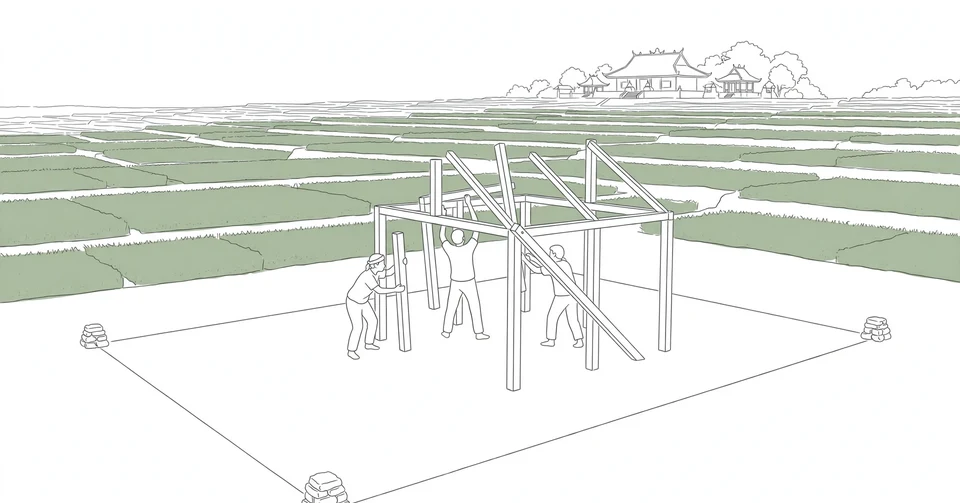
What the family receives instead of ownership is a right to use the plot, and that right is real. It carries no fixed expiry date, it can pass from parents to children, and the village stands behind it. What the family gives back is service, the ayahan duties that keep the village temples, ceremonies, and shared work running. Land and labour are tied together in a single bargain, and a karang ayahan is where that bargain becomes an address.
What a karang ayahan is
In the language of Indonesian customary law, a karang ayahan is communal land. It forms part of the hak ulayat, the collective right a customary law community holds over its territory, and on Bali that community is the desa adat, still widely known by its older name, desa pakraman. Bali's provincial regulation on desa pakraman, Regulation Number 3 of 2001, defines tanah ayahan desa, the fuller name behind the everyday term, as land owned by the desa pakraman, whether it lies inside or outside the village boundary. The same ground is also called karang desa, the village yard, and it counts among the village's own wealth, its druwen desa.
The arrangement sits inside a larger philosophy. A Balinese village is understood through Tri Hita Karana, the three causes of wellbeing: parahyangan, the realm of temples and gods; pawongan, the realm of people; and palemahan, the realm of territory and nature. A karang ayahan belongs to palemahan. It is the physical share of the village that a household looks after, one plot at a time.
The roots are old. Balinese legal writing traces the principle to the Pesamuhan Agung, the great assembly led by the priest Mpu Kuturan during the reign of King Udayana Warmadewa, somewhere between the years 988 and 1011. That assembly is remembered as deciding, among other things, that every house plot and the land around a customary village belongs to the village and to its Kahyangan Tiga temples, and that such land may not be bought or sold. A thousand years later, the karang ayahan on a modern street in Denpasar or Buleleng still runs on that decision.
A right to use, never a right to own
The cleanest way to understand a karang ayahan is to separate owning from holding. The village owns. The family holds. Scholars of Balinese land law describe the family's position as an incomplete individual right, because the strongest stick in the bundle, the right to dispose of the land, never leaves the village.
What the family does hold is substantial. A krama household entrusted with a karang ayahan may live on it, build a house on it, plant it and take its produce. The grant is made by the village itself, decided in the paruman, the village assembly, and administered by the bendesa adat, the customary village head. There is no lease term and no rent in the ordinary sense. As long as the household keeps the village rules, the awig-awig and its implementing decisions, the holding continues, and it continues across generations, so that grandchildren can grow up on the same karang ayahan their great grandparents cleared.
This is why a karang ayahan so often looks, from the street, exactly like private land. The wall is the family's wall. The gate is the family's gate. The difference only appears at the moment someone tries to treat the plot as an asset, and discovers that the most important document was never a certificate. It was membership.
The service that pays for the plot
Nothing about a karang ayahan is free, but the price is not money. The price is ayahan, the duty of service owed to the village, and it is not a formality. A household holding village land is expected to show up: to work on ceremonies at the Kahyangan Tiga temples, to help prepare festivals, to take its turn in the collective labour that repairs halls, cleans water channels, and stages the ritual calendar.
The duties map neatly onto the same three realms. Service at the temples answers to parahyangan. Helping neighbours and joining the village's shared work answers to pawongan. Looking after the plot itself, keeping it intact and its surroundings clean, answers to palemahan. Holding a karang ayahan means carrying all three at once, which is precisely what defines a full member of the village. I wrote elsewhere about how krama is the status that makes someone a full member of the village, and the land bargain sits at the centre of that status: rights and duties arrive together and cannot be split apart.
Each village writes its own version of the bargain down. The awig-awig, the written customary code every village composes for itself, sets out who may receive a karang ayahan, what the holder owes, and what is forbidden. The details differ from village to village, because the whole system rests on the principle that each desa adat governs its own territory by its own agreed rules.
Three things you may never do with it
The prohibitions around a karang ayahan are consistent across the legal literature, and they are strict. A holder may not sell the plot or hand it to someone else, least of all to a person who is not a member of the village, unless the village assembly itself agrees. A holder may not pledge the plot as collateral for a loan. A holder may not change the plot's designated form and purpose at will.
The only transfer the system comfortably allows is inheritance. When the holder dies, the karang ayahan passes to the heirs, undivided, together with the duties attached to it. The land is never really being given away in that moment. It is being handed along, the way a baton is handed along, inside the same community and under the same rules.
When a family line ends, the land goes home
What happens when there is nobody left to hand it to? A master's thesis from Universitas Diponegoro studied exactly this question in Desa Pekraman Bangkala, in Kubutambahan district, Buleleng. Inheritance there follows the mayorat pattern common in Bali's patrilineal system: the karang ayahan is never split, and it passes whole to a single son, to the eldest among families of the tri wangsa groups and to the youngest among Sudra families, in the local reading of custom.
When a family has no descendants at all, a condition called putung, the Bangkala answer is simple and revealing. The karang ayahan returns to the village. The village then grants it to another villager who is entitled to receive it, through the stipulated procedures and ceremonies. The thesis draws the obvious conclusion: the right over the land has belonged to the village all along, and the family held a right of use.
Bangkala's rule about empty lines is one of several ways a holding can end. The right over a karang ayahan can also lapse when the plot is abandoned, when the holder gives it up voluntarily, or when the village assembly decides to revoke it, for instance after a serious breach of the rules. None of this makes the holding fragile in daily life. Families hold their plots for centuries. It simply means the trust can be withdrawn when its conditions are no longer honoured.
Old land in a paper world
The system has survived a millennium, but it now lives inside a state that runs on certificates, and the friction shows. A 2019 study in Jurnal Analisis Hukum, a law journal published by Universitas Pendidikan Nasional in Denpasar, notes that disputes over karang ayahan keep arising between villagers, between villages and their own members, and with outsiders, and that a recurring cause is documentary: many customary plots were never certified as village land, their histories are unclear, and individual claims overlap the communal one. The Bangkala research, available through the Universitas Diponegoro repository, shows the adat machinery still working case by case, but it works in a landscape where land values keep rising and paper proof keeps gaining ground.
I find it hard to call the karang ayahan arrangement backward, even when it produces hard cases. Most modern arguments about land assume it is a thing to be owned, priced, and traded, and then argue about fairness at the edges. The Balinese village starts from the other end. Land is a relationship first: between a family and a community, between the living and the temples their ancestors built, between a household's comfort and its obligations. Ownership, in the full modern sense, is deliberately withheld so that the relationship cannot be sold off by any single generation.
The plot of land outlives every family that holds it. That is the point. A karang ayahan is the village lending a household a piece of permanence, and asking, in return, that the household help carry the village. As bargains go, it has lasted a thousand years, which suggests that both sides have been getting something they value.
More in Culture & Society
- Suka Duka Means the Banjar Shows Up for Joy and Grief Alike
- Tabuh Rah Spills Blood So the Ground Stays Calm
- The Bendesa Adat Speaks for a Village That Has Two Governments
- Catur Brata Is Four Silences Kept at the Same Time
- Your Weton Is the Day You Were Born, Counted Two Ways
- Rahu and Ketu Still Chase the Sun and Moon Across the Sky
Latest posts
- On Koyasan the Founder Is Said to Be Still Meditating
- Hiwatari Asks You to Walk Across the Fire
- Ngembak Geni Is the Morning Bali Starts Talking Again
- On Tumpek Landep Bali Blesses Everything Made of Metal
- Sudachi Is the Sharpest of Japan's Sour Citrus
- Shugendo Turns a Mountain Into a Place of Testing
- A Canang Sari Is Made Fresh Every Morning and Gone by Night
- The Aling-Aling Wall Exists Because Spirits Walk in Straight Lines
- Oi-Nishin Sent Tohoku Farmers Chasing Herring Every Spring
- The Nishin Goten Were Palaces Paid for by Fish
- The Tobi Were Edo's Daredevils Before They Were Its Firemen
- Kabosu Is Oita's Gentle Answer to Yuzu
- A Yamabushi Trains Where the Mountain Is the Temple
- Tri Hita Karana Holds a Village in Three Balances
- Shingon Has Kept Its Fire Ritual Burning for 1,200 Years