The Aling-Aling Wall Exists Because Spirits Walk in Straight Lines
· 9 min read
Behind almost every traditional Balinese gate stands an aling-aling, a carved screen wall built to stop spirits that can only travel straight, and to keep the courtyard behind it private.
Walk through the gate of a traditional Balinese house and you cannot keep walking straight. A few steps inside the entrance, a wall stands squarely in your path, and every guest, every delivery and every returning child has to turn aside and walk around it. That wall is the aling-aling, and it is not an accident of the floor plan.
The aling-aling exists because of one firm belief: harmful spirits travel only in straight lines. A spirit that finds the gate open and slips through it rushes forward in the only direction it knows, meets the wall, and can go no further. It cannot make the small turn that every human visitor makes without thinking.
The same wall does a second, quieter job. From the street, nobody can see into the courtyard at all. The family inside keeps its mornings, its work and its ceremonies to itself, and the aling-aling guards that privacy as faithfully as it guards the threshold.
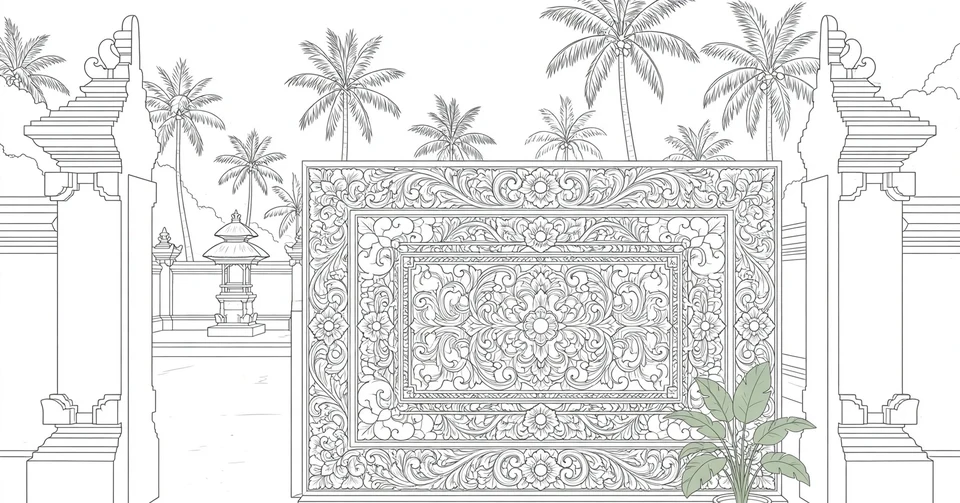
Most visitors to Bali have walked around an aling-aling without ever learning its name. The wall stands behind the gates of family compounds, temples, guesthouses and restaurants across the island, so familiar a piece of the streetscape that it hides in plain sight. As Atlas Obscura notes, most tourists have to walk around these barriers at some point during a trip, usually without recognising the cosmic role the wall is quietly playing.
The last of three lines of defence
A traditional Balinese compound is defended in layers, and the aling-aling is only the final one. I Kadek Merta Wijaya, an architecture lecturer at Warmadewa University in Denpasar, describes the sequence as a set of barriers meant first to confuse, then to pacify, and finally to obstruct whatever means the household harm. The spirits in question are believed to linger in the island's jungles, rivers, graveyards and crossroads, and the journey of one determined spirit toward a family's courtyard reads like a small obstacle course.
First comes the perimeter wall, the tembok penyengker, built of stone or brick and close to six feet tall, which wraps the whole compound and gives it the air of a small fortress. A spirit that persists has to find the single narrow entrance, the angkul-angkul, and before that gate it finds a gift: a canang sari, a woven coconut leaf tray of flowers and rice, often set beside a small shrine. The offering is the pacifying layer. It belongs to the same instinct that runs through all Balinese ritual life, where the bhuta kala, the rough and hungry forces of the unseen world, are settled with food and attention rather than fought head on.
Only then does the spirit climb the small staircase and pass through the gate itself. If the doors stand open, its straight rush ends at the aling-aling, set back a short distance inside. There is no drama in the design, and that is the point. The aling-aling does not frighten anything away. It simply stands where a straight line ends, and the whole defence depends on the intruder being unable to do the one thing every toddler learns to do on arrival: turn.
It helps to understand that the offering layers and the wall are one grammar, not two. Ground level caru offerings feed the forces that live low and restless, the canang sari at the gate gives a passing spirit its due, and the aling-aling closes the account for anything that remains unpacified. Hospitality first, masonry last.
What an aling-aling is made of
For all its cosmic duties, the aling-aling is a modest piece of building. It is a screen wall of stone or brick, commonly around 150 centimetres high, tall enough to block a view and a straight path, low enough to step around without ceremony. It stands a few steps behind the gateway rather than flush against it, so that the person entering has room to turn and the spirit, in theory, does not.
The surface of an aling-aling is rarely left plain. Many are embellished with intricately carved Hindu deities and motifs, the same stone carving tradition that covers Bali's temple gates. In wealthier compounds the wall becomes a small gallery of the carver's skill, and in some modern houses the screen is not a wall at all but a statue, which does the same work of blocking the line while standing in for the masonry. Form follows the rule, and the rule is only about position: whatever stands there must stand in the way.
The aling-aling also plays a part in the offering round. A small shrine is often built near the entrance, facing the road, and descriptions of Balinese house compounds point out that offerings of flowers and coconut leaves are placed there to make a wandering spirit pause and reconsider entering at all. Niches and ledges on or before the wall itself hold further small offerings, so the barrier is fed as well as built. A wall that receives flowers every day is not quite a fortification. It is closer to a member of the household with a specific job.
A wall that also minds its manners
Strip away the belief and the aling-aling still earns its place, because it solves an everyday problem elegantly. A Balinese compound is a family's whole world, several generations living in pavilions around an open courtyard, and the street outside is public in a way that leaves nothing unobserved. High walls and tiny doorways already limit what passers-by can glimpse, but an open gate would undo all of that in one straight sightline. The aling-aling closes the sightline. From the road you see carved stone; the courtyard, the washing, the sleeping pavilion and the family temple stay unseen.
The wall also choreographs arrival. Because the aling-aling blocks the direct path, a visitor enters by sidling to one side and leaves by the other, a small one way system at the scale of a doorway. Nobody crashes straight from the noisy street into the family's inner space. There is a pause built into the architecture, a half second in which a guest becomes a guest and a household registers who has come in. I find this the most likeable part of the design. Plenty of houses in plenty of countries have a hallway or a porch that does the same slowing work, but few admit so openly that the pause is the purpose.
Entrances, in Balinese thinking, are ambivalent places. A gate admits the welcome visitor and, potentially, the unwelcome influence, through the same opening. Keeping the opening small and immediately baffling it with an aling-aling is a way of treating the threshold with the suspicion it deserves, without surrendering the hospitality that the gate also represents.
One small wall inside a much larger order
The aling-aling is not a folk improvisation. It sits inside asta kosala kosali, the body of traditional rules that governs how Balinese houses and temples are laid out, oriented to the cardinal directions and proportioned, remarkably, from the measurements of the owner's own body, so that a house is quite literally built to its owner's measure. The architects who work from these rules, the undagi, place every structure in the compound according to what it is for and which direction it should face.
Within that order, the compound is zoned by tri mandala into three bands, from the most sacred to the most everyday. The family temple occupies the sacred end, toward the mountains, the direction called kaja, where the ancestors are honoured. Kitchens, stores and work areas sit toward the opposite, seaward end, kelod, the direction associated in Balinese lore with the underworld and its restless inhabitants. The gate, and the aling-aling behind it, stand at the outer edge of this map, exactly where the ordered world of the family meets the unordered world of the street. The wall is small, but it holds the border of the entire system.
This is why I am reluctant to call the straight line belief a superstition bolted onto a privacy screen. In the Balinese scheme the two jobs are one job. Privacy, orientation, offering and defence are all ways of keeping the inside of the compound in right relation with everything outside it, seen and unseen. The aling-aling is simply where that philosophy becomes a physical object you have to walk around.
Still standing behind modern gates
The idea has outlived the traditional compound. New homes in Bali still incorporate the protective threshold, and the aling-aling appears behind the entrances of villas, hotels and restaurants, where it now also does quieter commercial work: screening a lobby from a driveway, or giving a spa its moment of transition from street to calm. Sometimes the builders know the full reasoning and sometimes the wall is there because a Balinese entrance simply looks unfinished without one. Either way, the aling-aling keeps being built.
There is a lesson in that durability. Designs survive when every generation can find its own use for them, and the aling-aling has never depended on a single meaning. Believe that spirits travel in straight lines and the wall is a shield. Believe only in privacy and the wall is a screen. Believe in neither and it is still a handsome piece of carved stone that makes an entrance feel deliberate.
In the end, the aling-aling asks very little of anyone. It does not roar like the guardian faces carved above temple gates, and it does not demand offerings the way a shrine does. It stands in the doorway of the Balinese world and makes everything that enters, spirit or guest, slow down and turn. A house that insists on that small turn has quietly decided what kind of place it intends to be.
More in Culture & Society
- Suka Duka Means the Banjar Shows Up for Joy and Grief Alike
- Tabuh Rah Spills Blood So the Ground Stays Calm
- The Bendesa Adat Speaks for a Village That Has Two Governments
- Catur Brata Is Four Silences Kept at the Same Time
- Your Weton Is the Day You Were Born, Counted Two Ways
- Rahu and Ketu Still Chase the Sun and Moon Across the Sky
Latest posts
- On Koyasan the Founder Is Said to Be Still Meditating
- Hiwatari Asks You to Walk Across the Fire
- Ngembak Geni Is the Morning Bali Starts Talking Again
- Karang Ayahan Is the Plot of Land a Village Trusts You With
- On Tumpek Landep Bali Blesses Everything Made of Metal
- Sudachi Is the Sharpest of Japan's Sour Citrus
- Shugendo Turns a Mountain Into a Place of Testing
- A Canang Sari Is Made Fresh Every Morning and Gone by Night
- Oi-Nishin Sent Tohoku Farmers Chasing Herring Every Spring
- The Nishin Goten Were Palaces Paid for by Fish
- The Tobi Were Edo's Daredevils Before They Were Its Firemen
- Kabosu Is Oita's Gentle Answer to Yuzu
- A Yamabushi Trains Where the Mountain Is the Temple
- Tri Hita Karana Holds a Village in Three Balances
- Shingon Has Kept Its Fire Ritual Burning for 1,200 Years