Hiwatari Asks You to Walk Across the Fire
· 8 min read
Hiwatari is the Japanese ritual of walking barefoot across hot embers, the closing act of the yamabushi fire festival at Mount Takao. Here is what happens on the day, what the fire means, and why your feet survive it.
There is a moment, just before the first step, when your whole body files a formal protest. Hiwatari, the Japanese ritual of walking barefoot across a bed of hot embers, is built around exactly that moment. Everything before it, the chanting, the smoke, the waiting, is preparation. Everything after it takes about five seconds.
Hiwatari is not a stunt and not a performance, even though thousands of people gather to watch it. It is the closing act of a saito goma, an open air fire ritual performed by yamabushi, the mountain ascetics of Japanese Buddhism. The monks cross the fire first, praying as they go. Then, remarkably, the general public is invited to cross it too.
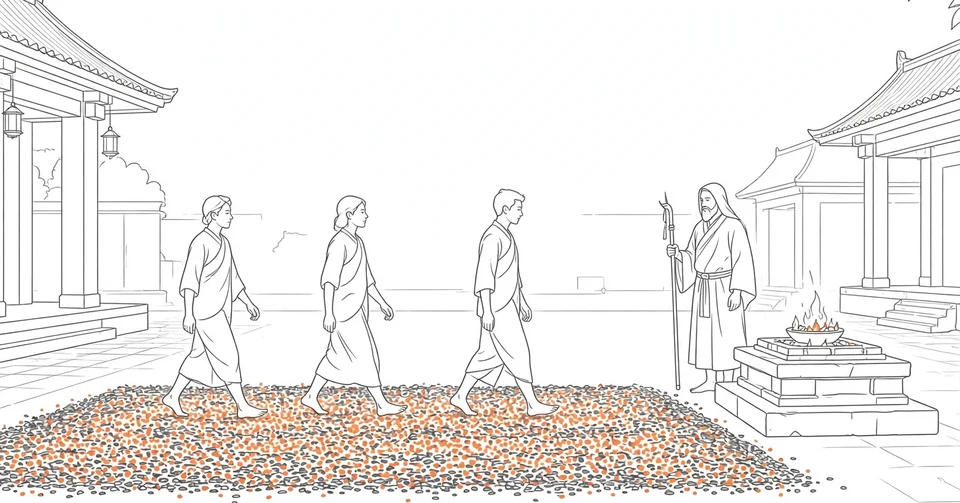
The best known hiwatari in Japan takes place at Mount Takao, on the western edge of Tokyo, where the Shingon temple Takao-san Yakuo-in holds its fire walking festival on the second Sunday of March every year. The mountain is close enough to the city that you can be back in Shinjuku by evening, which is part of why some 3,000 to 4,000 visitors make the trip.
Hiwatari is the last act of a much bigger fire
To understand hiwatari, you first have to understand the fire it walks out of. In a goma fire ritual, worshippers write their prayers on wooden sticks, and a priest feeds those sticks into a consecrated fire burning before Fudo Myoo, the fierce deity whose flames are said to burn away delusion and defilement. Most goma are held indoors, at an altar. A saito goma takes the same ritual outside and builds it much, much bigger.
The hiwatari grows directly out of that bonfire. The fire is lit, the prayers are offered, and instead of simply letting the flames die, the monks wait for them to collapse into embers. Those embers, still glowing, are then raked into a path. Walking that path is the final prayer of the day, made with the soles of your feet instead of with sticks of wood.
That sequence matters. Hiwatari is not a separate attraction bolted onto a festival. It is the point the whole ceremony has been walking towards, if you will forgive the pun, since the first stick was lit.
A day of smoke at the foot of Mount Takao
The Takao hiwatari does not happen up at the temple, near the summit. It is held in an open plaza at the foot of the mountain, in front of the Kito-den prayer hall, a short walk from Takaosanguchi Station on the Keio Line. According to the temple's own description of the day, the Saito Goma-ku is held there every year on the second Sunday of March, and the walking is done by yamabushi and participants together.
The ceremony begins around 1 in the afternoon with a procession. The yamabushi enter in their distinctive white robes and checked jackets, blowing conch shells, carrying a portable shrine loaded with amulets. What follows is roughly forty minutes of ritual before any fire is lit at all. There is a sword dance that retells a hero slaying a demon. Arrows are fired towards the four directions to keep demons from entering the ground. The names of people who have requested prayers are read aloud, one by one, which takes a while and is part of the point.
There is also the yutate, in which the monks, stripped to the waist, splash themselves with boiling water flicked from leafy branches. It is a purification, and it sets the tone for the day: hot things, endured calmly, on purpose.
Worshippers take part in a quieter purification too. They rub their bodies with sticks called nadegi, which are believed to take on their impurities, and the sticks are later thrown into the flames. Your troubles, quite literally, go up in smoke before anyone walks anywhere.
The bonfire itself is a stacked mound of wood and Japanese cypress greenery. When it is finally lit, witnesses say the smoke is enormous, a white column that swallows the plaza and leaves everyone's clothes smelling of it for days. The fire burns fiercely for about twenty minutes. Then the monks sprinkle water, stir the remains with long poles, and rake the glowing coals into a level path, the road that the hiwatari will cross.
The head yamabushi goes first, at a vigorous pace, chanting. The other monks follow. And then the gates open for the public, and the long line that has been forming all afternoon begins to shuffle forward, shoes in hand.
What the fire is supposed to do
Ask the temple what the hiwatari is for and the answer is practical, in the way prayers are practical. People cross the fire praying for protection against sickness and calamity, for safety within the family, for long life, and for peace in the world. The flames, the temple says, purify people by burning their defilements away.
I find that list moving in its modesty. Nobody in the line is asking for wealth or miracles. They are asking for an ordinary year: no hospital visits, no accidents, no phone calls in the night. The hiwatari is a ritual for people whose hopes are mostly about being left alone by misfortune, and there is something honest about walking through fire to say so.
The fire is also, in the theology behind it, the wisdom of Fudo Myoo. The same fire that terrifies is the fire that sees clearly, burning through the confusion that makes people suffer. To walk across it is to pass through that wisdom rather than just look at it. You do not watch the fire do its work. You step into it and let it do the work on you.
Why the embers do not do what you expect
Here is the question everyone actually wants answered: why does the hiwatari not burn your feet off?
Physics has a calm, unglamorous answer, and it does not involve faith, hypnosis, or mind over matter. As physicists who study firewalking explain, embers and ash are remarkably poor conductors of heat. Wood charcoal gives up its heat slowly, and the layer of ash that forms over a burned down fire insulates it further. Your foot, meanwhile, is mostly water, and water takes a lot of energy to heat up. Add the fact that each step touches the coals for only a fraction of a second, with blood flow carrying away what little heat arrives, and the sums work out kindly. A typical firewalk bed measures around 538 degrees Celsius, which sounds unsurvivable until you remember that temperature and heat are not the same thing.
Timing does much of the work too. By the time the public crosses at Takao, the path has been raked, watered, and walked on by an entire procession of monks. The fire a visitor crosses is fiercer in appearance than in fact.
None of this makes the hiwatari safe in the way a staircase is safe. The same physics explains the failures. Linger in one spot and the coals will catch up with you. Run, and your feet push deeper into the bed and the tops of them burn. A stray piece of metal in the embers conducts heat far better than charcoal and can injure. The monks' steady, unhurried pace is not just dignity. It is technique, refined over centuries, that happens to agree with thermodynamics.
Personally, I do not think the explanation shrinks the ritual at all. Knowing why the bridge holds does not make crossing the river free. Your feet still have to believe it before your head does, and the gap between those two beliefs is exactly where the hiwatari lives.
Standing in the line
For visitors, the practicalities are simple. Arrive well before the 1 o'clock start if you want a good view, because the plaza fills early. If you intend to walk, wear shoes that slip off easily, bring a small towel for your feet afterwards, and expect to queue: the line for the public crossing can stretch for an hour or more, long enough that some families give up and watch from the hill instead. Food stalls sell the usual festival fare, and your clothes will smell of cypress smoke on the train home, which most people seem to count as a souvenir.
What stays with me, reading accounts of the day, is the ordinariness of the crowd. Grandmothers. Children carried by their fathers. Office workers still in weekday shoes, holding them by the laces. The hiwatari asks the same five seconds of everyone, monk and tourist alike, and in that sense it is one of the most democratic rituals I know of. The fire does not check your credentials.
Every March, at the foot of an unremarkable plaza an hour from Shinjuku, a fire is built with great ceremony and then, instead of being worshipped from a safe distance, it is walked through and put out by feet. The prayers said over it are humble ones: health, safety, a quiet year. I can think of worse ways to start spring than by proving to yourself, one quick step at a time, that the thing you fear most is sometimes only hot for a moment, and then you are already on the other side.
More in Culture & Society
- Suka Duka Means the Banjar Shows Up for Joy and Grief Alike
- Tabuh Rah Spills Blood So the Ground Stays Calm
- The Bendesa Adat Speaks for a Village That Has Two Governments
- Catur Brata Is Four Silences Kept at the Same Time
- Your Weton Is the Day You Were Born, Counted Two Ways
- Rahu and Ketu Still Chase the Sun and Moon Across the Sky
Latest posts
- On Koyasan the Founder Is Said to Be Still Meditating
- Ngembak Geni Is the Morning Bali Starts Talking Again
- Karang Ayahan Is the Plot of Land a Village Trusts You With
- On Tumpek Landep Bali Blesses Everything Made of Metal
- Sudachi Is the Sharpest of Japan's Sour Citrus
- Shugendo Turns a Mountain Into a Place of Testing
- A Canang Sari Is Made Fresh Every Morning and Gone by Night
- The Aling-Aling Wall Exists Because Spirits Walk in Straight Lines
- Oi-Nishin Sent Tohoku Farmers Chasing Herring Every Spring
- The Nishin Goten Were Palaces Paid for by Fish
- The Tobi Were Edo's Daredevils Before They Were Its Firemen
- Kabosu Is Oita's Gentle Answer to Yuzu
- A Yamabushi Trains Where the Mountain Is the Temple
- Tri Hita Karana Holds a Village in Three Balances
- Shingon Has Kept Its Fire Ritual Burning for 1,200 Years