On Tumpek Landep Bali Blesses Everything Made of Metal
· 10 min read
Tumpek landep is the Balinese holy day that returns every 210 days, when heirloom blades, work tools, machines, and motorbikes are washed, decorated, and blessed in honour of Sang Hyang Pasupati.
Every 210 days, Bali gives its tools a holy day of their own. On tumpek landep, heirloom blades, kitchen knives, farm tools, machines, cars, and motorbikes are washed, dressed with young coconut leaf and flowers, sprinkled with holy water, and thanked. In 2026 the day falls on 14 November, and for one morning the streets of the island sparkle with offerings tied to handlebars and mirrors.
The scene can puzzle a visitor. A scooter is not a temple treasure, surely. But tumpek landep was never really about the object standing in front of the priest. It is a day of devotion to Sang Hyang Pasupati, the divine power believed to lend every tool its strength, and a reminder that the sharpest thing a person owns is not made of iron at all.
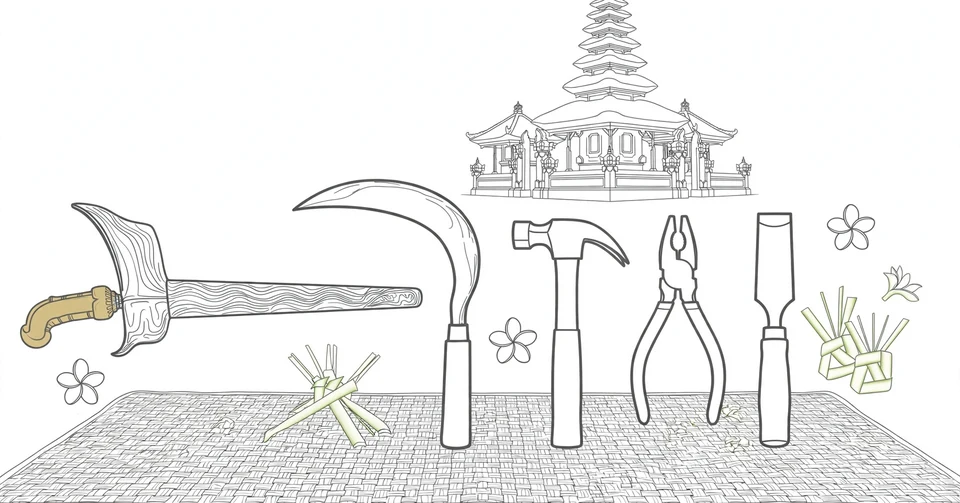
That double meaning is what keeps tumpek landep alive. The metal receives its blessing, and so does the mind that guides the hand holding it. Few holy days anywhere manage to honour a ceremonial dagger and a delivery scooter in the same breath, yet Bali has been widening this one for generations without breaking it.
A holy day that comes back every 210 days
Balinese time does not run in a straight line. The pawukon calendar turns in a cycle of 210 days, woven from weeks of different lengths running side by side, and tumpek landep arrives when Saturday meets Kliwon in the week called Landep, written in full as Saniscara Kliwon Wuku Landep. The name tumpek itself marks that meeting, the convergence of the Saturday and the Kliwon day. Because the cycle is shorter than the solar year, the Gregorian date wanders, and some calendar years hold the day twice.
Tumpek landep is one of six tumpek days spaced through the pawukon cycle, each devoted to a different part of creation:
- Tumpek Uduh, also called Tumpek Wariga, for plants and the coming harvest
- Tumpek Kandang, for animals and livestock
- Tumpek Krulut, for art, music, and the gamelan orchestras
- Tumpek Wayang, for shadow puppetry and storytelling
- Tumpek Kuningan, for ancestral spirits
- Tumpek Landep, for sharp tools and for sharpness of thought
Read together, the six days sketch a complete worldview, one in which plants, animals, art, ancestors, and human invention each receive a scheduled moment of gratitude. A guide to the six tumpek days places tumpek landep within that family and notes how naturally the day has stretched to cover motorbikes, with small offerings fluttering from rear view mirrors across the island. Tumpek landep is, in the end, simply the metal chapter of a much larger book of thanks.
Because the date moves, most families track tumpek landep the old way, with a printed Balinese calendar on the wall, or ask at the temple when the next one is due. The day is not a public holiday, and shops and offices carry on as usual, which gives the festival a distinctive texture: ordinary working Bali, briefly decorated. The ceremonies belong to households, workshops, and temple courtyards rather than to any official stage, and the biggest gatherings form at major temples such as Jagatnatha in Denpasar and Besakih on the slopes of Mount Agung, where crowds arrive in white and yellow carrying trays of offerings on their heads.
Tumpek landep began with heirloom blades
For most of its history, tumpek landep belonged to the pusaka, the sacred heirlooms kept by Balinese families. Kris daggers, spears, swords, and even hoes and sickles were brought out from their storage places, the gedong pusaka, and given their moment of care. These objects were never treated as antiques in a glass case. A pusaka was believed to carry ancestral presence and a living charge of spiritual energy, its taksu, and letting it gather dust for years was a kind of neglect with consequences.
The ritual work was gentle and precise. Heirlooms were cleansed with holy water, arranged upon altars, and presented with banten landep, offerings built from flowers, rice, coconut leaf, and small symbolic pieces of metal. A priest or the family elder recited prayers to Sang Hyang Pasupati, asking for the power resting inside the blade to be renewed. Scholars describe the rite as two acts folded into one: melaspas, a purification, and ngurip, an empowerment, a waking up of the energy that makes a tool more than shaped iron.
The Balinese attitude makes sense once you remember what a blade costs to create. The empu spends months on a single blade, folding, welding, and praying over the steel, so a finished kris arrives in a family already saturated with human effort and intention. An object like that does not get thrown into a drawer and forgotten.
Java keeps a cousin of this devotion in jamasan, the yearly heirloom washing that slowly wears old blades thin. Bali's version is less about the bath itself and more about the blessing that crowns it, but the instinct underneath is identical: what a family inherits, a family maintains, in public and on schedule.
Elders in Karangasem, interviewed for the study mentioned below, recall when tumpek landep carried a sharper sense of obligation. An heirloom was thought to hold a taksu turun-temurun, a charisma handed down the lineage, and a family that skipped the ritual was believed to risk not only misfortune but a loosening of its bond with its own ancestors. Children learned the day from the inside, helping to clean the heirlooms and arrange the offerings, absorbing the moral of the festival while their hands were busy: every tool, whether it works, defends, or simply remembers, must be used responsibly and held with gratitude.
Landep means sharp, and not only for metal
The word landep means sharp or pointed, and Balinese teaching refuses to leave the idea at the surface of a blade. The prayers of tumpek landep ask for landep in the buddhi, the intellect, and in the manah, the mind, a clarity sharp enough to tell dharma from adharma, good from harm, before the hand ever moves. A dull knife is an inconvenience. A dull mind, the tradition suggests, is a danger to everyone around it.
This is why the day honours Sang Hyang Pasupati as far more than a patron of smiths, although the smiths hold a special place in the story. The pande besi, Bali's traditional blacksmiths, were long regarded as descendants of Pasupati himself, craftsmen who turned the raw elements of the earth into implements for human welfare. When their descendants lay out a blade on tumpek landep, they are acknowledging a family resemblance between the human maker and the divine one.
Artists read the day personally as well. Performers and craftspeople speak of taksu, the spiritual charisma that lets work move an audience, and tumpek landep is when many ask for that gift to be sharpened along with their instruments. I find this the most attractive part of the whole observance. Tumpek landep could easily have shrunk into a quaint blessing of antiques in a museum. Instead it carries an argument: skill is sacred, tools deserve gratitude, and intelligence is something you maintain the way you maintain an edge, regularly and on purpose.
From heirloom blades to motorbikes
The modern chapter of tumpek landep is written in traffic. A 2025 study of the ritual in Karangasem, in eastern Bali, describes the morning of the festival there: streets filled with vehicles dressed in palm leaf ornaments called sampian, tamiang, and karang bunga, small woven trays of offerings set out everywhere, and motorcycles, cars, trucks, and even heavy machinery lined up in courtyards and temple compounds to wait their turn for holy water.
The details are tender rather than theatrical. Offerings are tucked onto dashboards, handlebars, and engines. A banten landep prepared for a vehicle often holds rice, fruit, coconut, and incense, sometimes with a small knife or coins standing in for sharpness and prosperity. The priest sprinkles tirta, the purifying holy water, while the prayers ask that the machine carry its people safely. An elder in Subagan village explained the logic to the researchers in one clean line of reasoning: the ancestors purified the kris because it protected and fed them, and their grandchildren purify the motorbike for exactly the same reason.
The blessing has also gone institutional. In Karangasem, schools, government offices, and police stations hold collective tumpek landep ceremonies for their vehicles and equipment, while young riders often take the lead in decorating their own motorcycles and then share the results on social media. Rather than reading this as the ritual going soft, the researchers frame it through desa kala patra, the Balinese principle that practice adapts to place, time, and circumstance. The form moves. The devotion, they argue, does not.
Workshops join in on their own terms. On tumpek landep morning, garages and small factories across Bali rest their machines for a while, and lathes, compressors, and heavy equipment receive the same treatment as a family car: a sprinkling of holy water and an offering of flowers, fruit, and yellow rice. It is a strange and lovely sight, the most rigid corner of the working world briefly softened by petals, and it underlines how completely the day has outgrown the heirloom cabinet without ever leaving it behind.
There is something quietly radical in watching a police truck receive flowers. Tumpek landep insists that no tool is too modern, too bureaucratic, or too ordinary to be folded back into gratitude. The scooter that fights through Denpasar traffic delivering food all year gets one morning of being treated as a partner rather than an appliance.
What the decorated streets are really saying
Strip the day down and tumpek landep makes three claims at once. It claims that objects made by human hands carry real value and deserve real care. It claims that the power inside them is borrowed rather than owned, and should be renewed with thanks. And it claims that the person using the tool is part of the maintenance, mind included.
Some households mark the day at the table as well, serving nasi kuning, the yellow rice tied to prosperity and gratitude, shared after the offerings are done. Others keep the whole thing small, a single offering resting on a single bicycle. The scale stays flexible because the pawukon cycle returns so faithfully: miss the full ceremony this time and tumpek landep will be back in 210 days, asking once again whether your tools, and your thinking, are as sharp as they should be.
That is the calm genius of the day. Bali does not ask anyone to worship a motorbike. It asks them to pause, once or twice a year, and notice how much of life runs through their hands and their machines, and to sharpen both before going back to work.
More in Culture & Society
- Suka Duka Means the Banjar Shows Up for Joy and Grief Alike
- Tabuh Rah Spills Blood So the Ground Stays Calm
- The Bendesa Adat Speaks for a Village That Has Two Governments
- Catur Brata Is Four Silences Kept at the Same Time
- Your Weton Is the Day You Were Born, Counted Two Ways
- Rahu and Ketu Still Chase the Sun and Moon Across the Sky
Latest posts
- On Koyasan the Founder Is Said to Be Still Meditating
- Hiwatari Asks You to Walk Across the Fire
- Ngembak Geni Is the Morning Bali Starts Talking Again
- Karang Ayahan Is the Plot of Land a Village Trusts You With
- Sudachi Is the Sharpest of Japan's Sour Citrus
- Shugendo Turns a Mountain Into a Place of Testing
- A Canang Sari Is Made Fresh Every Morning and Gone by Night
- The Aling-Aling Wall Exists Because Spirits Walk in Straight Lines
- Oi-Nishin Sent Tohoku Farmers Chasing Herring Every Spring
- The Nishin Goten Were Palaces Paid for by Fish
- The Tobi Were Edo's Daredevils Before They Were Its Firemen
- Kabosu Is Oita's Gentle Answer to Yuzu
- A Yamabushi Trains Where the Mountain Is the Temple
- Tri Hita Karana Holds a Village in Three Balances
- Shingon Has Kept Its Fire Ritual Burning for 1,200 Years