Shugendo Turns a Mountain Into a Place of Testing
· 9 min read
Shugendo is Japan's path of training and testing, a mountain religion where yamabushi climb sacred peaks treated as mandalas. Banned in 1872 and revived after the war, it still turns steep mountains into places of spiritual testing.
Some religions hand you a book. Shugendo hands you a mountain. The name is usually translated as the path of training and testing, and it is not a metaphor. For well over a thousand years, practitioners of shugendo have climbed Japan's steepest sacred peaks in the belief that spiritual power is something the body earns, step by step, in hard country.
The practitioners are called shugenja, or more commonly yamabushi, a word that points at people who prostrate themselves in the mountains. Their goal is not withdrawal for its own sake. The training is meant to build compassion and spiritual power, called siddhi, that can then be spent on other people, on healing, protection and prayer for the communities waiting at the foot of the mountain.
Shugendo is also one of the great blends of Japanese religion. It grew out of Shinto mountain worship, folk religion and Buddhism, took in the esoteric teachings of the Shingon and Tendai schools, and carries smaller traces of Taoism as well. The Japanese state once found that mixture so suspicious that it banned shugendo outright in 1872. The mountains kept it anyway, and today its oldest landscapes are protected as world heritage.
Where shugendo came from
Shugendo took shape during the seventh century, in the Nara period, out of local folk practice, Shinto reverence for sacred peaks and the Buddhism that had arrived from the continent. Tradition credits the ascetic and mystic En no Gyoja, also known as En no Ozunu, as its patriarch, the first to practise what later generations would organise into shugendo as a doctrine. Mountain hermits had climbed sacred peaks before him, but the stories gather around his name.
The legend says that after long austerities on Mount Sanjo, in the Omine range, En no Gyoja prayed for a guardian fierce enough to save people in a violent age. Gentler buddhas appeared and were judged too mild, until the mountain shook and a rock split open to reveal Zao Gongen, a wrathful deity found almost nowhere outside shugendo. Whether you read that as history or as theatre, it sets the tone of the whole tradition: the answer to prayer is something demanding.
From the ninth century, esoteric Buddhism flowed into the mountain practice. Shingon and Tendai rituals, mantras and initiations gave the ascetics a formal grammar, and the two schools became the tradition's institutional parents. In 1613 the Tokugawa government issued the Shugendo Hatto, a law that forced the many independent lineages to register under one of two umbrellas, the Shingon aligned Tozan ha or the Tendai aligned Honzan ha. Shugendo has lived inside, and sometimes underneath, those larger institutions ever since.
The physical evidence for the tradition's age turned up in an unexpected place. In 1907, a climbing party reached the summit of Mount Tsurugi, then regarded as the last unclimbed peak in Japan, and found a sword and the metal fitting of a cane already there. Scientific examination dated the objects to somewhere between the late Nara period and the early Heian period. Shugenja had stood on that summit more than a thousand years before the mountaineers arrived to claim it.
The mountain as a mandala
The core idea of shugendo is that a sacred mountain is not scenery. In the words of the scholar Miyake Hitoshi, mountains in this tradition are sacred realms inhabited by deities, places where the ordinary world and the spiritual world intersect. A great peak is read as a mandala, a map of the entire universe laid out in rock and forest, and walking into it is a ritual act rather than a hike.
That changes what a trail means. To enter the mountain, a practice called nyubu shugyo, is to move through the mandala stage by stage, passing places associated with buddhas and guardian deities, making offerings, reciting sutras and sometimes burying them. The Dewa Sanzan mountains in Yamagata give the clearest version of the idea. Pilgrims cross Mount Haguro, Mount Gassan and Mount Yudono in an order understood as birth, death and rebirth, so the walk itself performs the whole cycle of existence.
I find something honest in this geography of belief. The doctrine is not argued first and illustrated later. It is climbed. Whatever a practitioner understands at the summit has been filtered through weather, exhaustion and fear on the way up, and shugendo trusts that filter more than it trusts words.
Training is the doctrine
The most common form of shugendo practice is simply entering the mountains to train. Retreats involve steep ascents, standing under cold waterfalls, vigils, chanting and periods of silence, and the most advanced form is the winter retreat, said to confer special powers. The sound that announces the practitioners on the trail is the horagai, a conch shell trumpet whose call carries through the cedar forests and warns the mountain, politely, that they are coming. Around the mountain core sits a wide ritual repertoire inherited from esoteric Buddhism, including initiations modelled on tantric consecration and fire ceremonies such as the goma, usually centred on the fierce deity Fudo Myoo.
Historically, this is why villages valued their yamabushi. The powers earned in the mountains were spent back home as healing prayers, exorcisms, divination, protective charms and help with childbirth. Shugendo was never only a monks' pursuit. It runs on a spectrum from lay pilgrims and pilgrimage confraternities, village groups that pool money to send members up the sacred peaks, through to ordained priests who spend years receiving a lineage's full transmissions.
Omine, Kumano and the three mountains of Dewa
The historic heartland of shugendo is the Omine range in the Kii Mountains, a chain running about 100 kilometres from Yoshino in the north down toward Kumano in the south. Along its trail lie 75 recognised places of ascetic practice, and near the top of Mount Omine, at 1,719 metres, stands Ominesan ji, often described as the highest sacred site of the tradition. Mount Omine is famous for three tests of courage, ordeals of cliff and chain that are meant to strengthen the spiritual power of whoever takes them on.
Omine is also where shugendo keeps its most debated rule. A gate and a tall stone pillar on the trail mark a boundary, in Japanese a nyonin kekkai, beyond which women may not pass toward the summit of Mount Sanjogatake. A signboard states the rule plainly in Japanese and English. The Meiji government abolished such boundaries on shrine and temple land in 1872, and most mountains opened. The temple communities of Omine maintained theirs as religious tradition, and describe it as protecting an ascetic discipline they say has run unbroken for some 1,300 years. Critics, including scholars who study the site, see an old exclusion preserved long after its legal basis vanished. Both descriptions are on record, and the mountain, so far, has kept its rule.
At the southern end of the range stand the Kumano Sanzan, the three great shrines of Hongu, Hayatama and Nachi. In the Heian period, retired emperors and Kyoto nobles made the long pilgrimage to Kumano in such numbers that the roads were nicknamed the procession of ants. Kumano was the shared holy ground of shugendo, Shinto and Buddhism at once, which is exactly the mixture the tradition is made of.
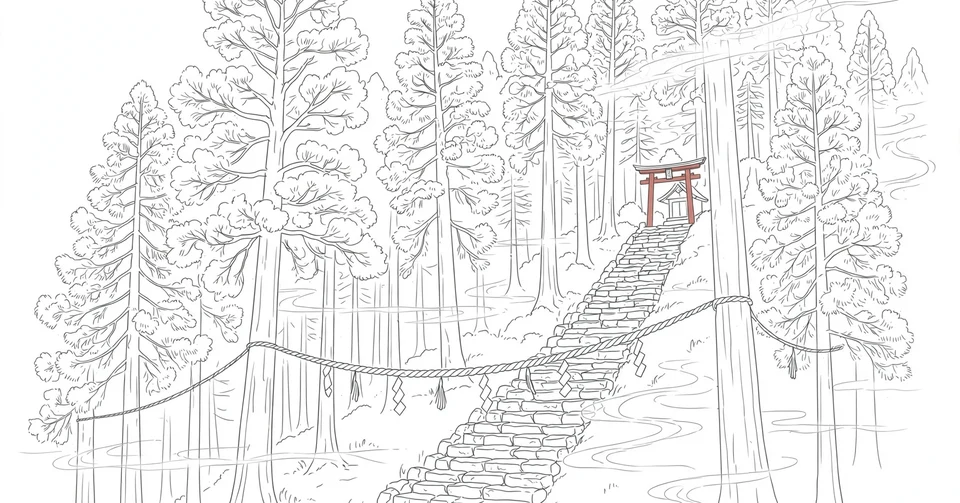
In the north, the Dewa Sanzan offer a different door into the same world. Mount Haguro is climbed by a stairway of 2,446 stone steps through ancient cedars, and its lodges still run yamabushi training, including the Autumn Peak, a mountain entry retreat held each year. For visitors who cannot give months to the mountains, Haguro is where shugendo most readily shows its working face. A fuller account of the tradition and its history is kept on Wikipedia, which traces its lineages and sacred sites in detail.
Banned in 1872, revived after the war
The Meiji government set out to prise Shinto and Buddhism apart, and a religion built on their fusion was an obvious problem. In 1872 the state ruled shugendo unacceptable precisely because it amalgamated the two, and forbade it. The mountain was closed, temples were reassigned, and whatever practice continued did so quietly and in secret.
What saved shugendo was the religious freedom that arrived after World War II. The wartime and Meiji era edicts were repealed, practitioners reclaimed Mount Omine and restored its traditions, and lineages that had been folded into the two old umbrellas could stand independently again. Kinpusen ji, the great temple of the Omine tradition, became independent in 1948. A ban of more than seventy years had failed to finish a practice that only needs a mountain and a reason to climb it.
A living heritage
In 2004, UNESCO inscribed the Sacred Sites and Pilgrimage Routes in the Kii Mountain Range on the World Heritage list. The listing covers Yoshino and Omine, Kumano Sanzan and Koyasan, joined by 307 kilometres of pilgrimage routes through dense forest, and it recognises a tradition of sacred mountains documented over more than 1,200 years. Shugendo is named in the listing as one of the faiths that shaped the landscape, the fusion made visible in stone and cedar.
Today the practice continues at every level, from white clad confraternity groups on summer ascents to priests deep into decades of transmissions. Numbers are smaller than in the Edo period, and some mountains have lost their resident ascetics, but the essential transaction is unchanged. A person walks into a mountain that is treated as a mandala, submits to its tests, and walks out expected to be of use to other people.
That may be the most durable idea shugendo has. The summit is not the point, and neither is the suffering. The point is what the climber carries back down.
More in Culture & Society
- Suka Duka Means the Banjar Shows Up for Joy and Grief Alike
- Tabuh Rah Spills Blood So the Ground Stays Calm
- The Bendesa Adat Speaks for a Village That Has Two Governments
- Catur Brata Is Four Silences Kept at the Same Time
- Your Weton Is the Day You Were Born, Counted Two Ways
- Rahu and Ketu Still Chase the Sun and Moon Across the Sky
Latest posts
- On Koyasan the Founder Is Said to Be Still Meditating
- Hiwatari Asks You to Walk Across the Fire
- Ngembak Geni Is the Morning Bali Starts Talking Again
- Karang Ayahan Is the Plot of Land a Village Trusts You With
- On Tumpek Landep Bali Blesses Everything Made of Metal
- Sudachi Is the Sharpest of Japan's Sour Citrus
- A Canang Sari Is Made Fresh Every Morning and Gone by Night
- The Aling-Aling Wall Exists Because Spirits Walk in Straight Lines
- Oi-Nishin Sent Tohoku Farmers Chasing Herring Every Spring
- The Nishin Goten Were Palaces Paid for by Fish
- The Tobi Were Edo's Daredevils Before They Were Its Firemen
- Kabosu Is Oita's Gentle Answer to Yuzu
- A Yamabushi Trains Where the Mountain Is the Temple
- Tri Hita Karana Holds a Village in Three Balances
- Shingon Has Kept Its Fire Ritual Burning for 1,200 Years