Aikido and the Martial Art That Refuses to Fight Back
· 10 min read
Aikido is Japan's martial art of harmony, founded by Morihei Ueshiba, where the goal is to end a fight without hurting anyone. Here is how aikido works, why it has no contests, and how to start.
In most martial arts, the question is how to win. In aikido, the question is different: how do you end a fight without anyone getting hurt? The art was built around that question, and after almost a century it still refuses to change its answer.
Aikido is a modern Japanese martial art founded by Morihei Ueshiba, a man who spent his youth learning how to fight and his later years learning why not to. The name breaks into three parts: ai means harmony, ki means spirit or energy, and do means the way. Put together, it is the way of harmony with the spirit, a name that sounds abstract until you see it in motion.
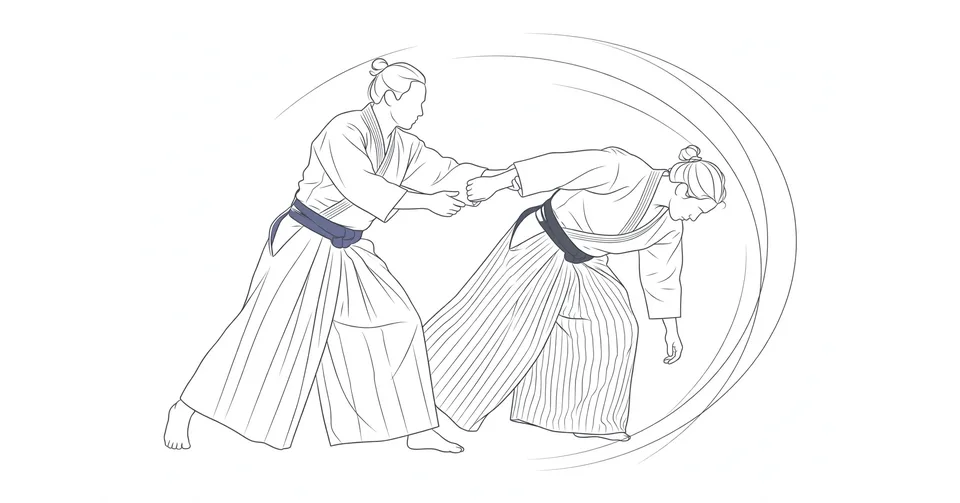
Watch a demonstration and the first thing you notice is how little force is involved. An attacker grabs a wrist or throws a punch, and the defender steps aside, turns, and guides that energy in a circle until the attacker is on the floor, unhurt and slightly confused. There is no punch back, no kick, no locked contest of strength. It looks gentle, and that is exactly the point.
Aikido Began With a Soldier Who Wanted Peace
Morihei Ueshiba was born on 14 December 1883 in Tanabe, a coastal town in southern Japan, and died on 26 April 1969. He lived through some of the most violent decades of the twentieth century, and the contrast shaped everything he built. As a young man he studied one hard art after another, above all Daito-ryu Aiki-jujutsu under Sokaku Takeda, the reviver of that old school, along with kenjutsu and Yagyu jujutsu. He also fell deeply under the influence of the Omoto-kyo religion, which taught that the universe moves toward harmony.
By the late 1920s Ueshiba had begun to pull those threads together into something of his own. He first used the term aikido around 1925, and the name was officially adopted in 1942. His dojo in Tokyo, founded in April 1931 as the Kobukan Dojo, became the headquarters of the art. After the Second World War, when the occupying forces banned martial arts instruction, aikido went quiet along with the rest. Teaching resumed in 1949, and the Aikikai Foundation was registered in 1948 as the organisation that still leads the main line of aikido today.
Ueshiba handed the leadership to his son Kisshomaru, who served as the second Doshu, or keeper of the way, and systematised the art so it could be taught around the world. Today the third Doshu is Moriteru Ueshiba, the founder's grandson, and the Hombu Dojo in Tokyo remains the world headquarters of aikido. That unbroken family line is part of why aikido has stayed so close to its founder's idea: it was never handed over to a committee or a sports federation.
How Aikido Works in Practice
The core idea of aikido is simple to state and hard to do. Instead of meeting force with force, you blend with it. When someone pushes, you turn. When someone pulls, you enter. The attacker's own momentum does the work, which is why a smaller person can throw a larger one without straining. The movement is almost always circular, a spiral that leads the attack off balance and down to the mat.
Training happens in pairs, and the two roles keep swapping. The nage, also called tori, performs the technique. The uke receives it, which means learning ukemi, the art of falling safely. A good uke is not a passive victim. They attack with commitment, stay connected through the technique, and roll out of the fall ready to stand up again. Beginners spend as much time learning to fall well as they do learning to throw, and that is deliberate: in aikido, knowing how to land is part of knowing how to stay safe.
Strikes exist in aikido, but they are used differently from other arts. An atemi is a strike aimed as a distraction or to unbalance, not to injure. The goal is always control rather than damage: a wrist lock that guides, a pin that holds, a throw that deposits the attacker on the floor instead of through it. Weapons appear too. Students train with the bokken, a wooden sword, and the jo, a short staff, in paired forms known as aiki-ken and aiki-jo. The sword tradition also lives on in kendo, the modern way of the sword, which trains the same cuts with bamboo swords and armour. The weapon work is not a separate hobby. It teaches distance, timing, and the same blending principle, just with something longer in your hands.
Look around a dojo and you will see the hakama, the wide pleated trousers worn over the uniform. In many dojos only higher grades wear them, so the sight of a black hakama sweeping across the mat is a quiet signal of seniority. There is no shouting, no sparring for points, and no bell at the end of a round. A class is closer to a slow, serious conversation between two bodies than to a contest.
Why There Are No Contests in Aikido
Here is the fact that surprises almost everyone who comes to aikido from another art: there are no competitions. Progress is judged only at formal gradings, from kyu grades up to dan grades, with a black belt at first dan. Ueshiba put it plainly: there are no contests in the art of peace, and a true warrior is invincible because he contests with nothing. His motto, masakatsu agatsu, means true victory is victory over oneself.
That stance puts aikido in sharp contrast with its siblings. Judo, which Ueshiba also knew well, became an Olympic sport, and karate reached the Tokyo 2020 Olympics. Aikido never followed. The one exception proves the rule: the Shodokan school, founded by Kenji Tomiki in 1967, introduced a codified competition system, and it remains controversial among other schools precisely because it breaks with the founder's principle. In the Aikikai, Iwama, Yoshinkan, and Ki Society lines, competition simply does not exist.
It is easy to call that a weakness, and plenty of people do. But the absence of contests is also what keeps aikido honest about its own goal. A competition needs a winner, and a winner needs a loser, and the moment you start keeping score, the art of not hurting people becomes a sport about hurting them a little less than the other person. Aikido chose to stay out of that bargain. I think that stubborn refusal is the bravest thing about it, and the reason it still feels different from every other martial art you can watch on television.
The Techniques, in Plain Language
Aikido has hundreds of named techniques, but they grow from a small set of ideas. Most beginners meet the same handful first, and those few are enough to show how the whole system thinks.
| Technique | What it does |
|---|---|
| Ikkyo | The first control, a straight arm pin that takes the attacker down in a line |
| Nikyo | A wrist twist that bends the joint and drops the attacker to their knees |
| Sankyo | A spiralling wrist lock that turns the whole body like a corkscrew |
| Shihonage | The four-direction throw, a wide circular movement that sends the attacker over |
| Iriminage | The entering throw, stepping through the attack and guiding the head down |
| Kotegaeshi | A wrist turn that flips the attacker forward onto the mat |
Every technique starts from an attack, and every attack in the dojo is announced by its name: a wrist grab, a shoulder grab, a straight punch, an overhead strike. The defender does not wait to see what happens. They move at the moment of the attack, and the technique is already halfway done before the attacker realises their balance is gone. That is the part that takes years to learn. The shape of a throw can be copied in a week. The timing, the calm, and the willingness to move toward an attack instead of away from it cannot be rushed.
Aikido Around the World
Aikido left Japan earlier than most people realise. It was first brought to the West in 1951, when Minoru Mochizuki visited France and introduced aikido techniques to judo students there. Tadashi Abe followed in 1952 as the official representative of the Hombu Dojo and stayed in France for seven years. In 1953, Koichi Tohei was sent to Hawaii for a year, and from there the art spread across the United States.
The spread created its own family tree. Gozo Shioda founded the Yoshinkan school in 1955, with a harder, more precise style. Mochizuki had already started the Yoseikan line in 1931. Tohei, after a disagreement with Kisshomaru Ueshiba, left the Aikikai in 1974 and founded the Ki Society, putting the emphasis on ki development and mind-body coordination. Each school argues, politely, that it is closest to what the founder intended. They all still trace back to the same dojo in Tokyo, and they all still practice without keeping score.
Today there are aikido dojos in almost every country, coordinated internationally by the International Aikido Federation. Some are large city dojos with a hundred members. Some are a dozen people in a community hall. The shape is the same everywhere: white uniforms, a wooden floor, a pair of practitioners, and the quiet work of learning to move with force instead of against it.
How to Start Aikido
Starting aikido is simpler than starting most martial arts, because there is nothing to win and nothing to prove on the first day. Most dojos welcome complete beginners, and the first class is usually free or cheap. You need a keikogi, the white training uniform, and bare feet. The hakama comes later, after you have earned it.
Expect the first months to feel strange. Your body will want to resist, to push back, to muscle through a technique, and the teacher will keep telling you to relax. That advice sounds like a platitude until the day it works, when a throw suddenly needs no effort at all and you understand what the circular movement was for. Progress is slow by design. Gradings come a few times a year, and the early kyu grades are mostly about learning to move safely and fall well.
If you are choosing a dojo, look for one affiliated with a recognised organisation, most often the Aikikai, and watch a class before joining. A good dojo feels calm and serious, with senior students who take care of beginners rather than showing off on them. The best sign is the uke: if the experienced students fall well and get up smiling, the teaching is sound.
Aikido will not make you a fighter, and it does not pretend to. What it offers instead is rarer: a physical practice built on the belief that strength is best used to protect people, including the person attacking you. In a century that has turned almost every human activity into a contest with a scoreboard, an art that refuses to compete is not a relic. It is a reminder that there was always another way to be strong, and that the founder who walked away from winning may have understood strength better than the rest of us.
More in Culture & Society
- Barong Is the Lion Bali Calls Out When the Village Needs Protection
- Setsubun, the Bean Throwing Festival That Chases Winter Away
- Karate, the Empty Hand That Became Japan's Most Exported Martial Art
- Kemari Is the Ball Game Japan Played Without Trying to Win
- Chagama Is the Kettle That Never Leaves the Tea Room
- Judo, the Gentle Way Japan Gave the World
Latest posts
- Satay and the Smoke That Carries Indonesia to the World
- Tumpeng Is the Rice Cone Java Serves When It Wants to Say Thanks
- Onsen Etiquette and the Unwritten Rules of Japan's Hot Springs
- Japan's Winter Illuminations Turn Dark Nights Into Light
- Lake Toba and the Supervolcano That Made the World's Largest Volcanic Lake
- Raja Ampat and the Coral Kingdom at the Edge of Indonesia
- Tokyo Skytree and How Japan Built the World's Tallest Tower
- Matsumoto Temari Turns Mountain Cocoons Into Wishes You Can Hold
- Nambu Tekki Is the Iron That Outlasted the Lords Who Ordered It
- Forest Bathing in Japan, the Quiet Science of Shinrin-Yoku
- Tokyo Tower and the Orange Giant That Refused to Be Replaced
- Emoji, the Tiny Pictures Japan Gave the World
- Temari Is the Embroidered Ball Japan Gives for Good Luck
- A Tetsubin Turns Iron and Fire Into Japan's Slowest Kettle
- Hakone and the Hot Spring Town Below Mount Fuji