The Japanese School Uniform and the Story Behind the Sailor Suit
· 11 min read
The Japanese school uniform looks simple, but the sailor suit, the gakuran, and the blazer each carry a century of history, from Meiji military dress to the classrooms of today.
A Japanese school uniform is one of the most recognisable outfits in the world. A navy sailor collar, a pleated skirt, a black jacket with a stiff collar, and you know exactly where you are, even in a photograph with no caption. The uniform is so familiar that it is easy to assume it has always looked this way, as if it arrived with the schools themselves. It did not. The Japanese school uniform is a patchwork of borrowed ideas, military tailoring, royal children's fashion, and postwar pragmatism, stitched together over about 150 years.
What surprises most visitors is how much the Japanese school uniform still matters. It is not a quaint leftover. It is a daily negotiation between a school, its students, and the country around them, about discipline, identity, and belonging. The Japanese school uniform tells you a lot about Japan, if you know how to read it.
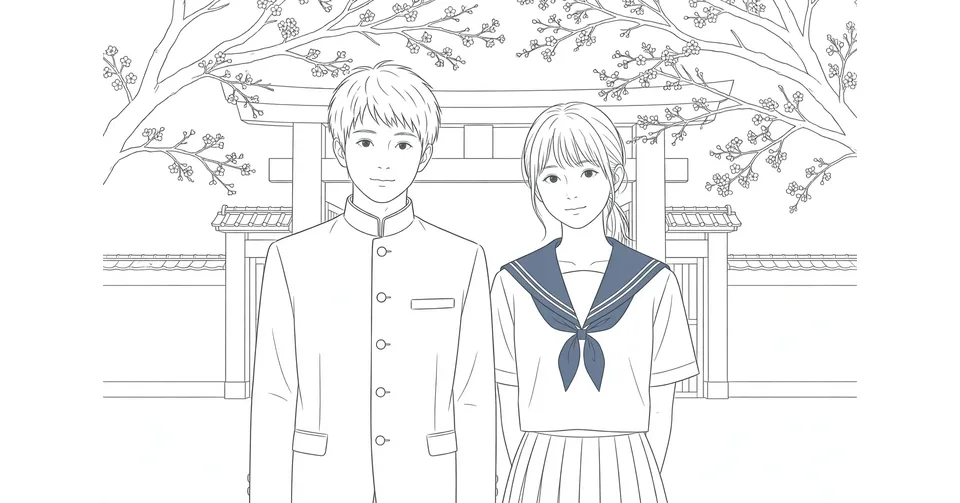
The first thing to understand is that the Japanese school uniform has never been a single design. There are three classic forms, and most schools use one of them. Boys in junior and senior high school traditionally wear the gakuran, a black tunic with a stand-up collar, five gold buttons, and straight black trousers. Girls traditionally wear the sailor suit, a blouse with a wide sailor collar, a ribbon or neckerchief, and a pleated skirt. The third form, the blazer, arrived later and now dominates, especially in high schools. Each of the three has its own origin story, and none of them began in a classroom.
The gakuran came from the army
The story of the Japanese school uniform begins in the Meiji era, when Japan was remaking itself at speed. Before uniforms, students wore what they wore at home. Girls wore kimono, sometimes with hakama, and boys wore kimono or hakama too. When the new Meiji state built modern schools, it also built a modern army and navy, and both needed Western-style dress. The schools followed.
The boys' uniform, the gakuran, is a direct descendant of European military tunics. The design traces back to the Prussian Waffenrock, a military coat introduced in 1842, which reached Japan through the uniforms of the new imperial army. The name itself is a small joke that stuck. Gaku means study or school, and ran is the second character in the old spelling of Holland, which for two centuries had been Japanese shorthand for Western things. So gakuran means, roughly, Western school clothing. The plainer Japanese term is tsume-eri, closed collar.
Gakushuin, the school for children of the imperial court and nobility, is usually named as the first school to adopt the stand-collar uniform, in 1879. A few schools had similar uniforms earlier, but the design that spread nationwide was the one set by Tokyo Imperial University in 1886. From there it moved down through the school system, and by the Taisho period the gakuran, black tunic, five gold buttons, black trousers, was the standard dress of the Japanese schoolboy. Apart from the footwear, it is still worn today, more than a century later.
That military root explains the stiffness of the Japanese school uniform, literally and figuratively. A stand-up collar does not invite slouching. The gakuran was meant to signal order and seriousness, and it still does. When Japanese schoolboys in the 1960s and 1970s pushed back against school authority, one of their targets was the gakuran itself, which student movements described as a symbol of authoritarian discipline. The jacket survived the protests. It is hard to kill a design that has become an identity. The full history of these uniforms, from the first stand-collar designs to the modern blazer, is well documented in the history of school uniforms in Japan.
The sailor suit sailed in from Britain
The girls' uniform has a softer origin, and a more surprising one. Before the sailor suit, schoolgirls wore kimono with hakama, in an undivided pleated skirt, often in a maroon-brown shade that became a signature of the Meiji and Taisho eras. You can still see that look at university graduation ceremonies today, where hakama remains formal dress.
The sailor suit came from European children's fashion. In 1846, Queen Victoria dressed her young son, the future Edward VII, in a miniature version of a British Royal Navy uniform, and the look caught on across Europe as a way to dress children. Japan picked it up for schools around 1920. Priority is genuinely disputed, which is part of the charm. Heian Jogakuin in Kyoto introduced a sailor-collared one-piece dress in 1920, and in 1921 two more schools followed with the two-piece blouse and skirt version that modern uniforms descend from. Kinjo Gakuin in Nagoya adopted it that September, and Fukuoka Jo Gakuin in December, under principal Elizabeth Lee, who reportedly modelled it on the sailor suit she had worn while studying in England.
So the Japanese school uniform for girls is, at its root, a British naval outfit, filtered through European children's fashion, then through a girls' school in Fukuoka. It is a reminder that the most Japanese-looking things are often the most borrowed. The sailor suit's wide collar, the three white stripes, the ribbon at the throat, all of it is naval dress, shrunk to school size.
By the 1920s the Japanese school uniform, in its two classic forms, was the standard across Japanese schools. The boys wore the army's coat and the girls wore the navy's collar, and the pairing stuck so firmly that it still defines what the world pictures when it hears the words Japanese school uniform. A good overview of how the sailor suit and the gakuran evolved side by side is at Study in Japan.
The blazer quietly took over the Japanese school uniform
If you walk past a Japanese high school today, though, you may not see a sailor suit at all. The blazer crept in after the war and arrived properly in the 1980s and 1990s, in a wave schools called model change, when each school redesigned its uniform to stand out. In 1986 the Akashi School Uniform Company published a book called Seifuku Kakumei, School Uniform Revolution, which argued that high schools should have their own distinctive uniforms. Schools listened. Blazers, checked skirts, coloured ribbons, and embroidered crests multiplied.
The numbers tell the story of the modern Japanese school uniform. In a 2023 survey by Kanko Gakuseifuku, a major uniform maker, only 8 percent of high-school girls were still wearing the sailor suit, while 70 percent wore a blazer. The sailor suit survives mainly in junior high schools, where it remains the classic image. In high schools, the blazer has won.
There is a practical reason, and a cultural one. Blazers are easier to vary, easier to make in different colours and fabrics, and easier to wear with trousers, which matters now that more schools offer trousers as a choice for girls. They are also easier to brand. A school with a distinctive blazer, tie, and crest has a visible identity in a crowded education market, and open days and brochures show it off.
No law requires a uniform at all
One of the most surprising facts about the Japanese school uniform is that no national law requires it. The education ministry does not mandate uniforms. Each school, together with its board of education, writes its own dress policy. Some schools have no uniform at all. Others have rules so detailed they read like a legal code.
That is why the rules get so extraordinarily specific. A school may dictate the length of a skirt, the colour of socks, the shade of a ribbon, the style of shoes, and even the colour of a student's hair. The famous rules about hair, underwear colour, and the ban on dyeing hair have made headlines in recent years, and some of the strictest have been relaxed after public criticism. But the underlying logic remains. The uniform is not just clothing. It is a system of belonging, and the rules are how a school draws its boundary.
This is also why uniforms differ so much between schools. A private school in Tokyo may have a designer blazer that costs as much as a small holiday, while a public junior high school in the countryside may use a plain gakuran and sailor suit that has barely changed in fifty years. The Japanese school uniform is one idea with thousands of local versions.
The uniform as identity, and as rebellion
For students, the Japanese school uniform is both a comfort and a cage, and often both at once. It erases visible differences in family income, which was one of the original arguments for it. A student from a poor family and a student from a rich one look the same in the morning. It also marks a student as belonging to a particular school, which carries pride, and sometimes trouble, when rival schools meet.
It is also the thing students rebel against first. The history of the Japanese school uniform is also a history of students finding ways to wear it wrong on purpose. Longer skirts in the 1970s, shorter skirts in the 1990s, loose socks in the 1990s, the collar popped, the ribbon loosened, the blazer worn oversized. Each generation has its own small act of tailoring, and each generation's teachers have their own countermeasures. The uniform survives because it is flexible enough to absorb rebellion without breaking.
Outside Japan, the Japanese school uniform took on a second life entirely. Anime and manga turned the sailor suit into a global symbol of Japanese youth, and the image travelled far beyond any classroom. The global reach of Japanese anime helped carry the sailor suit around the world, and the image is now as familiar abroad as it is in Japan. That global fame has a strange effect back home. The uniform is now both an ordinary school garment and an international icon, and Japanese teenagers are aware of both at once. Some love it. Some find the attention uncomfortable. Most, I suspect, just want to get through the school day.
What a uniform costs, and who pays
A Japanese school uniform is not cheap. A full set, including the jacket or blazer, trousers or skirt, shirts, tie or ribbon, and sometimes a sweater and gym kit, can cost tens of thousands of yen, and private school uniforms cost more. For families with several children, the bill is real. Schools usually sell uniforms through designated shops, and second-hand uniforms are passed down where the rules allow it.
There are quieter costs too. A uniform must be kept clean and presentable, which means regular washing and occasional replacement. In summer, the same heavy fabric that looks smart in winter becomes a burden, and many schools switch to a lighter summer uniform, usually a short-sleeved shirt without the jacket. The seasonal changeover, koromogae, is a small ritual of the school year, and students notice it the way office workers notice the first day they can leave their jacket at home.
I find the economics of the uniform oddly reassuring. For all the talk of tradition and discipline, the uniform is also a practical purchase, a piece of clothing that has to survive a teenager's daily life. It gets rained on, sat on, spilled on, and outgrown. The romance of the sailor suit meets the reality of the laundry basket, and the laundry basket wins.
Reading the uniform today
If you visit Japan and see students in uniform on a train, you are looking at a living piece of design history. The black gakuran carries the Prussian military coat of 1842. The sailor collar carries a British prince's outfit from 1846. The blazer carries the school branding wars of the 1980s. Almost two centuries of borrowed ideas, worn by teenagers on their way to class.
The Japanese school uniform also says something about how Japan handles foreign influence. It does not copy and it does not reject. It takes a foreign form, a military coat, a naval collar, a British blazer, and makes it so thoroughly Japanese that the rest of the world now thinks of it as Japanese first. The gakuran is no longer Prussian. The sailor suit is no longer British. They belong to the schools that wear them.
That is the part I like best. A uniform is supposed to make everyone the same, and in a way it does. But look closer and the differences are everywhere. The colour of a ribbon, the cut of a blazer, the crest on a pocket, the way a student wears the collar. The Japanese school uniform is a system for being the same, with room for being yourself inside it. Perhaps that is why it has lasted 150 years, and why it will probably last another fifty.
More in Culture & Society
- Rangda Is the Witch Queen Bali Never Lets Win
- Aikido and the Martial Art That Refuses to Fight Back
- Barong Is the Lion Bali Calls Out When the Village Needs Protection
- Setsubun, the Bean Throwing Festival That Chases Winter Away
- Karate, the Empty Hand That Became Japan's Most Exported Martial Art
- Kemari Is the Ball Game Japan Played Without Trying to Win
Latest posts
- Satay and the Smoke That Carries Indonesia to the World
- Tumpeng Is the Rice Cone Java Serves When It Wants to Say Thanks
- Onsen Etiquette and the Unwritten Rules of Japan's Hot Springs
- Japan's Winter Illuminations Turn Dark Nights Into Light
- Chagama Is the Kettle That Never Leaves the Tea Room
- Judo, the Gentle Way Japan Gave the World
- Lake Toba and the Supervolcano That Made the World's Largest Volcanic Lake
- Raja Ampat and the Coral Kingdom at the Edge of Indonesia
- Tokyo Skytree and How Japan Built the World's Tallest Tower
- Matsumoto Temari Turns Mountain Cocoons Into Wishes You Can Hold
- Nambu Tekki Is the Iron That Outlasted the Lords Who Ordered It
- Forest Bathing in Japan, the Quiet Science of Shinrin-Yoku
- Tokyo Tower and the Orange Giant That Refused to Be Replaced
- Emoji, the Tiny Pictures Japan Gave the World
- Temari Is the Embroidered Ball Japan Gives for Good Luck