Kecak Dance and the Hundred Voices That Tell the Ramayana
· 11 min read
The Kecak Dance is Bali's famous fire dance with no instruments at all, just a circle of men chanting "cak" while the Ramayana unfolds at sunset. Here is how it began, what happens on stage, and where to see it.
The Kecak Dance is the strangest sound in Balinese performance, and it is also the simplest. There is no orchestra, no drum, no flute. A circle of bare-chested men sits on the ground and chants "cak, cak, cak" in overlapping rhythms, and that human sound becomes the entire score for a story that is more than two thousand years old. If you have seen a photo of it, you have probably seen the fire. If you have heard it live, you remember the voices first.
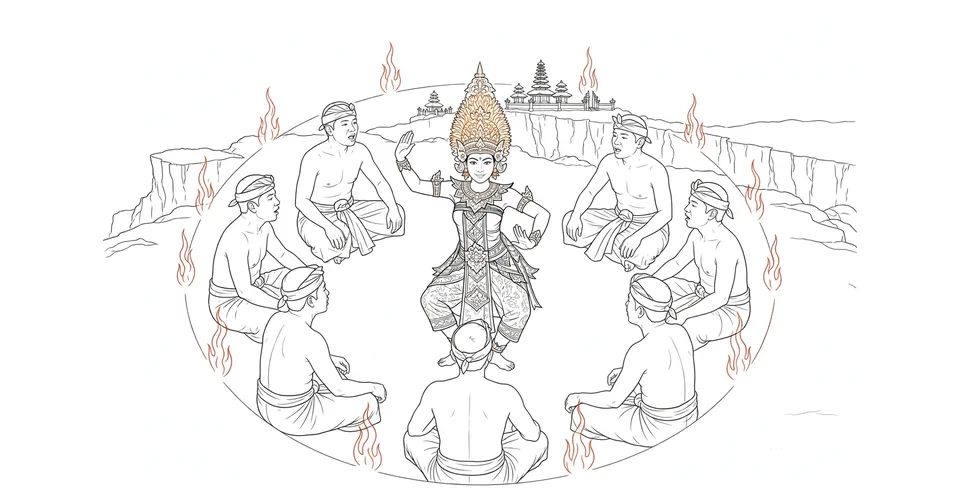
The dance tells an episode from the Ramayana, the Hindu epic of Prince Rama, his wife Sita, and the monkey god Hanuman. It lasts about an hour, it is performed outdoors at sunset, and at Uluwatu Temple it happens every evening on a cliff above the Indian Ocean. The Kecak Dance is not a museum piece. It is loud, crowded, a little chaotic, and completely alive, which is exactly why people keep coming back to it.
What the Kecak Dance is
At its simplest, the Kecak Dance is a dance drama without music. Between fifty and a hundred men sit in concentric circles, swaying and chanting in rhythmic patterns that speed up, slow down, and split into layers. The word kecak comes from the sound itself, that sharp "cak" repeated hundreds of times a minute. Costumed dancers move in the middle of the circle, acting out the story while the chorus reacts, gasps, and drives the tension higher.
There is a good reason the chorus matters so much. In most Balinese dance, the gamelan orchestra sets the pace and the mood. The Kecak Dance throws the orchestra away and hands the whole job to human voices. The result feels closer to a crowd than to a concert. When the chorus rises, the whole amphitheatre seems to lean forward. When it falls silent, you can hear the waves below the cliff.
The performance is often called a fire dance, and the nickname is earned. The climax comes when Hanuman, the white monkey god, is captured and set alight, and he dances through a bed of burning coconut husks. The flames are real, the danger is real, and the crowd always reacts. It is the moment everyone films, but it is only the ending of a story that has been building for almost an hour.
From a trance ritual to a stage
The Kecak Dance is younger than it looks. Its roots reach back to Sanghyang, an old Balinese ritual in which villagers entered trance states through rhythmic chanting, a practice meant to ward off evil spirits and heal the sick. But the dance as audiences know it today was shaped in the 1930s, when the Balinese artist Wayan Limbak worked with the German painter and musician Walter Spies, who was living in Bali at the time.
Limbak and Spies took the chanting of the Sanghyang ritual and gave it a story. They wrapped the vocal ritual around an episode from the Ramayana, added characters and costumes, and turned a sacred practice into a performance that visitors could follow. That history matters, because it explains the argument that has followed the dance ever since. A detailed history of the Kecak Dance traces the same path from Sanghyang ritual to public stage. The Kecak Dance is a modern theatrical form built on older ritual material, not an ancient ceremony frozen in time. Some purists have always been uneasy about that. Audiences, clearly, are not.
The dance spread quickly from its first performances. Uluwatu Temple, one of the six great sea temples of Bali, became its most famous stage. Ubud Palace offered a smaller, more intimate version in the island's cultural heart. Today the Kecak Dance is performed in many places across Bali, but those two stages remain the ones most visitors choose between.
The Ramayana in one hour
You do not need to know the Ramayana to enjoy the Kecak Dance, but the story lands harder when you know who is who. It begins with Prince Rama, exiled from his kingdom with his wife Sita and his brother Laksmana. The demon king Ravana kidnaps Sita and carries her to his island fortress. Rama, unable to find her, allies with the monkey army, and Hanuman, the monkey god, is sent to find her.
On stage, the story moves in scenes. Rama and Laksmana search the forest. Ravana appears, all menace and red costume. Sita waits in captivity. Then Hanuman arrives, leaping and tumbling, and the chorus erupts with him. He finds Sita, he is captured, and Ravana orders him burned alive. Hanuman escapes through the flames, the monkey army arrives, and the battle for Sita begins. The performance usually ends on that surge of battle and rescue, with the fire still crackling and the chanting at its loudest.
The dancers tell this story with their whole bodies. Balinese dance is famously precise, with every finger, eyebrow, and sideways glance carrying meaning, and the Kecak Dance is no exception. Rama moves with slow dignity. Ravana is broad and threatening. Hanuman is quick, comic, and impossible to ignore. If you have seen wayang, the shadow puppet theatre of Java, you will recognise the same story and some of the same characters, told here in flesh and fire instead of leather and lamplight.
What makes an hour of the Kecak Dance pass so fast is the chorus. It is not background music. The men chant in waves, sometimes whispering, sometimes shouting, and the rhythm changes with the story. During the search for Sita, the chanting is low and restless. During the battle, it becomes a roar. The audience sits close enough to feel it in the chest, and that closeness is part of the point. The Kecak Dance is not something you watch from a distance. It surrounds you.
Where to watch the Kecak Dance
The two best-known stages offer very different evenings. Uluwatu is the spectacle, Ubud is the tradition. Both are worth it, and the right choice depends on what kind of night you want.
| Venue | Setting | Show time | Ticket, adult | Best for |
|---|---|---|---|---|
| Uluwatu Temple | Cliff-top amphitheatre above the ocean | Daily, 18:00 to 19:00 | IDR 150,000 | Sunset, scale, the full fire climax |
| Ubud Palace | Courtyard in the centre of Ubud | Evenings, usually 19:00 | Often cheaper than Uluwatu | A smaller, closer, more intimate show |
Uluwatu is the one most visitors pick for their first Kecak Dance, and the reasons are obvious. The temple sits on a cliff some seventy metres above the sea on Bali's southern Bukit Peninsula, and the amphitheatre faces west, so the performance plays out against the sunset. The gate opens at 16:00, the show runs from 18:00 to 19:00 every day, and the dance ticket costs IDR 150,000 for adults and IDR 75,000 for children aged two to nine. Temple entry is a separate charge, around IDR 60,000 for adults, and a sarong is provided free at the gate, since the temple is a sacred site.
The trade-off at Uluwatu is the crowd. It is the most popular show on the island, the amphitheatre fills up, and the traffic leaving the temple after the performance can be slow. Arrive early, claim a seat, and watch the sun go down before the chanting starts. The monkeys that live around the temple are famous for snatching sunglasses and hats, so keep loose belongings zipped away.
Ubud Palace is a different evening. The stage is a courtyard in the middle of town, the audience sits close to the dancers, and the whole thing feels less like a stadium event and more like a neighbourhood gathering. Shows usually start around 19:00, and tickets are often cheaper than at Uluwatu. If you want to see the faces of the dancers and hear the individual voices in the chorus, Ubud is the better seat. If you want the ocean, the cliff, and the fire against the sunset, go to Uluwatu.
What to know before you go
A few practical things make an evening at the Kecak Dance much better. First, the show is outdoors, and Bali's rain does not check the schedule. The performance usually goes on in light rain, so a thin rain jacket is worth carrying in the wet season. Second, the seats are stone steps, and the best views are from the middle rows, high enough to see the whole circle and low enough to feel the chanting. Third, photography is allowed, but the flash is not your friend. The light changes fast at sunset, the fire is bright against a darkening sky, and a phone on night mode will do a better job than a flash ever could.
Money is straightforward. The Uluwatu dance ticket is IDR 150,000 for adults, and you pay temple entry separately at the gate. The current Uluwatu Kecak Dance ticket and schedule guide lists the same figures, and it is worth checking close to your visit, because schedules and prices can change, especially in peak season. Most guides list the same figures, and the temple's own information is the reference that matters on the day.
The last thing to know is that the Kecak Dance is not a quiet cultural experience, and you should not expect one. Children shout, the chorus shouts louder, the fire crackles, and the whole amphitheatre smells faintly of smoke and salt air. That is the show. If you arrive expecting a hushed museum performance, the noise will surprise you. If you arrive expecting noise, you will love it.
Why the Kecak Dance stays with you
I have watched a lot of traditional performance across Indonesia and Japan, and most of it asks you to sit still and admire skill. The Kecak Dance asks for something else. It asks a hundred ordinary men to sit in a circle and become the music, and it asks the audience to sit inside that circle with them. There is no orchestra to hide behind and no recording to fall back on. If the chorus loses the rhythm, the whole story stumbles. It never does.
There is also something quietly hopeful about how the dance came to be. A German artist and a Balinese dancer, working together in the 1930s, took a ritual meant to drive away evil and turned it into a story that anyone could follow. Bali has been doing this for a long time, taking outside influences and making them Balinese, from gamelan to tourism itself. The Kecak Dance is the clearest example of that habit. It is a collaboration that became a tradition, and it is now so thoroughly Balinese that most people are surprised to learn it is less than a hundred years old.
That is why the Kecak Dance endures while so many other performances fade into folklore shows for tour buses. It is not a relic. It is a living argument that a tradition can be invented, borrowed, remixed, and still be real. The fire at the end is not just a special effect. It is the moment the story proves it can survive being burned. When the chanting stops and the audience files out into the dark, the sound follows you down the cliff path, and it stays in your head long after the sunset is gone.
For a visitor planning a longer stay, the Kecak Dance fits naturally into a Bali itinerary alongside the island's temples and beaches, and it pairs well with a slow evening in Ubud or a day trip down the Bukit Peninsula. Bali rewards travellers who stay long enough to see it beyond the beaches, which is part of why the island keeps drawing people who work from there for months at a time, as I wrote about in my piece on why Bali became the world's remote work capital. Go for the sunset, stay for the chanting, and let the hundred voices do the rest.
More in Music & Entertainment
- Taiko Drums and the Thunder That Shook Japanese Festivals
- Hello Kitty and the Cat Who Conquered the World
- Japanese Kabuki and the Theatre That Paints Its Actors
- Chihayafuru Made a Card Game Feel Like a Sport
- Japanese Anime and How a Niche Hobby Conquered the World
- Love Live Sunshine and How Anime Changed Numazu
Latest posts
- Sapporo Snow Festival and the Ice City That Rises Every February
- Rangda Is the Witch Queen Bali Never Lets Win
- The Japanese School Uniform and the Story Behind the Sailor Suit
- Aikido and the Martial Art That Refuses to Fight Back
- Satay and the Smoke That Carries Indonesia to the World
- Barong Is the Lion Bali Calls Out When the Village Needs Protection
- Tumpeng Is the Rice Cone Java Serves When It Wants to Say Thanks
- Onsen Etiquette and the Unwritten Rules of Japan's Hot Springs
- Japan's Winter Illuminations Turn Dark Nights Into Light
- Setsubun, the Bean Throwing Festival That Chases Winter Away
- Karate, the Empty Hand That Became Japan's Most Exported Martial Art
- Kemari Is the Ball Game Japan Played Without Trying to Win
- Chagama Is the Kettle That Never Leaves the Tea Room
- Judo, the Gentle Way Japan Gave the World
- Lake Toba and the Supervolcano That Made the World's Largest Volcanic Lake