Real Wasabi Refuses to Grow Almost Anywhere
· 12 min read
Real wasabi will only grow in cold, clear running water, so the plant spends its life in terraced mountain streams in Shizuoka and Nagano. Almost everything green and fiery served under its name outside Japan is something else.
The green paste on most sushi plates around the world is not wasabi. It is a stand-in, usually horseradish dyed green, and it does a decent job of clearing the sinuses. But the real plant, the one Japanese farmers have coaxed out of mountain streams for four centuries, is something else entirely: fresher, sweeter, and so demanding about where it lives that only a handful of valleys in Japan can grow it well.
Real wasabi is a plant of running water. In the wild it grows along the beds of cold mountain streams, and the farmed plant grows the same way, standing in terraces of gravel while spring water flows over its roots day and night. Take away the stream and you do not have a smaller crop. You have a dead plant.
That stubbornness explains almost everything about wasabi: why it is expensive, why it is rare outside Japan, and why the tube in your fridge almost certainly contains none of it. It also explains why the people who do grow it, in places like Shizuoka and Nagano, treat a clear stream the way other farmers treat fertile soil.
Living in Shizuoka, where this plant's farming story began, I have come to think of wasabi less as a condiment and more as a report on the water. If the stream is clean and cold all year, the plant thrives. If anything changes, the plant says so first.
A plant that lives in the stream
Wasabi, Eutrema japonicum, belongs to the mustard family, Brassicaceae, which makes it a relative of both horseradish and mustard. That family resemblance is why the substitutes taste close enough to fool most people, and why the real thing still tastes different once you have had it side by side with the imitation.
The part that gets grated is not really a root. It is a rhizome, a thickened stem that creeps along the gravel as the plant grows, topped by long stalks and broad, heart-shaped leaves. Farmers separate two broad styles of growing it. Field wasabi, hatake wasabi, grows in soil in cool districts and mostly ends up in pastes and processed products. Water wasabi, sawa wasabi, grows semi-submerged in stream beds and produces the big, handsome rhizomes that get grated fresh at the table.
The conditions sawa wasabi insists on read like a list of reasons to give up. The water should run constantly, never pooling and never stopping, and it should stay cold, ideally somewhere around 10 to 13 degrees Celsius across the whole year. The air above it should stay cool too, roughly between 8 and 20 degrees, and the plants want shade rather than direct sun, with humid air in summer. Push the air temperature toward the high twenties and the plants suffer heat damage and soft rot. Let the water warm up, slow down or cloud over, and the roots lose the oxygen they need.
Very few places on earth hold that combination together for twelve months at a time: a cold spring that never warms, clean water in large volume, shade, and slopes gentle enough to build beds in. Japan's mountain valleys happen to have it, which is why this Japanese plant stayed a Japanese specialty even as sushi conquered the world.
How wasabi farming began in one Shizuoka village
The wild plant was gathered in Japan for centuries before anyone farmed it, eaten as a vegetable and used as a medicine. The farming story starts, by local tradition, in one place: Utogi, a mountain village along the Abe River that is now part of Shizuoka City. In the early 1600s, in the Keicho era, villagers there began taking the wild plants they gathered and setting them into the spring water near their homes. It worked, and Utogi became the birthplace of cultivated wasabi.
Then the village's crop reached the most powerful table in the country. Tradition in Shizuoka tells that Utogi wasabi was presented to Tokugawa Ieyasu, the founder of the shogunate, who had retired to Sunpu Castle in what is now Shizuoka City. Ieyasu is said to have liked it enormously, so much that the story says he ordered the cultivation methods kept secret, and some versions add that he prized the plant partly because its leaf resembled his family's hollyhock crest. This is legend rather than documented history, and it should be read that way. But like many legends, it protects a real fact underneath: Utogi guarded its know-how, and wasabi farming stayed a local near-monopoly for well over a century.
The secret leaked the way secrets do, through a gift. In 1744, so the account goes, seedlings from Utogi were carried south into the Amagi mountains of the Izu Peninsula, to Yugashima, and Izu growers began learning the craft. The Amagi range, soaked by heavy rain and drained by cold, clear rivers, turned out to be wasabi country of the first rank. It still is.
Stone terraces in the Amagi mountains
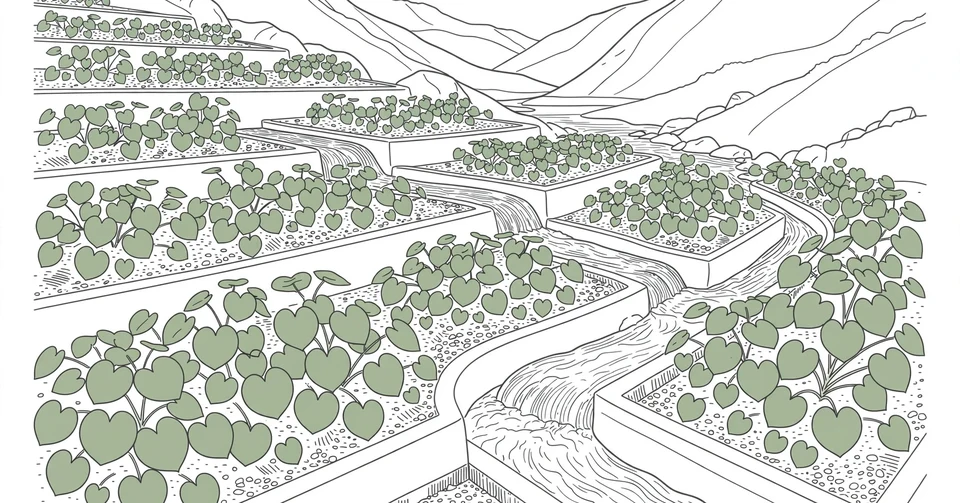
The classic Izu wasabi field is a staircase built into a valley. Instead of soil, the beds are made of stone, in a method called tatamiishi, worked out by a stonemason in Nakaizu around 1892. A tatamiishi bed is layered like a filter: large rocks at the bottom, smaller stones above them, then pebbles, and finally a surface of sand in which the plants sit. Spring water enters at the top terrace and flows down through the steps, passing through the stone layers as it goes, so each plant gets a constant supply of clean, oxygen-rich water around its roots.
Walk into a valley like Ikadaba in Izu City and the scale surprises people. The terraces climb the slopes in green tiers, the water moving quietly from bed to bed, and together fields like these make Izu one of the largest wasabi growing areas in Japan. The Nakaizu and Amagi-Yugashima districts remain the heart of it. In 2018 the whole tradition, under the name Traditional Wasabi Cultivation in Shizuoka, was recognised by the FAO as a Globally Important Agricultural Heritage System, and Shizuoka still leads Japan in water wasabi, first in rhizome production, growing area and value in recent prefectural figures.
These valleys sit in the same mountains that feed the hot spring town of Shuzenji, the oldest hot spring town in Izu, and the two make a natural pair on a trip: terraces of green in cold streams by day, a hot bath in the evening. Travellers heading that way often come through Mishima, where the Mishima Skywalk hangs over the valley on the road toward the peninsula, another reminder that this corner of Shizuoka is defined by its water, whether it is falling, flowing or steaming.
The prefecture's own food writers describe Izu wasabi well at the Shizuoka Food Information Center, including the voices of farmers who have worked these terraces for generations. What comes through in their accounts is patience. Nothing about this crop hurries.
A year and a half of standing in cold water
A seedling planted in a terrace takes about a year and a half to two years to become a harvestable rhizome. Farmers stagger their planting so that some beds are always ready, which spreads the harvest across the year, but it also means the work never really stops. Beds are weeded, cleared and repaired by hand, in water that numbs your legs in any season.
Winter is the hardest and, growers say, the tastiest time. The prefecture's producers describe harvesting on winter mornings when the plants are frozen in the beds, waiting until the afternoon thaw to pull them, and they say the rhizomes are at their most pungent in the cold months. The plant grows slowly in the cold, and the flavour concentrates with it.
Nagano is the other great centre, and its most famous address is the Daio Wasabi Farm in Azumino, at the foot of the Northern Alps. Founded in 1915, Daio covers about 15 hectares of beds fed by snowmelt spring water that runs at around 13 degrees all year, and it is often described as the largest commercial wasabi farm in the world. Its wooden waterwheels, turning slowly on the river at the edge of the fields, became famous far beyond Japan when Akira Kurosawa filmed them for his 1990 film Dreams. A century of farming there rests on the same foundation as in Izu: not soil, not fertiliser, but an enormous daily flow of cold, clean water.
Between them, Shizuoka and Nagano show the two faces of the crop. In Izu the fields are small, steep and family-run, folded into the mountains. In Azumino the beds run flat and wide to the horizon. The plant does not care about the scenery. It cares about the water, and both places happen to be rich in exactly the kind it demands.
Grated on sharkskin, gone in minutes
Fresh wasabi is not cut or crushed. It is grated, slowly, in small circles, traditionally on a pad of coarse sharkskin and today more often on a fine metal grater called an oroshigane. The slow circling matters. Grating breaks open the plant's cells, and only then do the flavour compounds form, as an enzyme gets to work on the substances stored inside the cells.
The chief of those compounds is allyl isothiocyanate, the same volatile oil that gives horseradish and mustard their kick, which is also why the imitation tastes as close as it does. In fresh wasabi it arrives with a crowd of subtler aromatic compounds around it, and the effect is different in kind: a clean heat that rises into the nose rather than sitting on the tongue, a brief sweetness underneath, and then, quickly, nothing. Unlike the burn of chilli, which is oil-based and lingers, this burn is carried on a volatile compound, and it escapes into the air.
That is why fresh paste fades so fast. Left uncovered, the grated paste loses its best flavour within roughly fifteen minutes, which is why sushi chefs grate it to order and tuck the paste between the fish and the rice, sealing it away from the air until the moment it is eaten. A rhizome on the counter of a good restaurant is not decoration. It is a clock that has not started yet.
My own rule since moving to Shizuoka is simple. If a restaurant grates it in front of me, I order the sashimi. The first time you taste the real thing, the surprise is not the heat, which is gentler than the tube suggests. The surprise is the sweetness and the green, almost floral aroma that the green paste never had.
Nothing on the plant goes to waste
The rhizome is the prize, but a wasabi farm sells nearly the whole plant. The leaves can be eaten fresh and carry a milder version of the same heat. The stems and flowers are cooked and eaten too. As one Izu grower puts it, there is nothing to throw away.
The most characterful use of the leaves and stems is wasabi-zuke: chopped greens pickled in sake lees, the solid residue left over from brewing sake. The lees mellow the raw bite of the leaves and add a deep, faintly alcoholic richness, and the pickle is considered a specialty of Shizuoka. Farm shops in the growing districts sell wasabi miso, wasabi pickles and wasabi-flavoured everything, from nori to soft ice cream of a startling green, some of it excellent and some of it cheerfully riding on the name.
There is a quiet logic to all this. A crop that takes the better part of two years to mature cannot afford waste, and the same lees that preserve the leaves come from the rice and water culture of the same mountains. Little in this food tradition stands alone.
The green paste that is not wasabi
Outside Japan, and honestly at plenty of counters inside Japan too, the paste called wasabi is a blend of horseradish, mustard, starch and green colouring, sometimes spinach powder, sometimes something more synthetic. In Japan horseradish itself is politely known as seiyo wasabi, western wasabi, and the powdered blends sold as kona wasabi are built on it. None of this is a scandal. Horseradish is a fine, fiery plant in its own right, and it grows in ordinary fields like an ordinary crop, which is precisely the point.
The substitution exists because the real plant refuses to scale. Commercial demand for wasabi flavour is global and enormous; the supply of cold, clean, constantly running spring water in shaded mountain valleys is not. True wasabi is therefore expensive, sold by the rhizome, and in most countries found only in high-end restaurants and specialty shops. A small number of growers have managed it abroad, in places like the Oregon coast, western Canada, Iceland and the United Kingdom, always by finding the same rare thing the Japanese growers found: the right water.
So the honest way to read a menu is this. If the paste arrives already extruded from a tube or a powder, it is horseradish wearing green, and there is no shame in enjoying it for what it is. If a pale green rhizome and a grater come to the table, or the chef grates a small mound to order, you are about to taste something that a mountain stream spent two years making.
The story is not getting easier. Japan's own wasabi production has been declining, and a warming climate is one of the reasons growers and researchers point to. A plant whose whole life depends on water that stays cold is, almost by definition, a plant on the front line of a warming world. That, more than the price or the rarity, is the real argument for paying attention to it. The terraces of Izu and Azumino are beautiful, but they are also instruments, measuring exactly how cold and clean the water still is. As long as wasabi grows there, the streams are healthy. It is worth hoping they keep growing for a long time yet.
For the botany, chemistry and cultivation detail behind this piece, the reference article on wasabi is a solid place to keep reading.
More in Food & Travel
Latest posts
- Manza Onsen Bathes at 1,800 Metres
- Irezumi Was an Art Before It Was a Warning
- The Oshi Kept Fuji's Pilgrims Fed, Housed, and Devout
- Japan's Population Decline and the Villages It Leaves Behind
- KRL Commuterline and the Trains That Move Jakarta
- Loma Linda's Long Lives Run on Saturdays
- Maruten Numazu and the Towering Kakiage Bowl of the Port
- The Three Sisters Grow Better Together
- Half the Old Springs in Japan Thank Kobo Daishi
- Tatamiishi Terraces Filter a River Through Stone
- Wasabi-Zuke Puts the Whole Plant in Sake Lees
- Konyoku Is Still Out There, Past the Last Train Station
- Karo Is the Tengger's Other Great Gathering
- Dry January Lasts a Month on Purpose
- Urashima's Dragon Palace Had a Name, Ryugu